Product
Supplier
Encyclopedia
Inquiry
Home > Inorganic Chemistry > Inorganic Acid > Hydrofluoric acid for Sale > Lithium Aluminum Hydride16853-85-3
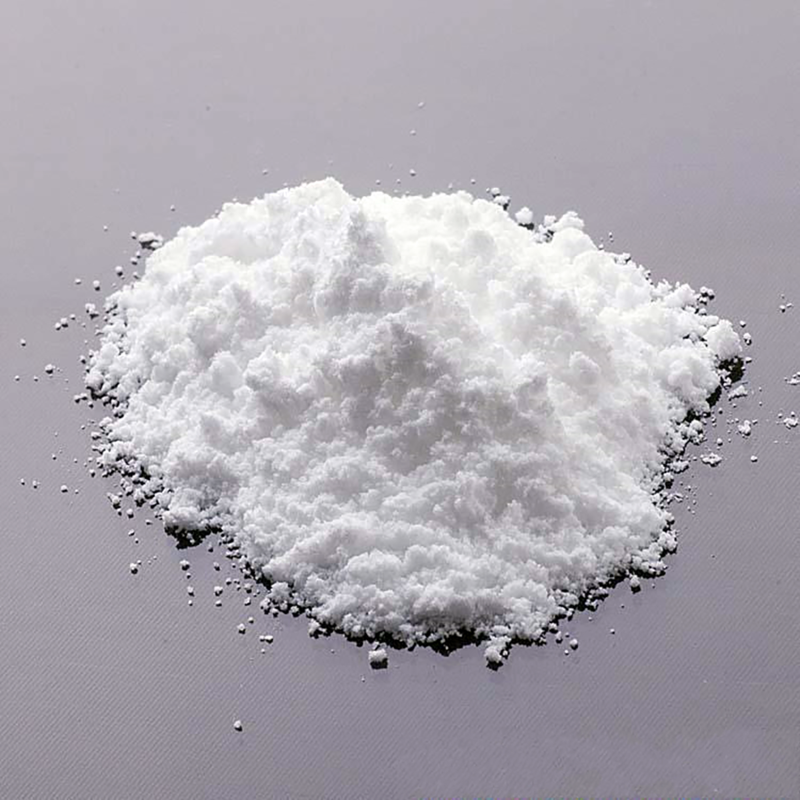
Lithium Aluminum Hydride16853-85-3 buy - large image1
Lithium Aluminum Hydride16853-85-3 buy - image1
Lithium Aluminum Hydride16853-85-3 buy - image2
Lithium Aluminum Hydride16853-85-3 buy - image3
Lithium Aluminum Hydride16853-85-3 buy - image4
Lithium Aluminum Hydride16853-85-3 buy - image5
Lithium Aluminum Hydride16853-85-3 buy - image6

Lithium Aluminum Hydride16853-85-3

33 Inquiries

Unit Price:

$33-34/MT FOB

Get Latest Price
CAS No.:

7664-39-3

Grade:

Industrial Grade

Content:

99.5%

Port:

上海

Brand:

OORENT

Packaging:

Vial/Bottle/Bag/Carton

Price valid (until):

2027-06-22

Company Type:
Trader
Location:
China
Qualification:
Main Products:

pharmaceutical intermediates,peptides,electronic chemicals

  • Product Description

  • Seller Information

  • Inquiry History

  • Description

    Product Detail


    Lithium Aluminum Hydride Basic information
    Product Name: Lithium Aluminum Hydride
    Synonyms: Aluminate (1-), tetrahydro-, lithium;Aluminate(1-), tetrahydro-, lithium, (T-4)-;Aluminum lithium hydride;LiAlH4;Lithium aluminohydride;Lithium aluminum tetrahydride;Lithium tetrahydroaluminate(1-);lithiumaluminumhydride,ethereal
    CAS: 16853-85-3
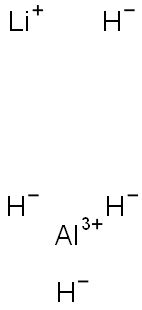
    MF: AlH4.Li
    MW: 37.95
    EINECS: 240-877-9
    Product Categories: Aluminum Hydrides;Synthetic Reagents;Alternative Energy;Aluminum Hydrides;Chemical Synthesis;Materials for Hydrogen Storage;Inorganics;Al (Alminum) Compounds;Classes of Metal Compounds;metal hydrides;Materials Science;Synthetic Reagents;25mL Sure/Seal Reagents;Organometallic Reagents;Li (Lithium) Compounds;Reduction;Synthetic Organic Chemistry;Typical Metal Compounds;1;16853-85-3v;16853-85-3
    Mol File: 16853-85-3.mol
    Shop Lithium Aluminum Hydride16853-85-3-Detailed Image 1

    Lithium Aluminum Hydride Chemical Properties
    Melting point  125 °C (dec.)(lit.)
    Boiling point  0°C
    bulk density 400kg/m3
    density  0.97 g/mL at 20 °C
    Fp  99 °F
    storage temp.  Store below +30°C.
    solubility  reacts with H2O, ethanol; seth, tetrahydrofuran
    form  tablets (~0.5 g each)
    pka 3.86
    color  White to light gray
    Specific Gravity 0.917
    Odor Odorless solid
    Water Solubility  Reacts
    Sensitive  Air & Moisture Sensitive
    Hydrolytic Sensitivity 8: reacts rapidly with moisture, water, protic solvents
    Merck  14,350
    Exposure limits TLV-TWA 2 mg(Al)/m3 (ACGIH).
    Stability: Stable. Reacts violently with water, liberating hydrogen. Incompatible with strong oxidizing agents, alcohols, acids.
    InChI 1S/Al.Li.4H/q-1;+1;;;;
    InChIKey OCZDCIYGECBNKL-UHFFFAOYSA-N
    SMILES [Li].[AlH3]
    CAS DataBase Reference 16853-85-3(CAS DataBase Reference)
    NIST Chemistry Reference Lithium tetrahydroaluminate(16853-85-3)
    EPA Substance Registry System Lithium aluminum hydride (16853-85-3)

    Safety Information
    Hazard Codes  F,C,Xi,Xn,F+,T
    Risk Statements  15-34-14/15-11-36/37-19-40-10-67-66-22-12-35-37-65-48/20-63-36/38-61-60
    Safety Statements  43-7/8-6A-45-43B-36/37/39-33-26-16-24/25-27-29-62-53
    RIDADR  UN 1410 4.3/PG I (LITHIUM ALUMINIUM HYDRIDE)
    RIDADR  UN 1411 4.3/PG I (LITHIUM ALUMINIUM HYDRIDE, ETHEREAL)
    WGK Germany  2
    RTECS  BD0100000
    10-21
    TSCA  TSCA listed
    HS Code  2850 00 20
    HazardClass  4.3
    PackingGroup  I
    Storage Class 4.3 - Hazardous materials which set free flammable gases upon contact with water
    Hazard Classifications Eye Dam. 1
    Skin Corr. 1A
    Water-react 1
    Hazardous Substances Data 16853-85-3(Hazardous Substances Data)
    Toxicity TLV-TWA (ACGIH) 2 mg (Al)/m3
    MSDS Information
    Provider Language
    SigmaAldrich English
    ACROS English
    ALFA English

    Lithium Aluminum Hydride Usage And Synthesis
    Description Lithium aluminum hydride (LiAlH4) is a promising compound for hydrogen storage, with a high gravimetric and volumetric hydrogen density and a low decomposition temperature. Similar to other metastable hydrides, LiAlH4 does not form by direct hydrogenation at reasonable hydrogen pressures; therefore, there is considerable interest in developing new routes to regenerate the material from the dehydrogenated products LiH and Al. It can also be used as a reducing agent in the preparation of reduced graphene oxide (rGO).
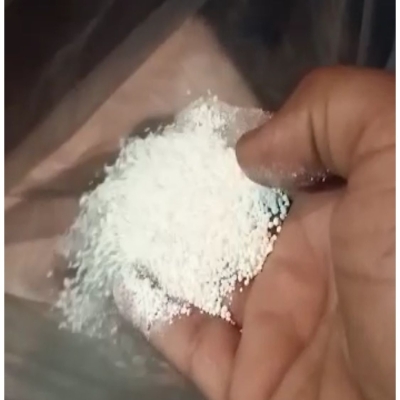
    Chemical Properties Lithium aluminum hydride is a white to gray powder. A combustible solid. monoclinic crystals; grey in the presence of aluminum impurity; stable below 120°C in dry air; turns grey on standing; hygroscopic; density 0.917 g/cm3; melts at 190°C (decomposes); reacts with water and alcohols; soluble in diethylether and tetrahydrofuran (about 30 and 13 g/100g, respectively at 25°C; also soluble in dimethylcellosolve; sparingly soluble in dibutylether; slightly soluble in dioxane (1g/L) and practically insoluble in hydrocarbons; can be solubilized in benzene by crown ether.
    Physical properties White crystalline powder when pure; monoclinic crystals; grey in the presence of aluminum impurity; stable below 120°C in dry air; turns grey on standing; hygroscopic; density 0.917 g/cm3; melts at 190°C (decomposes); reacts with water and alcohols; soluble in diethylether and tetrahydrofuran (about 30 and 13 g/100g, respectively at 25°C; also soluble in dimethylcellosolve; sparingly soluble in dibutylether; slightly soluble in dioxane (1g/L) and practically insoluble in hydrocarbons; can be solubilized in benzene by crown ether.
    Uses It is used as a powerful reducing agent inorganic synthesis. Except for olefinic doublebonds, almost all organic functional groupsare reduced by lithium aluminum hydride(Sullivan and Wade 1980). It is used extensivelyin pharmaceutical synthesis and in catalytichydrogenation.
    Uses Lithium aluminum hydride is among the most important industrial reducingagents. It is used extensively in organic syntheses and also in catalytichydrogenation. Reactant or reagent for:
    1. The preparation of thermoplastic polyester polyamides from oleic acid
    2. Lithium-polymer batteries
    3. Hydrodefluorination of gem-difluoromethylene derivatives
    4. Asymmetric aldol reactions
    5. Synthesis of Li-Al-N-H composites with hydrogen absorption / desorption properties
    6. LAH is a powerful reducing agent for many different reduction reactions such as that of ketones to alcohols
    Preparation Lithium aluminum hydride is prepared by reaction of lithium hydride with aluminum chloride in diethylether:
    4LiH + AlCl3 →(C2H5)2O→LiAlH4+3LiCl
    Application Lithium aluminum hydride (LiAlH4) is an effective reducing agent that can be used in chemical synthesis to reduce esters, carboxylic acids, acyl chlorides, aldehydes, epoxides, and ketones into the corresponding alcohols. In addition, amide, nitro, nitrile, imine, oxime, and azide compounds are converted into amines.
    LiAlH4 is a promising substance for hydrogen storage applications. Its properties include high gravimetric and volumetric hydrogen densities . It can also be used as a reducing agent in the preparation of reduced graphene oxide (rGO).
    General Description A white powder that turns gray on standing. If spread out over a large flat combustible surface, friction can cause ignition. Used to make other chemicals, as a polymerization catalyst, as a hydrogen source, and as a propellant.
    Air & Water Reactions Reacts with water vigorously attaining incandescence and ignition of evolved hydrogen [Kelen, Cahiers, 1977, (86), 100]. Reactions with water or moist air (or heated air) are violent and may be explosive [Schmidt, D.L., et al. Inorg. Synth. 1973. p. 14, 51].
    Reactivity Profile Lithium aluminium hydride is a powerful reducing agent. React violently on contact with many oxidizing agents. Ignites by friction, especially if powdered. Reacts vigorously with hydroxy compounds such as water, alcohols, carboxylic acids [Mellor 2 Supp. 2:142. 1961]. Caused a violent explosion when used to dry diethylene glycol dimethyl ether: Ignition may have been caused by heat from reaction with impurity water or perhaps decomposition of peroxides in the ether. About 75% of the ether had been removed when the explosion occurred [MCA Case History 1494. 1968]. Reduces carbon dioxide or sodium hydrogen carbonate to methane and ethane at elevated temperatures. These flammable or explosive gases can form when CO2 extinguishers are used to fight hydride fires. Forms explosive complexes with ether, dimethylamine and various tetrazoles. Tetrazoles include, 2-methyl, 2-ethyl, 5-ethyl, 2-methyl-5-vinyl, 5-amino-2-ethyl [US Pat. 3 396 170, 1968].
    Hazard Lithium aluminum hydride is a flammable substance. It ignites spontaneously on grinding and reacts violently with water and many organic substances. Diethyl ether, tetrahydrofuran or another suitable solvent should be used in its synthetic applications. Dry or powdered limestone is an appropriate fire extinguishing agent.
    Health Hazard Lithium aluminum hydride is highly corrosive to the skin, eyes, and mucous membranes. Contact with moisture forms lithium hydroxide, which can cause severe burns. Powdered LAH forms dusts that can pose an inhalation hazard. Ingestion of this substance may cause aching muscles, nausea, vomiting, dizziness, and unconsciousness and may be fatal. Ingestion can result in gas embolism due to the formation of hydrogen.
    No chronic effects of lithium aluminum hydride have been identified
    Flammability and Explosibility Lithium aluminum hydride is a highly flammable solid and may ignite in moist or heated air. Exposure to water results in the release of hydrogen, which can be ignited by the heat from the exothermic reaction. Lithium aluminum hydride should not be used as a drying agent for solvents because fires can easily result (LAH decomposes at about 125° C, a temperature easily reached at a flask's surface in a heating mantle). The decomposition products of LAH can be quite explosive, and the products of its reaction with carbon dioxide have been reported to be explosive. Use dry chemical powder or sand to extinguish fires involving lithium aluminum hydride. Never use water or carbon dioxide extinguishers on an LAH fire.
    reaction suitability reagent type: reductant
    Safety Profile Stable in dry air at room temperature. It decomposes above 125' forming Al, H2, and lithium hydride. Very powerful reducer. Can ignite if pulverized even in a dry box. Reacts violently with air, acids, alcohols, benzoyl peroxide, boron trifluoride etherate, (2 chloromethyl furan + ethyl acetate), diethylene glycol dimethyl ether, diethyl ether, 1,2-dimethoxyethane, dimethyl ether, methyl ethyl ether, (nitriles + H2O), perfluorosuccinamide, (perfluorosuccinamide + H20), tetrahydrofuran, water. To fight fire, use dry chemical, includmg special formulations of dry chemicals as recommended by the supplier of the lithium aluminum hydride. Do not use water, fog, spray, or mist. Incompatible with bis (2-methoxyethyl)ether, CO2, BF3, diethyl etherate, dibenzoyl peroxide, 3,5 dbromocyclopentene, 172-dimethoxy ethane, ethyl acetate, fluoro amides, pyridine, tetrahydrofuran. Used as a reducing agent in the preparation of pharmaceuticals. See also ALUMINUM, LITHIUM COMPOUNDS, and HYDRIDES.
    Potential Exposure This material is used as a catalyst and as a specialty reducing agent in organic synthesis.
    First aid If this chemical gets into the eyes, remove anycontact lenses at once and irrigate immediately for at least15 min, occasionally lifting upper and lower lids. Seek medical attention immediately. If this chemical contacts theskin, remove contaminated clothing and wash immediatelywith soap and water. Seek medical attention immediately. Ifthis chemical has been inhaled, remove from exposure,begin rescue breathing (using universal precautions, including resuscitation mask) if breathing has stopped and CPR ifheart action has stopped. Transfer promptly to a medicalfacility. When this chemical has been swallowed, get medical attention. Give large quantities of water and inducevomiting. Do not make an unconscious person vomit.Medical observation is recommended for 24-48 h afterbreathing overexposure, as pulmonary edema may bedelayed. As first aid for pulmonary edema, a doctor orauthorized paramedic may consider administering a corticosteroid spray.
    storage LAH should be handled in areas free of ignition sources under an inert atmosphere. Safety glasses, impermeable gloves, and a fire-retardant laboratory coat are required. A dry powder fire extinguisher or pail of sand (and shovel) must be available in areas where LAH is to be handled or stored. Work with large quantities of powdered LAH should be conducted in a fume hood under an inert gas such as nitrogen or argon. Lithium aluminum hydride should be stored in tightly sealed containers in a cool, dry area separate from combustible materials. Dry LAH powder should never be exposed to water or moist air. Lithium aluminum hydride can be a finely powdered reagent that produces a reactive dust on handling. The older practice of grinding lithium aluminum hydride prior to use can cause explosions and should not be employed.
    Shipping UN1410 Lithium aluminum hydride (dry), Hazard Class: 4.3; Labels: 4.3-Dangerous when wet material. UN1411 Lithium aluminum hydride, ethereal, Hazard Class: 4.3; Labels: 4.3-Dangerous when wet material, 3- Flammable liquid.
    Purification Methods Extract it with Et2O, and, after filtering, the solvent is removed under vacuum. The residue is dried at 60o for 3hours, under high vacuum [Ruff J Am Chem Soc 83 1788 1961]. It is a strong reducing agent. It IGNITES in the presence of a small amount of water and reacts with it EXPLOSIVELY. [Becher in Handbook of Preparative Inorganic Chemistry (Ed. Brauer) Academic Press Vol I p 805 1963.]
    Incompatibilities Combustible solid. Can ignite spontaneously in moist air or heat. Decomposes on heating @ 125C forming aluminum, lithium hydride and flammable hydrogen gas. A strong reducing agent; violent reaction with oxidizers. Violent reaction with water, alcohols, acids, dimethylether, ethers, tetrahydrofuran, benzoyl peroxide; boron trifluoride etherate. Reduces carbon dioxide or sodium hydrogen carbonate to methane and ethane at elevated temperatures. These flammable or explosive gases can form when CO2 extinguishers are used to fight hydride fires. Forms explosive complexes with ether, dimethylamine and various tetrazoles. Tetrazoles include, 2-methyl, 2-ethyl, 5-ethyl, 2-methyl-5-vinyl, 5-amino-2-ethyl .
    Waste Disposal Small amounts of excess LAH can be destroyed by forming a suspension or solution in an inert solvent such as diethyl ether or hexane, cooling in an ice bath, and slowly and carefully adding ethyl acetate dropwise with stirring. This is followed by the addition of a saturated aqueous solution of ammonium chloride.
    Excess lithium aluminum hydride and the products of the treatment described above should be placed in an appropriate container, clearly labeled, and handled according to your institution's waste disposal guidelines. For more information on disposal procedures, see Chapter 7 .

    Shop 3-Chloro-1-propene107-05-1-Detailed Image 2 Shop 3-Chloro-1-propene107-05-1-Detailed Image 3 Shop 3-Chloro-1-propene107-05-1-Detailed Image 4 Shop 3-Chloro-1-propene107-05-1-Detailed Image 5 Shop 3-Chloro-1-propene107-05-1-Detailed Image 6 Shop 3-Chloro-1-propene107-05-1-Detailed Image 7


    ECHEMI Editorial Reference
    It appears as colorless fuming liquid. It is intensively exothermic when being dissolved in water and further become hydrofluoric acid. colourless gas with a pungent odour

    Basic Info
    Product Name:

    Hydrofluoric acid

    Other Name:

    Hydrofluoric acid;Anhydrous hydrofluoric acid;Fluorhydric acid;Hydrofluoric acid gas;Hydrogen fluoride (HF);Hydrogen fluoride;Antisal 2b;Fluorine monohydride;Hydrogen monofluoride;Fluorine hydride (FH);Fluoric acid;Alsurf 45;G-C Hydrofluoride Gel;Urine Luck 6.3;Vita ceramic etch;Ultradent Porcelain Etch;Porcelain Conditioner;SA-X;32057-09-3;326604-75-5

    CAS No.:

    7664-39-3

    UN No.:

    1790

    Molecular Formula:

    FH

    InChIKeys:

    InChIKey=KRHYYFGTRYWZRS-UHFFFAOYSA-N

    Molecular Weight:

    20.00630

    Exact Mass:

    20.00620

    EC Number:

    231-634-8

    HScode:

    2811110000

    Categories:

    Inorganic Acid

    Characteristics
    PSA:

    0

    XLogP3:

    0.53270

    Appearance:

    colourless gas with a pungent odour

    Density:

    0.991 g/cm3 @ Temp: 19.54 °C

    Melting Point:

    -83.36 °C

    Boiling Point:

    20 °C

    Flash Point:

    -37.8ºC

    Water Solubility:

    H2O: soluble

    Storage Conditions:

    Protect against physical damage. Store at in well-ventilated area, separated from other storage.

    Vapor Pressure:

    25 mm Hg ( 20 °C)

    Vapor Density:

    1.27 (vs air)

    Toxicity:

    LC50 (15 min.) in rats, guinea pigs: 2689, 4327 ppm (Rosenholtz)

    Flammability characteristics:

    Nonflammable Gas

    Hazard Identification

    Classification of the substance or mixture

    Acute toxicity - Category 2, Oral

    Acute toxicity - Category 1, Dermal

    Skin corrosion, Sub-category 1A

    Acute toxicity - Category 2, Inhalation

    GHS label elements, including precautionary statements

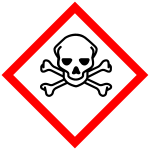
    Pictogram(s)
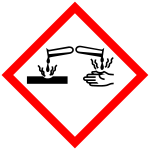
    Signal word

    Danger

    Hazard statement(s)

    H300 Fatal if swallowed

    H310 Fatal in contact with skin

    H314 Causes severe skin burns and eye damage

    H330 Fatal if inhaled

    Precautionary statement(s)
    Prevention

    P264 Wash ... thoroughly after handling.

    P270 Do not eat, drink or smoke when using this product.

    P262 Do not get in eyes, on skin, or on clothing.

    P280 Wear protective gloves/protective clothing/eye protection/face protection/hearing protection/...

    P260 Do not breathe dust/fume/gas/mist/vapours/spray.

    P271 Use only outdoors or in a well-ventilated area.

    P284 [In case of inadequate ventilation] wear respiratory protection.

    Response

    P301+P316 IF SWALLOWED: Get emergency medical help immediately.

    P321 Specific treatment (see ... on this label).

    P330 Rinse mouth.

    P302+P352 IF ON SKIN: Wash with plenty of water/...

    P316 Get emergency medical help immediately.

    P361+P364 Take off immediately all contaminated clothing and wash it before reuse.

    P301+P330+P331 IF SWALLOWED: Rinse mouth. Do NOT induce vomiting.

    P363 Wash contaminated clothing before reuse.

    P304+P340 IF INHALED: Remove person to fresh air and keep comfortable for breathing.

    P305+P351+P338 IF IN EYES: Rinse cautiously with water for several minutes. Remove contact lenses, if present and easy to do. Continue rinsing.

    P320 Specific treatment is urgent (see ... on this label).

    Storage

    P405 Store locked up.

    P403+P233 Store in a well-ventilated place. Keep container tightly closed.

    Disposal

    P501 Dispose of contents/container to an appropriate treatment and disposal facility in accordance with applicable laws and regulations, and product characteristics at time of disposal.

    Other hazards which do not result in classification

    no data available

    Handling and Storage

    Precautions for safe handling

    NO contact with incompatible substances. See Chemical Dangers. Handling in a well ventilated place. Wear suitable protective clothing. Avoid contact with skin and eyes. Avoid formation of dust and aerosols. Use non-sparking tools. Prevent fire caused by electrostatic discharge steam.

    Conditions for safe storage, including any incompatibilities

    Cool. Fireproof if in building. Keep in a well-ventilated room. Separated from food and feedstuffs and incompatible materials. Store in an area without drain or sewer access. See Chemical Dangers.Hydrogen fluoride must be stored to avoid contact with metals, concrete, glass, and ceramics, because it can severely corrode these materials. Contact with metals may form a flammable gas. Keep away from heat. Where possible automatically pump liquid from drums or other storage containers to process containers.

  • Seller Information
    Business Type:

    Trader

    Main Products:

    pharmaceutical intermediates,peptides,electronic chemicals

    Location:

    Room 102, 1st Floor, East Office Building, No. 45 Pengwan Road, Qianwan Bonded Port Area, Qingdao Zone, China (Shandong) Pilot Free Trade Zone

    Payment Terms:

    100% TT in advance

    Average lead Time:

    10

    Total Annual Revenue:

    $10 million-$25 million

    Total Employees:

    51-100

    Year of Establishment:

    2024

    A reliable supplier is like insurance.

    We are mainly specilized in supply of pharmaceutical intermediates, electronic chemicals,food additives, and other fine chemical products.
    Integrity is the foundation, quality is life. We would like to work together with you to build a greener and brighter future.

    Website: orientchem.cc
    Email: scarlett@orientchem.cc
    WhatsApp: +86 17753254221

  • Inquiry History
    33 Inquiries
    Country Product Purchase Quantity Date Posted
    Turkey

    Hydrogen Fluoride

    100 MT Sep 1, 2023
    Turkey

    Hydrofluoric Acid 70%

    10 MT May 25, 2026
    India

    Hydrofluoric acid

    25 MT Dec 20, 2025
    India

    Hydrofluoric acid 20%

    1000.00 KG Sep 4, 2025
    Zambia

    Hydrofluoric Acid

    1 MT Aug 25, 2025
    Egypt

    HF 70:75%

    1 20' Fcl Jan 17, 2025
    Saudi Arabia

    HYDROFLUORIC ACID

    33 MT Sep 4, 2024
    United Arab Emirates

    Hydrofluoric Acid

    150 MT Jul 21, 2024
    Vietnam

    HYDROFLUORIC ACID 55%

    42 MT Jan 30, 2024
    India

    hydrofluoric acid

    1 KG Jan 11, 2024
    Vietnam

    HF

    1 20' Fcl Oct 23, 2023
    Tanzania

    Hydrofluoric Acid

    20 KG Sep 29, 2023
    India

    Hydrofluoric acid 48%

    2.00 20' Fcl Aug 1, 2025
    Brazil

    Fluoride acid 70%

    1.00 20' Fcl Jul 19, 2025
    Vietnam

    Hydrofluoric acid

    1 20' Fcl Mar 17, 2025
    India

    hydrofluoric acid

    1 KG Jan 9, 2024
    Russia

    Hydrofluoric acid

    1000 KG Dec 11, 2023
    Vietnam

    High quality Hydrofluoric acid Industrial Grade

    50 MT Oct 23, 2023
    Kazakstan

    Hydrogen fluoride

    200 MT Oct 10, 2023
    France

    High quality Hydrofluoric acid Industrial Grade

    1 MT Sep 7, 2023
    • 1
    • 2
    • Go to Page Go
    Post an enquiry for this product
pic ×

Scan the QR Code to Share

All products displayed on this website are only for non-medical purposes such as industrial applications or scientific research, and cannot be used for clinical diagnosis or treatment of humans or animals. They are not medicinal or edible.

According to relevant laws and regulations and the regulations of this website, units or individuals who purchase hazardous materials should obtain valid qualifications and qualification conditions.

The information shown above is provided by the enterprise itself, and the authenticity, accuracy and legitimacy of the content are the responsibility of the publishing company. ECHEMI does not bear any guarantee responsibility for this. Please be aware that risks in internet transactions objectively exist.

Feedback & Suggestions
Send Message

Thank you for your feedback. If you require further assistance, please contact us by email at info@echemi.com or call us at +86-532-55729510.