Product
Supplier
Encyclopedia
Inquiry
Salicylaldehyde90-02-8C7H6O2 buy - large image1
Salicylaldehyde90-02-8C7H6O2 buy - image1
Salicylaldehyde90-02-8C7H6O2 buy - image2
Salicylaldehyde90-02-8C7H6O2 buy - image3
Salicylaldehyde90-02-8C7H6O2 buy - image4
Salicylaldehyde90-02-8C7H6O2 buy - image5
Salicylaldehyde90-02-8C7H6O2 buy - image6

Salicylaldehyde90-02-8C7H6O2

3 Inquiries

Unit Price:

$33-34/MT FOB

Get Latest Price
CAS No.:

90-02-8

Grade:

Pharmaceutical Grade

Content:

99.5%

Port:

上海

Brand:

OORENT

Packaging:

Vial/Bottle/Bag/Carton

Price valid (until):

2026-07-17

Company Type:
Trader
Location:
China
Qualification:
Main Products:

pharmaceutical intermediates,peptides,electronic chemicals

  • Product Description

  • Seller Information

  • Inquiry History

  • Description

    Product Detail

    Salicylaldehyde Basic information
    Product Name: Salicylaldehyde
    Synonyms: 2-Hydroxy Benzaldehyde (Salicylaldehyde);2-hydroxy-benzaldehyd;Benzaldehyde, o-hydroxy-;Benzaldehyde,2-hydroxy-;o-Formylphenol;o-hydroxy-benzaldehyd;o-hydroxybenzaldehyde,o-formylphenol,2-formylphenol.sah,salicylal;salicyaldehyde
    CAS: 90-02-8
    MF: C7H6O2
    MW: 122.12
    EINECS: 201-961-0
    Product Categories: Aromatic Aldehydes & Derivatives (substituted);Amino Group Labeling Reagents for HPLC;Analytical Chemistry;HPLC Labeling Reagents;UV Detection (HPLC Labeling Reagents);P-S;Aldehydes;Alpha Sort;Analytical Standards;Analytical/Chromatography;Building Blocks;C7;Carbonyl Compounds;Volatiles/ Semivolatiles;Chemical Synthesis;Chromatography;Environmental Standards;Organic Building Blocks;90-02-8;KT00001;bc0001
    Mol File: 90-02-8.mol
    Shop Salicylaldehyde90-02-8C7H6O2-Detailed Image 1

    Salicylaldehyde Chemical Properties
    Melting point  1-2 °C (lit.)
    Boiling point  197 °C (lit.)
    density  1.146 g/mL at 25 °C (lit.)
    vapor density  4.2 (vs air)
    vapor pressure  1 mm Hg ( 33 °C)
    refractive index  n20/D 1.573(lit.)
    FEMA  3004 | SALICYLALDEHYDE
    Fp  170 °F
    storage temp.  -20°C
    solubility  4.9g/l
    pka 8.37(at 25℃)
    form  Liquid
    color  Clear yellow
    PH 6-8 (H2O, 20℃)Not applicable
    Odor Bitter almonds
    Odor Type medicinal
    biological source synthetic
    Water Solubility  slightly soluble
    Sensitive  Air & Light Sensitive
    Merck  14,8326
    JECFA Number 897
    BRN  471388
    Henry's Law Constant 1.1×100 mol/(m3Pa) at 25℃, Ji et al. (2008)
    Exposure limits ACGIH: TWA 5 ppm (Skin)
    OSHA: TWA 5 ppm(19 mg/m3)
    NIOSH: IDLH 250 ppm; TWA 5 ppm(19 mg/m3); Ceiling 15.6 ppm(60 mg/m3)
    Dielectric constant 13.9(20℃)
    Stability: Stable. Combustible. Incompatible with strong bases, strong reducing agents, strong acids, strong oxidizing agents.
    Cosmetics Ingredients Functions FRAGRANCE
    InChI 1S/C7H6O2/c8-5-6-3-1-2-4-7(6)9/h1-5,9H
    InChIKey SMQUZDBALVYZAC-UHFFFAOYSA-N
    SMILES Oc1ccccc1C=O
    LogP 1.66 at 25℃ and pH6.2-6.3
    CAS DataBase Reference 90-02-8(CAS DataBase Reference)
    NIST Chemistry Reference Benzaldehyde, 2-hydroxy-(90-02-8)
    EPA Substance Registry System Salicylaldehyde (90-02-8)

    Safety Information
    Hazard Codes  Xn,N
    Risk Statements  21/22-36/38-68-36/37/38-20/21/22-51-36-51/53-22
    Safety Statements  26-36/37-36/37/39-36-61-64-29/35
    RIDADR  3082
    WGK Germany  2
    RTECS  VN5250000
    8-10-23
    TSCA  TSCA listed
    HazardClass  6.1(b)
    PackingGroup  II
    HS Code  29122990
    Storage Class 11 - Combustible Solids
    Hazard Classifications Acute Tox. 4 Oral
    Aquatic Chronic 2
    Eye Irrit. 2
    Muta. 2
    Skin Irrit. 2
    Hazardous Substances Data 90-02-8(Hazardous Substances Data)
    Toxicity MLD in rats (mg/kg): 900-1000 s.c. (Binet)
    MSDS Information
    Provider Language
    ACROS English
    SigmaAldrich English
    ALFA English

    Salicylaldehyde Usage And Synthesis
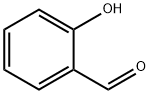
    Description Salicylaldehyde (2-hydroxybenzaldehyde) is an organic compound with the formula C6H4CHO-2-OH. Along with 3-hydroxybenzaldehyde and 4-hydroxybenzaldehyde, it is one of the three isomers of hydroxybenzaldehyde. It is a colorless or pale yellow liquid with a bitter almond odor and a burning taste. It is soluble in alcohol, benzene, and ether, and very slightly soluble in water. Salicylaldehyde is found in shrubs of the genus Spiraea and is usually produced from phenol by the action of chloroform in the presence of an alkali base. It is used in the production of coumarin, saligenin, and salicylaldoxime (an important analytical reagent), and also in analytical chemistry—for example, to detect hydrazine. Besides, salicylaldehyde is a key precursor to various chelating agents and a flavouring ingredient.
    Chemical Properties Salicylaldehyde is a colourless to yellow oily liquid with a pungent, irritating, bitter, almond-like odor similar to benzaldehyde, acetophenone and nitrobenzene, but with phenolic notes. It has a nut-like, coumarin flavor at low levels. slightly soluble in water, soluble in ethanol and ether. It turns purple in case of ferric chloride.
    Occurrence Occurs frequently in nature; in the flowers of Spirea ulmaria and other Spireae, in the roots of Crepis foetida L., in the fruits of Pinus avium, in the rind of Rauqolfia caffra, in the leaves of Ceanothus velutinus and in the essential oil of Cinnamomum cassia and of tobacco leaves. Also reported found in grapes, tomato, baked potato, cinnamon bark, cassia leaf, peppermint oil, pennyroyal oil, parmesan cheese, butter, milk powder, roasted chicken, beer, rum, Japanese whiskey, sherry, coffee, tea, soybean, mushroom, buckwheat, Bourbon vanilla, Chinese quince, Muscat grape, vanilla and mastic gum oil.
    Uses Salicylaldehyde, is used as flavor and fragrance components. Salicylaldehyde is also a common highly-functionalized arene, that can be used as a precursor in the synthesis of other chemicals.
    Preparation Salicylaldehyde is synthesized from phenol, chloroform, and alkali according to the Reimer–Tiemman method, which was developed in 1876. starting material for the manufacture of coumarin.
    Definition ChEBI: Salicylaldehyde is a hydroxybenzaldehyde carrying a hydroxy substituent at position 2. It has a role as a nematicide and a plant metabolite.
    Aroma threshold values Detection: 30 ppb
    Taste threshold values Taste characteristics at 20 ppm: spicy, medicinal and astringent
    Synthesis Reference(s) Synthetic Communications, 24, p. 1757, 1994 DOI: 10.1080/00397919408010181
    General Description Liquid; colorless or pale yellow; bitter almond odor. Sinks and mixes slowly in water.
    Reactivity Profile Salicylaldehyde is an aldehyde. Aldehydes are frequently involved in self-condensation or polymerization reactions. These reactions are exothermic; they are often catalyzed by acid. Aldehydes are readily oxidized to give carboxylic acids. Flammable and/or toxic gases are generated by the combination of aldehydes with azo, diazo compounds, dithiocarbamates, nitrides, and strong reducing agents. Aldehydes can react with air to give first peroxo acids, and ultimately carboxylic acids. These autoxidation reactions are activated by light, catalyzed by salts of transition metals, and are autocatalytic (catalyzed by the products of the reaction). The addition of stabilizers (antioxidants) to shipments of aldehydes retards autoxidation.
    Health Hazard Salicylaldehyde is a skin irritant; 500 mg/daycaused moderate irritation to rabbit skin. Itcan have injurious effects on fertility. Studieson rats indicate that subcutaneous administrationof salicylaldehyde in a high doseof >400 mg/kg can produce developmentalabnormalities, fetal death, and postimplantationmortality.
    The toxicity of this compound, however,is low. No toxic symptoms were noted.
    LD50 value, oral (rats): 520 mg/kg
    LD50 value, skin (rats): 600 mg/kg.
    Fire Hazard Combustible. Can react with oxidizing materials.
    Purification Methods It is precipitated as the bisulfite addition compound by pouring the aldehyde slowly and with stirring into a 25% solution of NaHSO3 in 30% EtOH, then standing for 30minutes. The precipitate, after filtering at the pump, and washing with EtOH, is decomposed with aqueous 10% NaHCO3, and the aldehyde is extracted into diethyl ether, dried with Na2SO4 or MgSO4, and distilled, under reduced pressure. Alternatively, salicylaldehyde is precipitated as its Cu complex by adding it to warm, saturated aqueous Cu(OAc)2, shaking and standing in ice. The precipitate is filtered off, washed with EtOH, then Et2O, and decomposed with 10% H2SO4; the aldehyde is extracted into Et2O, dried and vacuum distilled. It was also purified by dry column chromatography on Kieselgel G [Nishiya et al. J Am Chem Soc 108 3880 1986]. The acetyl derivative has m 38-39o (from pet ether or EtOH) and b 142o/18mm, 253o/atm. [Beilstein 8 IV 176.] The oxime, [94-67-7] M 137.1, crystallises CHCl3/pet ether (b 40-60o) with m 57o [Beilstein 8 IV 203.]
    Toxics Screening Level The initial threshold screening level (ITSL) for salicylaldehyde is 30 μg/m3 based on an annual averaging time.
    Waste Disposal Salicylaldehyde is burned in a chemicalincinerator equipped with an afterburner andscrubber.
    References

    Shop 3-Chloro-1-propene107-05-1-Detailed Image 2 Shop 3-Chloro-1-propene107-05-1-Detailed Image 3 Shop 3-Chloro-1-propene107-05-1-Detailed Image 4 Shop 3-Chloro-1-propene107-05-1-Detailed Image 5 Shop 3-Chloro-1-propene107-05-1-Detailed Image 6 Shop 3-Chloro-1-propene107-05-1-Detailed Image 7


    Basic Info
    Product Name:

    Salicylaldehyde

    Other Name:

    Benzaldehyde,2-hydroxy-;Salicylaldehyde;2-Hydroxybenzaldehyde;Salicylal;Salicylic aldehyde;o-Formylphenol;2-Formylphenol;o-Hydroxybenzaldehyde;NSC 112278;NSC 49178;NSC 83559;NSC 83560;NSC 83561;NSC 83562;NSC 97202;2-Hydroxy-1-benzaldehyde;1563136-87-7

    CAS No.:

    90-02-8

    Molecular Formula:

    C7H6O2

    InChIKeys:

    InChIKey=SMQUZDBALVYZAC-UHFFFAOYSA-N

    Molecular Weight:

    122.12

    Exact Mass:

    122.12

    BRN:

    471388

    EC Number:

    201-961-0

    UNII:

    17K64GZH20

    NSC Number:

    187662|49178

    DSSTox ID:

    DTXSID1021792

    Color/Form:

    Liquid|Colorless, oily liquid or dark-red oil|Colorless to straw, oily liquid

    HScode:

    29122990

    Characteristics
    PSA:

    37.3

    XLogP3:

    1.81

    Appearance:

    Clear yellow Liquid

    Density:

    1.1674 g/cm3 @ Temp: 20 °C

    Melting Point:

    -7 °C

    Boiling Point:

    197 °C @ Press: 760 Torr

    Flash Point:

    170 °F

    Refractive Index:

    n20/D 1.573(lit.)

    Water Solubility:

    H2O: slightly soluble

    Storage Conditions:

    Store below +30°C.

    Vapor Pressure:

    1 mm Hg ( 33 °C)

    Vapor Density:

    4.2 (vs air)

    Toxicity:

    Oral-rat LD50: 520 mg/kg;Abdominal cavity-mouse LD50:231 mg/kg

    Flammability characteristics:

    Open flame, high heat, oxidant is combustible; burning produces irritating smoke

    Odor:

    Bitter, almond-like odor

    Taste:

    Nut-like, coumarin flavor at low levels

    Henrys Law Constant:

    Henry's Law constant = 5.61X10⁻⁶ atm-cu m/mol at 25 °C (est)

    Collision Cross Section:

    118.7 Ų [M-H]-

    Experimental Properties:

    log Kow = 1.66 at 25 °C pH 6.2 - 6.3 (The pH value naturally occurred during testing) /OECD Guideline 107 (Partition Coefficient (n-octanol / water), Shake Flask Method)/|With sulfuric acid it gives an orange color|Conversion factors: 1 mg/L is equivalent to 200 ppm; 1 ppm is equivalent to 5.0 mg/cu m|Congealing point: 1.6 °C

    Air and Water Reactions:

    No rapid reaction with air. No rapid reaction with water.

    Reactive Group:

    Aldehydes

    Reactivity Profile:

    SALICYLALDEHYDE is an aldehyde. Aldehydes are frequently involved in self-condensation or polymerization reactions. These reactions are exothermic; they are often catalyzed by acid. Aldehydes are readily oxidized to give carboxylic acids. Flammable and/or toxic gases are generated by the combination of aldehydes with azo, diazo compounds, dithiocarbamates, nitrides, and strong reducing agents. Aldehydes can react with air to give first peroxo acids, and ultimately carboxylic acids. These autoxidation reactions are activated by light, catalyzed by salts of transition metals, and are autocatalytic (catalyzed by the products of the reaction). The addition of stabilizers (antioxidants) to shipments of aldehydes retards autoxidation.

    Heat of Combustion:

    -27.29 kJ/g at 20 °C and constant pressure

    Hazard Identification

    Classification of the substance or mixture

    Acute toxicity - Category 4, Oral

    Hazardous to the aquatic environment, long-term (Chronic) - Category Chronic 2

    GHS label elements, including precautionary statements

    Pictogram(s)

    Signal word

    Warning

    Hazard statement(s)

    H302 Harmful if swallowed

    H411 Toxic to aquatic life with long lasting effects

    Precautionary statement(s)
    Prevention

    P264 Wash ... thoroughly after handling.

    P270 Do not eat, drink or smoke when using this product.

    P273 Avoid release to the environment.

    Response

    P301+P317 IF SWALLOWED: Get medical help.

    P330 Rinse mouth.

    P391 Collect spillage.

    Storage

    none

    Disposal

    P501 Dispose of contents/container to an appropriate treatment and disposal facility in accordance with applicable laws and regulations, and product characteristics at time of disposal.

    Other hazards which do not result in classification

    no data available

    Handling and Storage

    Precautions for safe handling

    Handling in a well ventilated place. Wear suitable protective clothing. Avoid contact with skin and eyes. Avoid formation of dust and aerosols. Use non-sparking tools. Prevent fire caused by electrostatic discharge steam.

    Conditions for safe storage, including any incompatibilities

    Store the container tightly closed in a dry, cool and well-ventilated place. Store apart from foodstuff containers or incompatible materials.

  • Seller Information
    Business Type:

    Trader

    Main Products:

    pharmaceutical intermediates,peptides,electronic chemicals

    Location:

    Room 102, 1st Floor, East Office Building, No. 45 Pengwan Road, Qianwan Bonded Port Area, Qingdao Zone, China (Shandong) Pilot Free Trade Zone

    Payment Terms:

    100% TT in advance

    Average lead Time:

    10

    Total Annual Revenue:

    $10 million-$25 million

    Total Employees:

    51-100

    Year of Establishment:

    2024

    A reliable supplier is like insurance.

    We are mainly specilized in supply of pharmaceutical intermediates, electronic chemicals,food additives, and other fine chemical products.
    Integrity is the foundation, quality is life. We would like to work together with you to build a greener and brighter future.

    Website: orientchem.cc
    Email: scarlett@orientchem.cc
    WhatsApp: +86 17753254221

  • Inquiry History
    3 Inquiries
    Country Product Purchase Quantity Date Posted
    India

    SALICYLADEHYDE 99..5% AND 97%

    8 MT Jul 5, 2025
    Myanmar

    Salicylaldehyde

    1.00 MT Sep 4, 2024
    India

    Salicylaldehyde

    1.00 KG May 6, 2024
    Post an enquiry for this product
pic ×

Scan the QR Code to Share

All products displayed on this website are only for non-medical purposes such as industrial applications or scientific research, and cannot be used for clinical diagnosis or treatment of humans or animals. They are not medicinal or edible.

According to relevant laws and regulations and the regulations of this website, units or individuals who purchase hazardous materials should obtain valid qualifications and qualification conditions.

The information shown above is provided by the enterprise itself, and the authenticity, accuracy and legitimacy of the content are the responsibility of the publishing company. ECHEMI does not bear any guarantee responsibility for this. Please be aware that risks in internet transactions objectively exist.

Feedback & Suggestions
Send Message

Thank you for your feedback. If you require further assistance, please contact us by email at info@echemi.com or call us at +86-532-55729510.