






2,2'-Dithiobis(4-chlorophenol) High Purity Organic Intermediate CAS 97-18-7 Research Grade Reagent for Pharmaceutical and Polymer Synthesis
TDS
97-18-7
Reagent Grade
99%
qingdao
//
1g/vial, 5g/vial, 25g/vial, 100g/vial
2026-10-03

Medetomidine,Medetomidine hydrochloride,D-Lysergic Acid Methyl Ester,SR17018,Fluralaner,GS-441524
-
Product Description
-
Seller Information
-
DescriptionECHEMI Editorial ReferenceBithionol is a clinically approved anti-parasitic drug; has been shown to inhibit solid tumor growth in several preclinical cancer models.IC50 value:Target: anticaner agentBithionol caused dose dependent cytotoxicity against all ovarian cancer cell lines tested with IC50 values ranging from 19 μM - 60 μM. BT treatment resulted in cell cycle arrest at G1/M phase and increased ROS generation [1]. Both bithionol and bithionol sulphoxide demonstrated in vitro toxicity to Neoparamoeba spp. at
2,2'-thiobis(4,6-dichlorophenol) appears as white or grayish white crystalline powder with a very faint aromatic or phenolic odor. (NTP, 1992)
2,2'-thiobis(4,6-dichlorophenol) appears as white or grayish white crystalline powder with a very faint aromatic or phenolic odor. (NTP, 1992)|Bithionol is an aryl sulfide that is diphenyl sulfide in which each phenyl group is substituted at position 2 by hydroxy and at positions 3 and 5 by chlorine. A fungicide and anthelmintic, it was used in various topical drug products for the treatment of liver flukes, but withdrawn after being shown to be a potent photosensitizer with the potential to cause serious skin disorders. It has a role as an antiplatyhelmintic drug and an antifungal agrochemical. It is an aryl sulfide, an organochlorine pesticide, a dichlorobenzene, a polyphenol, a bridged diphenyl fungicide and a bridged diphenyl antifungal drug.|Bithionol, formerly marketed as an active ingredient in various topical drug products, was shown to be a potent photosensitizer with the potential to cause serious skin disorders. Approvals of the NDA's for bithionol drug products were withdrawn on October 24, 1967 (see the Federal Register of October 31, 1967 (32 FR 15046)).|Halogenated anti-infective agent that is used against trematode and cestode infestations.Certificates-
 TDS
TDS
Basic Info-
Product Name:
Bithionol
Other Name:Phenol,2,2′-thiobis[4,6-dichloro-;2,2′-Thiobis[4,6-dichlorophenol];XL 7;CP 3438;Actamer;Bidiphen;Bithionol;Bitin;2-Hydroxy-3,5-dichlorophenyl sulphide;Lorothidol;Lorothiodol;Neopellis;Vancide BL;Bis(2-hydroxy-3,5-dichlorophenyl) sulfide;2,2′-Dihydroxy-3,3′,5,5′-tetrachlorodiphenyl sulfide;Bithin;Bitionol;Bisoxyphen;D 26;Nobacter;TKhSD;NSC 47129;NSC 9872;2,2-Thiobis(4,6-dichlorophenol);2,4-Dichloro-6-(3,5-dichloro-2-hydroxyphenyl)sulfanylphenol;2,4-Dichloro-6-[(3,5-dichloro-2-hydroxyphenyl)sulfanyl]phenol
CAS No.:97-18-7
Molecular Formula:C12H6Cl4O2S
InChIKeys:InChIKey=JFIOVJDNOJYLKP-UHFFFAOYSA-N
Molecular Weight:356.05
Exact Mass:356.05
EC Number:202-565-0
UNII:AMT77LS62O
NSC Number:47129|9872
UN Number:2811
DSSTox ID:DTXSID9021342
Color/Form:White or grayish-white, crystalline powder
ATC Code:D - Dermatologicals|P - Antiparasitic products, insecticides and repellents
HScode:2930909090
Categories:
Characteristics-
PSA:
65.8
XLogP3:5.8
Appearance:white to beige
Density:1.73 g/cm3 @ Temp: 25 °C
Melting Point:188 °C
Boiling Point:444.7°C at 760 mmHg
Flash Point:222.8±28.7 °C
Refractive Index:1.741
Water Solubility:H2O: <0.1 g/100 mL at 23 ºC;DMSO: soluble 20mg/mL, clear
Storage Conditions:0-6°C
Vapor Pressure:1.1X10⁻⁹ mm Hg at 37 deg C
Toxicity:LD50 oral in rat: 7mg/kg
Odor:Odorless or with slight aromatic or phenolic odor
PKA:4.82None
Henrys Law Constant:Henry's Law constant = 1.0X10⁻¹³ atm-cu m/mol at 25 °C (est)
Dissociation Constants:4.82|pK1= 4.82; pK2= 10.50
Experimental Properties:Hydroxyl radical reaction rate constant = 8.8X10⁻¹² cu cm/molec-sec at 25 °C (est)|log Kow= 4.13 /Bithionol sulfoxide/
Air and Water Reactions:Insoluble in water.
Reactive Group:Sulfides, Organic
Reactivity Profile:2,2'-THIOBIS(4,6-DICHLOROPHENOL) is incompatible with acids, diazo and azo compounds, halocarbons, isocyanates, aldehydes, alkali metals, nitrides, hydrides, and other strong reducing agents. Reactions with these materials may generate heat and toxic or flammable gases.
Hazard IdentificationClassification of the substance or mixture
Acute toxicity - Category 2, Oral
GHS label elements, including precautionary statements
Pictogram(s) 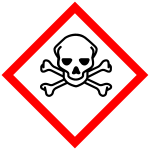
Signal word Danger
Hazard statement(s) H300 Fatal if swallowed
Precautionary statement(s) Prevention P264 Wash ... thoroughly after handling.
P270 Do not eat, drink or smoke when using this product.
Response P301+P316 IF SWALLOWED: Get emergency medical help immediately.
P321 Specific treatment (see ... on this label).
P330 Rinse mouth.
Storage P405 Store locked up.
Disposal P501 Dispose of contents/container to an appropriate treatment and disposal facility in accordance with applicable laws and regulations, and product characteristics at time of disposal.
Other hazards which do not result in classification
no data available
Handling and StoragePrecautions for safe handling
Handling in a well ventilated place. Wear suitable protective clothing. Avoid contact with skin and eyes. Avoid formation of dust and aerosols. Use non-sparking tools. Prevent fire caused by electrostatic discharge steam.
Conditions for safe storage, including any incompatibilities
Store in airtight containers. Protect from light.
-
-
Seller Information
-
Business Type:
Trader
-
Main Products:
Medetomidine,Medetomidine hydrochloride,D-Lysergic Acid Methyl Ester,SR17018,Fluralaner,GS-441524
-
Location:
RONGSHENG BEIYUANDAJIE 9, LICHENG DISTRICT,JINAN, SHANDONG CHINA
-
Payment Terms:
TT against copy of documents,TT against B/L draft before shipment,100% TT in advance
-
Average lead Time:
7
-
Total Annual Revenue:
$1 million-$2.5 million
-
Total Employees:
11-50
-
Year of Establishment:
2022
-
-
Country Product Purchase Quantity Date Posted Post an enquiry for this product


