Product
Supplier
Encyclopedia
Inquiry
1-Naphthol90-15-3 buy - large image1
1-Naphthol90-15-3 buy - image1
1-Naphthol90-15-3 buy - image2
1-Naphthol90-15-3 buy - image3
1-Naphthol90-15-3 buy - image4
1-Naphthol90-15-3 buy - image5
1-Naphthol90-15-3 buy - image6

1-Naphthol90-15-3

6 Inquiries

Unit Price:

$33-34/MT FOB

Get Latest Price
CAS No.:

90-15-3

Grade:

Pharmaceutical Grade

Content:

99.5%

Port:

shanghai

Brand:

OORENT

Packaging:

Vial/Bottle/Bag/Carton

Sample Available:

Yes

Price valid (until):

2026-10-17

Company Type:
Trader
Location:
China
Payment Terms:
100% TT in advance
Average Lead Time:
10 days
Qualification:
Main Products:

pharmaceutical intermediates,peptides,electronic chemicals

  • Product Description

  • Seller Information

  • Inquiry History

  • Description

    Product Detail

    1-Naphthol Basic information
    Product Name: 1-Naphthol
    Synonyms: 1-NAPHTHOL;α-Hydroxynaphthalene;α-Maphthol;1-napthol(alpha-napthol);1-naphthol (alpha);1-Naphthol 97+ %;2-NAPHTHOL 99.1%;BETA NAPTHOL 98% MIN.
    CAS: 90-15-3
    MF: C10H8O
    MW: 144.17
    EINECS: 201-969-4
    Product Categories: Aromatics;Functional Materials;Dyestuff Intermediates;Chemistry;Bioactive Small Molecules;Biochemicals and Reagents;Building Blocks;C9 to C20+;Cell Biology;Chemical Synthesis;Detection;Fluorescent Probes;Labels;N;Organic Building Blocks;Oxygen Compounds;Particles and Stains;Phenols;Color Former & Related Compounds;Developer;Aromatic Compounds;Intermediates of Dyes and Pigments;90-15-3;bc0001
    Mol File: 90-15-3.mol
    Shop 1-Naphthol90-15-3-Detailed Image 1

    1-Naphthol Chemical Properties
    Melting point  94-96 °C(lit.)
    Boiling point  278-280 °C(lit.)
    density  1.224
    bulk density 450kg/m3
    vapor density  4.5 (120 °C, vs air)
    vapor pressure  1 mm Hg ( 94 °C)
    refractive index  1.6224
    Fp  125 °C
    storage temp.  Store below +30°C.
    solubility  Soluble in benzene, chloroform, ether and ethanol.
    pka 9.34(at 25℃)
    form  Crystalline Flakes
    color  white to off-white
    Odor Slight phenolic odor
    explosive limit 5%
    Water Solubility  436.7mg/L(25 ºC)
    Specific Heat Capacity Cp(crystal): 1.16 J/(g·K); Cp(gas): 1.04 J/(g·K), at 25℃
    λmax 324nm(MeOH)(lit.)
    Sensitive  Air & Light Sensitive
    Merck  14,6383
    BRN  1817321
    Henry's Law Constant 1.6×10² mol/(m3Pa) at 25℃, HSDB (2015)
    Stability: Stable, but air and light sensitive - store under inert gas. Incompatible with strong bases, strong oxidizing agents.
    Major Application diagnostic assay manufacturing
    hematology
    histology
    Cosmetics Ingredients Functions HAIR DYEING
    Cosmetic Ingredient Review (CIR) 1-Naphthol (90-15-3)
    InChI 1S/C10H8O/c11-10-7-3-5-8-4-1-2-6-9(8)10/h1-7,11H
    InChIKey KJCVRFUGPWSIIH-UHFFFAOYSA-N
    SMILES Oc1cccc2ccccc12
    LogP 2.84 at 25℃
    CAS DataBase Reference 90-15-3(CAS DataBase Reference)
    NIST Chemistry Reference 1-Naphthalenol(90-15-3)
    EPA Substance Registry System 1-Naphthol (90-15-3)

    Safety Information
    Hazard Codes  Xn,N
    Risk Statements  21/22-37/38-41-51/53
    Safety Statements  22-26-37/39-2-61
    RIDADR  UN 2811 6.1/PG 3
    WGK Germany  1
    RTECS  QL2800000
    8-23
    Autoignition Temperature 510 °C
    TSCA  TSCA listed
    HazardClass  6.1
    PackingGroup  III
    HS Code  29071510
    Storage Class 6.1C - Combustible acute toxic Cat.3
    toxic compounds or compounds which causing chronic effects
    Hazard Classifications Acute Tox. 3 Dermal
    Acute Tox. 4 Oral
    Aquatic Acute 1
    Aquatic Chronic 3
    Eye Dam. 1
    Skin Irrit. 2
    Skin Sens. 1A
    STOT SE 2 Oral
    STOT SE 3
    Hazardous Substances Data 90-15-3(Hazardous Substances Data)
    Toxicity LD50 orally in Rabbit: 1870 mg/kg LD50 dermal Rabbit 880 mg/kg
    MSDS Information
    Provider Language
    Oxidation base 33 English
    SigmaAldrich English
    ACROS English
    ALFA English

    1-Naphthol Usage And Synthesis
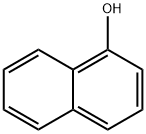
    Description 1-Naphthol, or α-naphthol, is a fluorescent organic compound with the formula C10H7OH. It is a white solid. It is an isomer of 2-naphthol differing by the location of the hydroxyl group on the naphthalene ring. The naphthols are naphthalene homologues of phenol, with the hydroxyl group being more reactive than in the phenols. Both isomers are soluble in simple alcohols, ethers, and chloroform. They are precursors to a variety of useful compounds. Naphthols (both 1 and 2 isomers) are used as biomarkers for livestock and humans exposed to polycyclic aromatic hydrocarbons.
    α-naphtol, combined with epichlorhydrine and sodium hydroxide to form alpha-naphtyl glycidyl ether, caused sensitization in one of three workers in a chemical plant.
    Chemical Properties 1-Naphthol is a light grey to brown solid with an unpleasant phenol odour, vapour volatility and sublimation. The compound darkens on exposure to air or light and evaporates with water vapour. Soluble in ethanol, ether, benzene, chloroform and alkali solutions, insoluble in water. In contact with ferric chloride produces a purple precipitate.
    Uses 1-Naphthol is used as a precursor in the manufacturing of various azo dyes and pharmaceuticals such as nadolol. It is used as biomarkers. It is used in analytical chemistry as Molisch's reagent (1-naphthol dissolved in ethanol) for checking the presence of carbohydrates. It plays an essential role with sodium hypobromite to detect the presence of arginine in proteins, which is called as Sakaguchi test.
    Preparation 2-Isopropylnaphthalene can be used to synthesize 1-naphthol by oxidation via the hydroperoxide (Hock synthesis).
    Historically 1-naphthol was produced via caustic fusion of naphthalene-1-sulfonic acid, but this was superseded by the I.G. Farbenindustrie process involving hydrolysis of 1-naphthylamine with aqueous 22 % sulfuric acid at 200°C under pressure in a lead-lined autoclave. To obtain a purer product, Union Carbide developed a process based on catalytic oxidation of tetralin to 1-tetralol and 1-tetralone followed by dehydrogenation. The two-stage catalytic process is claimed to give an overall yield of 72% 1-naphthol, with an overall efficiency of 97%.
    Application 1-Naphthol is a hydroxyl-aromatic compound. It has been used as a prooxidant to analyze its ability to induce hemolysis in a zebrafish G6PD (glucose-6-phosphate dehydrogenase) deficiency model.
    Definition ChEBI: 1-naphthol is a naphthol carrying a hydroxy group at position 1. It has a role as a genotoxin and a human xenobiotic metabolite.
    Reactions 1-Naphthol is reduced by sodium in liquid ammonia to give 5,6,7,8-tetrahydro-1-naphthol; oxidised by NaOCl - FeCl3 or I2-KI to give a purple colour. Phosphorus pentachloride is chlorinated at 150 °C to give 1-chloronaphthalene, thionyl chloride to give 4-chloro-1-naphthol, or Cl2-CH3COOH to give 2,4-dichloro-1-naphthol. Similarly, bromine produces 2,4-dibromo-1-naphthol, a reaction that can be used in quantitative titrations. Its nitration reaction produces a complex mixture. The crude 2,4-dinitro derivative is used as an acidic yellow dye, comparable to picric acid. Sulfonation at 50 °C readily produced 1-naphthol-2,4-disulfonic acid.
    Synthesis Reference(s) Synthetic Communications, 21, p. 379, 1991 DOI: 10.1080/00397919108016759
    Journal of the American Chemical Society, 107, p. 493, 1985 DOI: 10.1021/ja00288a037
    General Description 1-Naphthol, a metabolite of carbaryl and naphthanlene. It is formed by spontaneous reaction from (1R, 2S)-Naphthalene epoxide followed to form 1, 4-Dihydroxynaphthalene.
    Hazard Toxic by ingestion and skin absorption.
    Flammability and Explosibility Not classified
    Contact allergens 1-Naphthol can be used in dye manufacture and is classified as a hair dye. Combined with epichlorhydrin and NaOH to form alpha-naphthyl glycidyl ether, it caused sensitization in one of three workers in a chemical plant.
    Safety Profile Poison by ingestion and intraperitoneal routes. Moderately toxic by skin contact. An experimental teratogen. Experimental reproductive effects. A severe eye and skin irritant. Mutation data reported. Ingestion of large amounts can cause nephritis, vomiting, diarrhea, circulatory collapse, anemia, convulsions, and death. Can cause kidney irritation and injury to cornea and lens of the eye. Combustible when exposed to heat or flame. When heated to decomposition it emits acrid smoke and irritating fumes.
    Synthesis To a 10 mL pressure vessel, aryl halide (1.00 mmol), copper (I) oxide (0.05 mol), ligand (0.05 mol), 3 M sodium hydroxide (2 mL), and organic solvent (2 mL) were added. The reaction mixture was irradiated at 160 °C for 10 min with strong stirring. The reaction mixture was allowed to cool to room temperature. The reaction mixture was filtered through a plug of celite in a fritted filter funnel and washed with ethyl acetate. The product was extracted using 30 mL of ethyl acetate for three times. The organic extract is washed three times with 10 mL water and two times with 10 mL of brine. The combined organic phases were dried over anhydrous MgSO4 and the solvent was removed under reduced pressure to afford 1-naphthol.
    Purification Methods Sublime 1-naphthol, then crystallise it from aqueous MeOH (charcoal), aqueous 25% or 50% EtOH, *C6H6, cyclohexane, heptane, CCl4 or H2O. Dry it over P2O5 in vacuo. The 4-nitrobenzoate has m 143o (from EtOH). [Shizuka et al. J Am Chem Soc 107 7816 1985, Beilstein 8 H 596, 6 IV 4208.]

    1-Naphthol Preparation Products And Raw materials
    Raw materials Sulfuric acid-->Naphthalene-->1-Naphthylamine-->Naphthalene-2-sulfonic acid-->1,2,3,4-Tetrahydronaphthalene-->2-Ethylnitrobenzene-->Ammonium bisulfate-->1-Chloronaphthalene-->1-Naphthalenesulfonic acid-->Molybdic acid
    Preparation Products NAPROANILIDE-->1,4-Naphthoquinone-->Eriochrome Black T-->Napropamide-->2-Ethoxynaphthalene-1-carbonyl chloride-->17-Ethinyl-17-hydroxy-18-methylestra-5(10),9(11)-dien-3-one-3-ethylene ketal-->Ethyl 3-(6-methoxy-2-naphthyl)-3-methyl glycidate-->2-Nitroso-1-naphthol-->Methyl 3-(6-methoxy-2-naphthyl)-3-methyl glycidate-->3-Methoxy-18-methylestra-2,5(10)dien-17-one 17-ethylene ketal-->6-methoxy-alpha-methylnaphthalen-1-acetaldehyde-->17-Ethinyl-3,17-dihydroxy-18-methylestra-2,5(10)-diene3-methylether-->3-Methoxy-18-methylestra-1,3,5(10),8-tetraen-17-ethylene ketal-->1-Hydroxy-2-naphthoic acid-->sodium 2-[(2-hydroxynaphthyl)azo]naphthalenesulphonate-->fluorescent whitening agent OM-->1-Ethenyl-1,2,3,4-tetrahydro-6-methoxy-1-naphthalenol-->13-Ethyl-17-hydroxy-18,19-dinorpregn-5(10)-en-20-yn-3-one-->N,N'-Di-2-naphthyl-p-phenylenediamine-->6-Methoxy-2-Acetyl Naphthalene-->2-Bromo-1-(6-methoxy-2-naphthalenyl)-1-propanone-->Flavianic acid-->N-(1-Naphthyl)ethylenediamine dihydrochloride-->17-Ethynyl-18-methylestra-5(10),9(11)-dien-17-ol-3-one-->Acid red 1-->1-Naphthoxyacetic acid-->2-[(1-Naphthyloxy)methyl]oxirane-->2-(1-Naphthalenyloxy)propanoic acid-->1-Ethoxynaphthalene-->Mordant Black 3-->5,8-Dihydronaphthol-->calcium disodium bis[2-chloro-5-[(2-hydroxy-1-naphthyl)azo]-4-sulphonatobenzoate]-->1-Naphthyl chloroformate-->1-Nitroso-2-naphthol-->1,6-Dibromo-2-methoxynaphthalene-->4-Amino-1-naphthol hydrochloride-->1,6-Dibromo-2-naphthol-->O-2-Naphthyl chlorothioformate-->1-(6-hydroxy-2-naphthyl)ethan-1-one


    Shop Tirzepatide2023788-19-2-Detailed Image 2 Shop Tirzepatide2023788-19-2-Detailed Image 3 Shop Tirzepatide2023788-19-2-Detailed Image 4 Shop Tirzepatide2023788-19-2-Detailed Image 5 Shop Tirzepatide2023788-19-2-Detailed Image 6 Shop Tirzepatide2023788-19-2-Detailed Image 7


    ECHEMI Editorial Reference
    In the vast field of chemistry, 1-Naphthol, with its unique chemical structure and a wide range of applications, occupies a pivotal position. Cas form C₁₀H₈O. As a naphthalene derivative, 1-Naphthol has a phenolic hydroxyl group (OH) embedded in the first position of the naphthalene ring. This structural feature not only gives 1-naphthol its unique chemical properties, but also forms the basis for its application in many fields. In appearance, 1-Naphthol usually appears as a colorless crystalline or yellowish solid with a characteristic aromatic smell that is both a subtle revelation of its chemical properties and a potential use in the fragrance industry. However, beauty is often associated with risk, 1-Naphthol is powerful, but also has some toxicity, therefore, in the process of use, we must strictly comply with safety regulations to ensure the safety and health of the operator. In the field of organic synthesis, 1-Naphthol is very useful. It is not only an important raw material for synthetic dyes, but also an indispensable intermediate in the manufacturing process of chemicals such as drugs and pesticides. For example, in the dye industry, 1-Naphthol can be transformed into a variety of colorful and excellent performance dyes through a series of complex chemical reactions, which are widely used in textile, leather, printing and other industries. In terms of drug manufacturing, 1-Naphthol, as a key raw material, participates in the synthesis of a series of drug molecules with antibacterial, anti-inflammatory, anti-cancer and other biological activities, contributing to human health. In addition, 1-Naphthol's industrial applications do not stop there. It can also be used as an intermediate and additive for the manufacture of other organic compounds, providing strong support for the development of the chemical industry. At the same time, in the field of analytical chemistry, 1-Naphthol also shows its unique value. Due to its specific chemical properties, it is often used as an indicator and plays an important role in the monitoring and analysis of chemical reactions. It is worth mentioning that 1-Naphthol also shows its unique application potential in some specific areas. For example, in the food industry, it can be used as an antioxidant to effectively extend the shelf life of food; In the cosmetics industry, it can be used as a preservative to protect products from microorganisms. These applications not only broaden the market space of 1-Naphthol, but also provide more possibilities for its future development.

    Basic Info
    Product Name:

    1-Naphthol

    Other Name:

    1-Naphthalenol;1-Naphthol;C.I. 76605;BASF Ursol ERN;C.I. Oxidation Base 33;Durafur Developer D;Fouramine ERN;Fourrine 99;Fourrine ERN;Furro ER;1-Hydroxynaphthalene;α-Hydroxynaphthalene;Nako TRB;α-Naphthol;Tertral ERN;Ursol ERN;Zoba ERN;α-Naphthyl alcohol;1-Naphthyl alcohol;Naphthol-1;NSC 9586;Naphthyl-1-ol;5-Hydroxynaphthalene;50356-21-3

    CAS No.:

    90-15-3

    Molecular Formula:

    C10H8O

    InChIKeys:

    InChIKey=KJCVRFUGPWSIIH-UHFFFAOYSA-N

    Molecular Weight:

    144.17

    Exact Mass:

    144.17

    BRN:

    1817321

    EC Number:

    201-969-4

    UNII:

    2A71EAQ389

    NSC Number:

    9586

    DSSTox ID:

    DTXSID6021793

    Color/Form:

    Yellow monoclinic needles from water|Colorless prisms (from toluene)

    HScode:

    29071510

    Characteristics
    PSA:

    20.2

    XLogP3:

    2.8

    Appearance:

    white to off-white Crystalline Flakes

    Density:

    1.0954 g/cm3 @ Temp: 98.7 °C

    Melting Point:

    96 °C

    Boiling Point:

    288 °C

    Flash Point:

    125 °C

    Refractive Index:

    1.678

    Water Solubility:

    soluble in benzene, chloroform, ether and ethanol.

    Storage Conditions:

    Store in dark!

    Vapor Pressure:

    1 mm Hg ( 94 °C)

    Vapor Density:

    4.5 (120 °C, vs air)

    Toxicity:

    LD50 orally in Rabbit: 1870 mg/kg LD50 dermal Rabbit 880 mg/kg

    Explosive limit:

    5%

    Odor:

    Phenolic odor

    Taste:

    Disagreeable, burning taste

    OH:

    5.50e-10 cm3/molecule*sec

    Henrys Law Constant:

    6.00e-08 atm-m3/mole|Henry's Law constant = 6.0X10⁻⁸ atm-cu m/mole at 25 °C (est)

    Dissociation Constants:

    pKa = 9.34 at 25 °C

    Experimental Properties:

    Reduces ammoniacal silver nitrate. Sublimable; volatile with steam.|Enthalpy of fusion = 23.1 kJ/mol|Hydroxyl radical reaction rate constant = 1.34X10⁻¹² cu cm/molecule-sec at 25 °C

    Autoignition Temperature:

    541.7 °C

    Heat of Combustion:

    4957.4 kJ/mol (crystal) at 298.16 deg K; 5048.5 kJ/mol at 298.16 deg K (gas)

    Hazard Identification

    Classification of the substance or mixture

    Acute toxicity - Category 4, Oral

    Acute toxicity - Category 4, Dermal

    Skin irritation, Category 2

    Serious eye damage, Category 1

    Specific target organ toxicity – single exposure, Category 3

    GHS label elements, including precautionary statements

    Pictogram(s)

    Signal word

    Danger

    Hazard statement(s)

    H302 Harmful if swallowed

    H312 Harmful in contact with skin

    H315 Causes skin irritation

    H318 Causes serious eye damage

    H335 May cause respiratory irritation

    Precautionary statement(s)
    Prevention

    P264 Wash ... thoroughly after handling.

    P270 Do not eat, drink or smoke when using this product.

    P280 Wear protective gloves/protective clothing/eye protection/face protection/hearing protection/...

    P261 Avoid breathing dust/fume/gas/mist/vapours/spray.

    P271 Use only outdoors or in a well-ventilated area.

    Response

    P301+P317 IF SWALLOWED: Get medical help.

    P330 Rinse mouth.

    P302+P352 IF ON SKIN: Wash with plenty of water/...

    P317 Get medical help.

    P321 Specific treatment (see ... on this label).

    P362+P364 Take off contaminated clothing and wash it before reuse.

    P332+P317 If skin irritation occurs: Get medical help.

    P305+P354+P338 IF IN EYES: Immediately rinse with water for several minutes. Remove contact lenses, if present and easy to do. Continue rinsing.

    P304+P340 IF INHALED: Remove person to fresh air and keep comfortable for breathing.

    P319 Get medical help if you feel unwell.

    Storage

    P403+P233 Store in a well-ventilated place. Keep container tightly closed.

    P405 Store locked up.

    Disposal

    P501 Dispose of contents/container to an appropriate treatment and disposal facility in accordance with applicable laws and regulations, and product characteristics at time of disposal.

    Other hazards which do not result in classification

    no data available

    Handling and Storage

    Precautions for safe handling

    Handling in a well ventilated place. Wear suitable protective clothing. Avoid contact with skin and eyes. Avoid formation of dust and aerosols. Use non-sparking tools. Prevent fire caused by electrostatic discharge steam.

    Conditions for safe storage, including any incompatibilities

    Keep in dark places.

  • Seller Information
    Business Type:

    Trader

    Main Products:

    pharmaceutical intermediates,peptides,electronic chemicals

    Location:

    Room 102, 1st Floor, East Office Building, No. 45 Pengwan Road, Qianwan Bonded Port Area, Qingdao Zone, China (Shandong) Pilot Free Trade Zone

    Payment Terms:

    100% TT in advance

    Average lead Time:

    10 days

    Total Annual Revenue:

    $10 million-$25 million

    Total Employees:

    51-100

    Year of Establishment:

    2024

    A reliable supplier is like insurance.

    We are mainly specilized in supply of pharmaceutical intermediates, electronic chemicals,food additives, and other fine chemical products.
    Integrity is the foundation, quality is life. We would like to work together with you to build a greener and brighter future.

    Website: orientchem.cc
    Email: scarlett@orientchem.cc
    WhatsApp: +86 17753254221

  • Inquiry History
    6 Inquiries
    Country Product Purchase Quantity Date Posted
    India

    ALPHA NAPHTHO;1-NAPHTHO

    1 20' Fcl Dec 29, 2025
    Nigeria

    1-Naphthol

    100 G Jun 14, 2024
    Uzbekistan

    1-Naphthalenol

    1 KG Mar 18, 2026
    Hongkong, China

    1-napthol

    1 20' Fcl Mar 5, 2024
    Taiwan, China

    apha-naphthol

    26.5 MT Sep 17, 2026
    Vietnam

    Hair dye intermediates

    1000 KG Dec 4, 2024
    Post an enquiry for this product
pic ×

Scan the QR Code to Share

All products displayed on this website are only for non-medical purposes such as industrial applications or scientific research, and cannot be used for clinical diagnosis or treatment of humans or animals. They are not medicinal or edible.

According to relevant laws and regulations and the regulations of this website, units or individuals who purchase hazardous materials should obtain valid qualifications and qualification conditions.

The information shown above is provided by the enterprise itself, and the authenticity, accuracy and legitimacy of the content are the responsibility of the publishing company. ECHEMI does not bear any guarantee responsibility for this. Please be aware that risks in internet transactions objectively exist.

Feedback & Suggestions
Send Message

Thank you for your feedback. If you require further assistance, please contact us by email at info@echemi.com or call us at +86-532-55729510.