




Tripropylene glycol
-
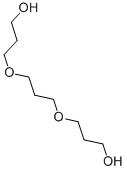
Tripropylene glycol
structure -
-
CAS No:
24800-44-0
-
Formula:
C9H20O4
-
Chemical Name:
Tripropylene glycol
-
Synonyms:
((1-methyl-1,2-ethanediyl)bis(oxy))bis-propano;[(1-methyl-1,2-ethanediyl)bis(oxy)]bis-Propanol;Tripropylene glycol, 98%, mixture of isomers;2-(2-(2-hydroxypropoxy)propoxy)-1-propanol;2-(2-(2-hydroxypropoxy)propoxy-1-propanol;tripropyleneglycol,mixtureofisomers;Tripropyleneglycol,90%;Propanol, (1-methyl-1,2-ethanediyl)bis(oxy)bis-
- Categories:
-
CAS No:
Description
Tripropylene glycol is a water-white liquid. Soluble in water, methanol, ether. Combustible. One of its unique features is its combination of water-solubility and good solubility for many organic compounds. Because of high boiling point and low volatility it is used in the formulation of textile soaps, lubricants, cutting oils, and similar applications.
Tripropylene glycol is a colorless liquid. (USCG, 1999)|Liquid|ODOURLESS COLOURLESS LIQUID.
Tripropylene glycol is a colorless liquid. (USCG, 1999)
Tripropylene glycol Basic Attributes
192.25
192.136154
2235421
246-466-0
5U049772F7
1348
TSCA listed
DTXSID7027837
Colorless to Light yellow
29094990
Characteristics
58.92000
Reactivity with Water No reaction; Reactivity with Common Materials: May attack some forms of plastics and elastomers; Stability During Transport: Stable; Neutralizing Agents for Acids and Caustics: Not pertinent; Polymerization: Not pertinent; Inhibitor of Polymerization: Not pertinent.
-0.83
Tripropylene glycol is a colorless liquid. (USCG, 1999)
1.021 g/mL at 25 °C (lit.)
-45°C
273 °C (lit.)
131.2±21.8 °C
n20/D1.444(lit.)
Miscible with water, methanol and ether.
<0.01 mm Hg ( 25 °C)
6.63 (vs air)
Non flammable
Characteristic.
3.0×10⁹mol/(m3Pa) at 25℃, HSDB (2015)
1 PPM EQUIV TO 7.86 MG/CU M @ 25 °C, 760 MM HG|1 MG/L= 128 PPM|SUPERCOOLS INSTEAD OF FREEZING|Does not crystallize
Water soluble.
Alcohols and Polyols
Tripropylene glycol is a ether-alcohol derivative. The ether being relatively unreactive. Flammable and/or toxic gases are generated by the combination of alcohols with alkali metals, nitrides, and strong reducing agents. They react with oxoacids and carboxylic acids to form esters plus water. Oxidizing agents convert alcohols to aldehydes or ketones. Alcohols exhibit both weak acid and weak base behavior. They may initiate the polymerization of isocyanates and epoxides. May attack some forms of plastics [USCG, 1999].
Store at room temperature, keep dry and cool
Safety Information
NONH for all modes of transport
1
Xi
26-36
YK6825000
Xi: Irritant;
36/37/38
SRP: At the time of review, criteria for land treatment or burial (sanitary landfill) disposal practices are subject to significant revision. Prior to implementing land disposal of waste residue (including waste sludge), consult with environmental regulatory agencies for guidance on acceptable disposal practices.
Special Hazards of Combustion Products: Acrid fumes of acids and aldehydes may form in fires.
|Warning|H315 (100%): Causes skin irritation [Warning Skin corrosion/irritation]|P261, P264, P271, P280, P302+P352, P304+P340, P305+P351+P338, P312, P321, P332+P313, P337+P313, P362, P403+P233, P405, and P501|Aggregated GHS information provided by 1118 companies from 5 notifications to the ECHA C&L Inventory. Each notification may be associated with multiple companies.|Not Classified
Plastic gloves; safety glasses or face shield (USCG, 1999)
COMBUSTIBLE.|FIRE HAZARD: SLIGHT, WHEN EXPOSED TO HEAT OR FLAME; CAN REACT WITH OXIDIZING MATERIALS.
WATER, FOAM, CARBON DIOXIDE, DRY CHEMICAL.
Collect leaking and spilled liquid in sealable containers as far as possible. Wash away remainder with plenty of water.
Well closed.
A harmful contamination of the air will not or will only very slowly be reached on evaporation of this substance at 20 °C.
NO open flames.
Use ventilation.
Protective gloves.
Wear safety spectacles.
| 0 - Materials that, under emergency conditions, would offer no hazard beyond that of ordinary combustible materials.| 1 - Materials that must be preheated before ignition can occur. Materials require considerable preheating, under all ambient temperature conditions, before ignition and combustion can occur.| 0 - Materials that in themselves are normally stable, even under fire conditions.
Tripropylene glycol was detected at unreported concentrations in the finished waters of 2 (Lake Tahoe, CA and Orange County, CA) of 16 advanced waste treatment plants in the USA(1).
Tripropylene glycol was tenatively measured (unreported concentration) in the personal air of one of 12 people during a study monitoring personal exposures to chemicals(1).
Toxicity
Tripropylene glycol's production and use in the manufacture of polyester polyols for urethane applications, in the manufacture of hydraulic and brake fluids, inks and some paints, and as a precursor of low molecular mass esters and polyesters(1) may result in its release to the environment through various waste streams(SRC).
Tripropylene glycol's production and use in the manufacture of polyester polyols for urethane applications, in the manufacture of hydraulic and brake fluids, inks and some paints, and as a precursor of low molecular mass esters and polyesters may result in its release to the environment through various waste streams. If released to the atmosphere, tripropylene glycol should exist in both the vapor and particulate phases based on an estimated vapor pressure of 3.2X10⁻⁴ mm Hg at 25 °C. Vapor-phase tripropylene glycol is degraded in the atmosphere by reaction with photochemically produced hydroxyl radicals with an estimated half-life of about 3 hours. Particulate-phase tripropylene glycol may be physically removed from the air by wet and dry deposition. An estimated Koc of 13 suggests that tripropylene glycol will have very high mobility in soil. By analogy to dipropylene glycol, a structurally similar compound, tripropylene glycol is expected to be resistant to biodegradation in both soil and water. Dipropylene glycol in a five day BOD test, reached 0-5% of the theoretical oxygen demand; over a four week period, only 0-3% by BOD was degraded. Tripropylene glycol is not expected to volatilize from moist soil or water surfaces based on an estimated Henry's Law constant of 3.3X10⁻¹⁵ atm-cu m/mole. Bioconcentration in aquatic organisms is unlikely given an estimated BCF value of 0. Exposure to tripropylene glycol may occur occupationally during its production or during its use in the manufacture of other products. (SRC)
The rate constant for the vapor-phase reaction of tripropylene glycol with photochemically produced hydroxyl radicals has been estimated as 5.6X10⁻¹¹ cu cm/molecule-sec at 25 °C(SRC) using a structure estimation method(1,SRC). This corresponds to an atmospheric half-life of about 3 hours at an atmospheric concentration of 5X10+5 hydroxyl radicals per cu cm(1,SRC).
An estimated BCF value of 0 was calculated for tripropylene glycol(SRC), using an estimated log Kow of -0.50(1,SRC) and a recommended regression-derived equation(2). According to a recommended classification scheme(3), this BCF value indicates that bioconcentration in aquatic organisms will not be an important fate process(SRC).
The Koc of tripropylene glycol is estimated as approximately 13(SRC), using an estimated log Kow of -0.50(1,SRC) and a regression-derived equation(2,SRC). According to a recommended classification scheme(3), this estimated Koc value suggests that tripropylene glycol has very high mobility in soil(SRC).
The Henry's Law constant for tripropylene glycol is estimated as 3.3X10⁻¹⁵ atm-cu m/mole(SRC) using a fragment constant estimation method(1). This value indicates that tripropylene glycol will be essentially nonvolatile from water surfaces(2,SRC). Tripropylene glycol's vapor pressure, 3.2X10⁻⁴ mm Hg(3,SRC) and Henry's Law constant(1,SRC) indicate that volatilization from dry and moist soil will not be a major fate process for this compound(SRC).
INDUSTRIAL EXPOSURE IS LIMITED ALMOST ENTIRELY TO DIRECT CONTACT WITH LIQ. VAPORS OR MISTS MAY BE ENCOUNTERED UNDER CERTAIN CONDITIONS.|NIOSH (NOES Survey 1981-1983) has statistically estimated that 74,637 workers (9,199 of these are female) are potentially exposed to tripropylene glycol in the USA(1).
Drug Information
...IS NOT ABSORBED THROUGH SKIN IN ACUTELY TOXIC AMT EVEN FROM PROLONGED & REPEATED CONTACT.
Non-irritating; no symptoms observed by any exposure route.
INGESTION: if large amounts are swallowed, induce vomiting; treat symptomatically. EYES or SKIN: flush with water; get medical attention if ill effects develop. (USCG, 1999)
Fresh air, rest.
Remove contaminated clothes. Rinse skin with plenty of water or shower.
First rinse with plenty of water for several minutes (remove contact lenses if easily possible), then refer for medical attention.
LOW TOXICITY.|SUMMARY TOXICITY STATEMENT; ACUTE... MODERATE VIA ORAL ROUTE. MODERATE= MAY CAUSE REVERSIBLE OR IRREVERSIBLE CHANGES TO EXPOSED TISSUE, NOT PERMANENT INJURY OR DEATH. CAN CAUSE CONSIDERABLE DISCOMFORT.|NO ILL-EFFECTS ON HUMAN BEINGS HAVE BEEN REPORTED...
Tripropylene glycol Use and Manufacturing
The only industrial process for manufacturing propylene glycol is direct hydrolysis of propylene oxide with water. Dipropylene glycol and tripropylene glycol are formed by sequential addition of propylene oxide to propylene glycol. Consequently, all three products are produced simultaneously and separated by distillation.
Intermediate in resins, plasticizers, pharmaceuticals, insecticides, dyestuffs, mold lubricants.
Finishing agents
Fabric, textile, and leather products not covered elsewhere
Tripropylene glycol is used for textile soaps, lubricants, cutting oils and greases. It acts as an intermediate in the preparation of urethanes. It is also used as a solvent in coatings and inks. It is utilized as varnish removers, emulsifiers and hydraulic fluids. As an additive, it is used for carburetor fuels. It is involved as a cooling media as well as an active ingredient of plasticizers.
10,000,000 - 50,000,000 lb|(1972) 8.75X10+8 GRAMS (SALES)|(1975) GREATER THAN 1.81X10+6 GRAMS (EST)
Mining (except oil and gas) and support activities|Propanol, [(1-methyl-1,2-ethanediyl)bis(oxy)]bis-: ACTIVE|CONTAINERS: DRUMS; TANK CARS; TANK TRUCKS.
EPA Safer Chemical Functional Use Classes -> Solvents|Safer Chemical Classes -> Green circle - The chemical has been verified to be of low concern
Price Analysis
Recommended Suppliers of Tripropylene glycol
-
![China]() CN
CN
5 YRS
Business licensedTrader Supplier of Intermediates,Building blocks,API,Silicones,Peptides,Lab chemicals,Biochemicals,Pharmaceuticals,Screening Compounds,Food Additives -
InquiryCAS No.: 24800-44-0Grade: Industrial GradeContent: 99%
-
![China]() CN
CN
5 YRS
Business licensedDistributor Supplier of DIMETHYL SULFOXIDE,NMP,MMTInquiryUnit Price: $1300-1400 /MT FOBCAS No.: 24800-44-0Content: 99% -
![China]() CN
CN
1 YR
Business licensedTrader Supplier of Chemical materialInquiryCAS No.: 24800-44-0Grade: Tech GradeContent: 99.9%


Learn More Other Chemicals
-
Polyethylene glycol octyl ether acid phosphate
31800-88-1
-
Carboxymethyl polyethylene glycol oleyl ether
57635-48-0
-
Aniline,4,4′-methylenedi-,polymer with 1,2,4-benzenetricarboxylic acid cyclic 1,2-anhydride,dimethyl terephthalate,ethylene glycol and 1,3,5-tris(2-hydroxyethyl)-s-triazine-2,4,6(1H,3H,5H)-trione
25950-45-2
-
Urea, reaction products with ethylene glycol and ethylene oxide Formula
78355-52-9
-
Benzenesulfonic acid, dodecyl-, compds. with ammonia-ethylene glycol reaction product morpholine derivs. residues Formula
68955-71-5
-
Octadecanoic acid, mixed esters with myristic acid and neopentyl glycol Formula
68585-01-3
-
(3-BROMOMETHYLPHENYL)BORONIC ACID NEOPENTYL GLYCOL ESTER Structure
143805-78-1
-
Methoxypolyethylene glycol succinimidyl succinate Structure
78274-32-5
-
What is Polypropylene glycol monoacrylate
50858-51-0
-
What is 1,4-Benzenedicarboxylic acid, 1,4-dimethyl ester, manuf. of, by-products from, polymers with diethylene glycol
70749-97-2