




Ledipasvir

-
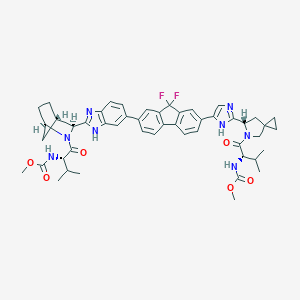
Ledipasvir
structure -
-
CAS No:
1256388-51-8
-
Formula:
C49H54F2N8O6
-
Chemical Name:
Ledipasvir
-
Synonyms:
Carbamic acid,N-[(1S)-1-[[(6S)-6-[5-[9,9-difluoro-7-[2-[(1R,3S,4S)-2-[(2S)-2-[(methoxycarbonyl)amino]-3-methyl-1-oxobutyl]-2-azabicyclo[2.2.1]hept-3-yl]-1H-benzimidazol-6-yl]-9H-fluoren-2-yl]-1H-imidazol-2-yl]-5-azaspiro[2.4]hept-5-yl]carbonyl]-2-methylpropyl]-,methyl ester;GS 5885;Ledipasvir;1350473-66-3
- Categories:
-
CAS No:
Description
ChEBI: A benzimidazole derivative that is used in combination with sofosbuvir (under the trade name Harvoni) for the treatment of chronic hepatitis C genotype 1 infection.
Ledipasvir is a benzimidazole derivative that is used in combination with sofosbuvir (under the trade name Harvoni) for the treatment of chronic hepatitis C genotype 1 infection. It has a role as an antiviral drug and a hepatitis C protease inhibitor. It is a carbamate ester, a L-valine derivative, a bridged compound, a carboxamide, a benzimidazole, a member of fluorenes, an organofluorine compound, a member of imidazoles, a N-acylpyrrolidine and an azaspiro compound.|Ledipasvir is a direct acting antiviral (DAA) medication used as part of combination therapy to treat chronic Hepatitis C, an infectious liver disease caused by infection with Hepatitis C Virus (HCV). HCV is a single-stranded RNA virus that is categorized into nine distinct genotypes, with genotype 1 being the most common in the United States, and affecting 72% of all chronic HCV patients. Treatment options for chronic Hepatitis C have advanced significantly since 2011, with the development of Direct Acting Antivirals (DAAs) such as ledipasvir. More specifically, ledipasvir is an inhibitor of the Hepatitis C Virus (HCV) Non-Structural Protein 5A (NS5A), which is required for viral RNA replication and assembly of HCV virions. Although its exact mechanism of action is unknown, it is postulated to prevent hyperphosphorylation of NS5A which is required for viral protein production. It is effective against genotypes 1a, 1b, 4a, and 5a and with a lesser activity against genotypes 2a and 3a of HCV. Ledipasvir and other direct acting antivirals are very potent options for the treatment of Hepatitis C, as they exhibit a high barrier to the development of resistance. This is an important advantage relative to HCV drugs that target other viral enzymes such as the protease, for which rapid development of resistance has proven to be an important cause of therapeutic failure. In a joint recommendation published in 2016, the American Association for the Study of Liver Diseases (AASLD) and the Infectious Diseases Society of America (IDSA) recommend ledipasvir as a first line therapy option in combination with [sofosbuvir] for the treatment of HCV genotypes 1a, 1b, 4, 5, and 6. Treatment with ledipasvir is used with the intent to cure, or achieve a sustained virologic response (SVR), after 12 weeks of daily therapy. SVR and eradication of HCV infection is associated with significant long-term health benefits including reduced liver-related damage, improved quality of life, reduced incidence of Hepatocellular Carcinoma, and reduced all-cause mortality. Treatment with direct acting antivirals such as ledipasvir is associated with very minimal side effects, with the most common being headache and fatigue. Lack of significant side effects and short duration of therapy is a considerable advantage over older interferon- and ribavirin-based regimens, which were limited by infusion site reactions, reduced blood count, and neuropsychiatric effects. Since 2014, ledipasvir has been available as a fixed dose combination product with [sofosbuvir] (tradename Harvoni) used for the treatment of chronic Hepatitis C. Approved in October 2014 by the FDA, Harvoni is indicated for the treatment of HCV genotypes 1, 4, 5, and 6 with or without [ribavirin] depending on the level of liver damage or cirrhosis. When combined together, ledipasvir and sofosbuvir as the combination product Harvoni has been shown to achieve a SVR between 93 and 99% after 12 weeks of treatment. Its use has also proven successful in the treatment of HCV in patients co-infected with HIV.|Ledipasvir is a Hepatitis C Virus NS5A Inhibitor. The mechanism of action of ledipasvir is as a P-Glycoprotein Inhibitor, and Breast Cancer Resistance Protein Inhibitor.|Ledipasvir is an orally available inhibitor of the hepatitis C virus (HCV) non-structural protein 5A (NS5A) replication complex, with potential activity against HCV. Upon oral administration and after intracellular uptake, ledipasvir binds to and blocks the activity of the NS5A protein. This results in the disruption of the viral RNA replication complex, blockage of HCV RNA production, and inhibition of viral replication. NS5A, a zinc-binding and proline-rich hydrophilic phosphoprotein, plays a crucial role in HCV RNA replication. HCV is a small, enveloped, single-stranded RNA virus belonging to the Flaviviridae family; HCV infection is associated with the development of hepatocellular carcinoma (HCC).
Ledipasvir Basic Attributes
889.02
889.00
1592732-453-0
013TE6E4WV
DTXSID90154829
C129019
J05AX65
29333990
Safety Information
3077
24/25
|Warning|H371 (100%): May cause damage to organs [Warning Specific target organ toxicity, single exposure]|P260, P264, P270, P309+P311, P405, and P501|Aggregated GHS information provided by 3 companies from 2 notifications to the ECHA C&L Inventory.
Toxicity
There is very little toxicity associated with the use of ledipasvir in combination products. The most common adverse reactions are headache and fatigue.
Ledipasvir is >99.8% bound to human plasma proteins.
Drug Information
When used in combination with the antiviral medication [sofosbuvir] as the commercially available product Harvoni, ledipasvir is indicated for the treatment of HCV genotypes 1, 4, 5, and 6 with or without [ribavirin] depending on the level of liver damage or cirrhosis. Its use has also proven successful in the treatment of HCV in patients co-infected with HIV.|FDA Label|Harvoni is indicated for the treatment of chronic hepatitis C (CHC) in adult and paediatric patients aged 3 years and above (see sections 4.2, 4.4 and 5.1).For hepatitis C virus (HCV) genotype-specific activity see sections 4.4 and 5.1.|Treatment of chronic hepatitis C
Ledipasvir acts against HCV and is categorized as a direct-acting antiviral agent (DAA). At a dose of 120 mg twice daily (2.67 times the maximum recommended dosage), ledipasvir does not prolong QTc interval to any clinically relevant extent.
Agents used in the prophylaxis or therapy of VIRUS DISEASES. Some of the ways they may act include preventing viral replication by inhibiting viral DNA polymerase; binding to specific cell-surface receptors and inhibiting viral penetration or uncoating; inhibiting viral protein synthesis; or blocking late stages of virus assembly. (See all compounds classified as Antiviral Agents.)
When given orally, ledipasvir reaches its maximum plasma concentration in about 4 to 4.5 hours with a maximum concentration (Cmax) of 323 ng/mL.|Following a single 90 mg oral dose of [14C]-ledipasvir, mean total recovery of the [14C]-radioactivity in feces and urine was approximately 87%, with most of the radioactive dose recovered from feces (approximately 86%). Unchanged ledipasvir excreted in feces accounted for a mean of 70% of the administered dose and the oxidative metabolite M19 accounted for 2.2% of the dose. These data indicate that biliary excretion of unchanged ledipasvir is a major route of elimination, with renal excretion being a minor pathway (approximately 1%).
In vitro, no detectable metabolism of ledipasvir was observed by human CYP1A2, CYP2C8, CYP2C9, CYP2C19, CYP2D6, and CYP3A4. Evidence of slow oxidative metabolism via an unknown mechanism has been observed. Following a single dose of 90 mg [14C]-ledipasvir, systemic exposure was almost exclusively to the parent drug (>98%). Unchanged ledipasvir is the major species present in feces.
The median terminal half-life of ledipasvir is 47 hours.
Ledipasvir is an inhibitor of the Hepatitis C Virus (HCV) NS5A protein required for viral RNA replication and assembly of HCV virions. Although its exact mechanism of action is unknown, it is postulated to prevent hyperphosphorylation of NS5A which is required for viral production.
GS-5885
Ledipasvir Use and Manufacturing
Preparation steps: 1-Ethyl-(3-dimethylaminopropyl)carbodiimide hydrochloride, 1-hydroxybenzotriazole, N-(methoxycarbonyl)-L-proline and N, N-dimethylformamide were added to the reaction kettle, the reaction mixture was stirred at 20 C for 0.5 hours, and the solution was then cooled to 0 C. LD-P and N-methylmorpholine were added to the reactor, naturally warmed to room temperature, and stirring was continued for 3.5 hours. Ethyl acetate and water were added, the layers were separated, and the organic phase was washed with 4% sodium hydrogen carbonate and water, and then The organic layer was distilled to 2 volumes, cooled to 20 C, acetone was added to the reactor, stirring was continued for 2.5 hours, and the mixture was centrifuged. The filter cake was washed with acetone and dried to obtain a solid LD-Q.Compound 1?-LDV-Bz-Bz (5.25 g, 4.5 mmol), potassium phosphate aqueous solution (1M/L, 50 mL) and tert-amyl alcohol (50 mL) were added to a three-necked flask, and the temperature was raised to 90 C. The mixture was stirred for 5 hours, then cooled to room temperature and extracted with ethyl acetate (100 mL). The organic phase was dried over anhydrous sodium sulfate and concentrated to give the product (4 g, yield 100%).To a three-necked flask compound 1?-LDV-Boc-Boc (5.45 g, 5 mmol) and DCM (40 mL) were added, to which a solution of HCl in dioxane (4 M/L, 40 mL) was added dropwise with stirring at 10 C. After the addition the mixture was stirred for 5 hours. Then the solvent was distilled off to give the product (4.44 g, yield 100%).Compound 9 hydrochloride (4.2 g, 5 mmol), (S)-2-methoxycarbonylamino-3-methyl-butyric acid (0.963 g, 5.5 mmol), EDCI (1.437 g, 7.5 mmol), HOBt (1.013 g, 7.5 mmol), triethylamine (2.53 g, 25 mmol) and DMF (100 mL) were added into a three-necked bottle. The mixture was stirred at 20 C. for 16 hours. After that ethyl acetate (100 mL) was added and the mixture was washed with brine (200 mL) twice. The organic phase was dried over anhydrous sodium sulfate and the solvent was distilled off to give the product (4.0 g, yield 90%) in which the content of compound 1-LDV is 99% and the content of defluorinated impurity is 0.15% (220 nm).Compound 13-Br (3.4 g, 5.675 mmol), compound 14-B (3.1 g, 6.243 mmol), PdCl2(dppf) (0.141 g, 0.2838 mmol), potassium carbonate (2.353 g, 17.025 mmol), water (10 mL) and tert-amyl alcohol (50 mL) were added into a three-necked bottle. Under nitrogen the mixture was heated to 90 C. and stirred for 16 hours. After that the mixture was cooled to room temperature and ethyl acetate (100 mL) was added. The mixture was washed with brine (200 mL) twice. The organic phase was dried over anhydrous sodium sulfate and the solvent was distilled off to give the product (4.54 g, yield 90%), in which the content of compound 1-LDV is 99.3% and the content of defluorinated impurity is 0.13% (220 nm).
Human drugs -> Harvoni -> EMA Drug Category|Antivirals for systemic use -> Human pharmacotherapeutic group|Human Drugs -> EU pediatric investigation plans|Human Drugs -> FDA Approved Drug Products with Therapeutic Equivalence Evaluations (Orange Book) -> Active Ingredients
Computed Properties
Molecular Weight:889.0
XLogP3:7.4
Hydrogen Bond Donor Count:4
Hydrogen Bond Acceptor Count:10
Rotatable Bond Count:12
Exact Mass:888.41343780
Monoisotopic Mass:888.41343780
Topological Polar Surface Area:175
Heavy Atom Count:65
Complexity:1820
Defined Atom Stereocenter Count:6
Covalently-Bonded Unit Count:1
Compound Is Canonicalized:Yes
Recommended Suppliers of Ledipasvir
-
![China]() CN
CN
5 YRS
Business licensed Certified factoryManufactory Supplier of BBiochemicals,Peptides,Silicones,Pharmaceuticals,Building blocks,Intermediates -
![China]() CN
CN
5 YRS
Business licensedTrader Supplier of API,nutrition supplements,plant extract,peptide,HCGInquiryCAS No.: 1256388-51-8Grade: Pharmaceutical GradeContent: 99% -
![China]() CN
CN
5 YRS
Business licensedTrader Supplier of PVC resin,pvc paste resin,melamineInquiryCAS No.: 1256388-51-8Grade: Industrial GradeContent: 99% -
![China]() CN
CN
3 YRS
Business licensedTrader Supplier of CHEMICALS,REAGENTSInquiryCAS No.: 1256388-51-8Grade: Pharmaceutical GradeContent: 99%

Latest News on Ledipasvir
- BMS Over $900 Million to Help Develop Potential 'Best-in-class' SHP2 Inhibitors
- AbbVie's blockbuster product for atopic dermatitis, Upadacitinib, has been approved for marketing in the EU and Japan
- Designing peptide inhibitors for possible COVID-19 treatments
- Chinese scientists discover the inhibitors of SARS-CoV-2
Learn More Other Chemicals
-
ledipasvir interMediate
1256393-27-7
-
ledipasvir interMediate
1256388-50-7
-
ledipasvir interMediate
1256387-87-7
-
Dabrafenib Formula
1195765-45-7
-
BOC-VAL-VAL-OH Formula
69209-73-0
-
BMS 303141 Formula
943962-47-8
-
(2S)-2-[[(2S)-2-[[2-[[2-[[(2S)-2-amino-3-(4-hydroxyphenyl)propanoyl]amino]acetyl]amino]acetyl]amino]-3-phenylpropanoyl]amino]-4-methylsulfanylbutanamide Structure
60117-17-1
-
(2S)-2-acetamido-6-amino-N-[(2S)-2-amino-3-methylbutanoyl]-N-propylhexanamide Structure
57899-96-4
-
What is 1-(6-methoxy-1,3-benzothiazol-2-yl)-3-phenylurea
26130-02-9
-
What is L-Tyrosyl-L-phenylalanine
17355-11-2