




4-BROMO METHYLBENZYL ALCOHOL
-
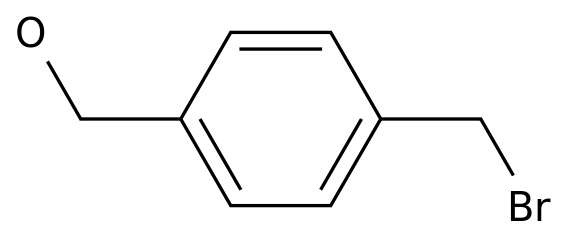
4-BROMO METHYLBENZYL ALCOHOL
structure -
-
CAS No:
71831-21-5
-
Formula:
C8H9BrO
-
Chemical Name:
4-BROMO METHYLBENZYL ALCOHOL
-
Synonyms:
(4-(BROMOMETHYL)PHENYL)METHANOL;4-Bromomethylbenzyl alcohol;4-BROMO METHYLBENZYL ALCOHOL;[4-(bromomethyl)phenyl]methanol;Benzenemethanol, 4-(bromomethyl)-;4-(bromomethyl)benzyl alcohol;4-(bromomethyl)benzylalcohol;SCHEMBL506795;4-(Bromomethyl)benzenemethanol;(4-bromomethyl-phenyl)-methanol
- Categories:
-
CAS No:
Safety Information
6.1
2811
P264, P280, P302+P352, P321, P332+P313, P362
H315
|Warning|H315 (100%): Causes skin irritation [Warning Skin corrosion/irritation]|P264, P280, P302+P352, P321, P332+P313, and P362|The GHS information provided by 1 company from 1 notification to the ECHA C&L Inventory.
4-BROMO METHYLBENZYL ALCOHOL Use and Manufacturing
4-Bromomethylbenzyl alcohol 4-Bromomethylbenzyl Alcohol General procedure: 4.1.57 Example 3Preparation of intermediate (Va where n=l and R= acetyl) 4-(4-acetyl-piperazin- 1 -yl-methy lpheny Dmethano 15.5 volumes of Toluene were loaded in a glass lined vessel under NPreparation 36[4-(Bromomethyl)phenyl]methanolTo a solution of 4-bromomethyl-benzoic acid methyl ester (5 g, 21.82 mmol) in DCM (200 mL) is added DIBAL-H (1.0 M in hexane, 54.56 mL, 54.56 mmol) drop wise at -78° C. The reaction mixture is allowed to warm to room temperature and stirred for 16 hours. The reaction mixture is quenched with sodium potassium tartrate (10percent solution, 8 mL) and diluted with DCM (100 mL). The combined organic layer is washed with water (50 mL), brine (25 mL), dried over sodium sulfate, and evaporated to give the title compound as an off white solid (3.5 g, 81percent). To a solution of methyl 4-(bromomethyl)benzoate (2.3 g, 0.01 mol) in dry DCM (80 mL) was added DIBAL- H (22 mL, 0.03 mol) at -78 °C under N2. The mixture was stirred at -78 °C for 1.5 h. The reaction mixture was quenched by careful addition of H2O (50 mL), and then extracted with DCM (100 mL X 3). The combined organic layers were dried over anhydrous sodium sulfate and concentrated to afford (4- (bromomethyl)phe[00217] Step 2: A solution of 4-(bromomethyl)benzoic acid (5.5 g, 25.6 mmol) in THF (30 mL) was cooled to 0 °C and treated with borane-THF solution (38.4 mL of 1 M, 38.4 mmol). The reaction mixture was allowed to warm to room temperature and then stirred for 2 h. The reaction was quenched with methanol followed by water and then concentrated under reduced pressure. The residue was partitioned between IN HC1 and ethyl acetate, and the organic layer washed with aHC0Step A Step A: Step A: (IX) Synthesis of Compound (25) (4-{(4-Fluoromethylbenzyl)(4H-1, 2, 4-triazol-4-yl)aminolbenzonitrile); Compound (28) was synthesized according to the scheme below.; (i) Synthesis of Compound (27) (4-Bromomethylbenzyl alcohol) (see Non-patent Literature 16 (Vassiliou, S, ; Xeilari, M.; Yiotakis, A, ; Grembecka, J.; Pawelczak, M.; Kafarskib, P.; Muchab, A., Bioorg. Med. Chem. 2007, 15, 3187-3200)); Under argon atmosphere, triphenylphosphine (14.2 g, 54.3 mmol) was added to a DMF (50 mL) solution of Compound (26) (5.00 g, 36.2 mmol) and carbon tetrabromide (18.0 g, 54.3 mmol) at 0 °C, and the mixture was heated up to room temperature. The mixture was stirred for 1 hour, and then water (300 mL) was added to the mixture, and the mixture was extracted with ethyl acetate (100 mL .x. 3). All the organic phases were mixed, sequentially rinsed with water (100 mL .x. 3) and a saline solution (100 mL .x. 1), dried (NaPreparation of 4-(bromomethyl)benzaldehyde 4.2.1.16 3-(4-((4-(hydroxymethyl)benzyl)thio)-1-oxoisoindolin-2-yl)piperidine-2, 6-dione (3p) White solid (398'mg, 87%). m.p.180 '182'C; 1H NMR (400'MHz, DMSO-d6) delta 10.99 (s, 1H), 7.67 (d, J?=?7.6'Hz, 1H), 7.58 (d, J?=?7.3'Hz, 1H), 7.50 (t, J?=?7.6'Hz, 1H), 7.30 (d, J?=?8.0'Hz, 2H), 7.23 (d, J?=?8.0'Hz, 2H), 5.12 (dt, J?=?13.3, 5.3'Hz, 2H), 4.46 (d, J?=?5.6'Hz, 2H), 4.32 (s, 2H), 4.20 (q, J?=?17.5'Hz, 2H), 3.01-2.78 (m, 1H), 2.59 (d, J?=?17.0'Hz, 1H), 2.47-2.31 (m, 1H), 2.06-1.89 (m, 1H). 13C NMR (101'MHz, DMSO-d6) delta 172.82, 170.90, 167.69, 141.59, 141.49, 135.36, 132.00, 131.56, 131.49, 129.04, 128.53, 126.48, 120.75, 62.56, 51.57, 46.61, 36.08, 31.17, 22.32. HRMS (EI) m/z calcd for C21H20N2O4S [M+H]+: 397.1217, found: 397.1213.
Computed Properties
Molecular Weight:201.06
XLogP3:1.8
Hydrogen Bond Donor Count:1
Hydrogen Bond Acceptor Count:1
Rotatable Bond Count:2
Exact Mass:199.98368
Monoisotopic Mass:199.98368
Topological Polar Surface Area:20.2
Heavy Atom Count:10
Complexity:87.3
Covalently-Bonded Unit Count:1
Compound Is Canonicalized:Yes
Recommended Suppliers of 4-BROMO METHYLBENZYL ALCOHOL
-
![China]() CN
5 YRS
Business licensedTrader Supplier of Intermediates,Building blocks,API,Silicones,Peptides,Lab chemicals,Biochemicals,Pharmaceuticals,Screening Compounds,Food Additives -
![China]() CN
2 YRS
Business licensedTrader Supplier of Pharmaceutical intermediates -
![China]() CN
5 YRS
Business licensedTrader Supplier of PVC resin,pvc paste resin,melamineInquiryCAS No.: 71831-21-5Grade: Industrial GradeContent: 99% -
![China]() CN
3 YRS
Business licensed Certified factoryManufactory Supplier of 4-(Pentafluorothio)aniline,Pentafluoro,Pentafluorothio,Pentafluorosulfur,[4-(bromomethyl)phenyl]-pentafluoro-lambda6-sulfane,[4-(pentafluoro-sulfanyl)phenyl]acetic acidInquiryCAS No.: 71831-21-5Grade: Industrial GradeContent: 95%

Learn More Other Chemicals
-
3-(3,4-Dichlorophenyl)benzyl alcohol
885963-67-7
-
4-BROMO-3',3''-DICHLOROTRITYL ALCOHOL
845790-85-4
-
4-(3-Chlorophenyl)benzyl alcohol
773872-31-4
-
4-(2-Cyanophenyl)benzyl alcohol Formula
154709-19-0
-
4-(3,4-Dichlorophenyl)benzyl alcohol Formula
885949-98-4
-
(2,6-DICHLORO-3-NITRO)BENZYL ALCOHOL Formula
160647-01-8
-
Dichlorobenzyl alcohol Structure
12041-76-8
-
3-ACETYLAMINO-2-FLUOROBENZYL ALCOHOL Structure
1003707-72-9
-
What is ETHYL-2-13C ALCOHOL
14770-41-3
-
What is (+)-SANTOLINA ALCOHOL
35671-15-9