




2-BROMO-5-PHENYL-1,3,4-OXADIAZOLE
-
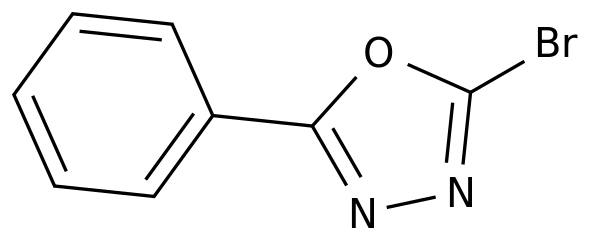
2-BROMO-5-PHENYL-1,3,4-OXADIAZOLE
structure -
-
CAS No:
51039-53-3
-
Formula:
C8H5BrN2O
-
Chemical Name:
2-BROMO-5-PHENYL-1,3,4-OXADIAZOLE
-
Synonyms:
2-bromo-5-phenyl-1,3,4-oxadiazole;1,3,4-OXADIAZOLE, 2-BROMO-5-PHENYL-;2-Bromo-5-phenyl-[1,3,4]oxadiazole;SCHEMBL1361864;CTK4J3530;KS-00000MWC;DTXSID70585415;2-Brom-5-phenyl-1,3,4-oxadiazol;ANW-49497;ZINC12505175
- Categories:
-
CAS No:
2-BROMO-5-PHENYL-1,3,4-OXADIAZOLE Use and Manufacturing
To a 500 mL four neck flask was charged tetra hydrofuran (170 mL) and 4 (17.0 g, 0.1163 mol). The reactionmass was cooled to -65 to -70 °C under nitrogen atmospherewith stirring and added n-butyl lithium (60.66 mL, 2.3 M inn-hexane, 0.1395 mol) over a period of 1h, further reactionmass was stirred at same temperature for 1.0 h. Bromine(11.15 g, 0.1395 mol) was added slowly to reaction mass bymaintaining the reaction temperature -65 to -70 °C. Furtherstirred the reaction mass for 1.0 h. Reaction completion wasmonitored by TLC. Reaction mass was warmed to around -10 °C and quenched with 1.0 N HCl solution (100 mL). Reactionmass was warmed to room temperature, compoundwas extracted with ethyl acetate (2 x 100 mL). Combinedorganic layer was washed with water (1 x 100 mL) followedby brine (100 mL), dried over anhydrous sodium sulphateand concentrated to one volume stage. Compound was crystallizedusing petroleum ether to yield the title compound asoff white solid. (Yield: 24.3 g, 93 percent). 1H-NMR (400 MHz, DMSO-d6): δ 7.57-7.68 (m, 3H), 7.95-7.98 (m, 2H). MS(ESI) m/z: 226.0A I L round bottom flask is charged with 2-bromo-5-phenyl-l, 3, 4-oxadiazole (3.07 g, 13.6 mmol, 1.00 equiv), tert-butyl (4-(4, 4, 5, 5-tetramethyl-l, 3, 2-dioxaborolan-2- yl)benzyl)carbamate available from Combi-Blocks (5.00 g, 15.0 mmol, 1.10 equiv), andPd(PPli3)4 (0.785 g, 0.680 mmol, 5.00 mol%). A reflux condenser is attached, and the unit is placed under an atmosphere of nitrogen. 265 mL of nitrogen-sparged DMF is added, followed by nitrogen sparged, aqueous sodium carbonate (1 M in water, 68 mL, 68 mmol, 5.0 equiv). The mixture is stirred at 80C for four hours. TLC showed consumption of starting materials. The solution is cooled and mixed with 500 mL water. Product is extracted with several portions of diethyl ether. Combined organic fractions are adsorbed to silica for purification by chromatography (30 to 70% EtOAc in hexane). The tert-butyloxycarbonyl-protected ( BOC- protected) product is isolated as a white solid. The solid is immediately dissolved in 60 mL dichloromethane, and treated with 3.0 mL of concentrated HCl. The mixture stirred overnight, which precipitated a white solid. The solid is isolated by filtration and rinsed with a small portion of methanol. The solid is dried in a vacuum oven (2.89 g, 74% yield).A I L round bottom flask is charged with 2-bromo-5-phenyl-l, 3, 4-oxadiazole (3.07 g, 13.6 mmol, 1.00 equiv), tert-butyl (4-(4, 4, 5, 5-tetramethyl-l, 3, 2-dioxaborolan-2- yl)benzyl)carbamate available from Combi-Blocks (5.00 g, 15.0 mmol, 1.10 equiv), and (0092) Pd(PPli3)4 (0.785 g, 0.680 mmol, 5.00 mol%). A reflux condenser is attached, and the unit is placed under an atmosphere of nitrogen. 265 mL of nitrogen-sparged DMF is added, followed by nitrogen sparged, aqueous sodium carbonate (1 M in water, 68 mL, 68 mmol, 5.0 equiv). The mixture is stirred at 80C for four hours. TLC showed consumption of starting materials. The solution is cooled and mixed with 500 mL water. Product is extracted with several portions of diethyl ether. Combined organic fractions are adsorbed to silica for purification by chromatography (30 to 70% EtOAc in hexane). The tert-butyloxycarbonyl-protected ( BOC- protected) product is isolated as a white solid. The solid is immediately dissolved in 60 mL dichloromethane, and treated with 3.0 mL of concentrated HCl. The mixture stirred overnight, which precipitated a white solid. The solid is isolated by filtration and rinsed with a small portion of methanol. The solid is dried in a vacuum oven (2.89 g, 74% yield). NMR (500 MHz, DMSO-d6) delta 8.74 (s, 3H), 8.22 - 8.07 (m, 4H), 7.78 (d, J = 8.0 Hz, 2H), 7.64 (q, J = 6.8, 6.4 Hz, 3H), 4.13 (s, 2H). 13C NMR (126 MHz, DMSO-d6) delta 164.02, 163.64, 138.05, 132.04, 129.84, 129.34, 126.72, 126.64, 123.20, 123.11, 41.68.EXAMPLE 31 (3aS, 7aS and 3aR, 7aR) 4-[4-(5-phenyl-1, 3, 4-oxadiazol-2-yl)octahydro-1H-pyrrolo[3, 2-b]pyridin-1-yl]-7H-pyrrolo[2, 3-d]pyrimidine To a stirred solution of the product of Example 2, Step 1 (40 mg, 0.099 mmol) and General procedure: In a 10 mL round-bottom flask under N2 atmosphere, 2-bromo-1, 3, 4-oxadiazole (0.7 mmol), alkyne (1.0 mmol), PdCl2(PPh3)2 (5 mol%), CuI (10 mol%), and Et3N (2.0 equiv) in anhydrous DMF (2.0 mL) were combined. The reaction mixture was stirred at 60 C for 6-16 h, and progress of reaction was monitored by TLC. Afterthe consumption of the starting materials, the reaction mixture wasallowed to cool, and subsequently extracted with Et2O (2 × 15 mL).The combined organic extracts were dried over anhydrous Na2SO4, filtered, and concentrated in vacuo followed by flash chromatographyon silica to afford the corresponding 2-alkynyl-1, 3, 4-oxadiazolein good yield.General procedure: In a 10 mL round-bottom flask under N2 atmosphere, 2-bromo-1, 3, 4-oxadiazole (0.7 mmol), alkyne (1.0 mmol), PdCl2(PPh3)2 (5 mol%), CuI (10 mol%), and Et3N (2.0 equiv) in anhydrous DMF (2.0 mL) were combined. The reaction mixture was stirred at 60 C for 6-16 h, and progress of reaction was monitored by TLC. Afterthe consumption of the starting materials, the reaction mixture wasallowed to cool, and subsequently extracted with Et2O (2 × 15 mL).The combined organic extracts were dried over anhydrous Na2SO4, filtered, and concentrated in vacuo followed by flash chromatographyon silica to afford the corresponding 2-alkynyl-1, 3, 4-oxadiazolein good yield.General procedure: In a 10 mL round-bottom flask under N2 atmosphere, 2-bromo-1, 3, 4-oxadiazole (0.7 mmol), alkyne (1.0 mmol), PdCl2(PPh3)2 (5 mol%), CuI (10 mol%), and Et3N (2.0 equiv) in anhydrous DMF (2.0 mL) were combined. The reaction mixture was stirred at 60 C for 6-16 h, and progress of reaction was monitored by TLC. Afterthe consumption of the starting materials, the reaction mixture wasallowed to cool, and subsequently extracted with Et2O (2 × 15 mL).The combined organic extracts were dried over anhydrous Na2SO4, filtered, and concentrated in vacuo followed by flash chromatographyon silica to afford the corresponding 2-alkynyl-1, 3, 4-oxadiazolein good yield.
Computed Properties
Molecular Weight:225.04
XLogP3:2.4
Hydrogen Bond Acceptor Count:3
Rotatable Bond Count:1
Exact Mass:223.95853
Monoisotopic Mass:223.95853
Topological Polar Surface Area:38.9
Heavy Atom Count:12
Complexity:150
Covalently-Bonded Unit Count:1
Compound Is Canonicalized:Yes
Recommended Suppliers of 2-BROMO-5-PHENYL-1,3,4-OXADIAZOLE
-
InquiryCAS No.: 51039-53-3Grade: Industrial GradeContent: 99%

Learn More Other Chemicals
-
10-Bromo-1-decanol
53463-68-6
-
Triclosan
3380-34-5
-
BOC-L-3-BENZOTHIENYLALANINE
154902-51-9
-
10-Chloro-1-decanol Formula
51309-10-5
-
2-(bromomethyl)-1-chloro-4-methoxybenzene Formula
3771-13-9
-
1,1,3-Tribromoacetone Formula
3475-39-6
-
Benzeneacetic acid, 3-methyl-, ethyl ester Structure
40061-55-0
-
2-BROMO-5-PHENYLPYRIDINE Structure
107351-82-6
-
What is 2,6-Diethylaniline
579-66-8
-
What is Ethyl 5-amino-4-cyano-3-(2-ethoxy-2-ox...
58168-20-0
2-BROMO-5-PHENYL-1,3,4-OXADIAZOLE
SDSRequest for Quotation