




2-Bromo-4-methoxybenzenol
-
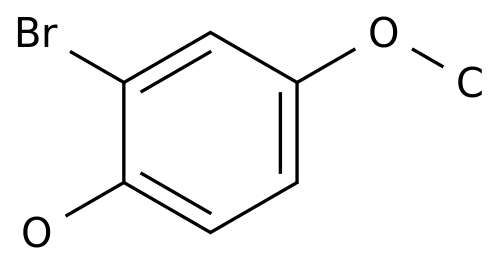
2-Bromo-4-methoxybenzenol
structure -
-
CAS No:
17332-11-5
-
Formula:
C7H7BrO2
-
Chemical Name:
2-Bromo-4-methoxybenzenol
-
Synonyms:
2-BROMO-4-METHOXYBENZENOL;2-bromo-4-methoxylphenol;3-Bromo-4-hydroxyanisole;2-Bromo-4-methoxyphenol ,98%;4-Methoxy-2-bromophenol;2-Bromo-4-methoxyphenol >;Phenol, 2-bromo-4-methoxy-;2-BROMO-4-METHOXYPHENOL
- Categories:
-
CAS No:
2-Bromo-4-methoxybenzenol Basic Attributes
203.03
203.03
168509
DTXSID70304961
White to Light yellow to Light orange
29071990
Characteristics
29.5
2.5
1.585±0.06 g/cm3(Predicted)
47
115 °C
102.2±21.8 °C
1.578
0.0183mmHg at 25°C
8.92±0.18(Predicted)
Inert atmosphere,Room Temperature
Safety Information
Xi
26-36/37/39
Xi
Irritant
P261, P264, P271, P280, P302+P352, P304+P340, P305+P351+P338, P312, P321, P332+P313, P337+P313, P362, P403+P233, P405, P501
20/21/22-36/37/38
|Warning|H315 (100%): Causes skin irritation [Warning Skin corrosion/irritation]|P261, P264, P271, P280, P302+P352, P304+P340, P305+P351+P338, P312, P321, P332+P313, P337+P313, P362, P403+P233, P405, and P501|Aggregated GHS information provided by 3 companies from 3 notifications to the ECHA C&L Inventory. Each notification may be associated with multiple companies.
2-Bromo-4-methoxybenzenol Use and Manufacturing
To a solution of 4-methoxyphenol (10 g, 81 mmol) in CHC13 (50 mL) was added BR (4 mL, 78 mmol) at 0 °C. The mixture was stirred at 0 °C for 1 h, then allowed to warm to room temperature, the mixture was stirred at room temperature for 1 h. The resulting mixture was diluted with dichloromethane (500 mL) and washed with saturated NaHS03 (3x 100 mL) and brine (200 mL), dried over anhydrous sodium sulfate, filtered and concentrated to afford the title compound (16.6 g, 100percent) as an off- white solid which was used in the next step.To a solution of 4-methoxyphenol (10 g, 81 mmol) in CHC1To a solution of 4-methoxyphenol (10 g, 81 mmol) in CHCl3 (50 mL) was added BRTo a solution of Example 2a (51.2 g, 0.41 mol) in DCM (0.5 L) cooled in an ice bath was added BrBr2 (64.7 g, 403 mmol) dissolved in CH2Cl2 (30 mL) was slowly addeddropwise to a solution of p-methoxyphenol (2) (50 g, 403 mmol) in CH2Cl2 (200 mL) under the ice bath.The reaction mixture was stirred for 2 h then poured into ice water and extracted with CH2Cl2. Theorganic layer was washed with a solution of saturated aqueous NaHCO3 and NaCl in sequence and thendried over anhydrous Na2SO4. The solvent was evaporated under reduced pressure and the residue wassubjected to flash column chromatography (petroleum ether: EtOAc, 20:1, V/V) to give 3 (80.0 g, 98.7percent)as colourless solidGeneral procedure: To a magnetic solution of aromatic compound (1 mmol)in acetonitrile (5 mL), OXBTEATB (0.233 g, 0.5 mmol) wasadded and stirred at room temperature for the appropriatetime (Table 1). The reaction was monitored by TLC (eluent:n-hexane/ethyl acetate: 5/1). The reaction mixture was transferredinto a separatory funnel after filtration of OXBTEABand was extracted with water (15 mL) and dichloromethane(20 mL). The organic layer was dried over anhydrousNa2SO4, and the solvent was concentrated in a rotary evaporator.The crude product was purified by passing it over acolumn of silica gel using a mixture of n-hexane and ethylacetate as the eluent. In order to regenerate the reagent, whitesolid was treated with liquid bromine. All the product structureswere confirmed by comparison of melting point or 1HNMR spectra with ones reported in the literature [29a-29e].A solution of 2.6 mL (100 mMol) bromine in 10 mL carbon disulfide was added dropwise over 30 minutes to a solution of 12.4 gm (100 mMol) 4-methoxyphenol in 20 mL carbon disulfide at 0° C. After 30 minutes an additional 1 mL of bromine in 10 mL carbon disulfide are added dropwise. The reaction mixture was then concentrated under reduced pressure and the residue was dissolved in diethyl ether. This solution was washed sequentially with 100 mL water and 100 mL saturated aqueous sodium chloride, dried over magnesium sulfate and concentrated under reduced pressure. The residue was subjected to silica gel chromatography, eluting with a gradient of hexane containing from 0 to 20percent ethyl acetate. Fractions containing product were combined and concentrated under reduced pressure to provide 11.6 gm (57percent) of the desired compound as a crystalline solid.A solution of 2.6 mL (100 mMol) bromine in 10 mL carbon disulfide was added dropwise over 30 minutes to a solution of 12.4 gm (100 mMol) 4-methoxyphenol in 20 mL carbon disulfide at 0°C. After 30 minutes an additional 1 mL of bromine in 10 mL carbon disulfide are added dropwise. The reaction mixture was then concentrated under reduced pressure and the residue was dissolved in diethyl ether. This solution was washed sequentially with 100 mL water and 100 mL saturated aqueous sodium chloride, dried over magnesium sulfate and concentrated under reduced pressure. The residue was subjected to silica gel chromatography, eluting with a gradient of hexane containing from 0 to 20percent ethyl acetate. Fractions containing product were combined and concentrated under reduced pressure to provide 11.6 gm (57percent) of the desired compound as a crystalline solid.1H-NMR(CDCl3): δ 7.0 (d, 1H), 6.95 (d, 1H), 6.8 (dd, 1H). 5.15 (s, 1H), 3.75 (s, 3H).2-bromo-4-methoxyphenol 2-bromo-4-methoxyphenol General procedure: To a 10 mL round bottom flask equipped with a magnetic stir bar were added phenols or alkenes (0.1 mmol), CBrGeneral procedure: To a 10 mL round bottom flask equipped with a magnetic stir bar were added phenols or alkenes (0.1 mmol), CBr
Computed Properties
Molecular Weight:203.03
XLogP3:2.5
Hydrogen Bond Donor Count:1
Hydrogen Bond Acceptor Count:2
Rotatable Bond Count:1
Exact Mass:201.96294
Monoisotopic Mass:201.96294
Topological Polar Surface Area:29.5
Heavy Atom Count:10
Complexity:108
Covalently-Bonded Unit Count:1
Compound Is Canonicalized:Yes
Recommended Suppliers of 2-Bromo-4-methoxybenzenol
-
![China]() CN
YRS
Business licensedTrader Supplier of Intermediates,Building blocks,API,Silicones,Peptides,Lab chemicals,Biochemicals,Pharmaceuticals,Screening Compounds,Food Additives -
InquiryUnit Price: nullnull /null nullCAS No.: 17332-11-5Grade: Pharmaceutical GradeContent: 99%
-
![China]() CN
YRS
Business licensedTrader Supplier of PVC resin,pvc paste resin,melamine

Learn More Other Chemicals
-
2,2-Difluoroacetamide
359-38-6
-
Undecanedioic acid
1852-04-6
-
2,4-Diamino-1-methylcyclohexane
13897-55-7
-
2,4-Hexadien-1-ol, 1-acetate Formula
1516-17-2
-
9-(4-Biphenylyl)-3-boronic acid Formula
1028648-22-7
-
9-Bromo-7-phenyl-7H-benzo[c]carbazole Formula
1357572-67-8
-
Reactive Blue 21 Structure
12236-86-1
-
2-(DIFLUOROMETHOXY)ANILINE Structure
22236-04-0
-
What is 5,10,15,20-TETRAPHENYL-21H,23H-PORPHINE IRON(III) CHLORIDE
16591-56-3
-
What is 3,3'-Dibromo-2,2'-bithiophene
51751-44-1