




Methyl 1-amino-1-cyclopentanecarboxylate hydrochloride
-
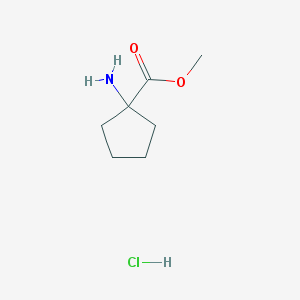
Methyl 1-amino-1-cyclopentanecarboxylate hydrochloride
structure -
-
CAS No:
60421-23-0
-
Formula:
C7H14ClNO2
-
Chemical Name:
Methyl 1-amino-1-cyclopentanecarboxylate hydrochloride
-
Synonyms:
METHYL 1-AMINOCYCLOPENTYLCARBOXYLATE HCL;methyl 1-aminocyclopentanecarboxylate, HCl;Cycloeucine methyl ester hydrochloride;Cyclopentanecarboxylic acid, 1-amino-, methyl ester, hydrochloride;Nsc161119;1-Amino-1-cyclopentanecarboxylic acid methyl ester hydrochloride;cycloeucinemethyl ester HCL;AC5C-OMe HCl
-
CAS No:
Safety Information
P261, P264, P270, P271, P280, P301+P312, P302+P352, P304+P340, P305+P351+P338, P312, P321, P330, P332+P313, P337+P313, P362, P403+P233, P405, P501
H302
Methyl 1-amino-1-cyclopentanecarboxylate hydrochloride Use and Manufacturing
To a suspension of 1-aminocyclopentanecarboxylic acid, (675 g, 5.23 mol, 1.0 equiv.) in MeOH (6.5 L) held at -15° C. with an ice/MeOH bath was added SOCl2 (687 mL, 9.4 mol, 1.8 equiv.), dropwise at such a rate that the reaction temp. did not exceed 7° C. After the addition was complete, cooling was removed, the reaction was allowed to stir at room temp. overnight, then was concentrated under reduced pressure. The residue was treated with CH2Cl2 (1 L) and concentrated under reduced pressure to afford methyl 1-aminocyclopentanecarboxylate HCl salt as a white solid (938 g, 100percent): 1H NMR (CD3OD) d 1.87-1.94 (m, 8H), 3.83 (s, 3H); NMR (DMSO-d6) δ1.67-1.71 (m, 2H), 1.83-1.98 (m, 4H), 2.06-2.14 (m, 2H), 3.73 (s, 3H), 8.81 (br s 3). This material was used in the next step without further purification1-aminocyclopentanecarboxylic acid (3.5 g, 26.9 mmol) and methanol (100 ml) were charged. An ice bath was set and thionyl chloride (3.9 ml, 53.9 mmol) was slowly added thereto. Then, the ice bath was removed, and the mixture was stirred at room temperature for 3 hours. The resultant product was vacuum-distilled to remove a solvent, and dried in a 60 oven so as to obtain methyl-1-aminocyclopentanecarboxylate hydrochloride (4.74 g, 26.4 mmol, 98 percent).[823] Preparation 1-Amino-l-cyclopentanecarboxylic acid (5.00 g, 38.8 mmol) was dissolved in methanol (100 mL) and then thionyl chloride (9.25 g, 77.7 mmol) was added dropwise with stirring. The resulting mixture was stirred overnight at room temperature and then concentrated in vacuo which left a white solid. The solid was tritruated in ethyl ether, filtered, and dried to give 6.78 g (97 percent) of methyl 1-amino- 1-cyclopentanecarboxylate hydrochloride as a white solid. 1H NMR was consistent with product. ESMS (M+1) 144.21-Aminocyclopentanecarboxylic acid (1.00 g, 7.74 mmol) was added to a solution of acetyl chloride (0.60 mL, 8.44 mmol) in methanol (10 mL). The reaction mixture was allowed to stir for EPO Example 2.1 To a stirring solution of anhydrous alcohol (10 mol eq. ) was added thionyl chloride (2 mol eq. ) at 0° C, and the resulting solution stirred for 1 hr. After warming to room temperature, the appropriate amino acid (1 mol eq) was added and the reaction heated at reflux for 6-16 hrs. Removal of solvent and recrystallisation from methanol/ether gave the amino ester hydrochloride salts.; This was synthesised according to Standard Procedure 1, using 1-AMINO-1- cyclopentanecarboxylic acid (3.876 g, 30 mmol) with thionyl chloride (4.44 mL, 45 mmol, ) and anhydrous methanol (15.5 mL). The product was isolated as a white solid (4.81 g, yield 89percent). 'H-NMR (CDC13 ; 300 MHz): 8 9.1 (3H, bs, NH3+Cl), 3.85 (3H, s, OCH3), 2.3-2. 2 (4H, m, 4H cyclopentane), 2. 15 (2H, 2H cyclopentane), 1.95 (2H, m, 2H cyclopentane). 13C-NMR (CDCl3 ; 75 MHz): 8 26.6 (2CH2 cyclopent), 38.1 (2CH2 cyclopent), 54.8 (CH30), 66.6 (cyclopentane), 174.1 (COOMe).General procedure: Thionyl chloride (10 mL) was slowly added to a cold suspension solution of the appropriate aminoacid (50 mmol) in methanol (50 mL) at 0 °C. The reaction mixture was stirred for 8–10 h and thenconcentrated on a rotary evaporator. The white precipitate formed was washed with anhydrous etherand then dried under vacuum. All data agreed with the reported data [43, 44].Methyl 1-{[(1-(2, 4-dichlorophenyl)-4-methyl-5-{4[(propylsulfonyl)oxy]phenyl}-1H- pyrazol-3-yl) carbonvl1ammo} cvclopentanecarboxylate; Step A Methyl 1-aminocyclopentanecarboxylate hydrochloride; Thionyl chloride (1.5 ml) was dissolved in methanol (15 ml) and poured over 1- aminocyclopentanecarboxylic acid (100 mg, 0.774 mmol). The mixture was refluxed 1 hour. The solvent was evaporated to give the product (107 mg, 77percent). 'H NMR (399.964 MHz) 8 9.00-8. 60 (br, 3H), 3.79 (s, 3H), 2.23 (s, 4H), 2.14-2. 00 (m, 2H), 1.90-1. 76 (m, 2H).Thionyl chloride (1.5 ml) was dissolved in methanol (15 ml) and poured over 1- Q aminocyclopentanecarboxylic acid (100 mg, 0.774 mmol). The mixture was refluxed 1 hour. The solvent was evaporated to give the product (107 mg, 77percent).
Recommended Suppliers of Methyl 1-amino-1-cyclopentanecarboxylate hydrochloride
-
![China]() CN
CN
5 YRS
Business licensedTrader Supplier of Intermediates,Building blocks,API,Silicones,Peptides,Lab chemicals,Biochemicals,Pharmaceuticals,Screening Compounds,Food Additives

Learn More Other Chemicals
-
4H-1-Benzopyran-4-one, 2-[4-[3-(dibutylamino)propoxy]-3,5-dimethylbenzoyl]-, hydrochloride (1:1)
67652-33-9
-
2-Cyclobutene-1-carboxylic acid, 4-(chlorocarbonyl)-, methyl ester, cis- (9CI)
139591-41-6
-
Cyclopentanecarboxylic acid, 2-(hydroxyimino)-, methyl ester (9CI)
170016-09-8
-
Cyclopentanecarboxylic acid, 2-hydroxy-, methyl ester, (1R,2R)- (9CI) Formula
124150-22-7
-
Cyclopropanecarboxylic acid, 1-amino-2-ethenyl-, ethyl ester, hydrochloride (9CI) Formula
681807-60-3
-
Cyclopenta[b]pyrrole-2-carboxylic acid, octahydro-, methyl ester, [2R-(2-alpha-,3a-ba-,6a-ba-)]- (9CI) Formula
156557-90-3
-
CYCLOPENTYL-(3,4,5-TRIMETHOXY-BENZYL)-AMINE HYDROCHLORIDE Structure
1052525-88-8
-
Cyclohexanecarboxylic acid, 2-(acetylamino)-, methyl ester, cis- (9CI) Structure
193635-12-0
-
What is D-arabino-Pentodialdo-5,2-furanoside, methyl 3,4-O-(1-methylethylidene)- (9CI)
821792-69-2
-
What is 2-Cyclopropylbenzenemethanamine hydrochloride
118184-64-8
Methyl 1-amino-1-cyclopentanecarboxylate hydrochloride
SDSRequest for Quotation