




Methyl 3-oxo-4-(2,4,5-trifluorophenyl)butanoate
-
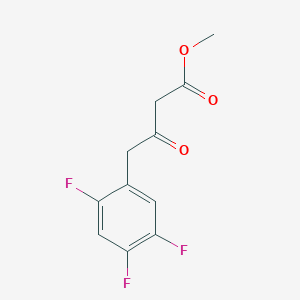
Methyl 3-oxo-4-(2,4,5-trifluorophenyl)butanoate
structure -
-
CAS No:
769195-26-8
-
Formula:
C11H9F3O3
-
Chemical Name:
Methyl 3-oxo-4-(2,4,5-trifluorophenyl)butanoate
-
Synonyms:
Methyl 3-oxo-4-(2,4,5-trifluorophenyl)butanoate
- Categories:
-
CAS No:
Methyl 3-oxo-4-(2,4,5-trifluorophenyl)butanoate Use and Manufacturing
Step-1: Preparation of Methyl 4-(2, 4, 5-trifluorophenyl)-3-oxobutanoate (Formula III)Monomethylmalonate potassium salt (MMMKS; 122.8 g), triethylamine (264 ml) and acetonitrile (1200 ml) were charged to a 3L round bottom flask (RBF) fitted with condenser, nitrogen inlet, thermometer pocket and overhead stirrer. MgCl2 (65.2 g) was added lot- wise to the above mixture over a period of 15-20 min at 30°C and the mixture was stirred for 10 min. The reaction mixture was heated to 50°C for 8 h at same temperature. After 8 hours, the reaction mixture was cooled to 30°C and marked as Part A. Ι, -carbonyldiimidazole (CDI) (1 10 g) and acetonitrile (250 ml) were charged to a 2L RBF fitted with nitrogen inlet, thermometer pocket, addition funnel and overhead stirrer. To this, a solution of 2, 4, 5-trifluorophenyl acetic acid (100 g) in acetonitrile (600 ml) was added slowly over a period of a 30 min at 30 °C and the reaction mixture was stirred at 30 °C for 3 h. This solution was marked as part B.The Part B solution was added drop-wise to part-A slurry over a period of 2 hour at 30 °C and the mixture was stirred. The progress of the reaction was monitored by TLC (Mobile phase: n-Hexane: ethyl acetate; 50:50). After 12 h, TLC analysis indicated <5percent of un-reacted starting material. The reaction mixture was concentrated under reduced pressure at 50-55°C to get a thick slurry. To this, water (1000 ml) was added and the mixture was cooled to 10-15°C and cone. HC1 (220.6 ml) was added slowly, below 20°C. MTBE (700 ml) was added to the mixture and the mixture was stirred for 30 min. The layers were separated and the aqueous layer was extracted with MTBE (200 ml). The combined organic layers were washed with 7 percent aqueous NaHC03 solution (400 ml) followed by washing with brine (200 ml). The organic layer was dried over sodium sulphate and concentrated under vacuum at 50°C to get an oil (120 g). The obtained oil was diluted with isopropyl alcohol (400 ml) and cooled to 20°C. To this water (800 ml) was added slowly over a period of 4 hours at 18-20°C. The slurry was then stirred for 4 hours and filtered. The obtained cake was washed with water (100 ml) and then suck dried to obtain free solid of titled product.Yield: 115 g (83 percent); m.p.: 37-39°C; HPLC Purity : > 95 percent. Step-1 Preparation of Methyl 4-(2, 4, 5-trifluorophenyl)-3-oxobutanoate (Formula III) [0156] Monomethylmalonate potassium salt (MMMKS; 122.8 g), triethylamine (264 ml) and acetonitrile (1200 ml) were charged to a 3 L round bottom flask (RBF) fitted with condenser, nitrogen inlet, thermometer pocket and overhead stirrer. MgClSynthesis of Grignard reagent (1) Mix 50 g of methyl bromoacetate with 200 ml of tetrahydrofuran and stir until clear. spare.(2) In a 1 L glass flask, 8.6 g of magnesium turnings and 200 ml of tetrahydrofuran are sequentially added, and the mixture is stirred thoroughly to start mixing;The flask was filled with nitrogen gas was isolated, 10ml of methyl bromoacetate tetrahydrofuran solution into the flask, heatWarmed to 45-50°C ; to reach the specified temperature, stop stirring, adding 0.5g elemental iodine, triggering the reaction, the bottom of the system gasBubble overflow. To be a large number of bubbles overflow, stir slowly start to stir the system from dark red to colorless and transparent, the systemTemperature is significantly increased. After the initiation of normal speed recovery, and began dropping the remaining methyl bromoacetate tetrahydrofuran solution, bodyThe temperature is maintained at a slight reflux (about 40-45 ° C) for about 1-1.5 hours and the addition is complete. After the drop was completed micro-reflux reversedShould be 2 hours, End of the reaction to give a Grignard reagent (2-2), spare. Synthesis of methyl 2, 4, 5-trifluorophenylacetoacetate (1) The prepared grignard reagent (2-2) was cooled to 0-5 ° C, 12.4g of cuprous iodide was added to the flask, and further cooled to -20--15 ° C.(2) 75 g of 2- (2, 4, 5-trifluorophenyl) acetyl chloride was mixed in 200 ml of tetrahydrofuran for use.(3) After reaching the specified temperature, A solution of 2- (2, 4, 5-trifluorophenyl) acetyl chloride in tetrahydrofuran was slowly added dropwise and the temperature was raised well before the dropwise addition. The reaction was controlled at -15 - -20 ° C. Did not increase the latter part of the heating temperature was about 2-2.5 hours was added dropwise, the solution is yellow-green. After the addition was completed, the mixture was stirred for 2 hours. Stop cooling, naturally warmed to room temperature, stirring was continued for 12 hours. Remove nitrogen protection, Open the stopper, the flask was added 70ml concentrated hydrochloric acid and 210ml of pure water mixed solution, System temperature has significantly increased and the bubble overflow, appropriate heating up to 30-40°C , Fully stirred (about 3h) to the system the remaining consumption of magnesium shaving to give a yellow clear solution.Stop stirring, static stratification, collecting the upper organic phase, The aqueous phase was extracted twice more with 200 ml of ethyl acetate, the organic phases were combined, The solvent was distilled off under reduced pressure at 55-60 ° C. Fast dry, add the right amount of anhydrous ethanol with dry, Concentration will be iodine was brought out, the color of concentrated solution.300ml absolute ethanol was drawn into the rotary flask, mixed well, drawn into a 2L reactor, Open heat to 50-60°C , incubated for 30 minutes. Stop heating900ml of pure water was poured into the reaction vessel, and the system was dispersed for about 10 minutes.Stir for 30 minutes. Filter, filter cake washed with pure water. Drum air at 55-60 ° C for 24 hours.60.7 g of a white solid was obtained. Yield: 91percent, purity: 99.1percent.- Methyl 4- (2, 4, 5-trifluorophenyl) acetoacetateacid (42.2g, 222 mmol) in THF (400 mL) was added 1, 1'- carbonyldiimidazole (39.5g, 244 mmol) in portions at 0 Methyl 4-(2.4.5-trifluorophenyl)acetoacetate (21)Meldrum's adduct (500.0 gm, 1.58 mol) (19) was charged in methanol (10.0 vol, 5.0 Ltr) at 25-30°C and the partially clear solution was refluxed at 60-63General procedure: A mixture of amides (amines) (0.6 mmol), 1, 3-dicarbonylcompounds (0.5 mmol), and DPAT (0.05 mmol) was stirred in refluxing toluene for 6 h. After completion of the reaction(Reaction progress was monitored by TLC), the mixture was washed with water (3 × 10 mL). The organic layer was dried over anhydrous Na2SO4, filtered and evaporated. Purification by column chromatography on silica gave the product 3, 4, 5.General procedure: A mixture of amides (amines) (0.6 mmol), 1, 3-dicarbonylcompounds (0.5 mmol), and DPAT (0.05 mmol) was stirred in refluxing toluene for 6 h. After completion of the reaction(Reaction progress was monitored by TLC), the mixture was washed with water (3 × 10 mL). The organic layer was dried over anhydrous Na2SO4, filtered and evaporated. Purification by column chromatography on silica gave the product 3, 4, 5.General procedure: A mixture of amides (amines) (0.6 mmol), 1, 3-dicarbonylcompounds (0.5 mmol), and DPAT (0.05 mmol) was stirred in refluxing toluene for 6 h. After completion of the reaction(Reaction progress was monitored by TLC), the mixture was washed with water (3 × 10 mL). The organic layer was dried over anhydrous Na2SO4, filtered and evaporated. Purification by column chromatography on silica gave the product 3, 4, 5.In 100 mL of tetrahydrofuran, Under nitrogen protection, Compound I 5.92 g (24 mmol) and 4.44 g (36 mmol) of NH2-OBn were added.Stir at room temperature for 1 hour.Further, 0.11 g (0.18 mmol) of [(p-cymene)RuCl2]2 and 0.049 g (0.09 mmol) of (R, S)-t-Butyl Josiphos were added.Continue to stir for 0.5 hours.Finally added 6.81g (50mmol)ZnCl2 and 5.88 g (94 mmol) of NaBH3CN, Continue to stir for 20 minutes.Heating back, TLC monitors the progress of the reaction, After the reaction is completed, Quenching excess reducing agent with a saturated solution of ammonium chloride, filter, Washed, The organic phase is concentrated under reduced pressure.Column chromatography, Obtained compound II 6.25 g (17.7 mmol), The yield was 74%, e.e. > 99.9%.Methyl 4-(2, 4, 5-trifluorophenyl)-3-carbonylbutanoate (1234.0 g, 4.95 mol) was added sequentially to a 10 L three-necked flask.Methanol (3.0L), R(+)-alpha-phenethylamine (1212.0 g, 10.00 mol), glacial acetic acid (150.0 g, 2.50 mol), Mechanical agitation, Heat to reflux for 16-18 h, HPLC monitoring.After the reaction is completed, most of the methanol is removed.Add dichloromethane, a solution of acetic acid (780 ml) in water (4.0 L), Stir for 10min, Let stand for liquid separation, The aqueous phase is extracted with dichloromethane, The organic phases were combined and washed with a 0.5 N aqueous solution of sodium hydroxide.Let stand for liquid separation, The organic phase is dried over magnesium sulfate.filter, The filtrate is concentrated, Get brown oil(1717.1 g, yield 98.5%).
Recommended Suppliers of Methyl 3-oxo-4-(2,4,5-trifluorophenyl)butanoate
-
![China]() CN
CN
5 YRS
Business licensedTrader Supplier of Intermediates,Building blocks,API,Silicones,Peptides,Lab chemicals,Biochemicals,Pharmaceuticals,Screening Compounds,Food AdditivesInquiryCAS No.: 769195-26-8Content: 99.00% -
![China]() CN
CN
8 YRS
Business licensed Certified factoryManufactory Supplier of Anti-tumor categories,Cardiovascular,Anti-Diabetes ClassInquiryCAS No.: 769195-26-8Grade: Pharmaceutical GradeContent: 99%

Learn More Other Chemicals
-
2-Cyclobutene-1-carboxylic acid, 4-(chlorocarbonyl)-, methyl ester, cis- (9CI)
139591-41-6
-
Cyclopentanecarboxylic acid, 2-(hydroxyimino)-, methyl ester (9CI)
170016-09-8
-
Cyclopentanecarboxylic acid, 2-hydroxy-, methyl ester, (1R,2R)- (9CI)
124150-22-7
-
Cyclopenta[b]pyrrole-2-carboxylic acid, octahydro-, methyl ester, [2R-(2-alpha-,3a-ba-,6a-ba-)]- (9CI) Formula
156557-90-3
-
Cyclohexanecarboxylic acid, 2-(acetylamino)-, methyl ester, cis- (9CI) Formula
193635-12-0
-
D-arabino-Pentodialdo-5,2-furanoside, methyl 3,4-O-(1-methylethylidene)- (9CI) Formula
821792-69-2
-
Cysteine, 2-methyl-, methyl ester (9CI) Structure
778548-47-3
-
Cyclopropanecarboxylic acid, 2-(1-methylethenyl)-, methyl ester, trans-(-)- Structure
52148-73-9
-
What is D-Glucuronal 3,4-Diacetate Methyl Ester
34296-99-6
-
What is 4-(4,5-di[1,1'-biphenyl]-4-yl-1H-imidazol-2-yl)phenyl methyl sulfide
312320-17-5
Methyl 3-oxo-4-(2,4,5-trifluorophenyl)butanoate
SDSRequest for Quotation