




Vancomycin, hydrochloride

-
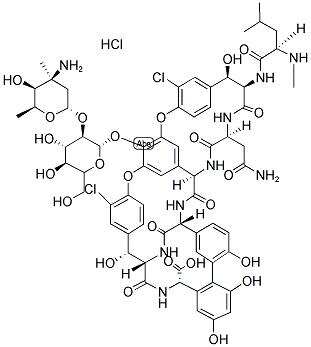
Vancomycin, hydrochloride
structure -
-
CAS No:
1404-93-9
-
Formula:
C66H75Cl2N9O24.xClH
-
Chemical Name:
Vancomycin, hydrochloride
-
Synonyms:
Vancomycin,hydrochloride;22H-8,11:18,21-Dietheno-23,36-(iminomethano)-13,16:31,35-dimetheno-1H,16H-[1,6,9]oxadiazacyclohexadecino[4,5-m][10,2,16]benzoxadiazacyclotetracosine,vancomycin deriv.;Vancocin hydrochloride;Vancocine hydrochloride;Lyphocin;Vancor;Meek;Vancocyn;Laikexin;12688-10-7;51274-08-9
- Categories:
-
CAS No:
Description
off white powderThe isolation of the glycopeptide antibiotic vancomycin(Vancocin, Vancoled) from Streptomyces orientalis (renamedA. orientalis) was described in 1956 by McCormick et al.232The organism originally was obtained from cultures of anIndonesian soil sample and subsequently has been obtainedfrom Indian soil. Vancomycin was introduced in 1958 as anantibiotic active against Gram-positive cocci, particularlystreptococci, staphylococci, and pneumococci. It is not activeagainst Gram-negativ
Antibacterial obtained from Streptomyces orientalis. It is a glycopeptide related to RISTOCETIN that inhibits bacterial cell wall assembly and is toxic to kidneys and the inner ear.
Characteristics
530.49000
-1.44
colorless to faint yellow or tan Powder
1.7±0.1 g/cm3
>190°C (dec.)
87℃
1.735
soluble in water. Slightly soluble in methanol, ethanol and dimethylsulfoxide.H2O: 50 mg/mL, clear, yellow
2-8°C
LD50 in mice (mg/kg): 489 i.v.; 1734 i.p.; 5000 s.c.; 5000 orally (Anderson)
Safety Information
NONH for all modes of transport
2
43-42
36/37-24/25-22-36
YW4380000
Xi
Stable at room temperature in closed containers under normal storage and handling conditions.
P280
H317
|Warning|H315 (14.41%): Causes skin irritation [Warning Skin corrosion/irritation]|P261, P264, P271, P272, P280, P302+P352, P304+P340, P305+P351+P338, P312, P321, P332+P313, P333+P313, P337+P313, P362, P363, P403+P233, P405, and P501|Aggregated GHS information provided by 120 companies from 14 notifications to the ECHA C&L Inventory. Each notification may be associated with multiple companies.
Toxicity
Intravenous vancomycin is associated with minor, transient and asymptomatic elevations in serum aminotransferase levels in 1% to 5% of patients, but similar or minimally lower rates of abnormalities are usually reported with comparative agents. In rare instances, the serum enzyme elevations are more marked and may be associated with mild symptoms, although usually without jaundice. In recent years, vancomycin has been linked to hypersensitivity reactions, including Stevens-Johnson syndrome, toxic epidermal necrolysis and the distinctive syndrome of drug reaction, eosinophilia and systemic symptoms (DRESS). These forms of hypersensitivity generally arise within a few days to 3 to 4 weeks after initiation of intravenous (iv) vancomycin therapy. Fever and severe skin rash generally dominate the clinical presentation, but systemic symptoms can include renal, respiratory or heart failure, neutropenia, thrombocytopenia, and liver injury. Cases of DRESS syndrome associated with vancomycin are often accompanied by serum enzyme elevations (Case 1), but marked elevations, symptoms and jaundice are uncommon. The usual systemic features of vancomycin induced DRESS syndrome are renal rather than liver injury but features of hypersensitivity are usually more prominent than organ-specific injury. Nevertheless, in rare instances the liver injury can be severe (Case 2) and result in hepatic failure and death. Patients who receive intravenous vancomycin often have multiple comorbidities including sepsis and receive multiple antibiotics which make the attribution of the hypersensitivity reactions and liver injury with vancomycin difficult. Other more well-known causes of DRESS syndrome include allopurinol, sulfonamides, and the aromatic anticonvulsants. These other causes of DRESS syndrome are more likely to be associated with clinically apparent and even fatal liver injury.
Drug Information
Antiinfective Agents
Substances that inhibit the growth or reproduction of BACTERIA. (See all compounds classified as Anti-Bacterial Agents.)
AB-Vancomycin
Vancomycin, hydrochloride Use and Manufacturing
Vancomycin hydrochloride is the salt of a glycopeptide antibiotic isolated from Amycolatopsis orientalis in 1956. Vancomycin exhibits potent activity against Gram positive bacteria and is highly effective against MRSA in vitro and in vivo. Vancomycin interferes with cell wall synthesis by binding to D-alanine-D-alanine residues.
Human Drugs -> FDA Approved Drug Products with Therapeutic Equivalence Evaluations (Orange Book) -> Active Ingredients
Computed Properties
Molecular Weight:1485.7
Hydrogen Bond Donor Count:20
Hydrogen Bond Acceptor Count:26
Rotatable Bond Count:13
Exact Mass:1483.406877
Monoisotopic Mass:1483.406877
Topological Polar Surface Area:531
Heavy Atom Count:102
Complexity:2960
Defined Atom Stereocenter Count:17
Undefined Atom Stereocenter Count:1
Covalently-Bonded Unit Count:2
Compound Is Canonicalized:Yes
Drug Function and Efficacy
Vancomycin is a glycopeptide narrow-spectrum antibiotic produced by Streptomyces orientalis. It is mainly effective against Gram-positive bacteria, such as Staphylococcus aureus and Staphylococcus epidermidis (including methicillin-resistant strains), as well as Streptococci (including Streptococcus pyogenes, Streptococcus pneumoniae, Streptococcus agalactiae, and Streptococcus viridans), Corynebacterium, Clostridium (highly sensitive to Clostridium difficile), Actinomycetes, Streptococcus, Bovine Streptococcus, Enterococcus, and Diphtheroids. In vitro tests showed that the strains sensitive to this product include Listeria monocytogenes, Lactobacillus, Actinomycetes, Clostridium and Bacillus. The MIC for most sensitive bacteria is 0.1-2 mu;g/ml. It is ineffective against Gram-negative rods, mycobacteria or fungi. In vitro tests showed that this product has a synergistic antibacterial effect against enterococci when used in combination with aminoglycoside antibiotics. Vancomycin exerts a rapid bactericidal effect by inhibiting the synthesis of bacterial cell walls. However, its site of action is different from that of penicillins and cephalosporins. It mainly inhibits the synthesis of cell wall glycopeptides, and may also change the permeability of bacterial cell membranes and selectively inhibit the biosynthesis of RAN. This product does not compete with penicillins for binding sites. Bacteria are not easy to develop resistance to it, and cross-resistance does not occur with other antibiotics, but recently, acquired resistance mediated by plasmids in enterococci has attracted attention.
Registered Holders
-
NORTH CHINA PHARMACEUTICAL HUASHENG CO LTD
Active![United States]() United States
United States
-
CONCORD BIOTECH LTD
Active![United States]() United States
United States
-
HOSPIRA INC
Active![United States]() United States
United States

Recommended Suppliers of Vancomycin, hydrochloride
-
![China]() CN
CN
5 YRS
Business licensed Certified factoryManufactory Supplier of BBiochemicals,Peptides,Silicones,Pharmaceuticals,Building blocks,Intermediates -
![China]() CN
CN
4 YRS
Business licensedTrader Supplier of Chemical,Intermediate,5-amino-1mq,SLU-PP332,Tirzepatide,Peptide,KY19382,5-deazaflavin,Dihexa,Urolithin AInquiryCAS No.: 1404-93-9Grade: Pharmaceutical GradeContent: 99% -
![China]() CN
CN
5 YRS
Business licensedTrader Supplier of additives,pharmaceutical chemicals,organic intermediate,chemical intermediates,Pharmaceutical Intermediates,catalyst,API -
![China]() CN
CN
2 YRS
Business licensedTrader Supplier of Propylene glycolInquiryCAS No.: 1404-93-9Grade: Pharmaceutical GradeContent: 99%

Learn More Other Chemicals
-
4H-1-Benzopyran-4-one, 2-[4-[3-(dibutylamino)propoxy]-3,5-dimethylbenzoyl]-, hydrochloride (1:1)
67652-33-9
-
Cyclopropanecarboxylic acid, 1-amino-2-ethenyl-, ethyl ester, hydrochloride (9CI)
681807-60-3
-
CYCLOPENTYL-(3,4,5-TRIMETHOXY-BENZYL)-AMINE HYDROCHLORIDE
1052525-88-8
-
2-Cyclopropylbenzenemethanamine hydrochloride Formula
118184-64-8
-
Des[4-(2-cycloproylMethoxy)] Betaxolol Hydrochloride Formula
464877-45-0
-
Ethanamine, 2-(decylthio)-, hydrochloride (1:1) Formula
36362-09-1
-
4,7-Dichloro-2-propylquinoline hydrochloride Structure
1204812-22-5
-
6,7-Dichloro-4-hydrazino-2-methylquinoline hydrochloride Structure
1170377-12-4
-
What is 2,8-Diazaspiro[4.5]decan-1-one, 2-[(4-bromophenyl)methyl]-, hydrochloride (1:1)
832710-56-2
-
What is 6,7-Dichloro-4-hydrazinoquinoline hydrochloride
1171843-02-9