




Lithium hydroxide
-
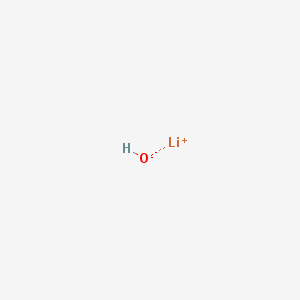
Lithium hydroxide
structure -
-
CAS No:
1310-65-2
-
Formula:
LiOH
-
Chemical Name:
Lithium hydroxide
-
Synonyms:
"Lithium hydroxide, anhydrous/ 99%";Lithium hydroxide ,99% [anhydrous];Lithium Hydroxide Anhydrous [for General Organic Chemistry];LithiuM hydroxide, anhydrous, pure, 98% 500GR;LITHIUM HYDROXIDE 98+ 100 G;LITHIUM HYDROXIDE 98+ 1 KG;Lithium hydroxide powder, reagent grade, >=98%;Lithium hydroxide reagent grade, 98%
- Categories:
-
CAS No:
Description
COLOURLESS-TO-WHITE HYGROSCOPIC CRYSTALS.
lithium hydroxide (LiOH) is a white solid made industrially as the monohydrate (LiOH.H2O) by reacting lime with a lithium ore or with a salt made from the ore. Lithium hydroxide has a closer resemblance to the group 2 hydroxides than to the group 1 hydroxides.
Lithium hydroxide, solution appears as a clear to water-white liquid which may have a pungent odor. Contact may cause severe irritation to skin, eyes, and mucous membranes. It may be toxic by ingestion, inhalation and skin absorption. It is used to make other chemicals.
Poison by ingestion and subcutaneous routes. Mtldly toxic by inhalation. A corrosive. When heated to decomposition it emits toxic fumes of Li.
It crystallises from hot water (3mL/g) as the monohydrate. It is dehydrated at 150o in a stream of CO2-free air. It sublimes at 220o with partial decomposition [Cohen Inorg Synth V 3 1957, Bravo Inorg Synth VII 1 1963].
Lithium hydroxide Basic Attributes
23.95
24.01870
215-183-4
TSCA listed
White to light yellow
28252010
Characteristics
23.06000
White tetragonal crystals; refractive index 1.464; density 1.46 g/cm3; melts at 450°C; decomposes at 924°C; dissolves in water (12.8g/100g at 20°C and 17.5 g/100g at 100°C); slightly soluble in alcohol. The monohydrate is white monoclinic crystalline solid; refractive index 1.460; density 1.51 g/cm3; soluble in water, more soluble than the anhydrous salt (22.3g and 26.8g/100g at 10 and 100°C, respectively); slightly soluble in alcohol; insoluble in ether.
-0.17680
White crystal or pill
1.43
470 °C (dec.) (lit.)
925°C
113 g/L (20 ºC)
Storage Room low temperature ventilation drying ,Separate storage with acids
Vapour pressure, Pa at 20°C: (negligible)
LD50 orally in Rabbit: 210 mg/kg
odorless
12 (50g/l, H2O, 50℃)
14[at 20 ℃]
Dilution with water may generate enough heat to cause steaming or spattering.
LITHIUM HYDROXIDE SOLUTION neutralizes acids exothermically to form salts plus water. Reacts with certain metals (such as aluminum and zinc) to form oxides or hydroxides of the metal and generate gaseous hydrogen. May initiate polymerization reactions in polymerizable organic compounds, especially epoxides. May generate flammable and/or toxic gases with ammonium salts, nitrides, halogenated organics, various metals, peroxides, and hydroperoxides. May serve as a catalyst. Reacts when heated above about 84°C with aqueous solutions of reducing sugars other than sucrose, to evolve toxic levels of carbon monoxide [Bretherick, 5th Ed., 1995].
Store below +30°C.
Safety Information
II
8
UN 2680
1
C
45-36/37/39-26-22
OJ6307070
C
Separated from food and feedstuffs, strong oxidants and strong acids. Store only in original container. Dry. Well closed. Store in an area without drain or sewer access.
Stable. Incompatible with moisture. strong acids, carbon dioxide.
P201, P202, P260, P261, P264, P270, P271, P280, P281, P301+P330+P331, P303+P361+P353, P304+P340, P305+P351+P338, P307+P311, P308+P313, P310, P311, P321, P363, P403+P233, P405, P501
52/53-35-20/22-22-34-23
UN 2679 8/PG II/III (LITHIUM HYDROXIDE SOLUTION)
Non-combustible, substance itself does not burn but may decompose upon heating to produce corrosive and/or toxic fumes. Some are oxidizers and may ignite combustibles (wood, paper, oil, clothing, etc.). Contact with metals may evolve flammable hydrogen gas. Containers may explode when heated.
Drug Information
TOXIC; inhalation, ingestion or skin contact with material may cause severe injury or death. Contact with molten substance may cause severe burns to skin and eyes. Avoid any skin contact. Effects of contact or inhalation may be delayed. Fire may produce irritating, corrosive and/or toxic gases. Runoff from fire control or dilution water may be corrosive and/or toxic and cause pollution.
Lithium hydroxide Use and Manufacturing
Lithium hydroxide is used as an electrolyte in certain alkaline storage batteries; and in the production of lithium soaps. Other uses of this compound include its catalytic applications in esterification reactions in the production of alkyd resins; in photographic developer solutions; and as a starting material to prepare other lithium salts.
The compound is soluble in water. The compound is used in the formulation of lithium soaps used in multipurpose greases; also in the manufacture of various lithium salts; and as an additive to the electrolyte of alkaline storage batteries. LiOH also is an efficient, light-weight absorbent for carbon dioxide.
Lithium hydroxide is used as a heat transfer medium, as a storage-battery electrolyte and also used for the production of lithium greases. It is also used in ceramics, in some portland cement formulations, in the absoption of carbondioxide from sealed enviornments such as submarines, spacecrafts and breathing apparatus. It is used in esterification reactions, as stabilizer in photographic developments and as a coolant in pressurized water reactors for corrosion control.
Lithium hydroxide is an alkali metal hydroxide that is used in storage batteries and soaps and as CO2 absorber in spacecrafts.
Price Analysis
- Data: 2026-09-03
- Price: 138000.00Yuan/ton
- Change: 0
Recommended Suppliers of Lithium hydroxide
-
![China]() CN
CN
5 YRS
Business licensed Certified factoryManufactory Supplier of Chemical Pesticides,Food Additives,Agrochemicals,Active Pharm Ingredients,Flavors and Fragrances,Chemical Catalyst,Chemical Materials,Chem&Pharm Intermediates,Organic Intermediates,Feed Additive -
![China]() CN
CN
6 YRS
Business licensed Certified factoryManufactory Supplier of Custom Synthetic Chemicals,Biological Stains,Pharmaceutical Intermediates,Cosmetic Grade Chemicals,Enzyme,Nucleosides,Indicators,Speciality Chemicals,Biological Chemicals,Enzyme Substrates -
![China]() CN
CN
6 YRS
Business licensedDistributor Supplier of Furan Resin,Furfuryl Alcohol,Furfural,THFA,2-Methyl Furan -
![China]() CN
CN
4 YRS
Business licensedTrader Supplier of 2-Aminobenzamide -
![China]() CN
CN
3 YRS
Business licensedTrader Supplier of api,Intermediates,Organic Chemistry,Inorganic Chemistry,Daily Chemicals,Cosmetic Raw Materals,CATALYST AND AUXILIARY,FLAVORS AND FRAGRANCES,Chemical Pesticides,ADDITIVEInquiryCAS No.: 1310-65-2Grade: Pharmaceutical GradeContent: 99%

Learn More Other Chemicals
-
3,6-DiaMino-9-[2-carboxy-4(or 5)-[[(2,5-dioxo-1-pyrrolidinyl)oxy]carbonyl]phenyl]-4,5-disulfoxanthyliuM Inner Salt LithiuM Salt
222164-96-7
-
Anhydro-5,6-dichloro-1,3′-diethyl-3-(3-sulfopropyl)benzimidazolooxacarbocyanine hydroxide
19163-98-5
-
Zirconate (ZrO32-), lithium (1:2)
12031-83-3
-
1-Butanaminium, N,N,N-trimethyl-, hydroxide (1:1) Formula
63951-24-6
-
1,3,6-Naphthalenetrisulfonic acid, 8-hydroxy-7-[2-[4′-[2-(2-hydroxy-1-naphthalenyl)diazenyl][1,1′-biphenyl]-4-yl]diazenyl]-, lithium salt (1:3) Formula
65150-87-0
-
Cobaltate(2-), bis[2-[2-[5-(aminosulfonyl)-2-(hydroxy-κO)phenyl]diazenyl-κN1]-3-(oxo-κO)-N-phenylbutanamidato(2-)]-, lithium (1:2) Formula
67906-22-3
-
Benzoic acid, 5-[2-[4-[2-[4-[2-[2,6-diamino-3-methyl-5-[2-(4-sulfophenyl)diazenyl]phenyl]diazenyl]-2-sulfophenyl]ethenyl]-3-sulfophenyl]diazenyl]-2-hydroxy-3-methyl-, lithium salt (1:4) Structure
65121-77-9
-
Pyridinium, 1-[2-[[4-[2-(2,6-dichloro-4-nitrophenyl)diazenyl]phenyl]ethylamino]ethyl]-, hydroxide (1:1) Structure
93919-20-1
-
What is Aluminate (Al(OH)63-), (OC-6-11)-, magnesium hydroxide sulfate (5:10:1:2)
101013-04-1
-
What is Thallium hydroxide (Tl(OH))
12026-06-1