




Icaritin
-
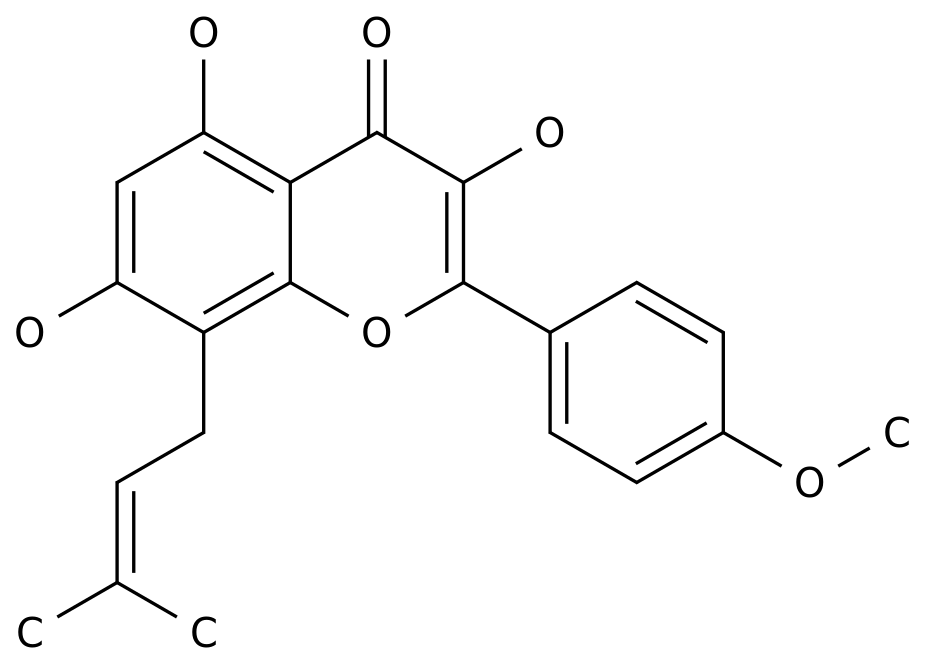
Icaritin
structure -
-
CAS No:
118525-40-9
-
Formula:
C21H20O6
-
Chemical Name:
Icaritin
-
Synonyms:
4H-1-Benzopyran-4-one,3,5,7-trihydroxy-2-(4-methoxyphenyl)-8-(3-methyl-2-buten-1-yl)-;4H-1-Benzopyran-4-one,3,5,7-trihydroxy-2-(4-methoxyphenyl)-8-(3-methyl-2-butenyl)-;3,5,7-Trihydroxy-2-(4-methoxyphenyl)-8-(3-methyl-2-buten-1-yl)-4H-1-benzopyran-4-one;Icaritin;AF 40;3,5,7-Trihydroxy-2-(4-methoxyphenyl)-8-(3-methylbut-2-enyl)chromen-4-one
- Categories:
-
CAS No:
Description
Icaritin(Anhydroicaritin) is a component of Epimedium flavonoid isolated from Herba Epimedii; enhances osteoblastic differentiation of mesenchymal stem cells (MSCs) while it inhibits adipogenic differentiation of MSCs by inhibiting PPAR-g pathway.IC50 value:Target: in vitro: Icaritin was unable to promote proliferation, migration and tube like structure formation by human umbilical vein endothelial cells (HUVECs) in vitro [1]. Icaritin potently inhibited proliferation of K562 cells (IC50
Icaritin has been used in trials studying the treatment of Solid Tumors, Metastatic Breast Cancer, and Hepatocellular Carcinoma (HCC).
Characteristics
96.2
4.8
light yellow to dark yellow
1.4±0.1 g/cm3
239-239.5 °C
582°C at 760 mmHg
206.7℃
1.657
DMSO: soluble5mg/mL, clear (warmed)
2-8°C
3.82E-14mmHg at 25°C
Icaritin Use and Manufacturing
3, 5, 7-trihydroxy-2- (4-methoxyphenyl) -8- (3-methylbut-2-en-1-yl) -4H-chromen-4-one (200 mg , 0.54 mmol) and diisopropylethylamine(DIPEA, 0.23 mL, 1.3 mmol) were dissolved in dry dichloromethane (10 mL) and then cooled in an ice bath.Dissolvetriphosgene (60 mg, 0.2mmol) in 10 mL of dichloromethane and slowly add it to the reaction flask.The reaction mixture was allowed to react at 0 C for 0.5 hours under nitrogen protection, and then transferredto room temperature and stirred for 3 hours.The reaction mixture was cooled to 0 C and diisopropylethylamine (0.14 mL, 0.81 mmol) and N-methylpiperazine (28mg, 0.23 mmol) were added. The reaction mixture was stirred at room temperature overnight.Theorganiclayer was concentrated under reduced pressure, and the residue was purified by silica gel column chromatography (ethyl acetate: petroleum ether = 4: 1) togive the title compound (70 mg, yield: 69%, HPLC: 97%) as a yellow solid.3, 5, 7-Trihydroxy-2- (4-methoxyphenyl) -8- (3-methylbut-2-en-1-yl) -4H-chromen-4-one (150 mg , 0.41 mmol) was dissolved in drypyridine (10 mL), and then 1-chloroformyl-4-piperidinylpiperidine hydrochloride (109 mg, 0.41 mmol) was added, and the mixture was stirred at roomtemperatureunder nitrogenovernight for reaction.Dichloromethane was added for extraction (40 mL x 3), and the organic phases were combined, washed with a saturated sodium chloride solution (30 mL), dried over anhydroussodium sulfate, and concentrated under reduced pressure.The residue was purified by silica gel column chromatography (dichloromethane: methanol = 20: 1) to give the title compound (70 mg, yield: 31%, HPLC: 98%)as a yellow solid.3, 5, 7-trihydroxy-2- (4-methoxyphenyl) -8- (3-methylbut-2-en-1-yl) -4H-chromen-4-one (500 mg , 1.36 mmol) and mono-tert-butylsuccinate (355 mg, 2.04 mmol) were dissolved in dry dichloromethane (25 mL).The reaction mixture was cooled to 0 , then 1- (3-dimethylaminopropyl-yl) -3-ethyl carbodiimide hydrochloride (EDCI, 392mg, 2.04mmol), 4-dimethylaminopyridine (DMAP , 50 mg, 0.41 mmol).The reactionmixture was stirred at 0 C for 30 minutes under nitrogen protection, and then moved to room temperature for 3 hours. The reaction was quenched by adding 10 mL of water, extractedwith dichloromethane(40 mL x 3), and the organic phases were combined and washed with saturated sodium chloride solution. (30 mL), dried over anhydrous sodium sulfate, and concentrated under reduced pressure.The residue was purified by silicagel column chromatography (ethyl acetate: petroleum ether = 1: 8) to give the title compound (200 mg, yield: 28%) as a yellow solid.3, 5, 7-Trihydroxy-2- (4-methoxyphenyl) -8- (3-methylbut-2-en-1-yl) -4H-chromen-4-one (150 mg , 0.41 mmol) was dissolved in drypyridine (10 mL), and then a solution of [1, 4'-bipiperidine] -1'-formyl chloride (235 mg, 1.02 mmol) in dichloromethane (10 mL) was added.Thereaction mixture was stirred at room temperature overnight undernitrogen protection, extracted with dichloromethane (40 mL × 3), combined organic phases, washed with saturated sodium chloride solution (30 mL), dried over anhydrous sodium sulfate, and concentrated under reduced pressure.The residue was purified by silica gel column chromatography (dichloromethane: methanol = 15: 1) to give the title compound(55 mg, yield: 18%)as a yellow solid.3, 5, 7-Trihydroxy-2- (4-methoxyphenyl) -8- (3-methylbut-2-en-1-yl) -4H-chromen-4-one (150 mg , 0.41 mmol) was dissolved in drypyridine (10 mL), and then a solution of 2-oxopyrrolidine-1-formyl chloride (119 mg, 0.81 mmol) in dichloromethane (10 mL) was added.Thereaction mixture was stirred at room temperature overnight undernitrogen protection, extracted with dichloromethane (40 mL × 3), combined organic phases, washed with saturated sodium chloride solution (30 mL), dried over anhydrous sodium sulfate, and concentrated under reduced pressure.The residue was purified by silica gel column chromatography (ethyl acetate: petroleum ether = 4: 1) to give the title compound(40 mg, yield: 17%, HPLC: 96%)as a yellow solid.
A metabolite of Icariin. Icaritin and Desmethylicaritin, two metabolites of Icariin, dramatically inhibit the growth of most malignant cells. They also have significant antiangiogenesis properties, inhibiting or eliminating entirely the development of new malignant cells.
Computed Properties
Molecular Weight:368.4
XLogP3:4.8
Hydrogen Bond Donor Count:3
Hydrogen Bond Acceptor Count:6
Rotatable Bond Count:4
Exact Mass:368.12598835
Monoisotopic Mass:368.12598835
Topological Polar Surface Area:96.2
Heavy Atom Count:27
Complexity:612
Covalently-Bonded Unit Count:1
Compound Is Canonicalized:Yes
Recommended Suppliers of Icaritin
-
![China]() CN
CN
3 YRS
Business licensedTrader Supplier of Apigenin,PQQ,NMNHInquiryUnit Price: $10.4-11.44 /G FOBCAS No.: 118525-40-9Grade: Chemical GradeContent: 99% -
![China]() CN
CN
5 YRS
Business licensedTrader Supplier of Intermediates,Building blocks,API,Silicones,Peptides,Lab chemicals,Biochemicals,Pharmaceuticals,Screening Compounds,Food Additives -
![China]() CN
CN
5 YRS
Business licensedTrader Supplier of PVC resin,pvc paste resin,melamine -
![China]() CN
CN
5 YRS
Business licensed Certified factoryManufactory Supplier of Healthcare Ingredients

Learn More Other Chemicals
-
Heliannone A
193411-10-8
-
Linustatin
72229-40-4
-
1-Benzopyrylium, 2-(3,4-dihydroxyphenyl)-3-[(2-O-β-D-glucopyranosyl-α-D-glucopyranosyl)oxy]-5,7-dihydroxy-, chloride (1:1)
38820-68-7
-
(11β,17β)-11-[4-(Dimethylamino)phenyl]-17-hydroxy-17-(1Z)-1-propen-1-ylestra-4,9-dien-3-one Formula
124478-60-0
-
3',4',5',3,5,6,7-Heptamethoxyflavone Formula
17245-30-6
-
(-)-8-Prenylnaringenin Formula
53846-50-7
-
Cirsimaritin Structure
6601-62-3
-
5,7,4'-trihydroxy-8-methoxyflavone Structure
57096-02-3
-
What is Desmethylicaritin
28610-31-3
-
What is Ombuoside
20188-85-6