




DEXAMETHASONE, USP Safety Data Sheets
SAFETY DATA SHEETS
According to the UN GHS revision 8
SECTION 1: Identification
1.1 GHS Product identifier
| Product name | Dexamethasone |
|---|
1.2 Other means of identification
| Product number | - |
|---|---|
| Other names | Dexamethasone; Auxiron; Pregna-1,4-diene-3,20-dione, 9-fluoro-11,17,21-trihydroxy-16-methyl-, (11β,16α)- |
1.3 Recommended use of the chemical and restrictions on use
| Identified uses | Veterinary Drug: GLUCOCORTICOSTEROID |
|---|---|
| Uses advised against | no data available |
1.4 Supplier's details
| Company | Echemi.com |
|---|---|
| Address | Echemi.com |
| Telephone | Echemi.com |
1.5 Emergency phone number
| Emergency phone number | Echemi.com |
|---|---|
| Service hours | Monday to Friday, 9am-5pm (Standard time zone: UTC/GMT +8 hours). |
SECTION 2: Hazard identification
2.1 Classification of the substance or mixture
Reproductive toxicity, Category 2
Specific target organ toxicity â repeated exposure, Category 2
2.2 GHS label elements, including precautionary statements
| Pictogram(s) | 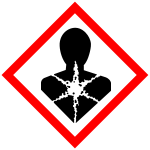 |
|---|---|
| Signal word | Warning |
| Hazard statement(s) | H361 Suspected of damaging fertility or the unborn child H373 May cause damage to organs through prolonged or repeated exposure |
| Precautionary statement(s) | |
| Prevention | P203 Obtain, read and follow all safety instructions before use. P280 Wear protective gloves/protective clothing/eye protection/face protection/hearing protection/... P260 Do not breathe dust/fume/gas/mist/vapours/spray. |
| Response | P318 IF exposed or concerned, get medical advice. P319 Get medical help if you feel unwell. |
| Storage | P405 Store locked up. |
| Disposal | P501 Dispose of contents/container to an appropriate treatment and disposal facility in accordance with applicable laws and regulations, and product characteristics at time of disposal. |
2.3 Other hazards which do not result in classification
no data available
SECTION 3: Composition/information on ingredients
3.1 Substances
| Chemical name | Common names and synonyms | CAS number | EC number | Concentration |
|---|---|---|---|---|
| Dexamethasone | Dexamethasone | 50-02-2 | 200-003-9 | 100% |
SECTION 4: First-aid measures
4.1 Description of necessary first-aid measures
If inhaled
Fresh air, rest. Half-upright position. Refer immediately for medical attention.
Following skin contact
Rinse skin with plenty of water or shower. Seek medical attention if you feel unwell.
Following eye contact
First rinse with plenty of water for several minutes (remove contact lenses if easily possible), then refer for medical attention.
Following ingestion
Rinse mouth. Do NOT induce vomiting. Give one or two glasses of water to drink. Refer immediately for medical attention.
4.2 Most important symptoms/effects, acute and delayed
SYMPTOMS: Symptoms of exposure to this type of compound include fluid and electrolyte disturbances, pituitary-adrenal suppression, hyperglycemia, increased susceptibility to infection including tuberculosis, myopathy, growth arrest, hypokalemic alkalosis and Cushing's syndrome consisting of "moon-face", "buffalo-hump", striae, acne and hirsuitism. Other symptoms of Cushing's syndrome include enlargement of supraclavicular fat pads, "central obesity" and ecchymoses. Flushing and increased bruising may also occur with this syndrome. Other symptoms of exposure include behavioral disturbances, glycosuria, nervousness, changes in mood or psyche, psychopathies of the manic-depressive or schizophrenic type and suicidal tendencies. Exposure may cause candidiasis, gluconeogenesis, cardiac failure (in extreme cases), spontaneous fractures, increased appetite, delayed wound healing, hyperhidrosis, mental and neurological disturbances, intracranial hypertension and increase in coagulability of the blood. It may also cause peptic ulceration with perforation or hemorrhage, amenorrhea, aseptic necrosis of the bone, muscular weakness, salt and water retention, hypertension, edema, increase in severity of diabetes, pancreatitis, thrombatic episodes and osteoporosis. Other symptoms of exposure to this type of compound include sleeplessness, skin eruptions, depression, euphoria, decrease in pain sensation, weakness, deafness, convulsions, intestinal perforation in ulcerative colitis, hypokalemia, muscle degeneration, rupture of the Achilles tendon, pseudotumor cerebri and cardiac conduction defect. It may cause congestive heart failure, suppression of the immune response mechanism, impairment of glucose tolerance, habituation and unmasking of latent psychiatric disorder. It may also cause potassium loss, loss of muscle mass, vertebral compression fractures, abdominal distention, ulcerative esophagitis, thin and fragile skin, petechiae, erythema, increased sweating, suppressed reactions to skin tests, allergic dermatitis, urticaria, angioneurotic edema, vertigo, headache, menstrual irregularities, secondary adrenocorticol and pituitary unresponsiveness, decreased carbohydrate tolerance, exophthalmos, hypersensitivity, thromboembolism, malaise, weight gain, nausea and intracranial pressure with papilledema. Ascites may occur. Skin exposure to this type of compound may cause loss of skin collagen and subcutaneous atrophy. Other symptoms via this route include burning, secondary infections, itching, irritation, pigmentation, dryness, folliculitis and hypertrichosis. Eye exposure to this type of compound may lead to corneal ulceration, raised intraocular pressure, reduced visual function and cataracts. Glaucoma may also occur. ACUTE/CHRONIC HAZARDS: This compound may be harmful by inhalation, ingestion or skin absorption. It may cause irritation. It may cause lacrimation. When heated to decomposition it emits toxic fumes of carbon monoxide, carbon dioxide and hydrogen fluoride. (NTP, 1992)
4.3 Indication of immediate medical attention and special treatment needed, if necessary
Immediate first aid: Ensure that adequate decontamination has been carried out. If patient is not breathing, start artificial respiration, preferably with a demand valve resuscitator, bag-valve-mask device, or pocket mask, as trained. Perform CPR if necessary. Immediately flush contaminated eyes with gently flowing water. Do not induce vomiting. If vomiting occurs, lean patient forward or place on the left side (head-down position, if possible) to maintain an open airway and prevent aspiration. Keep patient quiet and maintain normal body temperature. Obtain medical attention. Poisons A and B
SECTION 5: Fire-fighting measures
5.1 Suitable extinguishing media
Fires involving this material can be controlled with a dry chemical, carbon dioxide or Halon extinguisher. A water spray may also be used. (NTP, 1992)
5.2 Specific hazards arising from the chemical
Flash point data for this chemical are not available; however, it is probably combustible. (NTP, 1992)
5.3 Special protective actions for fire-fighters
Wear self-contained breathing apparatus for firefighting if necessary.
SECTION 6: Accidental release measures
6.1 Personal precautions, protective equipment and emergency procedures
Avoid dust formation. Avoid breathing mist, gas or vapours.Avoid contacting with skin and eye. Use personal protective equipment.Wear chemical impermeable gloves. Ensure adequate ventilation.Remove all sources of ignition. Evacuate personnel to safe areas.Keep people away from and upwind of spill/leak.
6.2 Environmental precautions
Personal protection: particulate filter respirator adapted to the airborne concentration of the substance. Do NOT let this chemical enter the environment. Sweep spilled substance into covered plastic containers. If appropriate, moisten first to prevent dusting. Carefully collect remainder. Then store and dispose of according to local regulations.
6.3 Methods and materials for containment and cleaning up
Collect and arrange disposal. Keep the chemical in suitable and closed containers for disposal. Remove all sources of ignition. Use spark-proof tools and explosion-proof equipment. Adhered or collected material should be promptly disposed of, in accordance with appropriate laws and regulations.
SECTION 7: Handling and storage
7.1 Precautions for safe handling
Handling in a well ventilated place. Wear suitable protective clothing. Avoid contact with skin and eyes. Avoid formation of dust and aerosols. Use non-sparking tools. Prevent fire caused by electrostatic discharge steam.
7.2 Conditions for safe storage, including any incompatibilities
Separated from food and feedstuffs, acids and metals. See Chemical Dangers. Provision to contain effluent from fire extinguishing. Store in an area without drain or sewer access.
SECTION 8: Exposure controls/personal protection
8.1 Control parameters
Occupational Exposure limit values
no data available
Biological limit values
no data available
8.2 Appropriate engineering controls
Ensure adequate ventilation. Handle in accordance with good industrial hygiene and safety practice. Set up emergency exits and the risk-elimination area.
8.3 Individual protection measures, such as personal protective equipment (PPE)
Eye/face protection
Wear tightly fitting safety goggles with side-shields conforming to EN 166(EU) or NIOSH (US).
Skin protection
Wear fire/flame resistant and impervious clothing. Handle with gloves. Gloves must be inspected prior to use. Wash and dry hands. The selected protective gloves have to satisfy the specifications of EU Directive 89/686/EEC and the standard EN 374 derived from it.
Respiratory protection
If the exposure limits are exceeded, irritation or other symptoms are experienced, use a full-face respirator.
Thermal hazards
no data available
SECTION 9: Physical and chemical properties and safety characteristics
| Physical state | PHYSICAL DESCRIPTION: Odorless white to off-white crystalline powder with a slightly bitter taste. (NTP, 1992) |
|---|---|
| Colour | Crystals from ether |
| Odour | no data available |
| Melting point/freezing point | 255-264ºC |
| Boiling point or initial boiling point and boiling range | 568.2ºC at 760 mmHg |
| Flammability | Combustible. Gives off irritating or toxic fumes (or gases) in a fire. |
| Lower and upper explosion limit/flammability limit | no data available |
| Flash point | 297.5ºC |
| Auto-ignition temperature | no data available |
| Decomposition temperature | 275°C |
| pH | no data available |
| Kinematic viscosity | no data available |
| Solubility | less than 1 mg/mL at 77° F (NTP, 1992) |
| Partition coefficient n-octanol/water | no data available |
| Vapour pressure | 8.86X10⁻¹⁴ mm Hg at 25 deg C (est) |
| Density and/or relative density | 1.32 g/cm3 |
| Relative vapour density | no data available |
| Particle characteristics | no data available |
SECTION 10: Stability and reactivity
10.1 Reactivity
Decomposes on heating above 275°C . This produces toxic fumes. This generates fire and explosion hazard. Reacts with copper, lead, silver, mercury and carbon disulfide. This produces particularly shock-sensitive compounds. Reacts with acids. This produces toxic and explosive hydrogen azide. See Notes.
10.2 Chemical stability
Dexamethasone sodium phosphate ophthalmic solution should be stored in tight, light-resistant containers. Dexamethasone sodium phosphate
10.3 Possibility of hazardous reactions
See Notes.DEXAMETHAZONE may be sensitive to prolonged exposure to light. This chemical is incompatible with strong oxidizers, strong acids, acid chlorides and acid anhydrides. Oxidation may occur with bases. (NTP, 1992)
10.4 Conditions to avoid
no data available
10.5 Incompatible materials
CHEMICAL PROFILE: An azide is a compound of hydrogen or a metal and the monovalent triatomic nitrogen anion. All azide salts and the acid are unstable and some decompose explosively. Extremely dangerous, shock or heat may explode them. If exposed to carbon disulfide, they form violentluy explosive salts. They can be sensitized by metal salts (especially heavy metal salts such as silver chloride etc.) or by traces of strong acids. They decompose explosively if heated or on impact. [Sax, 9th ed., 1996, p. 298]. (REACTIVITY, 1999)
10.6 Hazardous decomposition products
When heated to decomposition it emits toxic fumes of /hydrogen fluoride/.
SECTION 11: Toxicological information
Acute toxicity
- Oral: no data available
- Inhalation: no data available
- Dermal: no data available
Skin corrosion/irritation
no data available
Serious eye damage/irritation
no data available
Respiratory or skin sensitization
no data available
Germ cell mutagenicity
no data available
Carcinogenicity
TLV-A4
Reproductive toxicity
no data available
STOT-single exposure
no data available
STOT-repeated exposure
no data available
Aspiration hazard
no data available
SECTION 12: Ecological information
12.1 Toxicity
- Toxicity to fish: no data available
- Toxicity to daphnia and other aquatic invertebrates: no data available
- Toxicity to algae: no data available
- Toxicity to microorganisms: no data available
12.2 Persistence and degradability
no data available
12.3 Bioaccumulative potential
An estimated BCF of 14 was calculated for dexamethasone(SRC), using a log Kow of 1.83(1) and a regression-derived equation(2). According to a classification scheme(3), this BCF suggests the potential for bioconcentration in aquatic organisms is low(SRC).
12.4 Mobility in soil
The Koc of dexamethasone is estimated as 240(SRC), using a log Kow of 1.83(1) and a regression-derived equation(2). According to a classification scheme(3), this estimated Koc value suggests that dexamethasone is expected to have moderate mobility in soil.
12.5 Other adverse effects
no data available
SECTION 13: Disposal considerations
13.1 Disposal methods
Product
The material can be disposed of by removal to a licensed chemical destruction plant or by controlled incineration with flue gas scrubbing. Do not contaminate water, foodstuffs, feed or seed by storage or disposal. Do not discharge to sewer systems.
Contaminated packaging
Containers can be triply rinsed (or equivalent) and offered for recycling or reconditioning. Alternatively, the packaging can be punctured to make it unusable for other purposes and then be disposed of in a sanitary landfill. Controlled incineration with flue gas scrubbing is possible for combustible packaging materials.
SECTION 14: Transport information
14.1 UN Number
| ADR/RID: Not dangerous goods. (For reference only, please check.) | IMDG: Not dangerous goods. (For reference only, please check.) | IATA: Not dangerous goods. (For reference only, please check.) |
14.2 UN Proper Shipping Name
| ADR/RID: Not dangerous goods. (For reference only, please check.) | IMDG: Not dangerous goods. (For reference only, please check.) | IATA: Not dangerous goods. (For reference only, please check.) |
14.3 Transport hazard class(es)
| ADR/RID: Not dangerous goods. (For reference only, please check.) | IMDG: Not dangerous goods. (For reference only, please check.) | IATA: Not dangerous goods. (For reference only, please check.) |
14.4 Packing group, if applicable
| ADR/RID: Not dangerous goods. (For reference only, please check.) | IMDG: Not dangerous goods. (For reference only, please check.) | IATA: Not dangerous goods. (For reference only, please check.) |
14.5 Environmental hazards
| ADR/RID: No | IMDG: No | IATA: No |
14.6 Special precautions for user
no data available
14.7 Transport in bulk according to IMO instruments
no data available
SECTION 15: Regulatory information
15.1 Safety, health and environmental regulations specific for the product in question
| Chemical name | Common names and synonyms | CAS number | EC number |
|---|---|---|---|
| Dexamethasone | Dexamethasone | 50-02-2 | 200-003-9 |
| European Inventory of Existing Commercial Chemical Substances (EINECS) | Listed. | ||
| EC Inventory | Listed. | ||
| United States Toxic Substances Control Act (TSCA) Inventory | Listed. | ||
| China Catalog of Hazardous chemicals 2015 | Not Listed. | ||
| New Zealand Inventory of Chemicals (NZIoC) | Listed. | ||
| Philippines Inventory of Chemicals and Chemical Substances (PICCS) | Listed. | ||
| Vietnam National Chemical Inventory | Listed. | ||
| Chinese Chemical Inventory of Existing Chemical Substances (China IECSC) | Listed. | ||
| Korea Existing Chemicals List (KECL) | Listed. | ||
SECTION 16: Other information
Information on revision
| Creation Date | July 15, 2019 |
|---|---|
| Revision Date | July 15, 2019 |
Abbreviations and acronyms
- CAS: Chemical Abstracts Service
- ADR: European Agreement concerning the International Carriage of Dangerous Goods by Road
- RID: Regulation concerning the International Carriage of Dangerous Goods by Rail
- IMDG: International Maritime Dangerous Goods
- IATA: International Air Transportation Association
- TWA: Time Weighted Average
- STEL: Short term exposure limit
- LC50: Lethal Concentration 50%
- LD50: Lethal Dose 50%
- EC50: Effective Concentration 50%
References
- IPCS - The International Chemical Safety Cards (ICSC), website: http://www.ilo.org/dyn/icsc/showcard.home
- HSDB - Hazardous Substances Data Bank, website: https://toxnet.nlm.nih.gov/newtoxnet/hsdb.htm
- IARC - International Agency for Research on Cancer, website: http://www.iarc.fr/
- eChemPortal - The Global Portal to Information on Chemical Substances by OECD, website: http://www.echemportal.org/echemportal/index?pageID=0&request_locale=en
- CAMEO Chemicals, website: http://cameochemicals.noaa.gov/search/simple
- ChemIDplus, website: http://chem.sis.nlm.nih.gov/chemidplus/chemidlite.jsp
- ERG - Emergency Response Guidebook by U.S. Department of Transportation, website: http://www.phmsa.dot.gov/hazmat/library/erg
- Germany GESTIS-database on hazard substance, website: http://www.dguv.de/ifa/gestis/gestis-stoffdatenbank/index-2.jsp
- ECHA - European Chemicals Agency, website: https://echa.europa.eu/
Disclaimer: The above information is believed to be correct but does not purport to be all inclusive and shall be used only as a guide. The information in this document is based on the present state of our knowledge and is applicable to the product with regard to appropriate safety precautions. It does not represent any guarantee of the properties of the product. We as supplier shall not be held liable for any damage resulting from handling or from contact with the above product.
Related Products
Industry News
More Safety Data Sheets