Anti-aging drugs, saving 3 years stolen by the new crown
With the deepening of research on the mechanism of aging, the research on anti-aging drugs and the investment and financing in the field of anti-aging have increased sharply in recent years.
ALTOS, an anti-aging technology company founded in 2021, received a $3 billion investment from Bezos; In 2022, the Saudi royal family plans to invest $1 billion annually to promote basic research on anti-aging and the clinical transformation of anti-aging drugs...
The sudden concern of the rich in the anti-aging industry may be related to the accelerated aging caused by the sequelae of the new crown epidemic.
The new crown accelerates aging by 3-4 years
At the end of 2022, Omicron swept the country, and when most people "Yangkang" began to flock to the streets in search of the "lost three years".
However, the "lost three years" have not yet been found, and the new crown may have reduced human lifespan by three years in advance.
In May 2022, researchers at the University of Cambridge in the United Kingdom published a research paper in the Lancet journal EClinical Medicine. The study found that the cognitive impairment caused by severe COVID is equivalent to the natural cognitive decline that occurs between the ages of 50 and 70, which means that the brain is 20 years old and the effect can still be detected 6 months later.
On December 5, 2022, researchers at Harvard Medical School in the United States published a research paper in Nature Aging, a subjournal of Nature, showing that gene expression changes in the brains of severely ill patients with new crowns are similar to those of the elderly, and severe disease or accelerated brain aging.
Figure 1 "Nature Aging" research paper
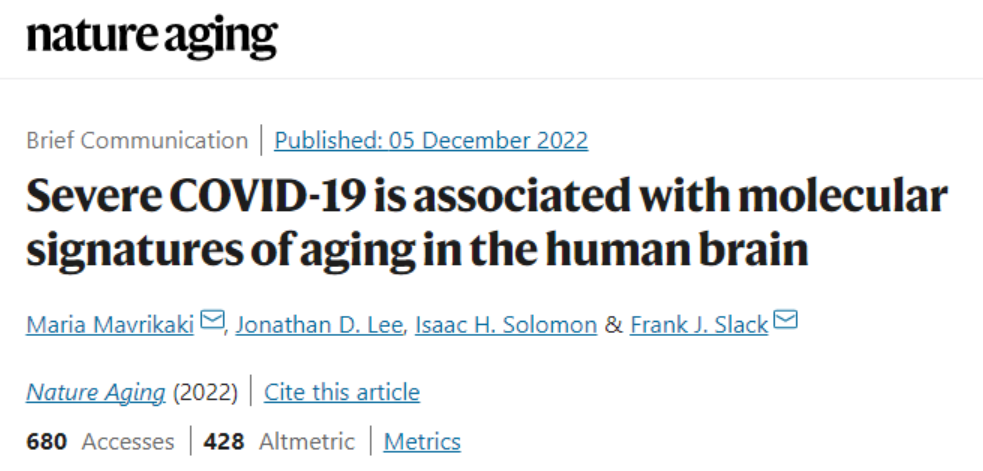
Image source: Reference [1]
In addition, the research team led by Dr. Ziyad Al-Aly, director of the Clinical Epidemiology Center at Washington University in St. Louis, after 2 and a half years of follow-up investigation, collected data on millions of people in the United States, and their research on long-term symptoms of the new crown, brain fog in the brain and long-term symptoms in the heart and kidneys found that after infection with the new crown virus, it will accelerate the aging process of people, and some organs may age for 3 to 4 years.
At the same time, a study published in Nature Communication by Yuhuichuan's team at Sun Yat-sen University quantified the aging process through telomere detection. The results showed a strong correlation between the epigenetic clock and the actual age of an individual. In blood samples from healthy individuals, non-severe new crown patients, and severe new crown patients, epigenetic aging and telomere wear are getting faster and faster.
Figure 2 Epigenetic aging acceleration in new crown patients, especially severe patients
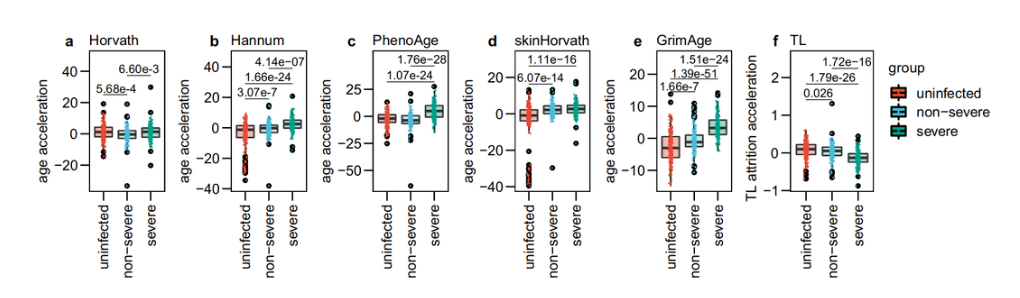
Image source: Reference [2]
As for why the new crown virus accelerates aging, on the one hand, it is because the new crown virus can directly damage immune cells and promote immune aging; On the other hand, the inflammatory response caused by infection with the new crown is one of the important signs of aging; In addition, in response to viral infections, the body increases the level of plasminogen activator inhibitors, which increase the risk of thromboembolism and coagulation disorders, and also forms a cycle with TGF-β, another marker of aging, which continuously promotes aging.
Of course, the current epidemic of Omicron infection has a lower risk of severe disease and may have a smaller impact on the rate of aging.
In addition, because the new crown virus has only been in existence for 3 years, scientists need longer time to study and observe whether the accelerated aging caused by the new crown is temporary or permanent. The Yuhuichuan team of Sun Yat-sen University found through longitudinal DNA methylation spectrum analysis that the accumulation of epigenetic aging caused by new crown infection may be partially reversed in some patients during the recovery period of the new crown.
Anti-aging drugs
Or provide new ideas for new crown treatment
Although the new crown virus can cause aging to accelerate, researchers have also found that selectively removing senescent cells through anti-aging drugs can greatly accelerate the recovery of the new crown, which provides new ideas for new crown treatment.
On July 16, 2021, a research team from the University of Minnesota and Mayo Clinic published a research paper in the journal Science showing that anti-aging drugs can reduce coronavirus-related mortality in elderly mice.
Figure 3 Science research paper
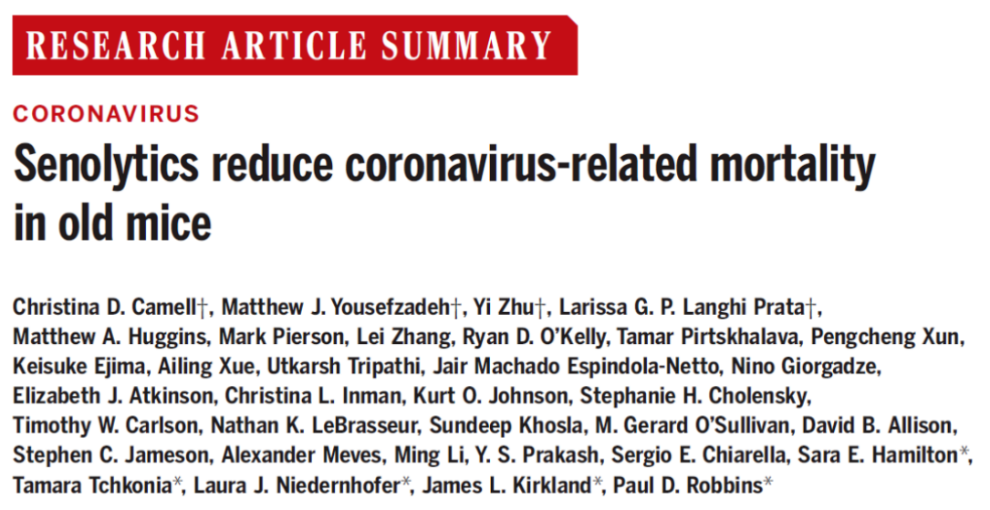
Image source: Reference [4]
In the field of anti-aging drugs, after decades of development, great progress has also been made, and these drugs may also play a role in the treatment of the new crown.
◆Senolytics
Studies have shown that senescent cells are involved in a variety of age-related diseases, including osteoporosis, atherosclerosis, type 2 diabetes, pulmonary fibrosis, and osteoarthritis. Therefore, targeting the removal of senescent cells through small molecule drugs can be used as potential targets for anti-aging, and these drugs are also collectively known as "Senolytics".
Dasatinib + quercetin was the first drug to be proposed Senolytics, a combination that increased the average lifespan of mice by about 36% after treating mice aged 24-27 months. Subsequent experiments based on this combination have shown that Senolytics can not only reduce the burden caused by senescent cells, but also effectively prevent the physical dysfunction caused by it.
In addition, Bcl-2 inhibitors, the natural product fisetone, cardiac glycosides (including digoxin, digitaloxin and wabaine, etc.) have been found to be effective in removing senescent cells.
However, there are also studies that show that not all senescent cells are harmful. Current Senolytics drugs are not yet able to accurately identify and locate truly harmful senescent cells.
◆ mTOR inhibitors
Rapamycin, a compound first isolated from bacteria in the soil of Easter Island in 1960, inhibits mammalian target rapamycin (mTOR) activity. Studies have shown that such drugs can extend the lifespan of mice by 9%-14%, and are classic targets in anti-aging drugs.
In addition, the researchers also found that rapamycin can enhance the elderly response to the flu vaccine, making the vaccine work better and improving their antiviral immunity.
◆Spermidine
Spermidine is a natural polyamine found in eukaryotic cells that plays a key role in controlling gene expression, apoptosis, and autophagy. Studies have found that spermidine exerts anti-aging effects through a variety of mechanisms of action, including improving autophagy, reducing insulin/IGF signaling, and improving immunity.
◆Drugs that regulate energy metabolism
Studies have found that the drugs originally used to treat diabetes, metformin and acarbose, are also expected to be used to fight aging. Studies in mice have shown that metformin can increase the average lifespan of female non-inbred mice by 40%; Acarbose can increase the average lifespan of male mice by about 17 percent, compared with about 5 percent in female mice.
◆NAD+
NAD+ (nicotinamide adenine dinucleotide) is an important coenzyme in cell life activities and participates in a variety of cellular metabolic functions through redox reactions. A number of studies have shown that NAD+ content is associated with aging, and with age, NAD+ content in the body gradually decreases, and NAD+ metabolism abnormalities can induce a variety of aging-related diseases, such as neurodegenerative diseases, cardiovascular diseases and tumors, and restoring NAD+ levels in the body can improve disease conditions and even prolong life.
In addition, with the breakthrough of biotechnology, emerging therapies such as gene therapy and stem cell therapy are also being studied for anti-aging. Perhaps in the near future, humanity will master the secret of aging, and before that, the covid has long been defeated.
Global anti-aging star company
As the global population aging becomes more and more prominent, anti-aging research has also moved out of university laboratories, and more companies have begun to focus on the clinical translation of anti-aging therapies.
According to incomplete statistics, there are currently hundreds of anti-aging companies in the world, among which many potential star companies have emerged.
◆Altos Lab
Altos, which was just founded in 2021, is known as the "strongest anti-aging company", and Bezos, the former world's richest man, invested $3 billion and broke the record for a single round of financing for a biotechnology company.
Altos' scientific team includes several pioneers and Nobel laureates in the field of anti-aging, including: Steve Horvath, the developer of the "biological clock" that can accurately measure human aging; Shinya Yamanaka, who won the 2012 Nobel Prize for the discovery of reprogramming; Nobel Prize vane, Lasker Award winner Peter Walter, and more.
Even Hal Barron, president of research and development and chief scientific officer of pharmaceutical giant GSK, moved to Altos as CEO and co-chairman.
Altos' research focuses on epigenetic reprogramming to create a completely new approach to medicine by cracking the mysteries of cell regeneration to reverse diseases and aging processes that lead to injury and disability.
◆Unity Biotechnology
Unity is another company Bezos has invested in, having raised a total of $29.06 billion from seven rounds of funding ahead of its 2018 IPO.
Unity's core technology is Senolytics technology. In November 2022, Unity announced that it had achieved critical safety and efficacy endpoints in its Phase II BEHOLD study of the investigational anti-aging drug Bcl-xL inhibitor UBX1325 (licensed by Ascentage Pharma) in the treatment of diabetic macular edema (DME).
◆Retro Biosciences
Co-founded by Sheng Ding, Joe Betts-LaCroix and Matt Buckley, Deans of Tsinghua University's School of Pharmacy, Retro raised $180 million in April 2022.
His research focuses on three directions: cell reprogramming, autophagy and plasma-related therapies. The company's official website states that Retro's goal is to extend human health by 10 years.
◆MyMD
MyMD Biopharmaceuticals is an established pharmaceutical company in the United States that started in the last century and successfully merged with Akers Biosciences in 2021. Its drug MYMD-1 is the only drug that has passed the FDA's phase II clinical trial in anti-aging, and is expected to become the first anti-aging marketed drug.
◆Viterillon
Co-founded by Dr. Xiaodong Wang and Dr. Zhiyuan Zhang, Viterilon focuses on the pathogenesis of aging-related degenerative diseases, such as programmed cell death, neuroprotective pathways and neuroinflammation, and explores and develops innovative drugs for the treatment of aging-related degenerative diseases.
At this stage, Viterillon has 7 pipelines in progress, of which SIR0365 has completed two Phase 1b patient clinical trials and SIR2446 is undergoing Phase 1a clinical trials in healthy subjects. In August 2022, Viterillon raised $200 million in Series B financing, bringing the total amount to more than $300 million.
Figure 4 Viterillon's R&D pipeline
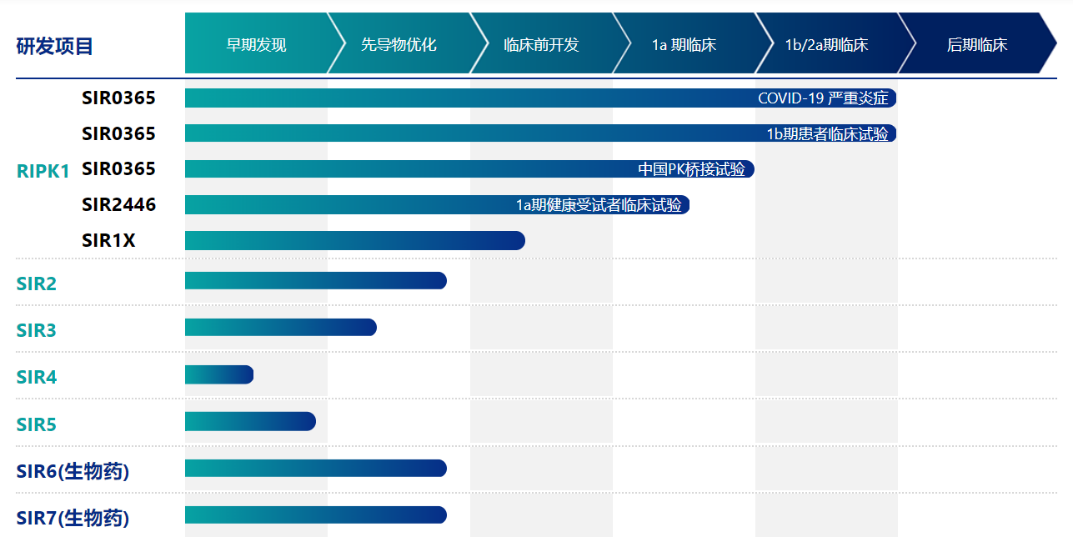
Image source: Viterillon official website
epilogue
Aging is a natural process, and nothing escapes the fate of decay, but this does not prevent human efforts to slow this process.
With the blessing of capital, anti-aging research is becoming one of the hottest fields in the world, with the deepening of research, more safe and effective anti-aging drugs will be developed in the future, and human life expectancy will be extended by more than three years.

You May Interested In


High Quality β-Nicotinamide adenine dinucleotide CAS 53-84-9 NADwith ready stock and best price
$3/UNIT FOB


2026-10-18
Trade Alert
Delivering the latest product trends and industry news straight to your inbox.
(We'll never share your email address with a third-party.)

Related News
-
24th Pharma Asia International Exhibition & Conferences to Open in Karachi, Pakistan
-
Pharma Asia 2026: Bringing the Global Pharmaceutical Industry to Pakistan
-
Egyptian Pharmaceutical Market Research
-
CPHI China 2023 | At the Heart of Pharma
-
A Guide Into What the Pharmaceutical Use of Hexamine Is
-
In line with the 8201, Hengrui Pharmaceutical plans the HER2 ADC in this way
-
$50 billion in products were 'returned' to rationalize those blockbuster BD deals
-
Tronsound long-acting IL-36R antibody obtained FDA clinical IND
-
Dapagliflozin is approved in the EU for the treatment of symptomatic chronic heart failure
-
The FDA accepted Zuranolone's NDA application and granted it priority review rights for the treatment of MDD and PDD
Recommend Reading
-
![Wanhua USA Reaches $7.75 Million Settlement in MDI/TDI Antitrust Lawsuit]()
Wanhua USA Reaches $7.75 Million Settlement in MDI/TDI Antitrust Lawsuit
-
![]()
"Zipper-Like" Opening and Closing of Hormuz Coupled with Russian Export Ban Send Energy and Chemical Prices Soaring
-
![Germany Passes Healthcare Reform, Multinational Drugmakers Face 15.5% Mandatory Discount]()
Germany Passes Healthcare Reform, Multinational Drugmakers Face 15.5% Mandatory Discount
-
![U.S. Fighter Jet Strikes Commercial Cargo Ship in Gulf of Oman, Disabling Propulsion]()
U.S. Fighter Jet Strikes Commercial Cargo Ship in Gulf of Oman, Disabling Propulsion
-
![Iran Closes Strait of Hormuz to All Vessels: Global Chemical Trade Gets Choked]()
Iran Closes Strait of Hormuz to All Vessels: Global Chemical Trade Gets Choked
-
![FDA Lifts Administrative Stay, Restoring Red No. 3 Ban Timeline for Food and Ingested Drugs]()
FDA Lifts Administrative Stay, Restoring Red No. 3 Ban Timeline for Food and Ingested Drugs
-
![Business Society’s Market Outlook for Acrylic Acid on September 3, 2026: Trending with Volatility]()
Business Society’s Market Outlook for Acrylic Acid on September 3, 2026: Trending with Volatility
-
![Business Society’s Market Outlook for Acetic Acid on September 3, 2026: Clearly Upward Trend]()
Business Society’s Market Outlook for Acetic Acid on September 3, 2026: Clearly Upward Trend
-
![South Korea Expands Mandatory GMO Labeling to Highly Processed Foods]()
South Korea Expands Mandatory GMO Labeling to Highly Processed Foods
-
![Business Society’s Market Outlook for Isooctanol on September 3, 2026: Strong Rebound with a Bullish Bias]()
Business Society’s Market Outlook for Isooctanol on September 3, 2026: Strong Rebound with a Bullish Bias