




Canadian Requirements for Supplemented Food Facts Label Coming Into Effect
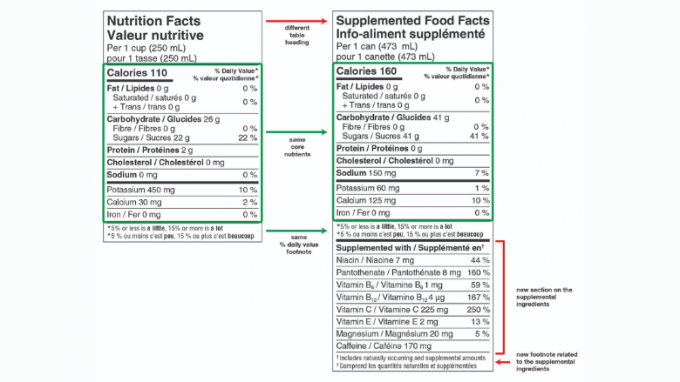
Canadian-supplemented-food-facts-label-example
Image credit: Health Canada
In a groundbreaking move, Canada is ushering in a new era of transparency and accountability for supplemented foods with stringent regulations now in effect. The regulatory framework, already in force, mandates comprehensive labeling updates for these prepackaged products, offering consumers a deeper understanding of the nutritional value and potential risks associated with added ingredients.
The transition period, a grace period for compliance, extends until December 31, 2025, giving eligible supplemented foods the opportunity to align with the regulations. This includes products with a valid temporary marketing authorization letter (TMAL) at the onset of the regulations or those that applied for a TMAL before the regulations came into effect and subsequently received a Health Canada notification.
A pivotal element of the revised regulations is the introduction of the Supplemented Food Facts table (SFFt), akin to the familiar nutrition facts label but tailored to reflect the unique composition of supplemented foods. Distinctive features of the SFFt include a prominent "Supplemented Food Facts" heading, mirroring the structure of a nutrition facts table for core nutrients, and a detailed breakdown of each supplemental ingredient under the "Supplemented with" heading.
Crucially, the SFFt captures the total amount of each supplemental ingredient in the food, encompassing quantities that are naturally present, added as supplemental ingredients, and derived from other sources such as flavorings and food additives. For instance, if calcium, a mandatory core nutrient, is added as a supplemental ingredient, it must be exclusively listed under the "Supplemented with" heading, consolidating the total amount from all sources.
A noteworthy departure from conventional labeling norms is the omission of established daily values for certain supplemental ingredients. This exclusion recognizes that some elements are not daily required nutrients, underscoring the regulatory commitment to precision and relevance in information dissemination.
Moreover, in a move towards heightened consumer protection, supplemented foods that could pose risks to vulnerable populations or require specific consumption guidelines will feature a caution box on the label's back or side. This cautionary measure aims to alert consumers to potential safety concerns, recommend serving limits for specific demographics, and discourage the mixing of certain supplemented foods or supplements.
As Canadian consumers navigate the evolving landscape of supplemented foods, these revamped regulations serve as a beacon of assurance, providing clarity on nutritional content, emphasizing safety considerations, and empowering individuals to make informed dietary choices. The era of enhanced labeling not only aligns with global trends in food transparency but also reinforces Canada's commitment to promoting public health and well-being through informed decision-making.

You May Interested In


High Quality β-Nicotinamide adenine dinucleotide CAS 53-84-9 NADwith ready stock and best price
$3/UNIT FOB


2026-10-18
Trade Alert
Delivering the latest product trends and industry news straight to your inbox.
(We'll never share your email address with a third-party.)

Related News
-
Private Equity Firm Acquires Lyons Magnus for About $1 Billion as Beverage and Nutrition Ingredients Consolidate
-
Food & Hospitality Asia 2026 Returns as the Biggest Event in a Decade
-
Hi & Fi Asia-China 2024
-
Hi & Fi Asia-China concluded successfully, and ECHEMI gained a lot from participating in the exhibition!
-
Hi & Fi Asia-China 2024: ECHEMI's customized digital solutions for the food industry attract countless attention
-
Hi & Fi Asia-China 2024: See how innovative ingredients lead the development of the food industry!
-
New EU Regulations for Wine Ingredients and Nutritional Labeling Come Into Effect December 8
-
Recreating Willy Wonka flavours with food science: 'In principle, we could simulate any flavour'
-
Japan Unveils Draft Guidelines to Enhance Safety and Quality Control of Food Ingredients
-
California Natural Color Unveils Pure Yellow Safflower Crystal Color at Fi Europe Tradeshow
Recommend Reading
-
![Crude Tanker Freight From the Americas to Asia Tops $80 Million per Voyage Amid Global Shipping Crunch]()
Crude Tanker Freight From the Americas to Asia Tops $80 Million per Voyage Amid Global Shipping Crunch
-
![One Million Tonnes of U.S. Ethane Arrive as China Sets a New Import Record]()
One Million Tonnes of U.S. Ethane Arrive as China Sets a New Import Record
-
![IEA Warns Oil Inventories Are Draining Fast as Chemicals Enter Risk Pricing]()
IEA Warns Oil Inventories Are Draining Fast as Chemicals Enter Risk Pricing
-
![A $25 Billion Bill Hits Global Companies as Chemical Costs Are Repriced]()
A $25 Billion Bill Hits Global Companies as Chemical Costs Are Repriced
-
![EU Puts Chemicals on Its China De-Risking Watchlist]()
EU Puts Chemicals on Its China De-Risking Watchlist
-
![Business Society’s Market Outlook for Methanol on August 31, 2026: Weak and Volatile]()
Business Society’s Market Outlook for Methanol on August 31, 2026: Weak and Volatile
-
![January China's bunker fuel market fluctuates]()
January China's bunker fuel market fluctuates
-
![Business Society’s Market Outlook for Melamine on August 31, 2026: Strong Consolidation]()
Business Society’s Market Outlook for Melamine on August 31, 2026: Strong Consolidation
-
![2026 Week 20 Market Observation: Formic Acid and Phosphoric Acid Strongly Surge, Melamine and Other Varieties Plunge Significantly]()
2026 Week 20 Market Observation: Formic Acid and Phosphoric Acid Strongly Surge, Melamine and Other Varieties Plunge Significantly
-
![Business Society’s Market Outlook for Acrylic Acid on August 31, 2026: Volatile Trend]()
Business Society’s Market Outlook for Acrylic Acid on August 31, 2026: Volatile Trend





