Major overseas ports are in traffic jams, buyers are anxiously waiting for unloading!
Since October, ocean freight, which has risen for 15 consecutive months, has declined for the first time. Wait-and-see customers have begun to actively place orders, and Yiwu has also ushered in a wave of shipments.
However, the congestion in major overseas ports has not eased, and there is even a worsening trend. Therefore, at this time, please be sure to remind customers of possible delays.
The following is a summary of the congestion situation of major ports.
America
The Ports of Los Angeles and Long Beach bear 40% of the U.S. cargo imports and are also the most heavily congested ports.
According to a report by CBS on October 13, the number of stranded freighters at the Port of Los Angeles and Long Beach reached a peak of 73 two weeks ago. As of the morning of the 12th, there are still 58 freighters waiting to be unloaded at the port.
According to local officials, there may be 500,000 containers waiting to be moved in the ports of Los Angeles and Long Beach. Part of the reason for the stranded goods is the shortage of warehouse workers and truck drivers. Long-term delays in the transportation of goods have caused soaring transportation costs, and thousands of small businesses have been injured.
The volume of imported containers in the Port of Los Angeles this week (October 17-23) increased by 6.21% compared with the previous week, and the current average waiting time for ships has been as long as 12.3 days.
The destination port is the foreign trader of the Port of Los Angeles and the Port of Long Beach. Please follow the Twitter of the Southern California Ocean Exchange. The real-time port situation will be released every day.
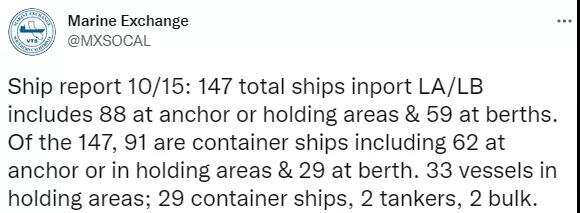
On October 15, there were a total of 147 vessels in the Port of Los Angeles and Long Beach, of which 88 were anchored at anchorages or waiting areas, and 59 were anchored at berths.
The good news is that the U.S. government has already taken action to "unblock" the port congestion: the White House proposed a "90-day sprint" plan, requiring some operations at the Port of Los Angeles to operate 24 hours a day to solve the problem of cargo backlog as soon as possible.
Therefore, following the announcement of the Port of Long Beach in September to switch to 24/7 operations, the Port of Los Angeles announced the same measures, and the International Wharf and Warehouse Alliance stated that its thousands of port workers agreed to work overtime.
Wal-Mart, UPS and FedEx, as the three largest cargo carriers in the United States, will gradually shift to all-weather operations to help speed up the transportation of goods across the United States.
Samsung, home building materials retail giant Home Depot, and Target, the second largest retail department store group in the United States after Wal-Mart, have also pledged to extend night and non-working hours operations.
The port operates 24/7, which will double the speed at which cargo can be transferred from container ships to highways/railways and other domestic transportation networks.
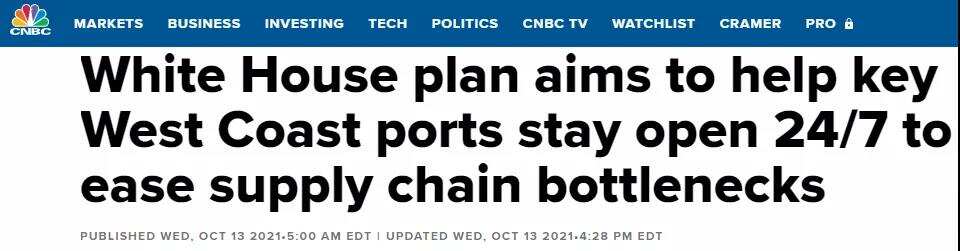


The White House announced that major ports on the West Coast of the United States will operate around the clock to ease supply chain problems.
In addition, the third-largest container port in the United States and the port of Savannah on the East Coast route are currently experiencing serious cargo accumulation. 80,000 containers are being backlogged at the Savannah port in Georgia, which is 50% more than before. Nearly 700 containers have been stranded in the port for a month.

The Port of Savannah has a backlog of 80,000 containers
The shipping bottleneck has seriously affected the US supply chain, and "#EmptyShelvesJoe (shelves empty)" has been hotly searched on their social media.

"Those who are still waiting for $35 in the five black provinces, come and see the little surprises that the shelves will give you."
U.K
The delay at the port of Felixstowe, Britain’s largest port, has made headlines in the British media. The port of Felixstowe, which is responsible for receiving nearly half of all imported goods from the UK, is heavily congested. The average waiting time for container ships has soared from 5 days to nearly 10 days.
A headline article on the “Times” website on October 13 wrote that a batch of cargo ships full of toys and electronic products were transferred to other places on the 12th as the capacity of the country’s largest container port, Felixstowe, was already saturated. "I don't want to look like a ‘Christmas Geek’, but there will be vacancies in the Christmas shelves this year," said a person in charge of a freight company.
Based on the model, the Russell Group said that between October 12 and December 25, the congestion in Felixstowe may affect approximately US$2.72 billion in imports from the UK.

The port of Felixstowe is fully loaded, and Christmas gift containers are turned away.
Asia
Typhoon Kompasu caused the worst container transport congestion in Southeast Asia in months, and it may take several weeks to resolve.
Singapore is one of the most efficient ports in the world for loading and unloading. On October 14, 37 cargo ships were waiting outside the port of Singapore, which was 18% higher than usual. Once the port of Singapore plugs in, it may have a knock-on effect on other ports.
There are 11 freighters waiting to enter the port outside Tanjung Pelepas, Malaysia, and the number of congested ships is 25% higher than usual.
Congestion in Hochiminh and Vung Tau ports in Vietnam is more serious, 38% higher than usual. The cargo terminal operations of Haiphong, Vietnam's third largest port, were also affected.
In addition, in the South Korean Port of Busan in East Asia, container ships now have to berth outside the port for three days before they can enter the port for unloading.
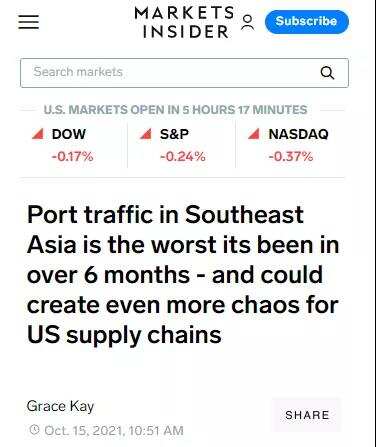
Southeast Asian ports face their worst situation in 6 months
Freightos pointed out that the shipping from Asia to the United States now takes about 70 days, which is 83% more than before the epidemic.
This time is basically spent waiting for the arrival and unloading of the cargo, and some ships even wait for 5 weeks outside the destination port.
For those businesses facing "Empty Shelves", only early orders can avoid the suffering of out of stock.

You May Interested In


High Quality β-Nicotinamide adenine dinucleotide CAS 53-84-9 NADwith ready stock and best price
$3E+1/UNIT FOB


2026-10-24
Trade Alert
Delivering the latest product trends and industry news straight to your inbox.
(We'll never share your email address with a third-party.)

Related News
-
SK Chemicals Partners with China’s Kelinle to Build Its Own Waste-Plastic Supply Network
-
European Gas Breaks €80 Intraday, Putting Chemical and Fertilizer Output Back Under Pressure
-
Lotte Chemical Jumps Nearly 13% as Korean Petrochemical Stocks Rally on Supply-Tightening Bets
-
Evonik Releases Financial Results Statement and Expects No Recovery in Global Chemical Market Demand in 2026
-
USDA Puts Fresh Money Into Local Food Markets
-
European Petrochemical Weakness Leaves Naphtha Oversupplied as Cracker Demand Struggles
-
"No available slots" returns as global shipping rates skyrocket amid multiple factors
-
EU Eyes Rare Trade Tool as PET, Epoxy Resin and Glass Fibre Face Import Curbs
-
Qatar LNG Hit by Attack: 17% Export Capacity Lost, $20 Billion Wiped Out
-
Vietnam Drives ASEAN Towards a Modern Economy
Recommend Reading
-
![“Soaring Sulfuric Acid, Tightening Ore Supplies”: The High-Stakes Battle Behind the Titanium Dioxide Price Surge]()
“Soaring Sulfuric Acid, Tightening Ore Supplies”: The High-Stakes Battle Behind the Titanium Dioxide Price Surge
-
![Phillips 66 Locks Out 385 Workers at 275,000-bpd Bayway Refinery]()
Phillips 66 Locks Out 385 Workers at 275,000-bpd Bayway Refinery
-
![Chemicals Take the Hit as China's Markets Thin Out — Wanhua, Juhua Chemical Slide Over 2%]()
Chemicals Take the Hit as China's Markets Thin Out — Wanhua, Juhua Chemical Slide Over 2%
-
![Two Saudi Crude Supertankers Hit in Hormuz as Brent Surges to Nearly $95]()
Two Saudi Crude Supertankers Hit in Hormuz as Brent Surges to Nearly $95
-
![Iran Closes Strait of Hormuz to All Vessels: Global Chemical Trade Gets Choked]()
Iran Closes Strait of Hormuz to All Vessels: Global Chemical Trade Gets Choked
-
![Business Society’s Trend Analysis for Polyester Staple Fiber on September 11, 2026: Volatile]()
Business Society’s Trend Analysis for Polyester Staple Fiber on September 11, 2026: Volatile
-
![Business Society September 21, 2026 Epoxy Chloropropane Trend Analysis: Volatility (Bearish)]()
Business Society September 21, 2026 Epoxy Chloropropane Trend Analysis: Volatility (Bearish)
-
![Business Society September 10, 2026 Phosphate Market Opinion: Fluctuation]()
Business Society September 10, 2026 Phosphate Market Opinion: Fluctuation
-
![Business Society, September 21, 2026: Fuel Oil 180CST Trend Analysis – Volatility]()
Business Society, September 21, 2026: Fuel Oil 180CST Trend Analysis – Volatility
-
![Business Society’s Trend Analysis for Epichlorohydrin on September 10, 2026: Volatile (Bearish) Trend]()
Business Society’s Trend Analysis for Epichlorohydrin on September 10, 2026: Volatile (Bearish) Trend