57-57-8
3 Inquiries
57-57-8
kg
2023-06-04

Custom Synthetic Chemicals,Biological Stains,Pharmaceutical Intermediates,Cosmetic Grade Chemicals,Enzyme,Nucleosides
-
Product Details
-
Seller Information
-
Inquiry History
-
DescriptionECHEMI Editorial ReferenceColorless to light yellow liqui β-Propiolactone is a colorless liquid which slowly hydrolyzes to hydracrylic acid and must be cooled to remain stable.
Beta-propiolactone appears as a colorless liquid with a slightly sweetish, pungent odor. Used as an intermediate in organic synthesis; disinfectant, sterilant for blood plasma, tissue grafts, vaccines, enzymes and surgical instruments. (EPA, 1998)|COLOURLESS LIQUID WITH PUNGENT ODOUR.|Colorless liquid with a slightly sweet odor.
Beta-propiolactone appears as a colorless liquid with a slightly sweetish, pungent odor. Used as an intermediate in organic synthesis; disinfectant, sterilant for blood plasma, tissue grafts, vaccines, enzymes and surgical instruments. (EPA, 1998)|Beta-propiolactone is a propan-3-olide. It derives from a 3-hydroxypropionic acid. It derives from a hydride of an oxetane.|Propiolactone is a lactone compound with a four-membered ring. It is a colorless liquid with a pungent slightly sweet odor. Propiolactone is a disinfectant used for the sterilization of blood plasma, vaccines, tissue grafts, surgical instruments, and enzymes. It has been used against bacteria, fungi, and virus. It is currently FDA approved for its use as an indirect additive used in food contact substances. Propiolactone was first commercially available in the United States in 1958.|beta-Propiolactone is used for vaccines, tissue grafts, surgical instruments, and enzymes, as a sterilant of blood plasma, water, milk, and nutrient broth, and as a vapor-phase disinfectant in enclosed spaces. Acute (short-term) inhalation exposure to beta-propiolactone causes severe irritation of the eyes, nose, throat, and respiratory tract in humans. Acute dermal exposure may cause irritation of the skin, blistering, or burns in humans. Contact with the eyes may cause permanent corneal opacification. Burns of the mouth and stomach may occur in humans following acute exposure via ingestion. No information is available on the chronic (long-term), reproductive, developmental, or carcinogenic effects of beta-propiolactone in humans. Squamous cell carcinomas of the forestomach have been reported in orally exposed rats. In dermally exposed rodents, skin tumors have been observed. The International Agency for Research on Cancer (IARC) has classified beta-propiolactone as a Group 2B, possible human carcinogen.|Propiolactone is a colorless, highly reactive, liquid, cyclic ether with a slightly sweet odor. Beta-propiolactone was used once mainly in the manufacture of acrylic acid and esters. It also was used as a sterilant for medical materials and procedures. However, it is no longer used for medical disinfection. Dermal exposure to beta-propiolactone causes the burning or blistering of the skin, and ingestion of this substance burns the mouth and stomach while exposure to its vapors causes severe irritation of the eyes, throat and respiratory tract. This substance is reasonably anticipated to be a human carcinogen. (NCI05)|Disinfectant used in vapor form to sterilize vaccines, grafts, etc. The vapor is very irritating and the liquid form is carcinogenic.Basic Info-
Product Name:
β-Propiolactone
Other Name:2-Oxetanone;Hydracrylic acid,β-lactone;Betaprone;BPL;Propanolide;Propiolactone;β-Propiolactone;β-Propionolactone;Propanoic acid,3-hydroxy-,β-lactone;1,3-Propiolactone;3-Hydroxypropionic acid lactone;3-Propanolide;3-Propiolactone;NSC 21626
CAS No.:57-57-8
Molecular Formula:C3H4O2
InChIKeys:InChIKey=VEZXCJBBBCKRPI-UHFFFAOYSA-N
Molecular Weight:72.06
Exact Mass:72.06
EC Number:200-340-1
UNII:6RC3ZT4HB0
ICSC Number:0555
NSC Number:758422|21626
UN Number:2810
DSSTox ID:DTXSID8021197
NCI Thesaurus Code:C44339
Color/Form:A COLORLESS LIQUID|Colorless liquid.
HScode:2932209090
Categories:
Characteristics-
PSA:
26.3
XLogP3:0.46 (estimated)
Appearance:Liquid
Density:1.1460 g/cm3 @ Temp: 20 °C
Melting Point:-33.4 °C
Boiling Point:61 °C @ Press: 20 Torr
Flash Point:158 °F
Refractive Index:1.445
Water Solubility:H2O: 37 g/100 mL
Storage Conditions:2-8°C
Vapor Pressure:Vapour pressure, Pa at 25°C: 453
Vapor Density:2.5
Toxicity:Inhalation-rat LC50: 25 ppm/6 hours; peritoneal-mouse LD50: 405 mg/kg
Flammability characteristics:Flammable; spicy and irritating smoke is released in the fire; rapid hydrolysis in water
Explosive limit:vol% in air: 2.9
Odor:PUNGENT
Experimental Properties:VERY HIGH CHEMICAL REACTIVITY DUE TO PRESENCE OF STRAINED FOUR-MEMBERED LACTONE RING|DECOMP IN WATER & ALCOHOL
Air and Water Reactions:Slow reaction with water to form beta- hydroxypropionic acid.
Reactive Group:Esters, Sulfate Esters, Phosphate Esters, Thiophosphate Esters, and Borate Esters
Reactivity Profile:BETA-PROPIOLACTONE is an ester. Esters react with acids to liberate heat along with alcohols and acids. Strong oxidizing acids may cause a vigorous reaction that is sufficiently exothermic to ignite the reaction products. Heat is also generated by the interaction of esters with caustic solutions. Flammable hydrogen is generated by mixing esters with alkali metals and hydrides. This chemical may be incompatible with alkalis.
Flammable Limits:LOWER FLAMMABLE LIMIT: 2.9%|Class IIIA Combustible Liquid: Fl.P. at or above 140°F and below 200°F.
Hazard IdentificationClassification of the substance or mixture
Skin irritation, Category 2
Eye irritation, Category 2
Acute toxicity - Category 2, Inhalation
Carcinogenicity, Category 1B
GHS label elements, including precautionary statements
Pictogram(s) 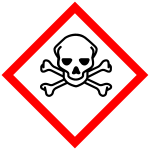

Signal word Danger
Hazard statement(s) H315 Causes skin irritation
H319 Causes serious eye irritation
H330 Fatal if inhaled
H350 May cause cancer
Precautionary statement(s) Prevention P264 Wash ... thoroughly after handling.
P280 Wear protective gloves/protective clothing/eye protection/face protection/hearing protection/...
P260 Do not breathe dust/fume/gas/mist/vapours/spray.
P271 Use only outdoors or in a well-ventilated area.
P284 [In case of inadequate ventilation] wear respiratory protection.
P203 Obtain, read and follow all safety instructions before use.
Response P302+P352 IF ON SKIN: Wash with plenty of water/...
P321 Specific treatment (see ... on this label).
P332+P317 If skin irritation occurs: Get medical help.
P362+P364 Take off contaminated clothing and wash it before reuse.
P305+P351+P338 IF IN EYES: Rinse cautiously with water for several minutes. Remove contact lenses, if present and easy to do. Continue rinsing.
P304+P340 IF INHALED: Remove person to fresh air and keep comfortable for breathing.
P316 Get emergency medical help immediately.
P320 Specific treatment is urgent (see ... on this label).
P318 IF exposed or concerned, get medical advice.
Storage P403+P233 Store in a well-ventilated place. Keep container tightly closed.
P405 Store locked up.
Disposal P501 Dispose of contents/container to an appropriate treatment and disposal facility in accordance with applicable laws and regulations, and product characteristics at time of disposal.
Other hazards which do not result in classification
no data available
Handling and StoragePrecautions for safe handling
NO open flames. Above 74°C use a closed system and ventilation. Handling in a well ventilated place. Wear suitable protective clothing. Avoid contact with skin and eyes. Avoid formation of dust and aerosols. Use non-sparking tools. Prevent fire caused by electrostatic discharge steam.
Conditions for safe storage, including any incompatibilities
Separated from food and feedstuffs. Cooled. Well closed. Ventilation along the floor.MATERIALS WHICH ARE TOXIC AS STORED OR WHICH CAN DECOMPOSE INTO TOXIC COMPONENTS ... SHOULD BE STORED IN A COOL WELL VENTILATED PLACE, OUT OF THE DIRECT RAYS OF THE SUN, AWAY FROM AREAS OF HIGH FIRE HAZARD, AND SHOULD BE PERIODICALLY INSPECTED. INCOMPATIBLE MATERIALS SHOULD BE ISOLATED .
-
-
Seller Information
-
Business Type:
Manufactory
-
Main Products:
Custom Synthetic Chemicals,Biological Stains,Pharmaceutical Intermediates,Cosmetic Grade Chemicals,Enzyme,Nucleosides
-
Location:
Room 308-80, building 1, 1963 Huaguan Road, Tianhe District, Guangzhou
-
Payment Terms:
TT against copy of documents,D/P,L/C,D/A,O/A,100% TT in advance
-
Average lead Time:
30 days
-
Total Annual Revenue:
$5 million-$10 million
-
Total Employees:
51-100
-
Year of Establishment:
2021
-
-
Inquiry History3 Inquiries
Country Product Purchase Quantity Date Posted  United States
beta-Propiolactone
50 G Sep 20, 2026  Egypt
Egypt
Beta Propiolactone
1 KG Oct 19, 2025
United States
beta-Propiolactone
1 G Sep 26, 2024 Post an enquiry for this product
More from this Seller
-
-

-
Urease, CAS:9002-13-5
Reagent Grade / 99%
$20-23/KG FOB
-
-
-

-
Cyclohexene-1-boronic acid pinacol ester
/ 98%
$1/KG EXW
-
-
-

-
Indium chloride
/ 98%
$1/KG EXW
-
-
-
 ACETYLACETONATE")
-
MANGANESE(II) ACETYLACETONATE
/ 99%
$1/KG EXW
-



Hot Related Products
-
 β-Alanine 98% Purity CAS 107-95-9 High Purity Beta-Amino Acid for Nutritional Supplements, Pharmaceutical Research, and Biochemical Applications
 -
 High purity 3-Mercaptopropionic acid
 -
 107-95-9 β-Alanine white powder
 -
 Cyclohexane Echemi Specialties
 -
 3-Mercaptopropionic acid 107-96-0 high purity
 -
 beta-Alanine
 -
 Cyclohexane 99.95% Transparent liquid
 -
 β-Alanine Raw Powder Wholesale Purity Degree 99%
 -
 Amino Acids β-Alanine CAS 107-95-9 Beta Alanine Food Grade
$5.3-6.36/G FOB
-
 Biggest manufacturer of Beta-alanine