Phosphorus pentachloride
ISO 7 Inquiries
10026-13-8
Industrial Grade
99%
25kg/drum
2023-12-31

Flavors & Fragrances,Catalyst & Auxiliary,Intermediates,Dyes & Pigments,Inorganic Chemistry,petro chemicals
-
Product Details
-
Seller Information
-
Inquiry History
-
Description
Phosphorus pentachloride (CAS No.: 10026-13-8) is supplied by NANTONG REFORM PETRO-CHEMICAL CO.,LTD, a Manufactory with 4 years on ECHEMI.
Key details: grade Industrial Grade, content 99%, packaging 25kg/drum.
Contact the supplier on this page to request a quotation or the latest price.
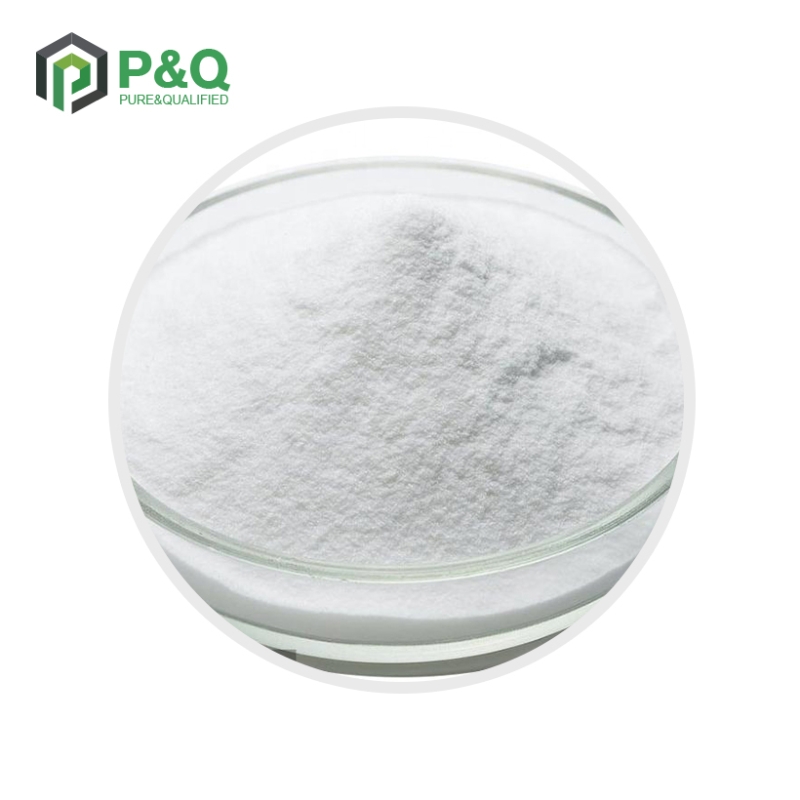
ECHEMI Editorial ReferenceYellowish crystalline powder and scales Phosphorus pentachloride is a pale yellow, fuming solid with an odor like hydrochloric acid.Phthalic anhydride is a white lustrous needle-like solid, phthalic anhydride is slightly soluble in water. Phthalic anhydride is an important chemical intermediate in the plastics industry. It has extensive industrial applications in the production of phthalic plasticisers, alkydic resins, polyesters resins, and synthetic resins.
Phosphorus pentachloride is a greenish-yellow crystalline solid with an irritating odor. It is decomposed by water to form hydrochloric and phosphoric acid and heat. This heat may be sufficient to ignite surrounding combustible material. It is corrosive to metals and tissue. Long term exposure to low concentrations or short term exposure to high concentrations can result in adverse health effects from inhalation.|FUMING WHITE-TO-YELLOW CRYSTALS WITH PUNGENT ODOUR.|White to pale-yellow, crystalline solid with a pungent, unpleasant odor.
Phosphorus pentachloride is a greenish-yellow crystalline solid with an irritating odor. It is decomposed by water to form hydrochloric and phosphoric acid and heat. This heat may be sufficient to ignite surrounding combustible material. It is corrosive to metals and tissue. Long term exposure to low concentrations or short term exposure to high concentrations can result in adverse health effects from inhalation.|Phosphorus pentachloride is a phosphorus halide.CertificatesBasic Info-
Product Name:
Phosphorus pentachloride
Other Name:Phosphorane,pentachloro-;Phosphorus chloride (PCl5);Pentachlorophosphorane;Phosphoric chloride;Phosphorus pentachloride;Phosphorus perchloride;Phosphorus(V) chloride;Pentachlorophosphorus
CAS No.:10026-13-8
Molecular Formula:Cl5P
InChIKeys:InChIKey=UHZYTMXLRWXGPK-UHFFFAOYSA-N
Molecular Weight:208.24
Exact Mass:208.24
EC Number:233-060-3
UNII:0EX753TYDU
ICSC Number:0544
UN Number:1806
DSSTox ID:DTXSID9033896
Color/Form:White to pale yellow crystalline mass|Tetragonal crystals|White to pale-yellow, crystalline solid.
HScode:28121045
Categories:
Characteristics-
PSA:
0
XLogP3:4.30870
Appearance:Yellow macroporous
Density:2.114 g/cm3 @ Temp: 20 °C
Melting Point:160.5 °C
Boiling Point:160 °C
Flash Point:none
Water Solubility:Decomposes in water;soluble in carbon disulfide and carbon tetrachloride.
Storage Conditions:2-8°C
Vapor Pressure:Vapour pressure, Pa at 55.5°C: 133
Vapor Density:Relative vapour density (air = 1): 7.2
Toxicity:Oral-Rat LD50: 660 mg/kg
Flammability characteristics:Non-combustible; Fire site produces toxic chloride and phosphorus oxide gas; reacts with water to generate hydrogen chloride
Explosive limit:A solution of phosphorus pentachloride in nitrobenzene is stable at 110 deg C but begins to decompose with acceralating violence above 120 deg C, with evolution of nitrous fumes.
Odor:Pungent, unpleasant odor
Experimental Properties:Deliquescent; reacts with alcohols to form corresponding chloride|Fuming in moist air|Hydrolyzed by water to form phosphoric acid and hydrogen chloride. Sublimes at about 100 °C without melting.|Heat of Formation = -443.5 kJ/mol|Vapor is 40% dissociated into phosphorus trichloride and chlorine at 180 °C; 80% dissociated at 250 °C and fully dissociated at 300 °C
Air and Water Reactions:Fumes in air, reacts violently with water to form phosphoric acid and hydrochloric acid [Oldbury Chemicals year/ p.9]. Phosphorus pentachloride reacts vigorously with water to generate gaseous HCl. Based on a scenario where the chemical is spilled into an excess of water (at least 5 fold excess of water), half of the maximum theoretical yield of Hydrogen Chloride gas will be created in 0.54 minutes. Experimental details are in the following: "Development of the Table of Initial Isolation and Protective Distances for the 2008 Emergency Response Guidebook", ANL/DIS-09-2, D.F. Brown, H.M. Hartmann, W.A. Freeman, and W.D. Haney, Argonne National Laboratory, Argonne, Illinois, June 2009.
Reactive Group:Acids, Strong Non-oxidizing
Reactivity Alerts:Water-Reactive
Reactivity Profile:PHOSPHORUS PENTACHLORIDE is a lightly yellow, fuming crystalline material, highly caustic, corrosive and toxic. Flammable by chemical reaction. Violent exothermic reaction with water or steam. When heated to decomposition it emits highly toxic fumes of chlorides and oxides of phosphorus. Explosive reaction with alkaline metals (sodium, potassium), urea. Ignites on contact with fluorine. Violent reaction with aluminum, chlorine trioxide, hydroxylamine, magnesium oxide, nitrobenzene, phosphorus(III) oxide, potassium. Carbamates form explosive products [Bretherick, 5th ed., 1995, p. 1360]. Reaction with the mixture of chlorine and chlorine dioxide causes explosion [Mellor, 1941, vol. 2, p. 281; 1940, vol. 8, p. 1013].
Flammable Limits:Noncombustible Solid
Physical Dangers:The vapour is heavier than air.
Corrosivity:Corrosive
Heat of Vaporization:64.9 kJ/mol
Critical Temperature & Pressure:Critical temperature = 372 °C
Hazard IdentificationClassification of the substance or mixture
Acute toxicity - Category 4, Oral
Skin corrosion, Sub-category 1B
Acute toxicity - Category 2, Inhalation
Specific target organ toxicity â repeated exposure, Category 2
GHS label elements, including precautionary statements
Pictogram(s) 
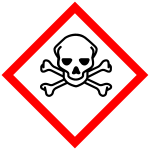

Signal word Danger
Hazard statement(s) H302 Harmful if swallowed
H314 Causes severe skin burns and eye damage
H330 Fatal if inhaled
H373 May cause damage to organs through prolonged or repeated exposure
Precautionary statement(s) Prevention P264 Wash ... thoroughly after handling.
P270 Do not eat, drink or smoke when using this product.
P260 Do not breathe dust/fume/gas/mist/vapours/spray.
P280 Wear protective gloves/protective clothing/eye protection/face protection/hearing protection/...
P271 Use only outdoors or in a well-ventilated area.
P284 [In case of inadequate ventilation] wear respiratory protection.
Response P301+P317 IF SWALLOWED: Get medical help.
P330 Rinse mouth.
P301+P330+P331 IF SWALLOWED: Rinse mouth. Do NOT induce vomiting.
P363 Wash contaminated clothing before reuse.
P304+P340 IF INHALED: Remove person to fresh air and keep comfortable for breathing.
P316 Get emergency medical help immediately.
P321 Specific treatment (see ... on this label).
P305+P351+P338 IF IN EYES: Rinse cautiously with water for several minutes. Remove contact lenses, if present and easy to do. Continue rinsing.
P320 Specific treatment is urgent (see ... on this label).
P319 Get medical help if you feel unwell.
Storage P405 Store locked up.
P403+P233 Store in a well-ventilated place. Keep container tightly closed.
Disposal P501 Dispose of contents/container to an appropriate treatment and disposal facility in accordance with applicable laws and regulations, and product characteristics at time of disposal.
Other hazards which do not result in classification
no data available
Handling and StoragePrecautions for safe handling
NO contact with water. Handling in a well ventilated place. Wear suitable protective clothing. Avoid contact with skin and eyes. Avoid formation of dust and aerosols. Use non-sparking tools. Prevent fire caused by electrostatic discharge steam.
Conditions for safe storage, including any incompatibilities
Separated from food and feedstuffs and incompatible materials. See Chemical Dangers. Dry. Well closed.Store in a glass bottle with a ground glass stopper and keep the bottle tightly closed. Protect against physical damage.
-
-
Seller Information
-
Business Type:
Manufactory
-
Main Products:
Flavors & Fragrances,Catalyst & Auxiliary,Intermediates,Dyes & Pigments,Inorganic Chemistry,petro chemicals
-
Location:
17th Yuanlin Road ,Chongchuan area ,Nantong city ,Jiangsu province ,China
-
Payment Terms:
L/C,100% TT in advance
-
Average lead Time:
2 days
-
Total Annual Revenue:
Above $100 million
-
Total Employees:
201-300
-
Year of Establishment:
2008
Company Certificates-
 GB/T19001-2016 / Iso9001:2015
-
-
Inquiry History7 Inquiries
Country Product Purchase Quantity Date Posted  India
India
Phosphorus pentachloride
1.5 MT Jul 28, 2026
India
Phosphorus Pentachloride
110 MT Apr 18, 2026
India
Phosphorus(V) chloride
12.25 TON May 24, 2024  Pakistan
Phosphorus pentachloride
1000 KG Jul 26, 2025  United States
Phosphorus(V) chloride
12.25 MT May 28, 2024
India
Phosphorus(V) chloride
12.25 TON Apr 12, 2024  Germany
PCl5
5 MT Nov 10, 2023 Post an enquiry for this product

More from this Seller
-
-

-
n-Hexadecyltrichlorosilane 5894-60-0
Industrial Grade / 99%
-
-
-

-
2-Bromobenzaldehyde
Industrial Grade / 99%
-
-
-

-
2-METHYL-1-BUTEN-3-YNE 78-80-8
Industrial Grade / 99%
-
-
-

-
ETHYLENE GLYCOL DI-N-BUTYRATE
Industrial Grade / 99%
-
-
-

-
Dodecanamide
Industrial Grade / 99%
-




Hot Related Products
-
 Hexylaminee
 -
 Isophthaloyl Dichloride & 1,3-benzenedicarboxylicacid
 -
 5330-98-3 2-chloro-3-nitrothiophene
 -
 CAS 7081-44-9 Veterinary 99% Cloxacillin Sodium Monohydrate
$5.2-6.24/KG FOB
-
 Ropivacaine RC09675
$1/KG EXW
-
 white powder Cilostazol") lower price 99%(HPLC) white powder Cilostazol
lower price 99%(HPLC) white powder Cilostazol -
") Hexylamine (high qualified)
Hexylamine (high qualified)$1-1.2/KG FOB
-
 high quality 5-Bromo-2-chloro-3-nitropyridine 99% transparent liquid KANBEI
 -
 Hot Sale 99% Ropivacaine powder 84057-95-4 Fast and Safe Delivery
 -
 Hexylamine 111-26-2