Glycidol .
1 Inquiries
556-52-5
200kg/drum
2023-05-12

Agrochemicals,Daily Chemicals,Catalysts & Chemical Auxiliary Agents,Extract,Inorganic Chemicals,Organic Intermediate
-
Product Description
-
Seller Information
-
Inquiry History
-
DescriptionECHEMI Editorial Referencecolourless liquid Glycidol is a colorless liquid.
Glycidol is an odorless clear colorless liquid. (NTP, 1992)|COLOURLESS SLIGHTLY VISCOUS LIQUID.|Colorless, odorless liquid.|Colorless liquid.
Glycidol is an odorless clear colorless liquid. (NTP, 1992)|Glycidol is an epoxide and a primary alcohol. It derives from a 1,2-epoxypropane.Basic Info-
Product Name:
Glycidol
Other Name:2-Oxiranemethanol;Glycidol;1-Propanol,2,3-epoxy-;Oxiranemethanol;Epihydrin alcohol;Glycidyl alcohol;3-Hydroxy-1,2-epoxypropane;Glycide;2,3-Epoxy-1-propanol;Allyl alcohol oxide;3-Hydroxypropylene oxide;1,2-Epoxy-3-hydroxypropane;1-Hydroxy-2,3-epoxypropane;2-(Hydroxymethyl)oxirane;Oxiranylmethanol;Epiol OH;(RS)-Glycidol;dl-Glycidol;(±)-Glycidol;(±)-2,3-Epoxy-1-propanol;Racemic glycidol;NSC 46096;Oxiran-2-ylmethanol;61915-27-3;98913-54-3;1852481-80-1
CAS No.:556-52-5
Molecular Formula:C3H6O2
InChIKeys:InChIKey=CTKINSOISVBQLD-UHFFFAOYSA-N
Molecular Weight:74.08
Exact Mass:74.08
EC Number:209-128-3
ICSC Number:0159
NSC Number:46096
UN Number:2810
DSSTox ID:DTXSID4020666
Color/Form:Colorless, slightly viscous liquid|Colorless liquid
HScode:2910900090
Categories:
Characteristics-
PSA:
32.8
XLogP3:-0.95
Appearance:White to light yellow-beige Powder, Crystals or Chunks
Density:1.115 g/cm3 @ Temp: 20 °C
Melting Point:-45 °C
Boiling Point:160 °C @ Press: 760 Torr
Flash Point:178 °F
Refractive Index:1.455
Water Solubility:H2O: soluble
Storage Conditions:2-8°C
Vapor Pressure:0.9 mm Hg ( 25 °C)
Vapor Density:2.15 (vs air)
Toxicity:Oral-Rat LD50: 420 mg/kg; Oral-Mouse LD50: 431 mg/kg
Flammability characteristics:Flammable, spicy and irritating smoke emitted from the fire
Explosive limit:Explodes when heated or in the presence of strong acids, bases, metals (e.g., copper, zinc), and metal salts (e.g., aluminum chloride, iron(III) chloride, tin(IV) chloride).
Henrys Law Constant:Henry's Law constant = 5.84X10⁻⁹ atm-cu m/mol at 25 °C (est)
Experimental Properties:Specific gravity: 1.115 at 20 °C/4 °C|1 ppm = 3.03 mg/cu m at 25 °C, 760 mm Hg; 1 mg/L = 330 ppm at 25 °C, 760 mm Hg|MW: 74.079. MP: 045 °C; BP: decomposes at 167 °C; 66 °C at 2.5 mm Hg. Density: 1.1143 g/cu cm at 25 °C. Index of refraction: 1.4287 at 20 °C/D. Very soluble in water, acetone, ethyl ether, ethanol; soluble in benzene, chloroform /DL-Glycidol/|BP: 167 °C (decomposes). Density: 1.117 g/cu cm at 20 °C. Index of refraction: 1.4293 at 16 °C/D. Specific optical rotation: + 15 deg (undiluted) at 25 °C/D. Very soluble in water, acetone, ethyl ether, ethanol. /D-Glycidol/|Specific optical rotation: 15 (undiluted) at 25 °C/D. BP: 167 °C (decomposes). Index of refraction: 1.4293 at 16 °C/D. Density: 1.1050 at 18 °C. Soluble in water, ethanol, ethyl ether, acetone, benzene, chloroform /L-Glycidol/|Raman: 205 (Sadtler Research Laboratories spectral collection) /Glycidol (L)/|Hydroxyl radical reaction rate constant = 4.66X10⁻¹² cu cm/molec-sec at 25 °C (est)
Air and Water Reactions:Sensitive to moisture.
Reactive Group:Alcohols and Polyols
Reactivity Alerts:Polymerizable
Reactivity Profile:GLYCIDOL is sensitive to moisture. It is also sensitive to light. It may polymerize if heated above room temperature. It may darken on storage. Stability studies of this chemical stored for two week protected from light indicated definite decomposition at 140° F, and strongly indicated instability at 77° F. A solution of this compound in water was found to be unstable when stored at room temperature, even after one day in the dark. This chemical is incompatible with strong oxidizers. It will undergo explosive decomposition in the presence of strong acids or bases, salts (such as aluminum chloride, iron(III)chloride or tin(IV) chloride) or metals (such as copper and zinc). It is also incompatible with nitrates. It will attack some forms of plastics, rubber and coatings. (NTP, 1992)
Autoignition Temperature:415 °C
Flammable Limits:Class IIIA Combustible Liquid: Fl.P. at or above 140°F and below 200°F.
Hazard IdentificationClassification of the substance or mixture
Acute toxicity - Category 4, Oral
Acute toxicity - Category 4, Dermal
Skin irritation, Category 2
Eye irritation, Category 2
Acute toxicity - Category 3, Inhalation
Specific target organ toxicity â single exposure, Category 3
Germ cell mutagenicity, Category 2
Carcinogenicity, Category 1B
Reproductive toxicity, Category 1B
GHS label elements, including precautionary statements
Pictogram(s) 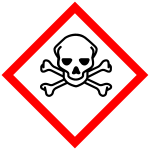

Signal word Danger
Hazard statement(s) H302 Harmful if swallowed
H312 Harmful in contact with skin
H315 Causes skin irritation
H319 Causes serious eye irritation
H331 Toxic if inhaled
H335 May cause respiratory irritation
H341 Suspected of causing genetic defects
H350 May cause cancer
Precautionary statement(s) Prevention P264 Wash ... thoroughly after handling.
P270 Do not eat, drink or smoke when using this product.
P280 Wear protective gloves/protective clothing/eye protection/face protection/hearing protection/...
P261 Avoid breathing dust/fume/gas/mist/vapours/spray.
P271 Use only outdoors or in a well-ventilated area.
P203 Obtain, read and follow all safety instructions before use.
Response P301+P317 IF SWALLOWED: Get medical help.
P330 Rinse mouth.
P302+P352 IF ON SKIN: Wash with plenty of water/...
P317 Get medical help.
P321 Specific treatment (see ... on this label).
P362+P364 Take off contaminated clothing and wash it before reuse.
P332+P317 If skin irritation occurs: Get medical help.
P305+P351+P338 IF IN EYES: Rinse cautiously with water for several minutes. Remove contact lenses, if present and easy to do. Continue rinsing.
P304+P340 IF INHALED: Remove person to fresh air and keep comfortable for breathing.
P316 Get emergency medical help immediately.
P319 Get medical help if you feel unwell.
P318 IF exposed or concerned, get medical advice.
Storage P403+P233 Store in a well-ventilated place. Keep container tightly closed.
P405 Store locked up.
Disposal P501 Dispose of contents/container to an appropriate treatment and disposal facility in accordance with applicable laws and regulations, and product characteristics at time of disposal.
Other hazards which do not result in classification
no data available
Handling and StoragePrecautions for safe handling
NO open flames. NO contact with incompatible substances. See Chemical Dangers. Above 72°C use a closed system and ventilation. Handling in a well ventilated place. Wear suitable protective clothing. Avoid contact with skin and eyes. Avoid formation of dust and aerosols. Use non-sparking tools. Prevent fire caused by electrostatic discharge steam.
Conditions for safe storage, including any incompatibilities
Store only if stabilized. Cool. Dry. Well closed. Ventilation along the floor. Separated from strong bases, strong acids and food and feedstuffs.Keep container tightly closed in a dry and well-ventilated place. Containers which are opened must be carefully resealed and kept upright to prevent leakage. Recommended storage temperature: 2 - 8 deg C Moisture sensitive. Handle and store under inert gas.
-
-
Seller Information
-
Business Type:
Manufactory
-
Main Products:
Agrochemicals,Daily Chemicals,Catalysts & Chemical Auxiliary Agents,Extract,Inorganic Chemicals,Organic Intermediate
-
Location:
hisense intelligence valley,no 2116,of phoenix road
-
Payment Terms:
TT against copy of documents,D/P,L/C
-
Average lead Time:
7 days
-
Total Annual Revenue:
Less than $1 million
-
Total Employees:
11-50
-
Year of Establishment:
2017
-
-
Inquiry History1 Inquiries
Country Product Purchase Quantity Date Posted  Russia
Glycidol 99.9%
3 MT Nov 1, 2024 Post an enquiry for this product
More from this Seller
-
-

-
Isobutyl Alcohol 99% powder aly- 78-83-1 lk
Industrial Grade / 99%
-
-
-

-
Dextransucrase 9032-14-8
Food Grade / 99%
$100-130/KG FOB
-