




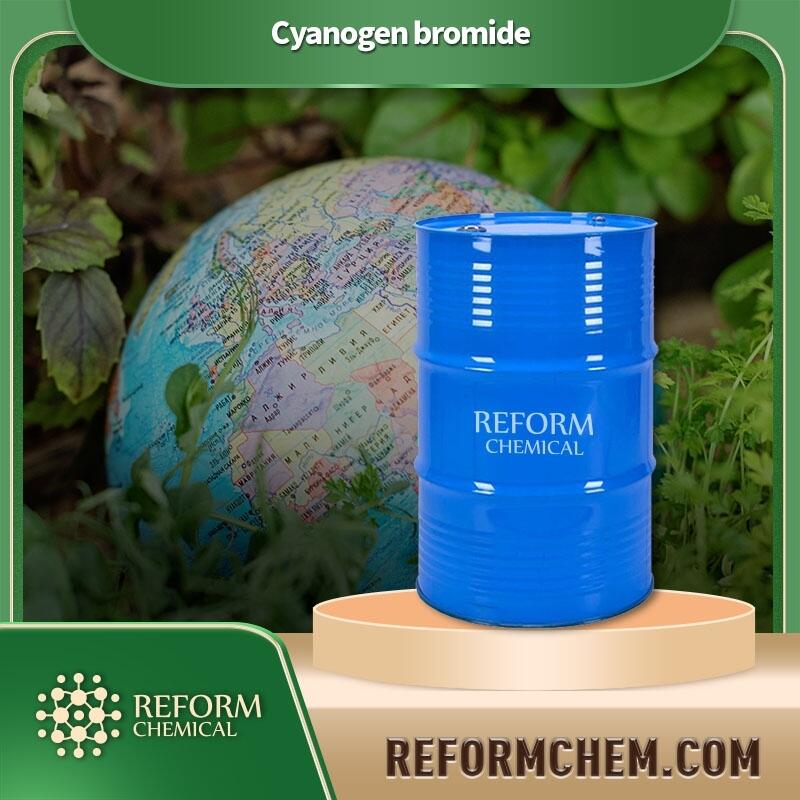

Cyanogen bromide 506-68-3
ISO
506-68-3
Industrial Grade
99%
200KG/drum
Yes
2023-09-04

Flavors & Fragrances,Catalyst & Auxiliary,Intermediates,Dyes & Pigments,Inorganic Chemistry,petro chemicals
-
Product Details
-
Seller Information
-
DescriptionECHEMI Editorial Referencewhite crystalline solid Cyanogen bromide is a colorless or white, volatile, crystalline solid with a penetrating odor.
Cyanogen bromide is a colorless to white crystalline solid with a penetrating odor. It is slightly soluble in water. It is gradually decomposed by water and very rapidly by acids to give off hydrogen bromide, a flammable and poisonous gas. Contamination with many materials can cause rapid decomposition of the material. It is toxic by inhalation of its vapors or by the hydrogen cyanide from decomposition or by ingestion. Toxic oxides of nitrogen are produced in fire involving this material. It is used in gold extraction, to make other chemicals, and as a fumigant.|COLOURLESS OR WHITE CRYSTALS WITH PUNGENT ODOUR.
Cyanogen bromide is a colorless to white crystalline solid with a penetrating odor. It is slightly soluble in water. It is gradually decomposed by water and very rapidly by acids to give off hydrogen bromide, a flammable and poisonous gas. Contamination with many materials can cause rapid decomposition of the material. It is toxic by inhalation of its vapors or by the hydrogen cyanide from decomposition or by ingestion. Toxic oxides of nitrogen are produced in fire involving this material. It is used in gold extraction, to make other chemicals, and as a fumigant.|Cyanogen Bromide is an inorganic compound used as a reagent in molecular biology. As a reagent for peptide mapping and amino acid sequence analysis, cyanogen bromide hydrolyzes peptide bonds at methionine residues in peptides and proteins. In addition, this agent acts as a coupling reagent for phosphoramidate or pyrophosphate inter-nucleotide bonds in DNA duplexes. (NCI)|Cyanogen bromide (CNBr). A compound used in molecular biology to digest some proteins and as a coupling reagent for phosphoroamidate or pyrophosphate internucleotide bonds in DNA duplexes.CertificatesBasic Info-
Product Name:
Cyanogen bromide
Other Name:Cyanogen bromide ((CN)Br);Cyanogen bromide;Bromine cyanide;Bromocyanogen;Bromocyanide (BrCN);Bromocyanide;Bromocyan;Cyanogen bromide (BrCN);Cyanogen monobromide;Bromine cyanide (BrCN);Cyanobromide;Campilit;Bromine monocyanide;NSC 89684;Cyanic bromide;Carbononitridic bromide
CAS No.:506-68-3
Molecular Formula:CBrN
InChIKeys:InChIKey=ATDGTVJJHBUTRL-UHFFFAOYSA-N
Molecular Weight:105.921
Exact Mass:105.92
EC Number:208-051-2
UNII:OS382OHJ8P
ICSC Number:0136
NSC Number:89684
UN Number:1889
DSSTox ID:DTXSID9021550
NCI Thesaurus Code:C402
Color/Form:White hygroscopic needles|Crystals|Crystalline solid|Colorless crystals
HScode:2853009021
Categories:
Characteristics-
PSA:
23.79000
XLogP3:0.85
Appearance:Cyanogen bromide is a colorless to white crystalline solid with a penetrating odor. It is slightly soluble in water. It is gradually decomposed by water and very rapidly by acids to give off hydrogen bromide, a flammable and poisonous gas. Contamination with many materials can cause rapid decomposition of the material. It is toxic by inhalation of its vapors or by the hydrogen cyanide from decomposition or by ingestion. Toxic oxides of nitrogen are produced in fire involving this material. It is used in gold extraction, to make other chemicals, and as a fumigant.
Density:2.015 g/cm3 @ Temp: 20 °C
Melting Point:52 °C
Boiling Point:61.4 °C @ Press: 760 Torr
Flash Point:-9.0±18.7 °C
Refractive Index:1.467
Water Solubility:decomposed slowly by cold H2O [HAW93]
Storage Conditions:work with BrCN should be conducted in a fume hood to prevent exposure by inhalation, and splash goggles and impermeable gloves should be worn at all times to prevent eye and skin contact. Containers of cyanogen bromide should be kept tightly sealed and stored under nitrogen in a secondary container in a refrigerator.
Vapor Pressure:100 mm Hg ( 22.6 °C)
Vapor Density:Relative vapour density (air = 1): 3.6
Toxicity:LCLO inhal (human) 92 ppm (398 mg/m3; 10 min) LCLO inhal (mouse) 115 ppm (500 mg/m3; 10 min)
Explosive limit:Impure BrCN can polymerize during storage; the danger of explosion exists with closed BrCN bottles.
Odor:Penetrating
Taste:Bitter
Experimental Properties:Decomposes in the presence of water|Dipole moment: 2.94 debyes|conversion factors: 1 mg/L is equivalent to 230.9 ppm and 1 ppm is equivalent to 4.33 mg/cu m at 25 °C, 760 mm Hg
Air and Water Reactions:It is slightly soluble in water. It is gradually decomposed by water and very rapidly by acids to give off hydrogen bromide, a poison gas.
Reactive Group:Cyanides, Inorganic
Reactivity Profile:CYANOGEN BROMIDE is not combustible itself, but impure cyanogen bromide decomposes rapidly and tends to explode. A violent reaction may take place on contact with large quantities of acid. Avoid physical damage, contact with acids or water, and store away from a location where water may be needed for fire control. [EPA, 1998]. Benzene and cyanogen halides yield HCl as a byproduct (Hagedorn, F. H. Gelbke, and Federal Republic of Germany. 2002. Nitriles. In Ullmann's Encyclopedia of Industrial Chemistry. Wiley-VCH Verlag GmbH & Co. KGaA.).
Autoignition Temperature:Not Applicable. Not flammable. (USCG, 1999)
Physical Dangers:The vapour is heavier than air.
Corrosivity:Corrodes most metals
Heat of Vaporization:33.82 kJ/mol
Hazard IdentificationClassification of the substance or mixture
Acute toxicity - Category 2, Oral
Acute toxicity - Category 1, Dermal
Skin corrosion, Sub-category 1B
Acute toxicity - Category 2, Inhalation
Hazardous to the aquatic environment, short-term (Acute) - Category Acute 1
GHS label elements, including precautionary statements
Pictogram(s) 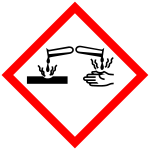
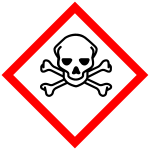
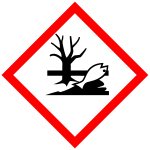
Signal word Danger
Hazard statement(s) H300+H310+H330 Fatal if swallowed, in contact with skin or if inhaled
H314 Causes severe skin burns and eye damage
H400 Very toxic to aquatic life
Precautionary statement(s) Prevention P264 Wash ... thoroughly after handling.
P270 Do not eat, drink or smoke when using this product.
P262 Do not get in eyes, on skin, or on clothing.
P280 Wear protective gloves/protective clothing/eye protection/face protection/hearing protection/...
P260 Do not breathe dust/fume/gas/mist/vapours/spray.
P271 Use only outdoors or in a well-ventilated area.
P284 [In case of inadequate ventilation] wear respiratory protection.
P273 Avoid release to the environment.
Response P301+P316 IF SWALLOWED: Get emergency medical help immediately.
P321 Specific treatment (see ... on this label).
P330 Rinse mouth.
P302+P352 IF ON SKIN: Wash with plenty of water/...
P316 Get emergency medical help immediately.
P361+P364 Take off immediately all contaminated clothing and wash it before reuse.
P301+P330+P331 IF SWALLOWED: Rinse mouth. Do NOT induce vomiting.
P363 Wash contaminated clothing before reuse.
P304+P340 IF INHALED: Remove person to fresh air and keep comfortable for breathing.
P305+P351+P338 IF IN EYES: Rinse cautiously with water for several minutes. Remove contact lenses, if present and easy to do. Continue rinsing.
P320 Specific treatment is urgent (see ... on this label).
P391 Collect spillage.
Storage P405 Store locked up.
P403+P233 Store in a well-ventilated place. Keep container tightly closed.
Disposal P501 Dispose of contents/container to an appropriate treatment and disposal facility in accordance with applicable laws and regulations, and product characteristics at time of disposal.
Other hazards which do not result in classification
no data available
Handling and StoragePrecautions for safe handling
Handling in a well ventilated place. Wear suitable protective clothing. Avoid contact with skin and eyes. Avoid formation of dust and aerosols. Use non-sparking tools. Prevent fire caused by electrostatic discharge steam.
Conditions for safe storage, including any incompatibilities
Separated from food and feedstuffs. See Chemical Dangers. Dry. Well closed.Cyanogen bromide can polymerize violently on prolonged storage at ambient temperature. ... /In the laboratory/ Containers of cyanogen bromide should be kept tightly sealed and stored under nitrogen in a secondary container in a refrigerator.
-
-
Seller Information
-
Business Type:
Manufactory
-
Main Products:
Flavors & Fragrances,Catalyst & Auxiliary,Intermediates,Dyes & Pigments,Inorganic Chemistry,petro chemicals
-
Location:
17th Yuanlin Road ,Chongchuan area ,Nantong city ,Jiangsu province ,China
-
Payment Terms:
L/C,100% TT in advance
-
Average lead Time:
2 days
-
Total Annual Revenue:
Above $100 million
-
Total Employees:
201-300
-
Year of Establishment:
2008
Company Certificates-
 GB/T19001-2016 / Iso9001:2015
-
-
Country Product Purchase Quantity Date Posted Post an enquiry for this product


More from this Seller
-
-

-
2,6-DI-TERT-BUTYLNAPHTHALENE SULFONIC ACID SODIUM SALT
Industrial Grade / 99%
-
-
-

-
2-Methylthiophenothiazine
Industrial Grade / 99%
-
-
-

-
Caprylic capric triglyceride
Industrial Grade / 99%
-
-
-
acetic acid")
-
2-Hydroxy-2-(4-methylphenyl)acetic acid
Industrial Grade / 99%
-
-
-

-
Trimethyl orthobutyrate CAS NO.43083-12-1 99% High Quality Industrial Grade liquid barrel
Industrial Grade / 99%
-
-
-

-
2-Octyl-2H-isothiazol-3-one
Industrial Grade / 99%
-


