isoamyl alcohol3
3 Inquiries
123-51-3
Industrial Grade
100%
Rotterdam
50KG
2023-12-24

Food Chemicals,Industrial Chemicals,Organic Chemicals
-
Product Description
-
Seller Information
-
Inquiry History
-
DescriptionECHEMI Editorial ReferenceColorless liquid with a disagreeable odor.
Isoamyl alcohol is a colorless liquid with a mild, choking alcohol odor. Less dense than water, soluble in water. Hence floats on water. Produces an irritating vapor. (USCG, 1999)|Liquid; PelletsLargeCrystals|Liquid|COLOURLESS LIQUID WITH CHARACTERISTIC ODOUR.|Colourless to pale yellow liquid|Colorless liquid with a disagreeable odor.
Isoamyl alcohol is a colorless liquid with a mild, choking alcohol odor. Less dense than water, soluble in water. Hence floats on water. Produces an irritating vapor. (USCG, 1999)|Isoamylol is an primary alcohol that is butan-1-ol in which a hydrogen at position 3 has been replaced by a methyl group. It has a role as a xenobiotic metabolite, a Saccharomyces cerevisiae metabolite and an antifungal agent. It is a primary alcohol, a volatile organic compound and an alkyl alcohol. It derives from a hydride of an isopentane.Basic Info-
Product Name:
Isoamyl alcohol
Other Name:1-Butanol,3-methyl-;Isopentyl alcohol;3-Methyl-1-butanol;Isoamyl alcohol;Isoamylol;Isopentanol;2-Methyl-4-butanol;Isobutyl carbinol;iso-Amyl alcohol;iso-Pentanol;3-Methylbutyl alcohol;NSC 1029;NSC 7905;3-Methylbutane-1-ol
CAS No.:123-51-3
Molecular Formula:C5H12O
InChIKeys:InChIKey=PHTQWCKDNZKARW-UHFFFAOYSA-N
Molecular Weight:88.15
Exact Mass:88.15
BRN:1718835
EC Number:204-633-5
UNII:DEM9NIT1J4
ICSC Number:0798
NSC Number:7905|1029
UN Number:1105|1201
DSSTox ID:DTXSID3025469
Color/Form:OILY, CLEAR LIQ|Colorless liquid.
HScode:29335995
Categories:
Characteristics-
PSA:
20.2
XLogP3:1.28
Appearance:<20(APHA) Liquid
Density:0.813 g/cm3 @ Temp: 15 °C
Melting Point:-117.2 °C
Boiling Point:132.5 °C
Flash Point:109.4 °F
Refractive Index:1.405
Water Solubility:H2O: 25 g/L (20 ºC)
Storage Conditions:Flammables area
Vapor Pressure:2 mm Hg ( 20 °C)
Vapor Density:3 (vs air)
Toxicity:Oral-Rat LD50: 1300 mg/kg; Abdominal cavity-mouse LD50: 233 mg/kg
Flammability characteristics:Inflammable in case of open flame, high temperature, oxidant; burning produces irritating smoke
Explosive limit:1.2-9%, 100°F
Odor:CHARACTERISTIC, DISAGREEABLE ODOR
Taste:PUNGENT, REPULSIVE TASTE
OH:1.31e-11 cm3/molecule*sec
Henrys Law Constant:1.41e-05 atm-m3/mole|Henry's Law constant = 1.41X10⁻⁵ atm-cu m/mol|Henry's Law constant = 1.41X10⁻⁵ atm-cu m/mol.
Experimental Properties:Standard heat of formation = -85.18 kcal/mol @ 25 °C|Heat Capacity = 50.5 cal/deg K-mol @ 25 °C
Air and Water Reactions:Highly flammable. Water soluble.
Reactive Group:Alcohols and Polyols
Reactivity Alerts:Highly Flammable
Reactivity Profile:ISOAMYL ALCOHOL attacks plastics [Handling Chemicals Safely, 1980. p. 236]. Mixtures with concentrated sulfuric acid and strong hydrogen peroxide may cause explosions. Mixing with hypochlorous acid in water or water/carbon tetrachloride solution can generate isoamyl hypochlorites, which may explode, particularly on exposure to sunlight or heat. Mixing with chlorine would also yield isoamyl hypochlorites [NFPA 491 M, 1991]. Base-catalysed reactions with isocyanates can occur with explosive violence [Wischmeyer,1969].
Peroxide Forming Chemical:Isoamyl alcohol|B: Compounds that form peroxides on concentration (distillation/evaporation)|48 samples had 0->1000 ppm peroxide; age 0.5-30 yrs (isoamyl alcohol); 2 samples had 100 ppm peroxide; age > 1 yr (isopentyl alcohol) ; 7 samples had 10-30 ppm peroxide; age > 1 yr (3-Methyl-1-butanol alcohol)|Kelly|See Bretherick's for discussions regarding the peroxide-forming abilities of primary alcohols and the potential contributions to incidents.|Mirafzal, G. A. et al., J. Chem. Educ., 1988, 65(9), A226–229
Autoignition Temperature:662 °F (USCG, 1999)|662 °F|340 °C
Heat of Combustion:-794.98 kcal/ mole @ constant pressure
Flammable Limits:Lower flammable limit: 1.2% by volume; Upper flammable limit: 9.0% (at 212 °F) by volume|Class II Combustible Liquid: Fl.P. at or above 100°F and below 140°F.
Heat of Vaporization:13.3 kcal/mole @ constant pressure
Critical Temperature & Pressure:Critical temperature = 307 deg K
Hazard IdentificationClassification of the substance or mixture
Flammable liquids, Category 3
Skin irritation, Category 2
Serious eye damage, Category 1
Acute toxicity - Category 4, Inhalation
Specific target organ toxicity â single exposure, Category 3
GHS label elements, including precautionary statements
Pictogram(s) 
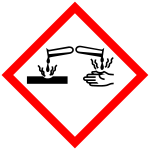

Signal word Danger
Hazard statement(s) H226 Flammable liquid and vapour
H315 Causes skin irritation
H318 Causes serious eye damage
H332 Harmful if inhaled
H335 May cause respiratory irritation
Precautionary statement(s) Prevention P210 Keep away from heat, hot surfaces, sparks, open flames and other ignition sources. No smoking.
P233 Keep container tightly closed.
P240 Ground and bond container and receiving equipment.
P241 Use explosion-proof [electrical/ventilating/lighting/...] equipment.
P242 Use non-sparking tools.
P243 Take action to prevent static discharges.
P280 Wear protective gloves/protective clothing/eye protection/face protection/hearing protection/...
P264 Wash ... thoroughly after handling.
P261 Avoid breathing dust/fume/gas/mist/vapours/spray.
P271 Use only outdoors or in a well-ventilated area.
Response P303+P361+P353 IF ON SKIN (or hair): Take off immediately all contaminated clothing. Rinse affected areas with water [or shower].
P370+P378 In case of fire: Use ... to extinguish.
P302+P352 IF ON SKIN: Wash with plenty of water/...
P321 Specific treatment (see ... on this label).
P332+P317 If skin irritation occurs: Get medical help.
P362+P364 Take off contaminated clothing and wash it before reuse.
P305+P354+P338 IF IN EYES: Immediately rinse with water for several minutes. Remove contact lenses, if present and easy to do. Continue rinsing.
P317 Get medical help.
P304+P340 IF INHALED: Remove person to fresh air and keep comfortable for breathing.
P319 Get medical help if you feel unwell.
Storage P403+P235 Store in a well-ventilated place. Keep cool.
P403+P233 Store in a well-ventilated place. Keep container tightly closed.
P405 Store locked up.
Disposal P501 Dispose of contents/container to an appropriate treatment and disposal facility in accordance with applicable laws and regulations, and product characteristics at time of disposal.
Other hazards which do not result in classification
no data available
Handling and StoragePrecautions for safe handling
NO open flames, NO sparks and NO smoking. Above 42°C use a closed system, ventilation and explosion-proof electrical equipment. Handling in a well ventilated place. Wear suitable protective clothing. Avoid contact with skin and eyes. Avoid formation of dust and aerosols. Use non-sparking tools. Prevent fire caused by electrostatic discharge steam.
Conditions for safe storage, including any incompatibilities
Fireproof. Separated from strong oxidants and reducing agents.IN GENERAL, MATERIALS WHICH ARE TOXIC AS STORED OR WHICH CAN DECOMP INTO TOXIC COMPONENTS ... SHOULD BE STORED IN A COOL, WELL-VENTILATED PLACE, OUT OF DIRECT RAYS OF THE SUN, AWAY FROM AREAS OF HIGH FIRE HAZARD, & SHOULD BE PERIODICALLY INSPECTED ... INCOMPATIBLE MATERIALS SHOULD BE ISOLATED FROM EACH OTHER.
-
-
Seller Information
-
Business Type:
Trader
-
Main Products:
Food Chemicals,Industrial Chemicals,Organic Chemicals
-
Location:
BINNEN PARALLELWEG 00027 5701PH HELMOND
-
Payment Terms:
TT against copy of documents
-
Average lead Time:
300 days
-
Total Annual Revenue:
$1 million-$2.5 million
-
Total Employees:
5-10
-
Year of Establishment:
1969
-
-
Inquiry History3 Inquiries
Country Product Purchase Quantity Date Posted  Russia
Isoamyl alcohol 99% min (CAS 123-51-3)
1 20' Fcl Feb 10, 2025  Israel
isoamyl alcohol
100 MT Nov 23, 2023  India
India
Isoamyl Alcohol
1 KG Feb 10, 2026 Post an enquiry for this product
More from this Seller
-
-

-
Paraffin Wax White low viscosity 100% White Powder
Industrial Grade / 100%
-
-
-

-
Retatrutide GLP-1 / GIP / GCGR
Pharmaceutical Grade / 100%
$400-500/MT FOB
-
-
-

-
copper pyrithione4
Industrial Grade / 100%
-
-
-

-
3-Chloro-2-hydroxypropyl trimethyl ammonium chloride
Industrial Grade / 100%
-
-
-

-
AC blowing agent 99% Azodicarbonamide 100% White Powder
Industrial Grade / 100%
-
-
-

-
Zinc Sulfate Monohydrate456
Food Grade / 100%
$400-500/MT FOB
-



Hot Related Products
-
 121-33-5,Vanillin,99,Vanillin, 4-Hydroxy-3-methoxybenzaldehyde, 3-Methoxy-4-hydroxybenzaldehyde, 2-Methoxy-4-formylphenol
 -
 TUODA-Vanillin
 -
 Vanillin
 -
 vanilin
 -
 Hot Selling Factory Supply Food Flavoring Agent Vanillin CAS 121-33-5
$16.7/KG FOB
-
 Ethyl Vanillin, JIUZHU, POLE BEAR BRAND, CAS
 -
 High quality 99%Vanillin
 -
 vanillin121-33-5
 -
 China Food Ingredient CAS 121-33-5 High Pure Ethyl Vanilla for cake
 -
 Pentane With High Purity