Material Safety Data Sheet
SECTION 1 - PRODUCT AND COMPANY INFORMATION
Product:
Sodium Dichloroisocyanurate Dihydrate
Chemical Family:
Chloroisocyanurate
Formula:
(NaCl2(NCO)3 2H2O)
Synonym(s):
Sodium Dichlor, Sodium dichloro-s-triazinetrione
Supplier:
EAST CHEMSOURCES LIMITED
Address:
NO.666 HAIBIN 12TH ROAD,HUANGDAO,QINGDAO
Tel:
0086 15053231572
SECTION 2 - HAZARDS IDENTIFICATION
Emergency Overview: Harmful if swallowed. Irritant to eyes and respiratory system.
Primary Route(s) of Entry:
Ingestion:
( )
Inhalation:
( )
Skin Contact:
( )
Eye Contact:
( )
Primary Health Hazards (Acute and Chronic): Carcinogenicity Listings:
OSHA:
( )
NTP:
( )
IARC:
( )
Signs & Symptoms of Exposure:
Ingestion: Irritation and/or burns can occur to the entire gastrointestinal tract, including the stomach and
intestines, characterized by nausea, vomiting, diarrhea, abdominal pain, bleeding and/or tissue ulceration.
Ingestion causes severe damage to the gastrointestinal tract with the potential to cause perforation.
Inhalation: Irritating to the nose, mouth, throat, and lungs. It may also cause burns to the respiratory tract with
the production of lung edema that can result in shortness of breath, wheezing, choking, chest pain, and
impairment of lung function. Inhalation of high concentrations can result in permanent lung damage from
the corrosive action of the lung.
Skin Contact: Dermal exposure can cause severe irritation and/or burns characterized by redness, swelling, and
scab formation. Prolonged skin exposure may cause permanent damage.
Eye Contact: Sever irritation and/or burns can occur following eye exposure. Contact may cause impairment of
vision and corneal damage.
Medical Conditions Aggravated by Exposure: Asthma, respiratory and cardiovascular disease.
SECTION 3 - COMPOSITION/INFORMATION ON INGREDIENT
Chemical or Common Name:
CAS #
available chlorine%
Sodium dichloroisocyanurate Dihydrate
51580-86-0
55-57.5
SECTION 4 - FIRST-AID MEASURES
Emergency and First Aid Procedures:
Ingestion: If swallowed, wash mouth thoroughly with plenty of water, give water to drink. Get medical attention
immediately.
Inhalation: In case of dust inhalation or breathing fumes released from heated material, remove person to fresh
air. Keep person quiet and warm. Apply artificial respiration if necessary and get medical attention
immediately.
Skin Contact: Remove contaminated clothing. Wash skin thoroughly with mild soap and plenty of water for at
least 15 minutes. Wash clothing before re- use. Get medical attention immediately.
Eye Contact: Holding the eyelids apart, flush eyes promptly with copious flowing water for at least 20 minutes.
Get medical attention immediately.
Note to Physician: Corrosive. No specific antidote. Treat symptomatically and supportively. In case of ingestion, MSDS of Sodium Dichloroisocyanurate Dihydrate (55%)
Ⓒ
2/5
do not induce vomiting.
SECTION 5 - FIRE-FIGHTING MEASURES
FIRE AND EXPLOSION HAZARD DATA
Flash Point: Not Flammable
Flammable Limits: N/A
LEL:
UEL:
Auto-ignition Temperature: N/A
Extinguishing Media: Water. Do not use dry chemical extinguisher containing ammonia compounds.
Special Fire-fighting Procedures: Fire fighters should wear full protective clothing and self-contained breathing
apparatus (SCBA) in positive pressure mode. Cool containers with water spray. On small fires, use water
spray or fog. On large fires, use heavy deluge of fog streams. Flooding amounts of water may be required
before extinguishment can be accomplished.
Unusual Fire and Explosion Hazards: When heated to decomposition, may release poisonous and corrosive
fumes of nitrogen trichloride, chlorine, and carbon monoxide.
SECTION 6 - ACCIDENTAL RELEASE MEASURES
Steps to Be Taken In Case Material Is Spilled or Released:
Hazardous concentrations in air may be found in local spill area and immediately downwind. If spill material is still
dry, do not put water directly on this product as a gas evolution may occur.
On Soil: Do not contaminate spill material with any organic materials, ammonia, ammonium salts, or urea.
Clean up all spill material with clean, dry dedicated equipment and place in a clean dry container.
On Water: This material is heavier than and soluble in water. Stop flow of material into water as soon a possible.
Begin monitoring for available chlorine and pH immediately.
In Air: vapors may be suppressed by the use of water fog.
SECTION 7 - HANDLING AND STORAGE
Precautions to Be Taken in Handling and Storage:
Handling: Do not take internally. Avoid contact with skin, eyes, and clothing. Upon contact with skin and eyes,
wash off with water.
Storage: Store in a dry, cool, well-ventilated area, away from incompatible materials. Do not store at
temperatures above 60°C/140°F. Product has an indefinite shelf-life limitation.
SECTION 8 - EXPOSURE CONTROLS/PERSONAL PROTECTION
Respiratory Protection: When dusty conditions are encountered, wear a NIOSH/OSHA full-face respirator with
chlorine cartridges, for protection against chlorine gas and dust/mist pre-filter. A respiratory protection
program meeting OSHA 1910.134 and ANSI Z88.2 requirements must be followed whenever workplace
conditions warrant a respirator's use.
Ventilation:
Local Exhaust: Use local exhaust ventilation to minimize dust and chlorine levels where industrial use occurs.
Otherwise, ensure good general ventilation.
Mechanical Exhaust:
Other Protective Clothing or Equipment: Neoprene gloves, Use chemical safety glasses to avoid eye contact.
Where industrial use occurs, chemical goggles may be required. Use impervious body covering clothes,
boots, and neoprene apron.
Work/ Hygienic Practices: Safety showers and eye bath should be provided. Do not eat, drink, or smoke until
after-work showering and changing clothes.
SECTION 9 - PHYSICAL/CHEMICAL CHARACTERISTICS
Boiling Point:
N/A
Vapor Pressure (mm Hg):
N/A under standard conditions
Vapor Density (Air=1):
N/A under standard conditions
Solubility in Water:
25g/100ml @ 30°C
Appearance and odor:
White granular solid with a mild chlorine-like odorMSDS of Sodium Dichloroisocyanurate Dihydrate (55%)
Ⓒ
3/5
Specific Gravity (H2O=1):
0.96
Percent volatile by volume:
N/A
Melting Point:
N/A
Evaporation Rate:
N/A under standard conditions
Molecular weight:
255.98
Bulk Density:
0.90-0.95 g/ml
pH:
5.5-7.0 (1% solution)
Thermal decomposition: Begins to lose 1 mole water at approximately 50°C; second mole water at 95°C;
decomposes at 240-250°C
SECTION 10 - STABILITY AND REACTIVITY
Stability: Stable under normal conditions
Conditions to Avoid: Do not package in paper or cardboard. Begins to lose one mole of water at approximately
50°C. Do not heat above 240°C (464°F).
Incompatibility: Organic materials, reducing agents, nitrogen containing materials, other oxidizers, acids, bases,
oils, grease, sawdust, dry fire extinguishers containing monoammonium compounds.
Hazardous Decomposition or By-Products: Nitrogen trichloride, chlorine, carbon monoxide.
Hazardous Polymerization: Will Not Occur.
Summary of Reactivity:
Oxidizer: Yes
Organic Peroxide: No
Pyroforic: No
Water Reactive: No
SECTION 11 - TOXICOLOGICAL INFORMATION
Acute Toxicity:
Rat oral LD50: 735mg/kg
Rabbit dermal LD50: > 2,000 mg/kg
Rat inhalation LC50: > 50mg/m3 /1 hour
Eye irritation (rabbit): Corrosive
Dermal Irritation (rabbit): Corrosive
Dermal Sensitization (guinea pig): Not a sensitizer
Chronic Toxicity: Chronic inhalation exposure may cause impairment of lung function and permanent lung damage.
Immediately Dangerous to Life or Health (IDLH): No level has been established for the components or the product
itself.
Target Organ Toxicity: This product is corrosive to all tissues contacted and upon inhalation, may cause irritation to
mucous membranes and respiratory tract. There are no known or reported effects from repeated exposure.
Toxicological investigation indicates it does not produce significant effects from chronic exposure.
Reproductive and Development Toxicity: Sodium Dichloroisocyanuric acid, when given orally to pregnant mice
form day 6 to day 15 of gestation, did not induce any significant teratogenic effects.
Carcinogenicity: Not known to be a carcinogen. Not included in NTP 8th Report on Carcinogens. Not classified by
IARC, OSHA, or EPA.
Mutagenicity: Not mutagenic in five Salmonella strains with or without metabolic activation.
SECTION 12 - ECOLOGICAL INFORMATION
Aquatic Toxicity:
96-hour-LC50-Fish: 0.22 mg/l (Rainbow trout), 0.28 mg/l (Bluegill sunfish)
48-hour-LC50-Daphnia magna: 0.2mg/l
Avian Toxicity:
Bobwhite quail, acute oral LD50:
730 mg/kg
Mallard duck, acute oral LD50:
3,300 mg/kg
Mallard duck, dietary LC50:
> 10,000 ppm
Bobwhite quail, dietary LC50:
> 10,000 ppmMSDS of Sodium Dichloroisocyanurate Dihydrate (55%)
Ⓒ
4/5
ENVIRONMENTAL HAZARDS (PR Notice 93-10)
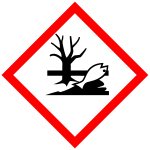
This product is toxic to fish and aquatic organisms. Do not contaminate water by cleaning of equipment or disposal
of wastes. Do not discharge effluent containing this product into lakes, streams, ponds, estuaries, oceans, or other
waters unless in accordance with the requirements of a National Pollutant Discharge Elimination System (NPDES)
permit and the permitting authority has been notified in writing prior to discharge. Do not discharge effluent
containing this product to sewer systems without previously notifying the local sewage treatment plant authority. For
guidance, contact your State Water board or Regional Office of the EPA.
SECTION 13 - DISPOSAL CONSIDERATIONS
Waste Disposal Method: Observe all federal, state, and local environmental regulations when disposing of this
material. Care must be taken to prevent environmental contamination from the use of this material.
Other Precautions: Personal precautions: for small spills in well-ventilated areas, wear a NIOSH approved
half-face or full face tight fitting respirator or a loose fitting powered air purifying respirator equipped with
chlorine cartridges. Chemical goggles should be worn when using a half-face respirator. In addition to
respiratory protection, wear coveralls, chemical resistant gloves, chemical resistant footwear, and chemical
resistant headgear for overhead exposure. For clean up of large spills, or small dry spills in confined areas,
wear full-face respirator with chlorine cartridges or a positive pressure supplied air respirator. Additionally,
body protection should be impervious clothing covering entire body to prevent personal contact with
material.
CAUTION - Protection concerns must also address the following: if this material becomes damp/wet or
contaminated in a container, the formation of nitrogen trichloride gas may occur and an explosive condition
may exist.
SECTION 14 - TRANSPORT INFORMATION
U.S. Department of Transportation - 49 CFR
Proper Shipping Name: SODIUM DICHLOROISOCYANURATE DIHYDRATE
Hazard Class/Division Number:
UN No.: 3077
Class: 9
ID Number: Not regulated
International Maritime Organization - IMDG
UN No.: 3077
Class: 9
IMDG page: 5147
SECTION 15 - REGULATORY INFORMATION
SARA Title III:
Section 311/312 Categorization (40CFR 370.2): This product is categorized as an immediate health hazard, and
fire and reactivity physical hazard.
TSCA: USA: Reported in the EPA TSCA Inventory.
Workplace Classification: This product is considered hazardous under the OSHA Hazard Communication
Standard (29CFR 1910.1200).
Waste Classifications: If this product becomes a waste, it does not meet the criteria of a hazardous waste as
defined under 40 CFR 261, in that it does not exhibit the characteristics of hazardous waste of Subpart C, nor
is it listed as hazardous waste under Subpart D.
EEC: Reported in EINECS (No. 220-767-7, 231-598-3)
Massachussets right-to-know substance list: Listed
Pennsylvania right to know list: Listed
Adverse human Health Effects: Harmful is swallowed
HMIS Rating: Health: 3, Fire: 0, Reactivity: 1
NFPA Rating: Health: 2, Fire: 0, Reactivity: 1
Special Hazard Warning: Oxidizer
SECTION 16 - OTHER INFORMATION
ALWAYS COMPLY WITH ALL APPLICABLE INTERNATIONAL, FEDERAL, STATE AND LOCAL
REGULATIONS REGARDING THE TRANSPORTATION, STORAGE, USE AND DISPOSAL OF THIS MSDS of Sodium Dichloroisocyanurate Dihydrate (55%)
Ⓒ
5/5
CHEMICAL.
Due to the changing nature of regulatory requirements, the REGULATORY INFORMATION listed in Section 15 of
this document should NOT be considered all-inclusive or authoritative. International, Federal, State and Local
regulations should be consulted to determine compliance with all required reporting requirements.
The information in this MSDS was obtained from sources which we believe are reliable. HOWEVER, THE
INFORMATION IS PROVIDED WITHOUT ANY WARRANTY, EXPRESS OR IMPLIED, REGARDING ITS
CORRECTNESS. The conditions or methods of handling, storage, use, and disposal of the product are beyond our
control and may be beyond our knowledge. FOR THIS AND OTHER REASONS, WE DO NOT ASSUME
RESPONSIBILITY AND EXPRESSLY DISCLAIM LIABILITY FOR LOSS, DAMAGE OR EXPENSE ARISING
OUT OF OR IN ANY WAY CONNECTED WITH THE HANDLING, STORAGE, USE OR DISPOSAL OF THE
PRODUCT. This MSDS was prepared and is to be used only for this product.









 Oman
Oman
 India
India
 United Arab Emirates
 United States
 Russia