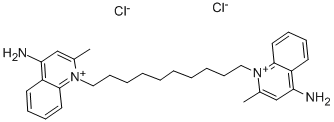
| Description | Dequalinium Chloride is a a potent and selective non-peptide blocker of the apamin-sensitive small conductance Ca2+-activated K+ channel (IC50 = 1.1 mM). |
| Chemical Properties | White or yellowish-white powder, hygroscopic. |
| Originator | Dequsan,Sante |
| Uses | Dequalinium Chloride is a quaternary ammonium cation and the active ingredient in various medications including antiseptic and anti-malarial agents. |
| Definition | ChEBI: Dequalinium chloride is an organic chloride salt that is the dichloride salt of dequalinium. It has a role as an antiseptic drug, a mitochondrial NADH:ubiquinone reductase inhibitor, an antifungal agent and an antineoplastic agent. It contains a dequalinium. |
| Manufacturing Process | a) 15 g of 4-aminoquinaldine, 15 g of decamethylene diiodide and 200 ml of methyl ethyl ketone were refluxed together for 400 hours. The mixture was allowed to cool, the precipitate filtered off, washed with methyl ethyl ketone, and 1,1'-decamethylenebis(4-aminoquinaldinium chloride) recrystallized from ethyl alcohol containing a little methyl alcohol.
b) 160 g of 4-aminoquinaldine, 174 g of decamethylene diiodide and 1,500 ml of methyl isobutyl carbinol were heated together at 120°C for 90 hours. The mixture was allowed to cool, the precipitate filtered off, washed with methyl ethyl ketone and 1,1'-decamethylenebis(4-aminoquinaldinium chloride) recrystallized from ethyl alcohol containing a little methyl alcohol.
b) 160 g of 4-aminoquinaldine, 174 g of decamethylene diiodide and 1,500 ml of methyl isobutyl carbinol were heated together at 120°C for 90 hours. The mixture was allowed to cool, the precipitate filtered off, washed with methyl ethyl ketone and 1,1'-decamethylenebis(4-aminoquinaldinium chloride) recrystallized from ethyl alcohol containing a little methyl alcohol. |
| Brand name | Decabis;Dequacaine;Dequafungan;Dequin;Faringina;Gargilon;Grocreme;Labosept;Maltyl;Phylletten;Soor-gel;Sorot;Tetesept. |
| Therapeutic Function | Antiseptic, Antifungal |
| World Health Organization (WHO) | Skin reactions to dequalinium chloride, including necrotic lesions, have been reported. It remains available as a mouth and throat disinfectant in many countries. |
| General Description | Dequalinium Chloride is a topical bacteriostat that is available as various salts. It is used in wound dressings and mouth infections and may also have antifungal action, but may cause skin ulceration. |
| Biological Activity | Dequalinium is a quaternary ammonium cation with diverse biological activities. It has antifungal activity against C. albicans, C. glabrata, and C. krusei (MICs = 0.5-2, 64-256, and 128 μg/ml, respectively), antitrichomonal activity against T. vaginalis (MICs = 28.8-230.4 μg/ml), and antibacterial activity against a panel of aerobic and facultative anaerobic bacteria (MICs = 0.25-256 μg/ml). Dequalinium inhibits apamin binding to, and net potassium loss mediated by, SKCa channels in guinea pig hepatocytes stimulated by angiotensin II (Item No. 17150). In vivo, dequalinium (1-10 mg/kg) inhibits primary and recurrent tumor growth in a W163 rat colon carcinoma isograft model. |
| References | 1) Miyata?et al.?(2014),?Pharmacologic rescue of an enzyme-trafficking defect in primary hyperoxaluria 1; Proc. Natl. Acad. Sci. USA?111?14406
2) Frey Tirri?et al.?(2011),?Antimicrobial topical agents used in the vagina; Curr. Probl. Dermatol.?40?36
3) Castle?et al.?(1993),?Dequalinium: a potent inhibitor of apamin-sensitive K+ channels in hepatocytes and of nicotinic responses in skeletal muscle; Eur. J. Pharmacol.?236?201
4) Orzaez?et al.?(2011),?Characterization of dequalinium as a XIAP antagonist that targets the BIR2 domain; Apoptosis?16?460 |