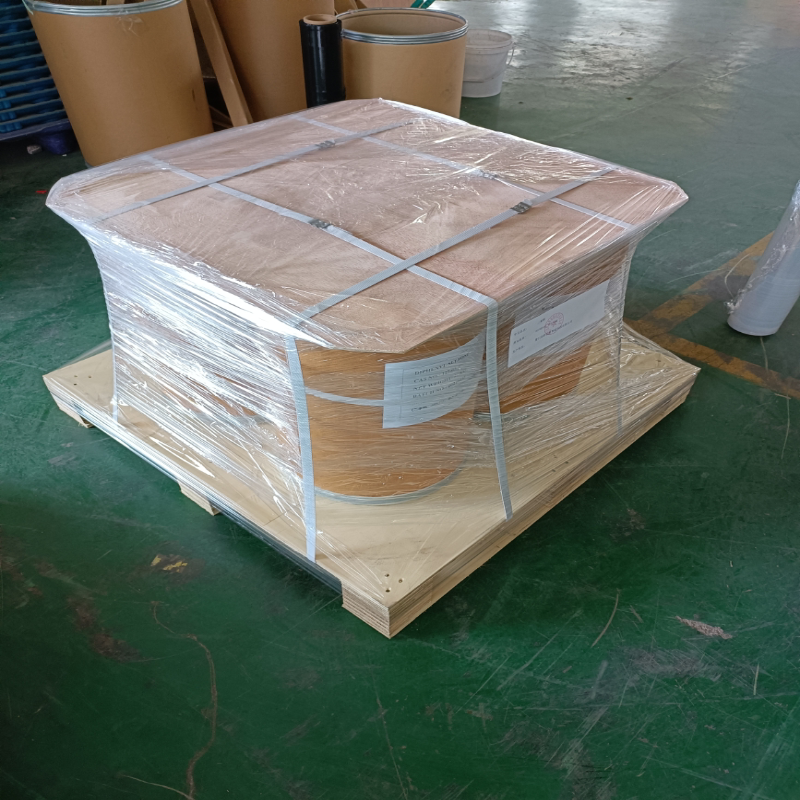
Product Name: Triforine
COA
26644-46-2
Industrial Grade
98%
Durban Port
UMGS
Packaging Sizes: 100 ml, 250 ml, 500 ml, 1 L, 5 L (EC formulations) 100g, 250g sachets (WP formulation)
2025-06-18

Chemicals bulk
-
Product Details
-
Seller Information
-
DescriptionECHEMI Editorial ReferenceChEBI: A member of the class of N-alkylpiperazines in which the two amino groups of piperazine are replaced by 1-formamido-2,2,2-trichloroethyl groups. A fungicide active against a range of diseases including powdery mildew, scab and rust.
Triforine appears as colorless crystals. Non corrosive. Used as a fungicide.
Triforine appears as colorless crystals. Non corrosive. Used as a fungicide.|Triforine is a member of the class of N-alkylpiperazines in which the two amino groups of piperazine are replaced by 1-formamido-2,2,2-trichloroethyl groups. A fungicide active against a range of diseases including powdery mildew, scab and rust. It has a role as an EC 1.14.13.70 (sterol 14alpha-demethylase) inhibitor, an allergen and an antifungal agrochemical. It is a N-alkylpiperazine, a member of formamides, an organochlorine compound and an amide fungicide.CertificatesBasic Info-
Product Name:
Triforine
Other Name:Formamide,N,N′-[1,4-piperazinediylbis(2,2,2-trichloroethylidene)]bis-;N,N′-[1,4-Piperazinediylbis(2,2,2-trichloroethylidene)]bis[formamide];N,N′-Bis(1-formamido-2,2,2-trichloroethyl)piperazine;Triforine;CELA-W 524;1,4-Bis(1-formamido-2,2,2-trichloroethyl)piperazine;Triforin;W 524;Funginex;Saprol;Biformylchlorazin;CA 70203;CELA 50;Asepta Funginex;NSC 263493;36660-66-9;37273-84-0;1135442-61-3
CAS No.:26644-46-2
Molecular Formula:C10H14Cl6N4O2
InChIKeys:InChIKey=RROQIUMZODEXOR-UHFFFAOYSA-N
Molecular Weight:434.96
Exact Mass:434.96
EC Number:247-872-0
UNII:N1A4W8U0HH
NSC Number:263493
UN Number:2588
DSSTox ID:DTXSID5032654
Color/Form:White to light brown crystals.
HScode:2933599019
Categories:
Characteristics-
PSA:
64.7
XLogP3:2.20
Density:1.554 g/cm3 @ Temp: 20 °C
Melting Point:155 °C (decomp)
Boiling Point:561.5±50.0 °C at 760 mmHg
Flash Point:293.4±30.1 °C
Refractive Index:1.571
Water Solubility:In water, 30 mg/L at 25 deg C.
Storage Conditions:0-6°C
Vapor Pressure:8 x 10 -2 Pa (25 °C)
Toxicity:Oral-Rat LD50: 6000 mg/kg; Oral-Mouse LD50: 6000 mg/kg
Flammability characteristics:Combustion produces toxic chloride and nitrogen oxide gases
Henrys Law Constant:Henry's Law constant = 3.8X10⁻⁹ atm-cu m/mole @ 25 °C /Estimated/
Dissociation Constants:pKa = 10.6
Collision Cross Section:185.83 Ų [M+Cl]-
Experimental Properties:Stable at less than or equal to 180 °C. Decomposed in aqueous solution exposed to UV or daylight. Decomposed in strongly acidic media (to trichloroacetaldehyde and piperazine salts) and in strongly alkaline media (to chloroform and piperazine); half-life of 3.5 days at pH 5 to 7 , 25 °C.|Hydroxyl radical reaction rate constant = 6.6X10⁻¹¹ cu cm/molecule-sec @ 25 °C /Estimated/
Air and Water Reactions:No rapid reaction with air. No rapid reaction with water.
Reactive Group:Amides and Imides
Reactivity Profile:A piperazine, trichloromethylformamide derivative. Decomposed in strong acid to trichloroacetaldehyde and piperazine salts, and in strongly alkaline media to chloroform and piperazine.
Hazard IdentificationClassification of the substance or mixture
Acute toxicity - Category 4, Oral
GHS label elements, including precautionary statements
Pictogram(s) 
Signal word Warning
Hazard statement(s) H302 Harmful if swallowed
Precautionary statement(s) Prevention P264 Wash ... thoroughly after handling.
P270 Do not eat, drink or smoke when using this product.
Response P301+P317 IF SWALLOWED: Get medical help.
P330 Rinse mouth.
Storage none
Disposal P501 Dispose of contents/container to an appropriate treatment and disposal facility in accordance with applicable laws and regulations, and product characteristics at time of disposal.
Other hazards which do not result in classification
no data available
Handling and StoragePrecautions for safe handling
Handling in a well ventilated place. Wear suitable protective clothing. Avoid contact with skin and eyes. Avoid formation of dust and aerosols. Use non-sparking tools. Prevent fire caused by electrostatic discharge steam.
Conditions for safe storage, including any incompatibilities
Store the container tightly closed in a dry, cool and well-ventilated place. Store apart from foodstuff containers or incompatible materials.
-
-
Seller Information
-
Business Type:
Distributor
-
Main Products:
Chemicals bulk
-
Location:
1 WOODMEAD DR WOODMEAD SANDTON JOHANNESBURG GAUTENG 2191
-
Payment Terms:
TT against B/L draft before shipment,100% TT in advance
-
Year of Establishment:
2023
-
-
Country Product Purchase Quantity Date Posted Post an enquiry for this product
More from this Seller
-
-
")
-
Isobutylidene Diurea (IBDU)
Agricultural Grade / 90%
-
-
-

-
Bentonite Granules Premium Quality Natural Clay for Industrial & Agricultural Use
Agricultural Grade / 85%
-
-
-
benzothiazole (TCMTB)")
-
2-(Thiocyanomethylthio)benzothiazole (TCMTB)
Pharmaceutical Grade / 95%
-
-
-

-
Sodium Naphtha Sulphonate High-Performance Dispersant & Wetting Agent
Industrial Grade / 5%
-
-
-

-
Penconazole Systemic Triazole Fungicide for Preventive & Curative Disease Control
Pharmaceutical Grade / 98%
-
-
-

-
Ziram Broad-Spectrum Protective Fungicide
Industrial Grade / 97%
-


Hot Related Products
-
 manufacturer of Magnesium sulfate anhydrous
$570-700/MT FOB
-
") Anhydrous Piperazine (PIP)
Anhydrous Piperazine (PIP) -
 MAGNESIUM SULPHATE HEPTAHYDRATE White free flow crystals
 -
 More than 15 years GMP Factory Suppy 99.5% Magnesium sulfate Medical Grade CAS 10034-99-8
 -
 Magnesium Sulphate Heptahydrate 99% Industrial Grade for Agriculture Fertilizer Supplier India
 -
 Magnesium sulfate heptahydrate Magnesium sulfate Magnesium Fertilizer
 -
 Magnesium Sulphate Heptahydrate 99% White or colorless acicular or oblique columnar crystals
 -
 Magnesium sulfate heptahydrate RC04542
$1/KG EXW
-
 Triethylamine 99% Powder SAA998609989 SAA
$8700-9200/MT FOB
-
 top sale magnesium sulfate heptahydrate