Product
Supplier
Encyclopedia
Inquiry
cellulase CAS:9012-54-8 buy - large image1
cellulase CAS:9012-54-8 buy - image1
cellulase CAS:9012-54-8 buy - image2
cellulase CAS:9012-54-8 buy - image3
cellulase CAS:9012-54-8 buy - image4
cellulase CAS:9012-54-8 buy - image5
cellulase CAS:9012-54-8 buy - image6

cellulase CAS:9012-54-8

TDS 8 Inquiries

Unit Price: Get Latest Price
CAS No.:

9012-54-8

Grade:

Industrial Grade

Content:

98%

Port:

SHANGHAI

Brand:

Orient

Packaging:

1KG, 25KG, 200KG, 1000KG, customized

Price valid (until):

2026-01-12

Company Type:
Trader
Location:
China
Qualification:
Main Products:

pharmaceutical intermediates,peptides,electronic chemicals

  • Product Description

  • Seller Information

  • Inquiry History

  • Description

    Focusing on innovative research, development, and production in the field of fine chemicals, we prioritize technology, quality, and market orientation. We collaborate with global partners to build a high-tech chemical industry chain and promote sustainable development in the industry.

    The company's main products include pharmaceutical intermediates, food additives, essence, spices and plant extracts. The products have passed international certification and are exported to Europe, America, Japan, South Korea and Southeast Asia.


    Product Name: cellulase
    Synonyms: Celluase;cellulasefromtrichodermalongibrachia-tum;qianweimeis;Fungalcellulase;1,4-[1,3:1,4]-BETA-D-GLUCAN;1,4-[1,3:1,4]-BETA-D-GLUCAN 4-GLUCANO-HYDROLASE;IUB: 3.2.1.4;MEICELASE
    CAS: 9012-54-8
    MF: NULL
    MW: 0
    EINECS: 232-734-4
    Product Categories: Biochemistry;Enzyme;Glycohydrolase;Hydrolase;3.2.x.x Glycosidases;3.x.x.x Hydrolases;Application Index;Carbohydrate hydrolysis&PTM analysis;Carbohydrate HydrolysisEnzyme Class Index;9012-54-8
    Mol File: Mol File
    Shop cellulase CAS:9012-54-8-Detailed Image 1

    cellulase Chemical Properties
    density  1.2 g/mL at 25 °C
    vapor pressure  0.004Pa at 25℃
    storage temp.  2-8°C
    solubility  deionized water: soluble5.0mg/mL (Sterile; In the presence of 0.15% polyhexamethylene biguanide (PHMB).)
    form  powder
    color  white
    biological source fungus (Trichoderma viride)
    Water Solubility  Soluble in cold water.
    Specific Activity 3-10units/mg solid
    LogP -1.3 at 20℃
    EPA Substance Registry System Cellulase (9012-54-8)

    Safety Information
    Hazard Codes  Xn,Xi
    Risk Statements  42
    Safety Statements  22-24-36/37-2-45-23
    WGK Germany  1
    RTECS  FJ5375000
    3-10
    TSCA  Yes
    HS Code  35079090
    MSDS Information

    cellulase Usage And Synthesis
    Brief Introduction Cellulase naturally occurs in plant tissues; wherein it acts as a reinforcing material. It is thick and viscous in its physical arateristics, which makes it ideal for adding to foods and beverages to make ingredients combine and congealtogether. Cellulase is found in all plants and is quite abundant. Actually, it is the most widespread organic compound and is found in every habitat around the world. Its abundance and ease of acquisition make cellulase an ideal additive to foods and drinks, because it is cheap and easy to extract. Cellulase, as a nutrient, belongs to the category of roughage or fiber. Its binding properties make it popular among large-scale food and drink industries, who use it produce fruit juice, sparkling waters, spirits and other alcoholic beverages. When combined with other enzymes, cellulase is applied to produce wine; here its role is to extract foreign and unwanted substances from grape skins. In less quantities, cellulase is added as a congealant to washing and cleaning agents.
    Chemical properties It appears as off-white amorphous powder or liquid. It is soluble in water, almost insoluble in ethanol, chloroform and ether. It is relatively stable against heat. Even after being heated at 100 ℃ for 10min, it can still maintain 20% of the original activity. The general optimum temperature is 50~60 ℃, the optimum Ph value is 4.5~5.5.
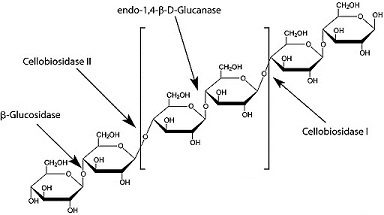
    Biological enzymes Cellulase is a group of enzymes that catalyze the hydrolysis of cellulose to produce glucose and low polymerizing fibers, including three major components of dextran endonuclease, dextran exonuclease and cellobietase. It is not a single enzyme, but a synergistic multi-component enzyme system. Cellulase is an off-white powder or liquid. In 1906, Seilliere found the cellulase in the digestive solution of the snail. The cellulase hydrolyzes the β-1, 4-glucosidic linkages in the fibers to produce soluble polymers and D-glucose. Endocellulase breaks down internal bonds that it interrupts the cellulose’s crystalline structure, causing the exposure of cellulose polysaccharide chains.
    Exocellulase continues the process of endocellulase by breaking down the ends of the particular chains into maximum 4 units. That’s how disaccharides or tetrasaccharides like the cellobiose appear. Exocellulases were found in 2 forms: CBHII acts at the non-reducing cellulose end while the CBHI acts at the reducing end.
    Beta-glucosidase or cellobiase usually hydrolyses the above mentioned exocellulase and produces monosaccharides. The oxidative cellulase uses radical reactions like dehydrogenase and cellobiose to depolymerize cellulose. The activity of cellulase is commonly to split cellulose and convert it into beta-glucose. The symbiotic bacteria of herbivores produce this form of cellulase. Humans and other animals, besides ruminants, cannot generate this form of cellulase. Thus, they can split it only partially by using fermentation and they are not able to utilize the energy from the fibrous plants.
    According to the source of the enzyme, the relative molecular mass of the lowest 5000, up to 400000. The optimum pH is 4.0 to 5.0. The optimum temperature is 40~60 ℃. Some of the metal ions Mg2 +, Cl2 + and neutral salts can activate the enzyme, and some other metal ions Ag2 +, Cu2 +, Mn2 +, Hg2 + and dyes can inactivate the enzyme.
    The addition of cellulase to the wine can improve the saccharification effect and the liquor yield, and reduce the viscosity of the mash. Cellulase mainly comes from Aspergillus Niger and Trichoderma.
    Shop cellulase CAS:9012-54-8-Detailed Image 2
    Figure 1 the molecular structural formula of the cellulase
    Source The source of cellulase is very broad. Insects, mollusks, protozoa, bacteria, actinomycetes, fungi and so can all produce cellulase.
    1. Bacteria: Bacteria produce a lower amount of cellulase, mainly EG, most of which are not active against crystalline cellulose, and the resulting enzyme is an intracellular enzyme or adsorbed on the bacterial wall and rarely secreted into the extracellular which increases the difficulty of extraction and purification. Therefore, in practice, bacteria are rarely used in industry. At present, more research focuses on the cellulose slime, Anoeba limax Duzardin and fibrobacter.
    2. Actinomyces: Very few studies focus on actinomycetes. Mycobacterium and the original actinomycete produce almost no cellulase or have low yield; species produce a relatively high amount include black and red spin actinomycetes, rose actinomycetes, actinomycetes cellulosae and white rose actinomycetes.
    3. Fungi: Current microorganisms used in the production of cellulase mostly belong to fungi with more studies focusing on Trichoderma, Aspergillus, Rhizopus and Peculiar mold. They can produce a large number of cellulase, especially for Trichoderma. Trichoderma reesei and Trichoderma viride are fungi with high enzyme activity in Trichoderma. The fungi can produce three types of cellulase, being able to be secreted into the bacteria. They generally don’t gather to form a multi-enzyme complex, but having a strong synergistic effect with each other. At present, its preparations include cellulase from Trichoderma viride, Aspergillus Niger, Fusariumsis, Paecilomyces and Penicillium decumbens and other cellulase.
    Microorganisms of the genera Trichoderma and Aspergillus are regarded to be cellulase producers, and crude enzymes produced by these microorganisms are commercially available for use in agriculture. Microorganisms of the genus Trichoderma produce comparatively large quantities of endo-ß-glucanase and exo-ß-glucanase, but only low levels of ß-glucosidase, while those of the genus Aspergillus produce comparatively large quantities of endo-ß-glucanase and ß-glucosidase with low levels of exo-ß-glucanase production.
    4. Yeast: Due to the demand for industrial production of cellulase, it is required to increase enzyme production, exocrine and heat resistance. Recently, more and more research has been done on cellulase gene cloning. Although almost all of the cloned genes can be expressed in E. coli, but due to extraction difficulties and low level of expression, the current gene expression research has been transferred to the eukaryotic expression system. Yeast expression systems are mostly applied currently. Yeast does not produce toxins. Apply it for the expression of cellulase gene, the product is highly glycosylated. After correct processing and modification, it can be directly secreted into the medium with the expression level being high. For example, the yield of the CHB Ⅱ, EG Ⅰ expressed in yeast is up to 100mg/L or more, and has a normal biological activity.

    First aid measures

    General advice
    Consult a physician. Show this material safety data sheet to the doctor in attendance.
    If inhaled
    If breathed in, move person into fresh air. If not breathing, give artificial respiration. Consult a physician.
    In case of skin contact
    Wash off with soap and plenty of water. Consult a physician.
    In case of eye contact
    Rinse thoroughly with plenty of water for at least 15 minutes and consult a physician.
    If swallowed
    Never give anything by mouth to an unconscious person. Rinse mouth with water. Consult a physician.

    Firefighting measures


    Suitable extinguishing media
    Use water spray, alcohol-resistant foam, dry chemical or carbon dioxide.
    Special hazards arising from the substance or mixture

    Carbon oxides Nitrogen oxides (NOx)

    Advice for firefighters

    Wear self-contained breathing apparatus for firefighting if necessary.

    Shop Diethyl oxalacetate sodium salt 40876-98-0-Detailed Image 2

    Shop Trimellitic Anhydride  C9H4O5 552-30-7-Detailed Image 2

    Shop Trimellitic Anhydride  C9H4O5 552-30-7-Detailed Image 3


    Shop Trimellitic Anhydride  C9H4O5 552-30-7-Detailed Image 4

    Shop Trimellitic Anhydride  C9H4O5 552-30-7-Detailed Image 5

    Shop Trimellitic Anhydride  C9H4O5 552-30-7-Detailed Image 6


    Shop Trimellitic Anhydride  C9H4O5 552-30-7-Detailed Image 7


    Shop Trimellitic Anhydride  C9H4O5 552-30-7-Detailed Image 8

    Shop Trimellitic Anhydride  C9H4O5 552-30-7-Detailed Image 9

    Shop Trimellitic Anhydride  C9H4O5 552-30-7-Detailed Image 10

    Shop Trimellitic Anhydride  C9H4O5 552-30-7-Detailed Image 11

    Shop Trimellitic Anhydride  C9H4O5 552-30-7-Detailed Image 12

    ——  Q&A  ——

    Q1:Do you provide sample?

    A: Yes, we can provide free sample, you only need pay the shipping cost.

    Q2: What is the lead time?

    A: For stock goods, it usually take about 5-7 days by air, 15-30 days by sea,For customized products, the delivery time needs to be confirmed based on the actual situation.

    Q3: How can I buy? What is the payment method?

    A: You can contract us through Email or you can browse our website:orientchem.cc, we have bank transfer,

    A:We attach great importance to after-sales service of our products. If there are any quality issues, please contact us within 30 days of receiving the goods and we will handle returns and exchanges for you.


    Certificates

    Basic Info
    Product Name:

    Cellulase

    Other Name:

    Cellulase;E.C. 3.2.1.4;Endo-1,4-β-glucanase;β-1,4-Glucanase;Endocellulase;β-1,4-Endoglucan hydrolase;Cellzyme;Avicelase;Endo-β-1,4-glucanase;Pancellase SS;Endo-1,4-β-D-glucanase;Cellulysin;Celluclast 2.0L;Meicelase CEP;Cellulase A;Cellulosin AP;Onozuka R 10;Enzylon CA 40;Endoglucanase D;Celluclast 250L;Cooper cellulase;Maxazyme;SP 227;Macerozyme R 10;Meicelase CM 8B;Alkali cellulase;Cellulase A 3;Cellodextrinase;Zimet 43/803;Zimet 43/802;Zimet 43/804;Genencor 150L;Onozuka SS;Celluclast;Cellzyme 2400T;Spezyme FP 100;Meicelase;SP 359;Celluclast 2L;Cx-cellulase;Endoglucanase I;Cellulase K 344;Cellulase K 425;Endoglucanase 3;Celluzyme 1500T;Celluzyme;Avicelase I;Econase CE;1,4-β-D-Glucan endoglucanase;Onozuka RS;Onozuka P 500;1,4-β-D-Endoglucanase;β-1,4-Glycanase;Enchiron CM 10;Endoglucanase CelD;Endoglucanase E;Endoglucanase Z;Vesselex;Cellulase Y-NC;Onozuka FA;Endoglucanase E';Cellulase Cx;Cellulase Ononzuka 3S;Endoglucanase V;Cellulase TL 1000;EG III cellulase;Cellulase EG III;1,4-β-D-Glucan 4-glucanohydrolase;Maxazyme CL 2000;Endoglucanase K;Enzylon CM 10;Biocellulase;Cellulase YC;Cellulase ML;Celluclast 1.5L;β-1,4-D-Endoglucanase;Primafast 100;Pergalase A 40;Denimax T;Enzylon CM 40L;Godo TCL;Carezyme;Roglyr 1538;Rucolase;SP 424;SP 640;SP 431;Endoglucanase G;Celluzyme 0.7T;Enzylon CM 20L;Cellusoft;OP 8800;Hostazym C;Cellulyve Tr 300G;Cellulyve Tr 340G;Novozyme 342;9037-40-5;143296-48-4;145172-25-4;149718-64-9;152443-09-9;160995-61-9;179530-34-8;214975-89-0;881098-86-8;2242562-77-0

    CAS No.:

    9012-54-8

    InChIKeys:

    FYGDTMLNYKFZSV-CSHPIKHBSA-N

    Molecular Weight:

    504.4

    Exact Mass:

    504.169037

    EC Number:

    232-734-4

    HScode:

    35079090

    Characteristics
    PSA:

    269

    XLogP3:

    -3.25

    Appearance:

    white powder

    Density:

    1.8±0.1 g/cm3

    Boiling Point:

    865.2±65.0 °C at 760 mmHg

    Flash Point:

    477.0±34.3 °C

    Refractive Index:

    1.673

    Water Solubility:

    soluble in cold water.deionized water: soluble 5.0mg/mL (Sterile; In the presence of 0.15% polyhexamethylene biguanide (PHMB).)

    Storage Conditions:

    2-8°C

    Hazard Identification

    Classification of the substance or mixture

    Respiratory sensitization, Category 1

    GHS label elements, including precautionary statements

    Pictogram(s)

    Signal word

    Danger

    Hazard statement(s)

    H334 May cause allergy or asthma symptoms or breathing difficulties if inhaled

    Precautionary statement(s)
    Prevention

    P261 Avoid breathing dust/fume/gas/mist/vapours/spray.

    P284 [In case of inadequate ventilation] wear respiratory protection.

    Response

    P304+P340 IF INHALED: Remove person to fresh air and keep comfortable for breathing.

    P342+P316 If experiencing respiratory symptoms: Get emergency medical help immediately.

    Storage

    none

    Disposal

    P501 Dispose of contents/container to an appropriate treatment and disposal facility in accordance with applicable laws and regulations, and product characteristics at time of disposal.

    Other hazards which do not result in classification

    no data available

    Handling and Storage

    Precautions for safe handling

    Handling in a well ventilated place. Wear suitable protective clothing. Avoid contact with skin and eyes. Avoid formation of dust and aerosols. Use non-sparking tools. Prevent fire caused by electrostatic discharge steam.

    Conditions for safe storage, including any incompatibilities

    Store the container tightly closed in a dry, cool and well-ventilated place. Store apart from foodstuff containers or incompatible materials.

  • Seller Information
    Business Type:

    Trader

    Main Products:

    pharmaceutical intermediates,peptides,electronic chemicals

    Location:

    Room 102, 1st Floor, East Office Building, No. 45 Pengwan Road, Qianwan Bonded Port Area, Qingdao Zone, China (Shandong) Pilot Free Trade Zone

    Payment Terms:

    100% TT in advance

    Average lead Time:

    10

    Total Annual Revenue:

    $10 million-$25 million

    Total Employees:

    51-100

    Year of Establishment:

    2024

    A reliable supplier is like insurance.

    We are mainly specilized in supply of pharmaceutical intermediates, electronic chemicals,food additives, and other fine chemical products.
    Integrity is the foundation, quality is life. We would like to work together with you to build a greener and brighter future.

    Website: orientchem.cc
    Email: scarlett@orientchem.cc
    WhatsApp: +86 17753254221

  • Inquiry History
    8 Inquiries
    Country Product Purchase Quantity Date Posted
    Pakistan

    BIO POLISH Enzyme

    1 TON Aug 24, 2023
    Pakistan

    BIO POLISH Enzyme

    1 20' Fcl Nov 7, 2023
    United States

    Alkaline cellulase (endo-1,4-β-glucanase)

    50 KG Dec 9, 2025
    South Korea

    Cellulase

    100 G Jun 9, 2025
    Pakistan

    BIO POLISH Enzyme for Textile Auxiliary FOR COTTON TEXTILE

    1 20' Fcl May 8, 2024
    Kazakstan

    Cellulase

    1 MT Aug 5, 2025
    Bangladesh

    Raw Biopolish Enzyme

    2.00 MT Apr 14, 2025
    India

    cellulase

    5 MT Nov 1, 2023
    Post an enquiry for this product
pic ×

Scan the QR Code to Share

All products displayed on this website are only for non-medical purposes such as industrial applications or scientific research, and cannot be used for clinical diagnosis or treatment of humans or animals. They are not medicinal or edible.

According to relevant laws and regulations and the regulations of this website, units or individuals who purchase hazardous materials should obtain valid qualifications and qualification conditions.

The information shown above is provided by the enterprise itself, and the authenticity, accuracy and legitimacy of the content are the responsibility of the publishing company. ECHEMI does not bear any guarantee responsibility for this. Please be aware that risks in internet transactions objectively exist.

Feedback & Suggestions
Send Message

Thank you for your feedback. If you require further assistance, please contact us by email at info@echemi.com or call us at +86-532-55729510.