Product
Supplier
Encyclopedia
Inquiry
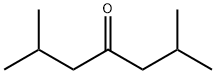
2,6-Dimethyl-4-heptanone108-83-8 buy - large image1
2,6-Dimethyl-4-heptanone108-83-8 buy - image1
2,6-Dimethyl-4-heptanone108-83-8 buy - image2
2,6-Dimethyl-4-heptanone108-83-8 buy - image3
2,6-Dimethyl-4-heptanone108-83-8 buy - image4
2,6-Dimethyl-4-heptanone108-83-8 buy - image5
2,6-Dimethyl-4-heptanone108-83-8 buy - image6

2,6-Dimethyl-4-heptanone108-83-8

7 Inquiries

Unit Price: Get Latest Price
CAS No.:

108-83-8

Grade:

Pharmaceutical Grade

Content:

99.5%

Port:

上海

Brand:

OORENT

Packaging:

Vial/Bottle/Bag/Carton

Price valid (until):

2026-07-17

Company Type:
Trader
Location:
China
Qualification:
Main Products:

pharmaceutical intermediates,peptides,electronic chemicals

  • Product Description

  • Seller Information

  • Inquiry History

  • Description

    Product Detail  

    2,6-Dimethyl-4-heptanone Basic information
    Product Name: 2,6-Dimethyl-4-heptanone
    Synonyms: 2,6-DIMETHYL-4-HEPTANONE;2,6-Dimethyl-4-heptanone, remainder mainly 4,6-dimethyl-2-heptanone;Diisobutyl ketone~Isovalerone;Dimethylheptanone;2 6-DIMETHYL-4-HEPTANONE 99+%;2,6-DIMETHYL-4-HEPTANONE, TECH., 80%;2,6-Dimethyl-4-Heptanone,Purified;2,6-Dimethyl-4-heptanone, remainder mainly 4,6-dimethyl-2-heptanone, tech., 80%
    CAS: 108-83-8
    MF: C9H18O
    MW: 142.24
    EINECS: 203-620-1
    Product Categories:
    Mol File: 108-83-8.mol
    Shop 2,6-Dimethyl-4-heptanone108-83-8-Detailed Image 1

    2,6-Dimethyl-4-heptanone Chemical Properties
    Melting point  -46 °C
    Boiling point  165-170 °C(lit.)
    density  0.808 g/mL at 25 °C(lit.)
    vapor density  4.9 (vs air)
    vapor pressure  1.7 mm Hg ( 20 °C)
    refractive index  n20/D 1.412(lit.)
    FEMA  3537 | 2,6-DIMETHYL-4-HEPTANONE
    Fp  120 °F
    storage temp.  Store below +30°C.
    solubility  Miscible with ethanol, ether, carbon tetrachloride, chloroform, benzene and most organic liquids.
    form  Liquid
    color  Clear colorless to slightly yellow
    Specific Gravity 0.810 (20/4℃)
    Odor Sweet Pineapple-Banana-like fruity taste, but with a somewhat harsh chemical note.
    Odor Type green
    biological source synthetic
    explosive limit 0.8-6.2%, 100°F
    Water Solubility  0.05 g/100 mL
    JECFA Number 302
    BRN  1743163
    Henry's Law Constant 6.36(x 10-4 atmm3/mol) at 20 °C (approximate - calculated from water solubility and vapor pressure)
    Exposure limits ACGIH:TLV-TWA 25 ppm (145 mg/m3)
    OSHA:PEL-TWA 50 ppm (290 mg/m3)
    NIOSH:REL-TWA 25 ppm
    Dielectric constant 9.9100000000000001
    Stability: Stable. Flammable. Incompatible with strong oxidizing agents.
    Major Application flavors and fragrances
    Cosmetics Ingredients Functions PERFUMING
    InChI 1S/C9H18O/c1-7(2)5-9(10)6-8(3)4/h7-8H,5-6H2,1-4H3
    InChIKey PTTPXKJBFFKCEK-UHFFFAOYSA-N
    SMILES CC(C)CC(=O)CC(C)C
    LogP 3.71 at 20℃
    CAS DataBase Reference 108-83-8(CAS DataBase Reference)
    NIST Chemistry Reference 4-Heptanone, 2,6-dimethyl-(108-83-8)
    EPA Substance Registry System Diisobutyl ketone (108-83-8)

    Safety Information
    Hazard Codes  Xi
    Risk Statements  10-37
    Safety Statements  24
    RIDADR  UN 1157
    OEB A
    OEL TWA: 25 ppm (150 mg/m3)
    WGK Germany  1
    RTECS  MJ5775000
    Autoignition Temperature 745 °F
    TSCA  TSCA listed
    HazardClass  3
    PackingGroup  III
    HS Code  29141990
    Storage Class 3 - Flammable liquids
    Hazard Classifications Flam. Liq. 3
    STOT SE 3
    Hazardous Substances Data 108-83-8(Hazardous Substances Data)
    Toxicity LD50 orally in Rabbit: 5750 mg/kg LD50 dermal Rabbit 16000 mg/kg
    IDLH 500 ppm
    MSDS Information
    Provider Language
    2,6-Dimethyl-4-heptanone English
    SigmaAldrich English
    ACROS English
    ALFA English

    2,6-Dimethyl-4-heptanone Usage And Synthesis
    Description 2, 6-Dimethyl-4-heptanone, also known as diisobutyl ketone, belongs to the family of ketones, being a flavoring ingredient. It can also be used as the extraction solvent for the determination of ten trace metals (V, Cr, Fe, Co, Ni, Cu, Zn, Mo, Cd, Pb) in aqueous samples with plasma atomic emission spectrometry. Similar logic can also be applied to the measurement of phosphorus using 2, 6-dimethyl-4-heptanone as the extraction agent. It is also an important organic solvent widely used as industrial intermediates.
    Chemical Properties 5-Methyl-3-heptanone is a colorless liquid with low solubility in water (0.3 wt %); water is poorly soluble in the ketone (0.9 wt %). 5-Methyl-3-heptanone is highly soluble in common organic solvents.
    Physical properties Clear, colorless liquid with a mild, sweet, ether-like odor. Odor threshold concentration is 0.11 ppm (quoted, Amoore and Hautala, 1983).
    Occurrence Reported found in baked potato and wheaten bread.
    Uses 2,6-Dimethyl-4-heptanone is used as a coating solvent. It is an active component of mint oil. It acts as a dispersant for organosol type resins. It is involved in the antigerminative treatment of bulbs and tubers. Further, it is used as a solvent for nitrocellulose. In addition to this, it acts as an intermediate in the preparation of inhibitors, active pharmaceutical ingredients and dyes.
    Uses Diisobutyl ketone is used as a solvent fornitrocellulose, lacquers, and synthetic resins;in organic syntheses.
    Uses Diisobutyl ketone (DIBK) is a transparent liquid with a distinct odor and a high boiling point. It is an heavy-end byproduct of producing MIBK. DIBK is used in many applications such as nitrocellulose lacquers, synthetic resins, coatings and stains, paint strippers, leather finishings, adhesives, printing and coating inks, cleaning and dregreasing, Flavors and fragrances, solvent and re-crystallization aid for pharmaceuticals, mining, and as a chemical intermediate. DIBK has good activity for many synthetic resins including nitrocellulose, rosin esters, phenolics, hydrocarbons, alkyds, polyesters, and acrylics. It is useful as a retarder solvent to improve flow and minimize humidity blushing. The low density and low surface tension of DIBK enables formulators to develop high-solids coatings with low VOC content and excellent flow and leveling properties. DIBK has excellent viscosity reduction for and reduces surface tension in high solid’s coatings. It has good volume-to-weight advantage over other classes of solvents used in coatings. It is a non-HAP (Hazardous Air Pollutant) solvent.
    Uses Diisobutyl Ketone is a component of mint oil and L-carvone solutions for fungicidal and antigerminative treatment of bulbs and tubers.
    Production Methods Diisobutyl ketone is produced by hydrogenation of phorone or by metal-catalyzed decomposition of isovaleric acid.It is also a by-product in the manufacture of methyl isobutyl ketone.
    Definition ChEBI: 2-Methyl-4-heptanone is a ketone.
    Synthesis Reference(s) Journal of the American Chemical Society, 95, p. 6876, 1973 DOI: 10.1021/ja00801a081
    General Description A clear colorless liquid. Flash point 140°F. Less dense than water and insoluble in water. Vapors heavier than air.
    Air & Water Reactions Flammable. Insoluble in water.
    Reactivity Profile 2,6-Dimethyl-4-heptanone may attack some plastics. 2,6-Dimethyl-4-heptanone reacts with oxidizers.
    Health Hazard Inhalation of vapor causes irritation of nose and throat. Ingestion causes irritation of mouth and stomach. Vaporirritates eyes. Contact with liquid irritates skin.
    Health Hazard Inhalation of the vapors of diisobutyl ketonecan produce irritation of the eyes, nose, andthroat. At 25 ppm its odor was unpleasant, but the irritation effect on humanswas insignificant. At 50 ppm the irritationwas mild. A 7- hour exposure to 125 ppmhad no adverse effect on rats; however, at250 ppm, female rats developed increasedliver and kidney weights. An 8-hour exposure to 2000 ppm was lethal. Ingestion ofthis compound can cause the symptoms ofheadache, dizziness, and dermatitis.
    LD50 value, oral (rats): 5.8 g/kg.
    Flammability and Explosibility Not classified
    Chemical Reactivity Reactivity with Water No reaction; Reactivity with Common Materials: May attack some forms of plastics; Stability During Transport: Stable; Neutralizing Agents for Acids and Caustics: Not pertinent; Polymerization: Not pertinent; Inhibitor of Polymerization: Not pertinent.
    Safety Profile Moderately toxic by ingestion and inhalation. Mddly toxic by skin contact. Human systemic effects by inhalation: headache, nausea or vomiting, and unspecified eye effects. An eye and skin irritant. Narcotic in high concentrations. Flammable liquid when exposed to heat or flame; can react with oxidizing materials. To fight fire, use Con, dry chemical, water spray, mist or fog. When heated to decomposition it emits acrid smoke and fumes. See also KETONES.
    Potential Exposure Human Data;Primary Irritant. Diisobutyl ketone is used as a solvent; as a dispersant for resins; and as an intermediate in the synthesisof pharmaceuticals and pesticides.
    First aid If this chemical gets into the eyes, remove anycontact lenses at once and irrigate immediately for at least15 min, occasionally lifting upper and lower lids. Seek medical attention immediately. If this chemical contacts the
    Environmental fate Biological. Using the BOD technique to measure biodegradation, the mean 5-d BOD value (mM BOD/mM diisobutyl ketone) and ThOD were 4.86 and 37.4%, respectively (Vaishnav et al., 1987).
    Chemical/Physical. Diisobutyl ketone will not hydrolyze because it has no hydrolyzable functional group.
    At an influent concentration of 300 mg/L, treatment with GAC resulted in nondetectable concentrations in the effluent. The adsorbability of the carbon used was 60 mg/g carbon (Guisti et al., 1974).
    storage Color Code—Red: Flammability Hazard: Store ina flammable liquid storage area or approved cabinet awayfrom ignition sources and corrosive and reactive materials. Prior to working with DIBK you should be trained on itsproper handling and storage. Before entering confined spacewhere DIBK may be present, check to make sure that anexplosive concentration does not exist. Store in tightlyclosed containers in a cool, well-ventilated area. Metal containers involving the transfer of this chemical should begrounded and bonded. Where possible, automatically pumpliquid from drums or other storage containers to processcontainers. Drums must be equipped with self-closingvalves, pressure vacuum bungs, and flame arresters. Useonly nonsparking tools and equipment, especially whenopening and closing containers of this chemical. Sources ofignition, such as smoking and open flames, are prohibitedwhere this chemical is used, handled, or stored in a mannerthat could create a potential fire or explosion hazard.Wherever this chemical is used, handled, manufactured, orstored, use explosion-proof electrical equipment andfittings.
    Shipping This compound requires a shipping label of“FLAMMABLE LIQUID.” It falls in Hazard Class 3 andPacking Group II.
    Incompatibilities Forms explosive mixture with air.Incompatible with strong acids, aliphatic amines, strongoxidizers. Attacks some forms of plastics, coatings, andrubber.
    Toxics Screening Level The Initial Threshold Screening Level (ITSL) for diisobutyl ketone (DIBK; also known as 2,6-dimethyl-4-heptanone) is 1500 μg/m3 with 8-hr averaging time.
    Waste Disposal Incineration, molten metal salt destruction.
    References Bone, K. M., and W. D. Hibbert. "Solvent extraction with ammonium pyrrolidinedithiocarbamate and 2,6-dimethyl-4-heptanone for the determination of trace metals in effluents and natural waters." Analytica Chimica Acta 107.JUN(1979):219-229.
    Miyazaki, Akira, A. Kimura, and Y. Umezaki. "Determination of ng ml-1 levels of phosphorus in waters by diisobutyl ketone extraction and inductively coupled plasma atomic emission spectrometry." Analytica Chimica Acta 127.96(1981):93-101.
    Zhang, Fagen, et al. "Comparative metabolism and pharmacokinetics of diisobutyl ketone and diisobutyl carbinol in male SD rats." Toxicology Letters 232.1(2015):175-181.

    2,6-Dimethyl-4-heptanone Preparation Products And Raw materials
    Raw materials Phorone
    Preparation Products 5-CHLORO-1H-INDAZOLE-3-CARBOXYLIC ACID-->2,6-DIMETHYL-3-HEPTENE-->4-ETHYNYL-2,6-DIMETHYL-4-HEPTANOL-->1-isobutyl-3-methylbutylamine-->2,6-Dimethyl-4-propyl-4-heptanol

    Shop Semaglutide 910463-68-2C187H291N45O59-Detailed Image 3 Shop Semaglutide 910463-68-2C187H291N45O59-Detailed Image 4 Shop Semaglutide 910463-68-2C187H291N45O59-Detailed Image 5 Shop Semaglutide 910463-68-2C187H291N45O59-Detailed Image 6 Shop Semaglutide 910463-68-2C187H291N45O59-Detailed Image 7 Shop Semaglutide 910463-68-2C187H291N45O59-Detailed Image 8


    colourless liquid2, 6-Dimethyl-4-heptanone, also known as diisobutyl ketone, belongs to the family of ketones, being a flavoring ingredient. It can also be used as the extraction solvent for the determination of ten trace metals (V, Cr, Fe, Co, Ni, Cu, Zn, Mo, Cd, Pb) in aqueous samples with plasma atomic emission spectrometry. Similar logic can also be applied to the measurement of phosphorus using 2, 6-dimethyl-4-heptanone as the extraction agent. It is also an important organic solvent widel

    Basic Info
    Product Name:

    Isobutyl ketone

    Other Name:

    4-Heptanone,2,6-dimethyl-;2,6-Dimethyl-4-heptanone;DIBK;Diisobutyl ketone;s-Diisopropylacetone;Isobutyl ketone;Isovalerone;DIBC;NSC 15136;NSC 406913;958635-42-2

    CAS No.:

    108-83-8

    Molecular Formula:

    C9H18O

    InChIKeys:

    InChIKey=PTTPXKJBFFKCEK-UHFFFAOYSA-N

    Molecular Weight:

    142.24

    Exact Mass:

    142.24

    BRN:

    1743163

    EC Number:

    203-620-1

    UNII:

    V52W30H1BU

    ICSC Number:

    0713

    NSC Number:

    406913|15136

    UN Number:

    1157

    DSSTox ID:

    DTXSID4025080

    Color/Form:

    WATER CLEAR LIQUID|Colorless oil|Colorless liquid

    HScode:

    29141990

    Characteristics
    PSA:

    17.1

    XLogP3:

    2.56 (est)

    Appearance:

    Clear colorless to slightly yellow Liquid

    Density:

    0.8062 g/cm3 @ Temp: 20 °C

    Melting Point:

    -41.5 °C

    Boiling Point:

    168 °C

    Flash Point:

    120 °F

    Refractive Index:

    n 20/D 1.412(lit.)

    Water Solubility:

    H2O: 0.05 g/100 mL.Miscible with ethanol, ether, carbon tetrachloride, chloroform, benzene and most organic liquids.

    Storage Conditions:

    Flammables area

    Vapor Pressure:

    1.7 mm Hg ( 20 °C)

    Vapor Density:

    4.9 (vs air)

    Toxicity:

    Oral-rat LD50: 5750 mg/kg; Oral-Mouse LD50: 1416 mg/kg

    Flammability characteristics:

    combustible

    Explosive limit:

    0.8-6.2%, 100°F

    Odor:

    Peppermint odor

    OH:

    2.60e-11 cm3/molecule*sec

    Henrys Law Constant:

    Henry's Law constant = 1.17X10⁻⁴ atm-cu m/mol at 25 °C (est)

    Experimental Properties:

    Saturation concentration in air: 9.3 g/cu m at 20 °C; 17 g/cu m at 30 °C|Air pollution factors: 1 mg/cu m = 0.172 ppm, 1 ppm = 5.81 mg/cu m|May attack some forms of plastics|LOW VOLATILITY|For more Other Experimental Properties (Complete) data for DIISOBUTYL KETONE (9 total), please visit the HSDB record page.

    Air and Water Reactions:

    Flammable. Insoluble in water.

    Reactive Group:

    Ketones

    Reactivity Alerts:

    Highly Flammable

    Reactivity Profile:

    DIISOBUTYL KETONE may attack some plastics. It reacts with oxidizers. (NTP, 1992)

    Autoignition Temperature:

    745 °F (USCG, 1999)|745 °F (396 °C)|396 °C

    Heat of Combustion:

    -16,040 BTU/LB= -8,910 CAL/G= -373X10+5 J/KG

    Ionization Potential:

    9.04 eV

    Flammable Limits:

    Lower flammable limit: 0.8% by volume @ 200 °F (93 °C); Upper flammable limit: 7.1% by volume @ 200 °F (93 °C)|Class II Combustible Liquid: Fl.P. at or above 100°F and below 140°F.

    Heat of Vaporization:

    121 BTU/LB= 67 CAL/G= 2.8X10+5 J/KG

    Hazard Identification

    Classification of the substance or mixture

    Flammable liquids, Category 3

    Specific target organ toxicity – single exposure, Category 3

    GHS label elements, including precautionary statements

    Pictogram(s)
    Signal word

    Warning

    Hazard statement(s)

    H226 Flammable liquid and vapour

    H335 May cause respiratory irritation

    Precautionary statement(s)
    Prevention

    P210 Keep away from heat, hot surfaces, sparks, open flames and other ignition sources. No smoking.

    P233 Keep container tightly closed.

    P240 Ground and bond container and receiving equipment.

    P241 Use explosion-proof [electrical/ventilating/lighting/...] equipment.

    P242 Use non-sparking tools.

    P243 Take action to prevent static discharges.

    P280 Wear protective gloves/protective clothing/eye protection/face protection/hearing protection/...

    P261 Avoid breathing dust/fume/gas/mist/vapours/spray.

    P271 Use only outdoors or in a well-ventilated area.

    Response

    P303+P361+P353 IF ON SKIN (or hair): Take off immediately all contaminated clothing. Rinse affected areas with water [or shower].

    P370+P378 In case of fire: Use ... to extinguish.

    P304+P340 IF INHALED: Remove person to fresh air and keep comfortable for breathing.

    P319 Get medical help if you feel unwell.

    Storage

    P403+P235 Store in a well-ventilated place. Keep cool.

    P403+P233 Store in a well-ventilated place. Keep container tightly closed.

    P405 Store locked up.

    Disposal

    P501 Dispose of contents/container to an appropriate treatment and disposal facility in accordance with applicable laws and regulations, and product characteristics at time of disposal.

    Other hazards which do not result in classification

    no data available

    Handling and Storage

    Precautions for safe handling

    NO open flames, NO sparks and NO smoking. Above 49°C use a closed system, ventilation and explosion-proof electrical equipment. Handling in a well ventilated place. Wear suitable protective clothing. Avoid contact with skin and eyes. Avoid formation of dust and aerosols. Use non-sparking tools. Prevent fire caused by electrostatic discharge steam.

    Conditions for safe storage, including any incompatibilities

    Fireproof. Separated from strong oxidants.MATERIALS WHICH ARE TOXIC AS STORED OR WHICH CAN DECOMPOSE INTO TOXIC COMPONENTS ... SHOULD BE STORED IN A COOL, WELL VENTILATED PLACE, OUT OF THE DIRECT RAYS OF THE SUN, AWAY FROM AREAS OF HIGH FIRE HAZARD, AND SHOULD BE PERIODICALLY INSPECTED. IMCOMPATIBLE MATERIALS SHOULD BE ISOLATED.

  • Seller Information
    Business Type:

    Trader

    Main Products:

    pharmaceutical intermediates,peptides,electronic chemicals

    Location:

    Room 102, 1st Floor, East Office Building, No. 45 Pengwan Road, Qianwan Bonded Port Area, Qingdao Zone, China (Shandong) Pilot Free Trade Zone

    Payment Terms:

    100% TT in advance

    Average lead Time:

    10

    Total Annual Revenue:

    $10 million-$25 million

    Total Employees:

    51-100

    Year of Establishment:

    2024

    A reliable supplier is like insurance.

    We are mainly specilized in supply of pharmaceutical intermediates, electronic chemicals,food additives, and other fine chemical products.
    Integrity is the foundation, quality is life. We would like to work together with you to build a greener and brighter future.

    Website: orientchem.cc
    Email: scarlett@orientchem.cc
    WhatsApp: +86 17753254221

  • Inquiry History
    7 Inquiries
    Country Product Purchase Quantity Date Posted
    Germany

    Diisobutyl Ketone

    6000 L Jul 17, 2025
    Italy

    Diisobutyl Ketone (DIBK)

    24 MT Feb 10, 2025
    Thailand

    DIBK

    19 20' Fcl Jan 3, 2024
    Burkina-faso

    Diisobutyl Ketone (DIBK)

    1 20' Fcl Jun 20, 2025
    Vietnam

    Diisobutyl ketone

    1.00 20' Fcl Apr 16, 2026
    Indonesia

    Diisobutyl ketone (DIBK)

    2 20' Fcl May 24, 2024
    Turkey

    Isobutyl ketone.

    2000 L Nov 14, 2023
    Post an enquiry for this product
pic ×

Scan the QR Code to Share

All products displayed on this website are only for non-medical purposes such as industrial applications or scientific research, and cannot be used for clinical diagnosis or treatment of humans or animals. They are not medicinal or edible.

According to relevant laws and regulations and the regulations of this website, units or individuals who purchase hazardous materials should obtain valid qualifications and qualification conditions.

The information shown above is provided by the enterprise itself, and the authenticity, accuracy and legitimacy of the content are the responsibility of the publishing company. ECHEMI does not bear any guarantee responsibility for this. Please be aware that risks in internet transactions objectively exist.

Feedback & Suggestions
Send Message

Thank you for your feedback. If you require further assistance, please contact us by email at info@echemi.com or call us at +86-532-55729510.