Industrial Grade Acrylamide 98% 79-06-1 Colorless odorless
19 Inquiries
79-06-1
Industrial Grade
98%
Antwerp, Belgium
MX
25kg
Yes
2026-10-23

Dihexa,Semax Powder,Piracetam Powder,Pramiracetam Powder,Noopept Powder,Oxiracetam Powder
-
Product Description
-
Seller Information
-
Inquiry History
-
DescriptionECHEMI Editorial ReferenceAcrylamide is odorless and colorless crystal. It is soluble in water, ethanol, acetone, ether, and methyl chloroform, and slightly soluble in toluene but insoluble in benzene. Acrylamide is a water-soluble monomer with two reactive centers (a vinyl group - with its reactive double bond, and an amide group). Because of its high reactivity, aqueous acrylamide monomer is stabilized with dissolved cupric salts and oxygen to prevent polymerization during shipping and storage. Acrylamide, in monomeri
Acrylamide is an odorless, white crystalline solid that initially was produced for commercial purposes by reaction of acrylonitrile with hydrated sulfuric acid.Acrylamide exists in two forms: a monomer and a polymer. Monomer acrylamide readily participates in radicalinitiated polymerization reactions, whose products form the basis of most of its industrial applications. The single unit form of acrylamide is toxic to the nervous system, a carcinogen in laboratory animals and a suspected carcinogen in humans. The multiple unit or polymeric form is not known to be toxic.Acrylamide is formed as a by-product of the Maillard reaction. The Maillard reaction is best known as a reaction that produces pleasant flavor, taste, and golden color in fried and baked foods; the reaction occurs between amines and carbonyl compounds, particularly reducing sugars and the amino acid asparagine. In the first step of the reaction, asparagine reacts with a reducing sugar, forming a Schiff’s base. From this compound, acrylamide is formed following a complex reaction pathway that includes decarboxylation and a multistage elimination reaction. Acrylamide formation in bakery products, investigated in a model system, showed that free asparagine was a limiting factor. Treatment of flours with asparaginase practically prevented acrylamide formation. Coffee drinking and smoking are other major sources apart from the human diet.
Acrylamide, in monomeric form, is an odorless, flake-like crystals which sublime slow at room temperature. May be dissolved in a flammable liquid.
ChEBI: A member of the class of acrylamides that results from the formal condensation of acrylic acid with ammonia.
acrylamide: An inert gel (polyacrylamide)employed as a medium inelectrophoresis. It is used particularlyin the separation of macromolecules,such as nucleic acids and proteins.Basic Info-
Product Name:
Acrylamide
Other Name:ETHYLENECARBOXAMIDE;ACRYLAMIDE 2K;ACRYLAMIDE 4K;ACRYLAMIDE-HG;ACRYLAMIDE HGX;ACRYLAMIDE MONOMER;ACRYL-40(TM);ACRYLIC ACID AMIDE
CAS No.:79-06-1
UN No.:2074
Molecular Formula:C3H5NO
InChIKeys:HRPVXLWXLXDGHG-UHFFFAOYSA-N
Molecular Weight:71.08
Exact Mass:71.08
BRN:605349
EC Number:201-173-7
TSCA:TSCA listed
Color/Form:White
HScode:29241900
Categories:
Characteristics-
PSA:
43.09000
Chemical Properties:Reactivity with Water No reaction; Reactivity with Common Materials: Data not available; Stability During Transport: Stable; Neutralizing Agents for Acids and Caustics: Not pertinent; Polymerization: May occur at temperature above 50°C (120°F); Inhibitor of Polymerization: Oxygen (air) plus 50 ppm of copper as copper sulfate.
XLogP3:0.358
Appearance:White crystals
Density:1,322 g/cm3
Melting Point:82-86 °C(lit.)
Boiling Point:125 °C25 mm Hg(lit.)
Flash Point:138 °C
Refractive Index:1.460
Water Solubility:Acrylamide is routinely tested at 250 mg/mL in water, giving a clear colorless solution. It is soluble at least to 40% (w/v) in water, and reportedly up to 215 g/100 mL in water at 30°C.
Storage Conditions:Storage Room low temperature ventilation drying ,Separate storage with oxidizing agent, acid, food and chemical additive
Vapor Pressure:0.03 mm Hg ( 40 °C)
Vapor Density:2.45 (vs air)
Toxicity:All acrylamide in the environment is synthetic, the main source being the release of the monomer residues from polyacrylamide used in water treatment or in industry. Products and compounds containing polyacrylamide can serve as sources of exposure to residues of acrylamide.
Flammability characteristics:The volatility of acrylamide is low (0.03 mmHg at 40 °C), and it does not pose a significant flammability hazard.
Explosive limit:A VIOLENT EXPLOSION OCCURRED DURING COMMON LAB PROCEDURE OF DISSOLVING ELECTROPHORESIS POLYACRYLAMIDE GELS WITH H2O2, IN ORDER TO MEASURE RADIOACTIVE SPECIES BY SCINTILLATION COUNTING.
Odor:Odorless solid
PH:5.0-7.0 (50g/l, H2O, 20℃)
PKA:15.35±0.50(Predicted)
Henrys Law Constant:(x 10-9atmm3/mol): 3.03 at 20 °C (approximate - calculated from water solubility and vapor pressure)
Air and Water Reactions:Acrylamide is very soluble in water. The solvent is not necessarily water soluble.
Reactivity Profile:ACRYLAMIDE SOLUTION reacts with azo and diazo compounds to generate toxic gases. Flammable gases are formed with strong reducing agents. Combustion generates mixed oxides of nitrogen (NOx). Spontaneous, violent polymerization occurs at the melting point (86°C of the undissolved solid [Bretherick, 5th ed., 1995, p. 428].
Autoignition Temperature:424°C
Critical Temperature & Pressure:2-8°C
Hazard IdentificationClassification of the substance or mixture
Acute toxicity - Category 3, Oral
Acute toxicity - Category 4, Dermal
Skin irritation, Category 2
Eye irritation, Category 2
Skin sensitization, Category 1
Acute toxicity - Category 4, Inhalation
Germ cell mutagenicity, Category 1B
Carcinogenicity, Category 1B
Specific target organ toxicity â repeated exposure, Category 1
Reproductive toxicity, Category 2
GHS label elements, including precautionary statements
Pictogram(s) 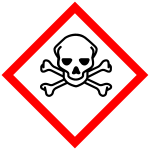

Signal word Danger
Hazard statement(s) H301 Toxic if swallowed
H312 Harmful in contact with skin
H315 Causes skin irritation
H319 Causes serious eye irritation
H317 May cause an allergic skin reaction
H332 Harmful if inhaled
H340 May cause genetic defects
H350 May cause cancer
H372 Causes damage to organs through prolonged or repeated exposure
Precautionary statement(s) Prevention P264 Wash ... thoroughly after handling.
P270 Do not eat, drink or smoke when using this product.
P280 Wear protective gloves/protective clothing/eye protection/face protection/hearing protection/...
P261 Avoid breathing dust/fume/gas/mist/vapours/spray.
P272 Contaminated work clothing should not be allowed out of the workplace.
P271 Use only outdoors or in a well-ventilated area.
P203 Obtain, read and follow all safety instructions before use.
P260 Do not breathe dust/fume/gas/mist/vapours/spray.
Response P301+P316 IF SWALLOWED: Get emergency medical help immediately.
P321 Specific treatment (see ... on this label).
P330 Rinse mouth.
P302+P352 IF ON SKIN: Wash with plenty of water/...
P317 Get medical help.
P362+P364 Take off contaminated clothing and wash it before reuse.
P332+P317 If skin irritation occurs: Get medical help.
P305+P351+P338 IF IN EYES: Rinse cautiously with water for several minutes. Remove contact lenses, if present and easy to do. Continue rinsing.
P333+P317 If skin irritation or rash occurs: Get medical help.
P304+P340 IF INHALED: Remove person to fresh air and keep comfortable for breathing.
P318 IF exposed or concerned, get medical advice.
P319 Get medical help if you feel unwell.
Storage P405 Store locked up.
Disposal P501 Dispose of contents/container to an appropriate treatment and disposal facility in accordance with applicable laws and regulations, and product characteristics at time of disposal.
Other hazards which do not result in classification
no data available
Handling and StoragePrecautions for safe handling
NO open flames. Prevent deposition of dust. Handling in a well ventilated place. Wear suitable protective clothing. Avoid contact with skin and eyes. Avoid formation of dust and aerosols. Use non-sparking tools. Prevent fire caused by electrostatic discharge steam.
Conditions for safe storage, including any incompatibilities
Separated from incompatible materials. See Chemical Dangers. Cool. Keep in the dark. Well closed. Store in an area without drain or sewer access.
-
-
Seller Information
-
Business Type:
Distributor
-
Main Products:
Dihexa,Semax Powder,Piracetam Powder,Pramiracetam Powder,Noopept Powder,Oxiracetam Powder
-
Location:
Chaussee de Namur 249 bte 6 1300 Wavre
-
Payment Terms:
TT against copy of documents,L/C,TT against B/L draft before shipment,100% TT in advance
-
Average lead Time:
14 days
-
Total Annual Revenue:
$5 million-$10 million
-
Total Employees:
51-100
-
Year of Establishment:
2016
-
-
Inquiry History19 Inquiries
Country Product Purchase Quantity Date Posted  Pakistan
Acrlalmide
25.00 MT Nov 12, 2024  India
India
Acrylamide
800.00 KG Aug 22, 2024  Brazil
Acrylamide powder 98% and solution 50%
100 MT Jun 27, 2024  Australia
Acrylamide
500 G Jul 13, 2026  United States
Acrylamide
10 KG Jun 24, 2025  Kuwait
ACRYLAMIDE
100 MT Jun 10, 2025
Pakistan
Acrylamide
100 KG Apr 18, 2025
Kuwait
ACRYLAMIDE (Acrylic Amide)
1.00 KG Mar 24, 2025
India
Acrylamide
10000 KG Jan 28, 2025
India
Acrylamide
1500.00 KG Aug 21, 2024
India
acrylamide 98%
50 MT Aug 6, 2024
India
Acrylamide 98%
25 MT Aug 28, 2026
India
Acrylamide
2.00 20' Fcl Apr 1, 2026
Kuwait
ACRYLAMIDE (Acrylic Amide)
1.00 20' Fcl Apr 21, 2025
India
Acrylamide
1.00 MT Apr 10, 2025
India
acrylamide
1.00 TON Feb 8, 2025
India
Acrylamide 50%
10.00 MT Oct 29, 2024
India
Acrylamide
25 MT Oct 9, 2024  Philippines
high quality acrylamide
1 MT Feb 27, 2024 Post an enquiry for this product


More from this Seller
-
-

-
Quality 98% Medetomidine HCl Medetomidine hydrochloride CAS 86347-14-0/86347-15-1
Pharmaceutical Grade / 99%
$980-1200/MT FOB
-
-
-

-
High Quality Food Grade Glycerol/Glycerin 99.5% CAS 56-81-5 with Low Price
Industrial Grade / 99%
$950-1050/MT FOB
-
-
-

-
Urea 46% Nitrogen Fertilizer / Best Price Urea 46% Granular Fertilizer in Bulk
Industrial Grade / 99%
$690-780/MT FOB
-
-
-

-
Lauric Acid Supplier
Cosmetics Grade / 99%
$650/MT FOB
-
-
-

-
Supply Top Quality Acetylsalicylic Acid /Aspirin 99% Powder CAS 50-78-2
Pharmaceutical Grade / 99%
$1200-1300/MT FOB
-
-
-

-
Top Quality Coluracetam powder 98% with best price 135463-81-9
Pharmaceutical Grade / 98%
$8-10/G FOB
-


Hot Related Products
-
 Bioglutide7732-18-5
 -
 Acrylic Acid 99.7% Batong Chemical
 -
 Polyacrylamide superior quality
 -
 Formalin; Methanal
 -
 WATER DEMINERALIZED
 -
 10ml/3ml. CAS No, 7732-18-5") Bacteriostatic Water (BAC water) 10ml/3ml. CAS No, 7732-18-5
Bacteriostatic Water (BAC water) 10ml/3ml. CAS No, 7732-18-5$7-9/UNIT EXW
-
 BAC water High Quality 99% Purity of CAS-7732-18-5 Wholesale
$9.23-11.07/UNIT FOB
-
 99% Purity of BAC Water CAS-7732-18-5 Wholesale Price
 -
 Acrylic Acid CAS NO. 79-10-7
 -
 Formaldehyde CAS:50-00-0