




Methylparaben

-
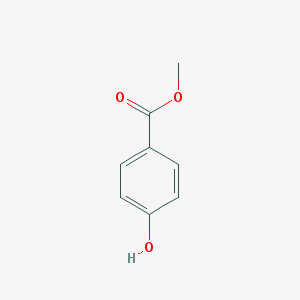
Methylparaben
structure -
-
CAS No:
99-76-3
-
Formula:
C8H8O3
-
Chemical Name:
Methylparaben
-
Synonyms:
NIPAGIN PLAIN;P-HYDROXYBENZOIC ACID METHYL ESTER;RARECHEM AL BF 0098;METHYLPARABEN,FCC;METHYLPARABEN,NF;4-HYDROXYBENZOICACIDMETHYLESTER(METHYLPARABEN);4-HYDROXYLMETHYLBENZOATE;Methyl-4-hydroxybenzoat
-
Categories:
Active Pharmaceutical Ingredients > Synthetic Anti-infective Drugs
-
CAS No:
Description
Methyl Paraben, isolated from the barks of Tsuga dumosa the methyl ester of p-hydroxybenzoic acid, is a standardized chemical allergen. Methyl Paraben is a stable, non-volatile compound used as an antimicrobial preservative in foods, drugs and cosmetics. The physiologic effect of Methyl Paraben is by means of increased histamine release, and cell-mediated immunity[1].
Methylparaben occurs as colorless crystals or a white crystalline powder. It is odorless or almost odorless and has a slight burning taste. Soluble in alcohol,ether; slightly soluble in water, benzene, and carbontetrachloride.
ChEBI: Methylparaben is a 4-hydroxybenzoate ester resulting from the formal condensation of the carboxy group of 4-hydroxybenzoic acid with methanol. It is the most frequently used antimicrobial preservative in cosmetics. It occurs naturally in several fruits, particularly in blueberries. It has a role as a plant metabolite, an antimicrobial food preservative, a neuroprotective agent and an antifungal agent.
The carcinogenic potential of methyl paraben has been studied in rodents. Several studies are available, but none that expose animals via oral or dermal routes. No evidence of a carcinogenic effect was observed following intravenous or subcutaneous injection .
Fractionally crystallise the ester from its melt, and recrystallise it from *benzene, then from *benzene/MeOH and dry it over CaCl2 in a vacuum desiccator. [Beilstein 10 IV 360.]
Methylparaben Basic Attributes
152.15
152.15
509801
202-785-7
TSCA listed
White to almost white
29182930
Characteristics
46.5
2
White to almost white Crystalline Powder
1,46g/cm
125-128 °C (lit.)
298.6 °C
280°C
1.4447 (estimate)
Slightly soluble in water.
0-6°C
0.000005 hPa (20 °C)
ADI 0~10mg/kg(FAO/WHO,2001).GRAS(FDA,§184.1490,2000).LD503000mg/kg(Dog, mouth)
Flammable, spicy and irritating smoke emitted from the fire
odorless or faint char. odor, sl. burning taste
5.8 (H2O, 20°C) (saturated solution)
pKa 8.15(H2O,t =20.0) (Uncertain)
4.5×10³mol/(m3Pa) at 25℃, HSDB (2015)
>600 °C
room temp
Safety Information
UN 2769
1
Xi,Xn
26-36-24/25-39
DH2450000
Xi,Xn
Aqueous solutions of methylparaben at pH 3–6 may be sterilized by autoclaving at 120°C for 20 minutes, without decomposition. Aqueous solutions at pH 3–6 are stable (less than 10% decomposition) for up to about 4 years at room temperature, while aqueous solutions at pH 8 or above are subject to rapid hydrolysis (10% or more after about 60 days storage at room temperature);Methylparaben should be stored in a well-closed container in a cool, dry place.
Stable. Incompatible with strong oxidizing agents, strong bases.
P273
Toxic. Use in foods restricted to 0.1%.
The antimicrobial activity of methylparaben and other parabens is considerably reduced in the presence of nonionic surfactants, such as polysorbate 80, as a result of micellization.However, propylene glycol (10%) has been shown to potentiate the antimicrobial activity of the parabens in the presence of nonionic surfactants and prevents the interaction between methylparaben and polysorbate 80.Incompatibilities with other substances, such as bentonite, magnesium trisilicate,talc,tragacanth,sodium alginate, essential oils,sorbitol,and atropine,have been reported. It also reacts with various sugars and related sugar alcohols. Absorption of methylparaben by plastics has also been reported; the amount absorbed is dependent upon the type of plastic and the vehicle. It has been claimed that low-density and high-density polyethylene bottles do not absorb methylparaben.Methylparaben is discolored in the presence of iron and is subject to hydrolysis by weak alkalis and strong acids.
UN 2769
This substance is one of the parabens family. Parabens are esters formed by p-hydroxybenzoic acid and an alcohol. They are largely used as biocides in cosmetics and toiletries, medicaments, or food. They have synergistic power with other biocides. Parabens can induce allergic contact dermatitis, mainly in chronic dermatitis and wounded skin.
Methylparaben Use and Manufacturing
It is derived from the esterification of p-hydroxybenzoic acid and methanol in the presence of sulfuric acid.
As preservative in foods, beverages and cosmetics.
Methylparaben is the ester of methyl alcohol and p-hydroxybenzoic acid, It is a bacteriostatic agent and preservative that was added to local anesthetic agents without vasoconstrictors before 1984 to prevent bacterial growth. Allergic reactions developed from repeated exposures to parabens led to the removal of this agent from dental anesthetic solutions. Similar products produced by similar production methods, like ethyl p-hydroxybenzoate (paraben B) and propyl p-hydroxybenzoate (Nepalese c), are also disinfectant preservatives. The products are irritating to the skin.
Methyl 4-hydroxybenzoate is used as an anti-fungal agent. It is also used as a preservative in foods, beverages and cosmetics. It acts as an inhibitor of growth of molds and to lesser extent bacteria and as a vehicle for ophthalmic solution.
Methylparaben and propylparaben are the most common of these. parabens is one of the most commonly used group of preservatives in the cosmetic, pharmaceutical, and food industries. Parabens provide bacteriostatic and fungistatic activity against a diverse number of organisms, and are considered safe for use in cosmetics, particularly in light of their low sensitizing potential. An evaluation of preservatives for use in leave-on cosmetic preparations lists parabens among the least sensitizing. The range of concentrations used in cosmetics varies between 0.03 and 0.30 percent, depending on the conditions for use and the product to which the paraben is added.Methylparaben is one of the most popular preservatives in beauty products and food items. According to the National Library of Medicine, the ingredient occurs naturally in a handful of fruits—like blueberries—though it can also be created synthetically.It's found in everything from cream cleansers and moisturizers to primers and foundations and helps these products maintain their effectiveness. Rabach says that it's chock-full of anti-fungal and antibacterial properties, which work wonders to extend the shelf life of skincare, haircare, and cosmetic products.
Methylparaben is an antimicrobial agent which is a white free-flowing powder. it is active against yeast and molds over a wide ph range. see parabens.
Recommended Suppliers of Methylparaben
-
![China]() CN
CN
YRS
Business licensed Certified factoryManufactory Supplier of Agrochemicals,Daily Chemicals,Catalysts & Chemical Auxiliary Agents,Extract,Inorganic Chemicals,Organic Intermediate,Pigment & Dyestuff,Polymer,Flavour & Fragrance,Basic Organic Chemicals,Pharmaceutical -
![India]() IN
IN
YRS
Business licensed Verified SupplierTrader Supplier of Stearate,Pine Oil,Talc,Magnesium Chloride,Ferric Chloride Liquid/Anhydrous,Calcium Chloride,FeldsparInquiryUnit Price: nullnull /null nullCAS No.: 99-76-3 -
![Hongkong, China]() HK
HK
YRS
Business licensedTrader Supplier of chemicalsInquiryCAS No.: 99-76-3Grade: Food GradeContent: 99.99% -
![China]() CN
CN
YRS
Business licensedDistributor Supplier of DIMETHYL SULFOXIDE,NMP,MMTInquiryUnit Price: nullnull /null nullCAS No.: 99-76-3Content: 99% -
![China]() CN
CN
YRS
Business licensedTrader Supplier of Demulsifier Active IngredientInquiryUnit Price: nullnull /null nullCAS No.: 99-76-3Grade: Pharmaceutical GradeContent: 99%


Learn More Other Chemicals
-
Potassium methylparaben
26112-07-2
-
Sodium methylparaben
5026-62-0
-
Tedizolid
856866-72-3
-
Tedizolid phosphate Formula
856867-55-5
-
Atovaquone Formula
95233-18-4
-
Garlic oil Formula
8008-99-9
-
Ganciclovir sodium Structure
107910-75-8
-
Resorcinol Structure
108-46-3
-
What is 1-Bromo-3-chloro-5,5-dimethylhydantoin
16079-88-2
-
What is N,N-Dimethyl 4-formyl-1H-imidazole-1-sulfonamide
140174-48-7