




2-bromo-3-octylthiophene
-
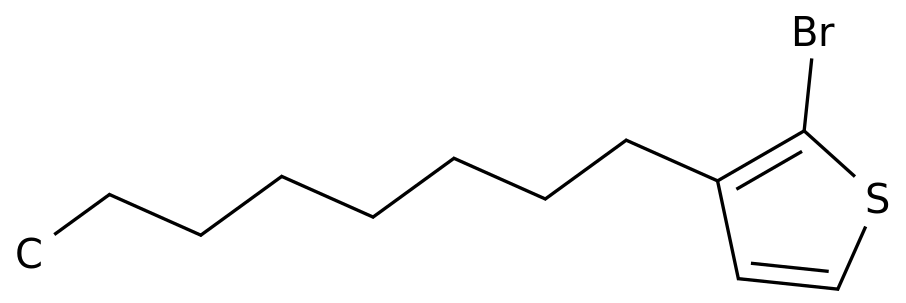
2-bromo-3-octylthiophene
structure -
-
CAS No:
145543-83-5
-
Formula:
C12H19BrS
-
Chemical Name:
2-bromo-3-octylthiophene
-
Synonyms:
2-Bromo-3-octylthiophene;Thiophene, 2-bromo-3-octyl-;2-bromo-3-octyl-thiophene;2-Bromo-3-n-octylthiophene;ACMC-209cvf;C12H19BrS;Thiophene,2-bromo-3-octyl-;2-bromanyl-3-octyl-thiophene;SCHEMBL1225175;CTK4C4595
- Categories:
-
CAS No:
2-bromo-3-octylthiophene Use and Manufacturing
A 1 M solution of compound 8b in DMF was cooled to 0 °C in the absence of light and NBS (1.0 eq.) was added. The mixture was allowed to warm to room temperature, stirred overnight and then diluted with DCM . The solution was extracted with H60 g (305 mmol) of 3-n-octylthiophene is dissolved in 100 ml of DMF in a 500 ml four-necked flask. The resultant solution is cooled to 5° C., and a solution obtained by dissolving 55 g (310 mmol) of NBS in 50 ml of DMF is added dropwise thereto over 5 minutes using a pressure equalizing funnel. Thereafter, the resultant solution is stirred at 25° C. for 1 hour using a magnetic stirrer, and then added into 500 ml of pure water in a 1 L beaker. The resultant mixture in the beaker is stirred at 25° C. for 20 minutes using a magnetic stirrer. 300 ml of ethyl acetate is added to the solution in the beaker, and the contents of the beaker are stirred at 25° C. for 10 minutes using a magnetic stirrer. The ethyl acetate layer is taken out, washed with 300 ml of pure water three times, and dehydrated using anhydrous sodium sulfate. Then, the resultant liquid is subjected to filtration, and solvent is removed by distillation under reduced pressure, whereby 83 g of a yellow oily material is obtained. The yellow oily material is subjected to vacuum distillation (at 1 mmHg to 3 mmHg and a temperature of 120 to 130° C.), whereby 76 g of a pale-yellow oily material is obtained (yield: 93percent).2-bromo-3-octylthiophene (10)Compound 10 was prepared by the reported process (He M, Leslie TM, Sinicropi JA, Synthesis of chromophores with extremely high electro-opticactivity, 1. thiophene-bridge-based chromophores. Chem Mater 2002; 14: 4662-8) . Compound 9 (5.49 g, 28 mmol) was added dropwise to a solution of N-bromosuccinimide (NBS) (5.76 g, 28 mmol) in DMF (30 mL) The mixture was stirred at room temperature for 12 h.Water (150 mL) was added, And extracted with ethyl acetate (2 X 150 mL).The organic layer was dried with sodium sulfate, Lt; / RTI & gt;The crude product, Purification by column chromatography with hexane gave the desired compound as a colorless oil (6.95 g, 90percent).To a 250 mL of two-ported flask filled with 3-octylthiophene (10.00 g, 50.93 mmol) was added 60 mL of DMF. A solution of NBS (9.26 g, 52.03 mmol) in 60 mL of DMF was added dropwise in an iced saline bath. After addition was completed, the mixture was warmed to the room temperature and then stirred at this temperature overnight. The reaction was stopped and the resultant product was poured into 200 mL of water. The mixture was extracted with dichloromethane (60 mL×4). The organic phase was washed with aqueous potassium hydroxide solution (2 M, 100 mL), saturated saline (100 mL) and water (100 mL×2), successively. The organic phase was dried over anhydrous sodium sulfate. The solvent was removed under reduced pressure. The resultant product was separated with chromatographic column, in which eluant was petroleum ether, to give a liquid as oil (12.60 g, yield: 89percent).To a 250 mL two-necked flask containing 3-octylthiophene (10.00 g, 50.93 mmol) was added 60 mL of DMF. Ice bath, a solution of NBS (9.26 g, 52.03 mmol) in 60 mL of DMF was added dropwise. After completion of the addition, the mixture was slowly warmed to room temperature and stirred at room temperature overnight. The reaction was stopped, poured into 200 mL of water and extracted with dichloromethane (60 mL x 4). The organic phase was washed successively with aqueous potassium hydroxide (2M, 100 mL), saturated brine (100 mL) and water (100 mL X 2) and dried over anhydrous sodium sulfate. The solvent was removed under reduced pressure and the petroleum ether was used as the eluent to separate 12.60 g of an oily liquid in a yield of 89percent3-octylthiophene (10.80 g, 55.00 mmol) was dissolved in chloroform (70 ml) and acetic acid (70 ml). N-Bromosuccinimide (9.62 g, 54.00 mmol) was slowly added. The mixture was stirred for 3 h at r.t. Then the reaction was quenched by water (200 ml). Organic layer was separated and aqueous layer was extracted with CHClCompd. (1-e) (chemical industry (strain) tokyo made) 10. A 2g dissolved in dimethyl formamide ([...] chemical (strain) made) 100 ml to, N-(wako pure chemical industries (strain) made) tribromoacetic arylsuccinimide 9. 24g is added, under a nitrogen atmosphere, stirred at room temperature for 3 hours. The solution obtained in 200 ml water, 200 ml n-hexane, dichlomethane 200 ml is added, by which the organic layer, after washing with 200 ml water, dried with magnesium sulfate. The resultant solution to column chromatography (filler: silica gel, eluent: Phenylbicyclohexane) is purified by compd. (1-f)14. 4g is obtained.Under argon gas protection, to a 100 mL of two-ported flask filled with magnesium chips (704 mg, 28.96 mmol) was added 20 mL of ethyl ether and was slowly added dropwise a mixed solution of (4.00 g, 14.56 mmol) was slowly added dropwise to a 100 mL two-necked flask containing magnesium hydroxide (704 mg, 28.96 mmol) 1, 2-dibromoethane (1.37 g, 7.28 mmol) and 20 mL of diethyl ether, , under the protection of argon. Drop complete, heat reflux 4 hours, down to room temperature. The resulting Grignard reagent was slowly added dropwise to a mixed solution of Ni (dppp) Cl2 (177 mg, 0.326 mmol), 2, 5-dibromothiophene (1.40 g, 5.56 mmol) and 25 mL of diethyl ether. After completion of the dropwise addition, the mixture was heated under reflux for 18 hours. To the room temperature, 20 mL of dilute hydrochloric acid (2 M) was added, poured into 200 mL of water, and extracted with dichloromethane (100 mL of X3). The organic phase was washed successively with aqueous sodium carbonate (2M, 100 mL), brine (100 mL) and water (100 mL) and dried over anhydrous sodium sulfate. The solvent was removed under reduced pressure and the petroleum ether was used as the eluent to separate 2.30 g of a pale yellow oily liquid in a yield of 84%0.53 g (21.8 mmol) of magnesium turnings were introduced in a 100 ml flask and suspended in 30 ml of anhydrous diethyl ether. To the resulting suspension, maintained under an argon (Ar) atmosphere, was slowly added a solution of 3.0 g (3.9 mmol) of
Computed Properties
Molecular Weight:275.25
XLogP3:6.7
Hydrogen Bond Acceptor Count:1
Rotatable Bond Count:7
Exact Mass:274.03908
Monoisotopic Mass:274.03908
Topological Polar Surface Area:28.2
Heavy Atom Count:14
Complexity:138
Covalently-Bonded Unit Count:1
Compound Is Canonicalized:Yes
Recommended Suppliers of 2-bromo-3-octylthiophene
-
![China]() CN
2 YRS
Business licensedTrader Supplier of Pharmaceutical intermediates -
![China]() CN
5 YRS
Business licensed Certified factoryManufactory Supplier of Active Pharm Ingredients,Chemical Catalyst,Pharmaceutical Intermediates,Flavors and Fragrances,Agrochemicals,Chemical Pesticides,Organic Intermediates,OLED IntermediatesInquiryCAS No.: 145543-83-5Grade: Pharmaceutical GradeContent: 99% -
![China]() CN
5 YRS
Business licensedTrader Supplier of PVC resin,pvc paste resin,melamine

Learn More Other Chemicals
-
(2E)-3-(1-METHYL-1H-PYRROL-2-YL)ACRYLIC ACID
51485-76-8
-
Benadryl N-oxide hydrochloride
13168-00-8
-
6-CHLORO-3-IODO-IMIDAZO[1,2-A]PYRIDINE
885275-59-2
-
(2-Bromophenyl)diphenylphosphine Formula
62336-24-7
-
1-Morpholinocyclopentene Formula
936-52-7
-
4-[2-(Boc-amino)ethoxy]-benzoic acid Formula
168892-66-8
-
3-amino-5-bromopyridine-2-carboxylic acid Structure
870997-85-6
-
2-Amino-6-methylpyridine Structure
1824-81-3
-
What is 3-Bromo-2-methylthiophene
30319-05-2
-
What is THIOPHEN-2-YLMETHYL-PHOSPHONICACIDDIETHYLESTER
2026-42-8