




L-(-)-Ornithine

-
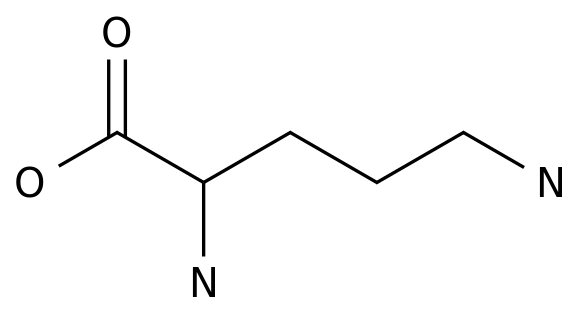
L-(-)-Ornithine
structure -
-
CAS No:
70-26-8
-
Formula:
C5H12N2O2
-
Chemical Name:
L-(-)-Ornithine
-
Synonyms:
L-Ornithine;Ornithine,L-;Pentanoic acid,2,5-diamino-,(S)-;Ornithine;L-(-)-Ornithine;(S)-2,5-Diaminopentanoic acid;(S)-Ornithine;(S)-α,δ-Diaminovaleric acid;(+)-S-Ornithine;L-Norvaline,5-amino-;(2S)-2,5-Diaminopentanoic acid;7006-33-9;204201-13-8;410523-46-5
- Categories:
-
CAS No:
Description
L-ornithine has an antifatigue effect in increasing the efficiency of energy consumption and promoting the excretion of ammonia.
Solid
L-ornithine is an optically active form of ornithine having L-configuration. It has a role as a hepatoprotective agent, an algal metabolite and a mouse metabolite. It is an ornithine and a non-proteinogenic L-alpha-amino acid. It is a conjugate base of a L-ornithinium(1+). It is a conjugate acid of a L-ornithinate. It is an enantiomer of a D-ornithine.|Produced during the urea cycle, ornithine is an amino acid produced from the splitting off of urea from arginine. L-Ornithine allows for the disposal of excess nitrogen and acts as a precursor of citrulline and arginine.|Ornithine is a naturally occurring amino acid found in meat, fish, dairy and eggs. Ornithine is one of the key reactants in the urea cycle that is responsible for 80% of the nitrogen excretion in the body. Ornithine enhances liver function and helps detoxify harmful substances.|An amino acid produced in the urea cycle by the splitting off of urea from arginine.
Characteristics
89.34000
0.53780
Solid
1.165 g/cm3
140 °C
345.6ºC at 760 mmHg
177ºC
1.508
H2O: 620 mg/mL
sce-hmn-lym 10 mg/L MUREAV 372,75,1996
1.94(at 25 °C)
1.94 (at 25 °C)
129.79 Ų [M+H]+ [CCS Type: DT, Method: stepped-field]|136.8 Ų [M-H]- [CCS Type: DT, Method: stepped-field]|121 Ų [M+H]+ [CCS Type: TW, Method: calibrated with polyalanine]|127.7 Ų [M+H]+ [CCS Type: DT, Method: single field calibrated with ESI Low Concentration Tuning Mix (Agilent)]
Drug Information
Used for nutritional supplementation, also for treating dietary shortage or imbalance. It has been claimed that ornithine improves athletic performance, has anabolic effects, has wound-healing effects, and is immuno-enhancing.
A non-essential and nonprotein amino acid, ornithine is critical for the production of the body's proteins, enzymes and muscle tissue. Ornithine plays a central role in the urea cycle and is important for the disposal of excess nitrogen (ammonia). Ornithine is the starting point for the synthesis of many polyamines such as putrescine and spermine. Ornithine supplements are claimed to enhance the release of growth hormone and to burn excess body fat. Ornithine is necessary for proper immune function and good liver function.
Absorbed from the small intestine via a sodium-dependent active transport process
Ornithine undergoes extensive metabolism in the liver to L-arginine, polyamines, and proline, and several other metabolites.
L-Ornithine is metabolised to L-arginine. L-arginine stimulates the pituitary release of growth hormone. Burns or other injuries affect the state of L-arginine in tissues throughout the body. As De novo synthesis of L-arginine during these conditions is usually not sufficient for normal immune function, nor for normal protein synthesis, L-ornithine may have immunomodulatory and wound-healing activities under these conditions (by virtue of its metabolism to L-arginine).
2,5 Diaminopentanoic Acid
L-(-)-Ornithine Use and Manufacturing
Hepatoprotectant, anticholesteremic
L-Ornithine: ACTIVE
Cosmetics -> Skin conditioning
Computed Properties
Molecular Weight:132.16
XLogP3:-4.4
Hydrogen Bond Donor Count:3
Hydrogen Bond Acceptor Count:4
Rotatable Bond Count:4
Exact Mass:132.089877630
Monoisotopic Mass:132.089877630
Topological Polar Surface Area:89.3
Heavy Atom Count:9
Complexity:95
Defined Atom Stereocenter Count:1
Covalently-Bonded Unit Count:1
Compound Is Canonicalized:Yes
Recommended Suppliers of L-(-)-Ornithine
-
![China]() CN
CN
5 YRS
Business licensed Certified factoryManufactory Supplier of fine chemicals,pharmaceutical materials -
![China]() CN
CN
6 YRS
Business licensed Certified factoryManufactory Supplier of Custom Synthetic Chemicals,Biological Stains,Pharmaceutical Intermediates,Cosmetic Grade Chemicals,Enzyme,Nucleosides,Indicators,Speciality Chemicals,Biological Chemicals,Enzyme Substrates -
![China]() CN
CN
10 YRS
Business licensed Certified factoryManufactory Supplier -
![China]() CN
CN
5 YRS
Business licensed Certified factoryManufactory Supplier of Herb Extracts,Cosmetic raw materails,API

Learn More Other Chemicals
-
Elastins, cartilage, hydrolyzates
100085-10-7
-
Peptones
73049-73-7
-
Hydrolyzed vegetable protein
100209-45-8
-
Micro-Green Formula
10024-66-5
-
Strontium dichloride hexahydrate Formula
10025-70-4
-
2,5-Pyridinedicarboxylic acid Formula
100-26-5
-
N-Acetyl-α-D-glucosamine Structure
10036-64-3
-
Ceramides Structure
100403-19-8
-
What is 1-Methylnicotinamide chloride
1005-24-9
-
What is Noreugenin
1013-69-0