




Ursodeoxycholic acid

-
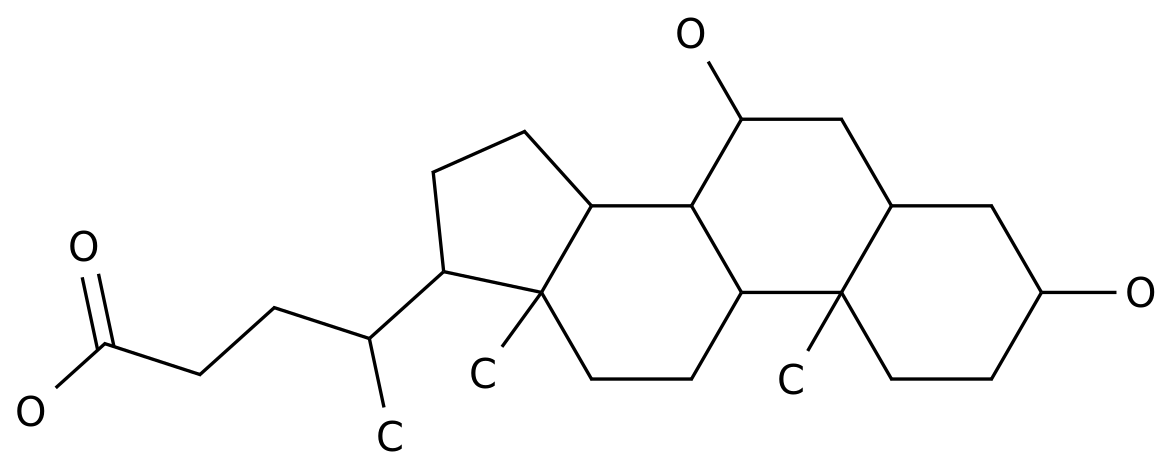
Ursodeoxycholic acid
structure -
-
CAS No:
128-13-2
-
Formula:
C24H40O4
-
Chemical Name:
Ursodeoxycholic acid
-
Synonyms:
Cholan-24-oic acid,3,7-dihydroxy-,(3α,5β,7β)-;5β-Cholan-24-oic acid,3α,7β-dihydroxy-;5β-Cholanic acid,3α,7β-dihydroxy-;(3α,5β,7β)-3,7-Dihydroxycholan-24-oic acid;17β-(1-Methyl-3-carboxypropyl)etiocholane-3α,7β-diol;Ursocholic acid,deoxy-;Ursodeoxycholic acid;Ursodesoxycholic acid;3α,7β-Dihydroxy-5β-cholan-24-oate;3α,7β-Dihydroxycholanic acid;3α,7β-Dihydroxy-5β-cholanic acid;3α,7β-Dihydroxy-5β-cholanoic acid;7β-Hydroxylithocholic acid;3α,7β-Dihydroxy-5β-cholan-24-oic acid;Urso;Actigall;Ursodiol;Deursil;Desocol;Ursofalk;Ursochol;Cholit-Ursan;Ursacol;Destolit;Paptarom;Arsacol;Urdes;Solutrat;Lyeton;Ursobilin;Ursolvan;Ursodamor;Delursan;Desol;Litursol;NSC 683769;Adursal;UDCA;Ursic acid;Ursosan;Ursocol;Ursogall;Urosiol;50809-41-1;80225-86-1;2599839-20-8
- Categories:
-
CAS No:
Description
Ursodiol reduces cholesterol absorption and is used to dissolve gallstones.Target: OthersUrsodiol, also known as ursodeoxycholic acid and the abbreviation UDCA, is one of the secondary bile acids, which are metabolic byproducts of intestinal bacteria. The drug reduces cholesterol absorption and is used to dissolve (cholesterol) gallstones in patients who want an alternative to surgery. The drug is very expensive, however, and if the patient stops taking it, the gallstones tend to recur i
Solid
Ursodeoxycholic acid is a bile acid found in the bile of bears (Ursidae) as a conjugate with taurine. Used therapeutically, it prevents the synthesis and absorption of cholesterol and can lead to the dissolution of gallstones. It has a role as a human metabolite and a mouse metabolite. It is a bile acid, a dihydroxy-5beta-cholanic acid and a C24-steroid. It is a conjugate acid of an ursodeoxycholate.|Ursodeoxycholic acid is an epimer of [chenodeoxycholic acid]. It is a mammalian bile acid found first in the bear and is apparently either a precursor or a product of chenodeoxycholate. Its administration changes the composition of bile and may dissolve gallstones. It is used as a cholagogue and choleretic.|Ursodiol is a Bile Acid.|Ursodeoxycholic acid or ursodiol is a naturally occurring bile acid that is used dissolve cholesterol gall stones and to treat cholestatic forms of liver diseases including primary biliary cirrhosis. Ursodiol has been linked to rare instances of transient and mild serum aminotransferase elevations during therapy and to rare instances of jaundice and worsening of liver disease in patients with preexisting cirrhosis.|Ursodiol is a synthetically-derived form of ursodiol, a bile acid produced by the liver and secreted and stored in the gallbladder. Also produced by the Chinese black bear liver, ursodiol has been used in the treatment of liver disease for centuries. This agent dissolves or prevents cholesterol gallstones by blocking hepatic cholesterol production and decreasing bile cholesterol. Ursodiol also reduces the absorption of cholesterol from the intestinal tract.|An epimer of chenodeoxycholic acid. It is a mammalian bile acid found first in the bear and is apparently either a precursor or a product of chenodeoxycholate. Its administration changes the composition of bile and may dissolve gallstones. It is used as a cholagogue and choleretic.
Ursodeoxycholic acid Basic Attributes
392.57200
392.57
204-879-3
724L30Y2QR
DTXSID6023731
C1818
A05AA02|A - Alimentary tract and metabolism
2918199090
Characteristics
77.76000
4.47790
Solid
1.128 g/cm3
203 °C
547.1ºC at 760mmHg
298.8ºC
1.543
ethanol: 50 mg/mL, clear
Store in a tightly closed container. Store in a cool, dry area away from incompatible substances.
0mmHg at 25°C
208.98 Ų [M-H]- [CCS Type: DT, Method: stepped-field]|198.7 Ų [M+Na]+ [CCS Type: DT, Method: single field calibrated with ESI Low Concentration Tuning Mix (Agilent)]|200.9 Ų [M-H]- [CCS Type: DT, Method: single field calibrated with ESI Low Concentration Tuning Mix (Agilent)]|198.3 Ų [M-H]- [CCS Type: DT, Method: single field calibrated]|186.8 Ų [M+H-2H2O]+ [CCS Type: DT, Method: single field calibrated]|200.2 Ų [M+HCOO]- [CCS Type: DT, Method: single field calibrated]|205.7 Ų [M+K-H+HCOO]- [CCS Type: DT, Method: single field calibrated]|199.4 Ų [M+Na-H+Cl]- [CCS Type: DT, Method: single field calibrated]|203.2 Ų [M+Na-H+HCOO]- [CCS Type: DT, Method: single field calibrated]
Safety Information
NONH for all modes of transport
2
R36/37/38
S24/25
FZ2000000
Xi
Stable under normal temperatures and pressures.
P264, P280, P302+P352, P305+P351+P338, P321, P332+P313, P337+P313, P362
H315
|Warning|H315 (100%): Causes skin irritation [Warning Skin corrosion/irritation]|P264, P280, P302+P352, P305+P351+P338, P321, P332+P313, P337+P313, and P362|Aggregated GHS information provided by 98 companies from 3 notifications to the ECHA C&L Inventory. Each notification may be associated with multiple companies.
Toxicity
Neither accidental nor intentional overdosing with ursodeoxycholic acid has been reported. Doses of ursodeoxycholic acid in the range of 16-20 mg/kg/day have been tolerated for 6-37 months without symptoms by 7 patients. The LD50 for ursodeoxycholic acid in rats is over 5000 mg/kg given over 7-10 days and over 7500 mg/kg for mice. The most likely manifestation of severe overdose with ursodeoxycholic acid would probably be diarrhea, which should be treated symptomatically.
n multiple clinical trials in a variety of conditions, ursodiol has not been found to cause increases in serum enzyme elevations, worsening of underlying liver disease or clinically apparent liver injury. Nevertheless, there have been rare reports of clinical decompensation in patients with advanced liver disease and cirrhosis started on ursodiol, but the reason for such reactions is not known. In at least one instance, there was recurrence of jaundice on restarting ursodiol. Thus, ursodiol has beneficial effects on several forms of liver disease and has not been convincingly linked to cases of clinically apparent acute liver injury in patients without cirrhosis. There is some concern that ursodiol may be harmful in patients with advanced liver disease (Childs class B and C) and such patients probably should not receive ursodiol.
Drug Information
The drug decreases the absorption of cholesterol and is used to dissolve (cholesterol) gallstones in patients as an alternative to a surgical procedure to remove the gallstones.|FDA Label
Ursodeoxycholic acid or ursodiol is a naturally occurring bile acid that is used dissolve cholesterol gall stones and to treat cholestatic forms of liver diseases including primary biliary cirrhosis. Ursodiol has been linked to rare instances of transient and mild serum aminotransferase elevations during therapy and to rare instances of jaundice and worsening of liver disease in patients with preexisting cirrhosis.
Gastrointestinal Agents
Ursodiol (commonly known as ursodeoxycholic acid) is a product of metabolism of bacteria in the intestine. It is considered a secondary bile acid. The other type of bile acid, primary bile acids, are produced hepatically and subsequently stored in the gallbladder. When primary bile acids are secreted into the large intestine, they can be broken down into secondary bile acids by bacteria present in the intestine. Both types of bile acids assist in the metabolism of dietary fat. Ursodeoxycholic acid regulates cholesterol levels by slowing the rate at which the intestine is able to absorb cholesterol and also acts to break down micelles, which contain cholesterol. Because of this property, ursodeoxycholic acid is used to treat gall stones non-surgically.
Gastrointestinal agents that stimulate the flow of bile into the duodenum (cholagogues) or stimulate the production of bile by the liver (choleretic). (See all compounds classified as Cholagogues and Choleretics.)
Only small quantities of ursodiol appear in the systemic circulation and very small amounts are excreted into urine. Eighty percent of lithocholic acid formed in the small bowel is excreted in the feces, but the 20% that is absorbed is sulfated at the 3-hydroxyl group in the liver to relatively insoluble lithocholyl conjugates which are excreted into bile and lost in feces.
Ursodeoxycholic acid reduces elevated liver enzyme levels by facilitating bile flow through the liver and protecting liver cells. The main mechanism if anticholelithic. Although the exact process of ursodiol's anticholelithic action is not completely understood, it is thought that the drug is concentrated in bile and decreases biliary cholesterol by suppressing hepatic synthesis and secretion of cholesterol and by inhibiting its intestinal absorption. The reduced cholesterol saturation permits the gradual solubilization of cholesterol from gallstones, resulting in their eventual dissolution.
3 alpha,7 beta Dihydroxy 5 beta cholan 24 oic Acid
Ursodeoxycholic acid Use and Manufacturing
1. Used as an anticholelithogenic. Epimer with Chenodiol with respect to the hydroxyl group at C7.
2. Anticonvulsant
3. Anticholelithogenic; LD50(rat) 890 mg/kg ip
Human drugs -> Rare disease (orphan)|Human Drugs -> FDA Approved Drug Products with Therapeutic Equivalence Evaluations (Orange Book) -> Active Ingredients|Lipids -> Sterol Lipids [ST] -> Bile acids and derivatives [ST04] -> C24 bile acids, alcohols, and derivatives [ST0401]
Computed Properties
Molecular Weight:392.6
XLogP3:4.9
Hydrogen Bond Donor Count:3
Hydrogen Bond Acceptor Count:4
Rotatable Bond Count:4
Exact Mass:392.29265975
Monoisotopic Mass:392.29265975
Topological Polar Surface Area:77.8
Heavy Atom Count:28
Complexity:605
Defined Atom Stereocenter Count:10
Covalently-Bonded Unit Count:1
Compound Is Canonicalized:Yes
Drug Function and Efficacy
By inhibiting the reabsorption of cholesterol in the intestine and reducing the secretion of cholesterol into the bile, the saturation of cholesterol in the bile is reduced. Cholesterol stones may be gradually dissolved due to the dispersion of cholesterol and the formation of liquid crystals. The treatment of liver and cholestatic diseases is mainly based on the relative replacement of lipophilic, detergent-like toxic bile acids by hydrophilic, cytoprotective and non-cytotoxic ursodeoxycholic acid, as well as the promotion of hepatocyte secretion and immunomodulation.
Registered Holders
-
SHILPA PHARMA LIFESCIENCES LTD
Active![United States]() United States
United States
-
ALIVUS LIFE SCIENCES LTD
Active![United States]() United States
United States
-
ARCH PHARMALABS LTD
Active![United States]() United States
United States

Recommended Suppliers of Ursodeoxycholic acid
-
![China]() CN
CN
5 YRS
Business licensed Certified factoryManufactory Supplier of Dichloromethane,Linocaine hydrochloride -
![China]() CN
CN
6 YRS
Business licensedDistributor Supplier of Nutrition supplement material,Pharmaceutical raw material,Chemical raw materialInquiryCAS No.: 128-13-2Grade: Pharmaceutical GradeContent: 99% -
![China]() CN
CN
4 YRS
Business licensedTrader Supplier of intermediates ,fine chemical,food additives -
![China]() CN
CN
8 YRS
Business licensed Certified factoryManufactory Supplier of plant extract,Fruit powder,herb extractInquiryCAS No.: 128-13-2Grade: Pharmaceutical GradeContent: 98% -
![China]() CN
CN
5 YRS
Business licensed Certified factoryManufactory Supplier of dasatinib,ingenol mebutate,hesperidin,irinotecan HCL,erlotinib,nastrozole,moxifloxacin hydrochloride,nilotinib,berberine hydrochloride,gefitinib,ursodeoxycholic acid,rutin,diosmin,SN-38,natural indigo,troxerutin,cabazitaxelInquiryCAS No.: 128-13-2Grade: Pharmaceutical GradeContent: 98%

Learn More Other Chemicals
-
3,5-DIBROMO-2-[[[(3,5-DINITROBENZOYL)AMINO]THIOXOMETHYL]AMINO]-BENZOIC ACID
535965-38-9
-
3,5-DIBROMO-2-[[[[(2-CHLOROPHENOXY)ACETYL]AMINO]THIOXOMETHYL]AMINO]-BENZOIC ACID
532386-89-3
-
3,5-DIBROMO-2-[[[(4-METHYL-3-NITROBENZOYL)AMINO]THIOXOMETHYL]AMINO]-BENZOIC ACID
532943-48-9
-
3,5-DIBROMO-2-[[[[3-(2-FURANYL)-1-OXO-2-PROPENYL]AMINO]THIOXOMETHYL]AMINO]-BENZOIC ACID Formula
586392-09-8
-
3,5-DIBROMO-2-[[[[(2-METHYLPHENOXY)ACETYL]AMINO]THIOXOMETHYL]AMINO]-BENZOIC ACID Formula
531548-30-8
-
2-(1,8-dibromo-16,18-dioxo-17-azapentacyclo[6.6.5.0~2,7~.0~9,14~.0~15,19~]nonadeca-2,4,6,9,11,13-hexaen-17-yl)benzoic acid Formula
333340-54-8
-
3,5-DIBROMO-2-[[[[3-(PHENOXYMETHYL)BENZOYL]AMINO]THIOXOMETHYL]AMINO]-BENZOIC ACID Structure
586393-79-5
-
3,5-DIBROMO-2-[[[(4-CHLOROBENZOYL)AMINO]THIOXOMETHYL]AMINO]-BENZOIC ACID Structure
531530-32-2
-
What is 9-Octadecenoic acid (9Z)-, compd. with N,N-dimethylcyclohexanamine (1:1)
65122-23-8
-
What is 2-Cyano-3-(6,6-dimethylbicyclo[3.1.1]hept-2-yl)-2-propenoic acid
79570-01-7