




China Pharmaceutical Industry Market
Status and Outlook Analysis Report 2022
![China's pharmaceutical market size from 1,430.4 billion RMB in 2017 to 179.19 billion RMB in 2020, with a compound annual growth rate of 7.8%]()
-
Overview Of The Development Of China's Pharmaceutical Industry
2021 China's pharmaceutical market size of 1,922 billion RMB, is expected to further reach 223.11 billion RMB in 2022 China's pharmaceutical market size.In recent years, the scale of China's pharmaceutical market has been growing at a relatively fast pace.

2021 China's Pharmaceutical Market Boom Continues
-
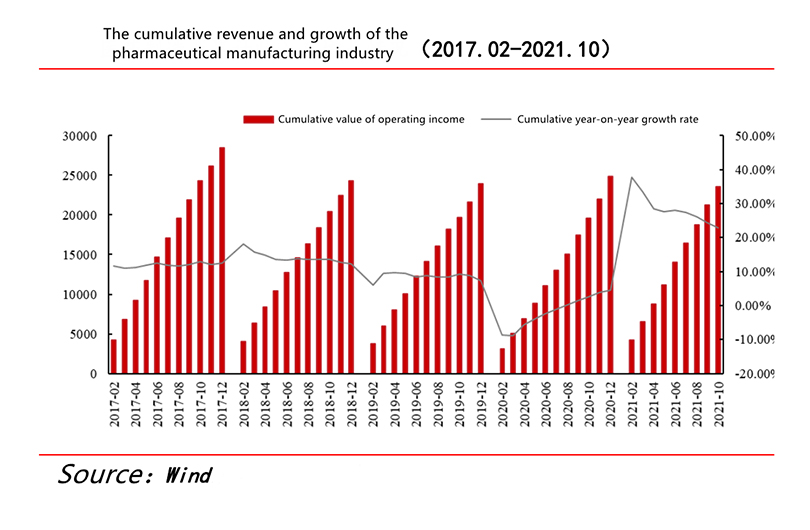
From February to October 2021, the overall operating revenue and total profit of pharmaceutical manufacturing industry showed a trend of declining growth rate, with the year-on-year growth rate of revenue declining from 37.70% in February to 22.80% in October and the year-on-year growth rate of total profit declining from 95.40% in February to 76.70% in October. The main reason for this result is the low base of the epidemic factor in the first half of last year, and the lower comparable base effect disappeared month by month after the epidemic was brought under control in 2020.ENTER
-
![2021 China's pharmaceutical market boom continues]()
- Segmentation Structure Share
- Profitability Of The Industry
- Enterprise Registration Volume
-
China's Pharmaceutical Market Segmentation Structure Share
From the point of view of patent drugs and generic drugs, the difference between the market shares of patent drugs and generic drugs in the Chinese pharmaceutical market is relatively small, with patent drugs accounting for 56% and generic drugs accounting for 44%. With the support of national strategic policies and the gradual increase of market demand for patented drugs, it is expected that the share of patented drugs will continue to grow in the future. -
Profitability Of China's Pharmaceutical Industry
In recent years, the operating income of China's pharmaceutical industry has shown a trend of first decline and then increase, and the total profit has shown an overall growth trend. Data shows that in 2021, the operating revenue of China's pharmaceutical industry reached RMB 2,928.85 billion. It is expected that in 2022, the revenue of China's pharmaceutical industry will exceed RMB 3 trillion and the total profit will be close to RMB 700 billion. -
China's Pharmaceutical Enterprise Registration Volume
According to the data, China's pharmaceutical-related enterprise registrations continued to increase rapidly from 2017-2021, with the number of new enterprises increasing from 118,000 in 2017 to 25.0 million in 2021, with a compound annual growth rate of 20.6%. It is expected that the number of new pharmaceutical-related enterprises in China will reach 298,000 in 2022, an increase of 19.2% year-on-year.
Segments Of China's Pharmaceutical Industry Market

CXO
Booming industry and strong demand for R&D

API
Chemical API market is building core competitive advantages

Generic Drugs
Low penetration rate, fast growth rate and certain barriers to entry
Innovative Drugs
Medium and long-term growth still has more room for improvement

Pharmaceutical Equipment
Continued prosperous development, biologics market expansion brings important drivers

Vaccines
COVID-19 epidemic drives rapid industry development

Life Science Reagents
Strong demand for research and development, industry favorable policies continue
Ⅰ. CXO
-
Innovative drug market size surges
-
Drug R&D spending continues to grow
-
According to Frost & Sullivan, the global innovative drug market will grow from $822 billion to $961.6 billion from 2017 to 2021, with a compound annual growth rate of about 4%, and the combined revenue of the top 20 global innovative drug companies will grow at a compound annual growth rate of 9.9% during the same period.
![Innovative drug market]()
-
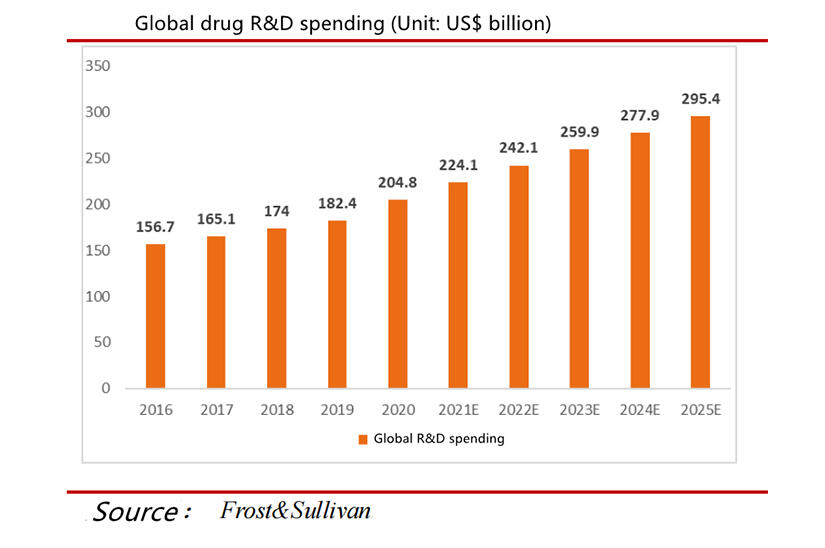
As global pharmaceutical companies continue to invest in R&D, the GAGR of global drug R&D spending from 2016-2021 is 7.4%, and global drug R&D spending is expected to reach $295.4 billion by 2025, which will still maintain a compound growth rate of 7.2% from 2021-2025.
![Drug R&D spending continues to grow]()

Ⅱ. API is building core competitive advantages
Under the situation of globalization of pharmaceuticals, global pharmaceutical companies have strengthened their innovation ability, and CDMO services for APIs and key intermediates are developing rapidly.
-
According to the financial reports of major Chinese CXO companies, Chinese CDMO companies, led by Hechuan Pharmaceuticals, have shown strong upward growth in the past three years, with an average compound growth rate of 28% in the number of projects of Chinese core CDMO companies. Meanwhile, revenue and net income of major Chinese CXO companies grew 41.8% and 49.4% year-over-year respectively. In the first three quarters of 2021, with strong performance growth also statically validating the high boom in drug development and outsourcing.ENTER
-
![CHINES~1]()

III. Generic drugs -- Low penetration rate, fast growth rate and certain barriers to entry
Since China's drug consumption structure is still dominated by generic drugs, the PPI of the chemical drug preparation manufacturing industry can be considered as mainly reflecting the price trend of generic drugs. It can be seen that after the start of the collection, even though the collection rules are gradually moderated, generic drugs are always under greater downward pressure on prices.
Against the backdrop of progressively milder government policies, generic drug prices still kept moving downward, which we believe is mainly due to the increase in supply.
According to the 2021 Annual Drug Review Report issued by NMPA, the number of generic ANDA and consistency evaluation applications continued to increase from 2017 to 2021, reflecting that the supply of generic drugs is still increasing the work. The scope of procurement will be expanded, and the number of generic names for national and local procurement in each province will exceed 350 in total. In addition, the orders in hand and new orders of generic CROs will continue to increase in 2020 and 2021. Therefore, we judge that in the future, with the continuous increase of supply, generic drugs, especially those with limited price reduction due to insufficient competition when they were first included in the procurement, will still face price pressure in the future.
Ⅳ. Innovative Drugs

Oncology, and some mature targets such as EGFR, CD19, HER2, etc. have multiple drugs in various stages of development, which can improve the success rate of approval and listing, but the market competition is more intense after listing. On the other hand, thanks to the implementation of a series of accelerated measures such as priority review, conditional approval and accelerated approval based on trial data from other countries/regions, the gap of 43 new imported oncology drugs approved in China between 2010 and 2020 compared with the time to market in the U.S. has been significantly shortened. The lag time for oncology drugs approved in the U.S. from 2016-2020 is only 2.7 years, and Chinese innovative drugs will directly face global competition.
With the reform of the review and approval system of innovative drugs, on the one hand, the R&D of innovative drugs in China has become homogeneous, with indications mainly concentrated in a few areas.
The wave of products entering the global market is expected in 2022
China's innovative drugs is entering the global market
-
With the increase in the stock of innovative drugs year by year and the intensification of in-volume, coupled with the general background of medical insurance cost control, it has become a general trend for innovative drugs to enter the global market. However, in the context of the relative lack of funds for medical insurance, in order to protect more types of diseases and cover a wider range of patients, limiting the price of listed drugs through medical insurance negotiations has become an effective means of policy regulation.ENTER
-
![China's innovative drugs is entering the global market]()

China's pharmaceutical equipment industry to continue the prosperous development of the rapid growth of the market size. According to the National Bureau of Statistics, the size of China's pharmaceutical equipment market size in 2020 is about 20 billion RMB. According to the financial data of several core companies in the market in the first three quarters of 2021, we expect that the market size of China's pharmaceutical equipment in 2021 may reach more than 25 billion RMB.

Ⅵ. Vaccines
COVID-19 epidemic drives rapid industry development.
-
Driven by the COVID-19 epidemic, China's vaccine industry accumulates a large amount of cash under the domestic sales + export model of COVID-19 vaccine throughout 2021, laying a good financial foundation for future innovation and development on one hand, and laying a good foundation for other categories of vaccines to enter the global market in the future on the other hand. As of December 2021, the cumulative vaccination of China's COVID-19 vaccine exceeded 2.5 billion doses; in terms of export, from the customs data, China's human vaccine export continued to increase in 2021, and considering the repeated impact of the epidemic, there is still room for overseas export in the future.ENTER
-
![China's innovative drugs is entering the global market]()

Ⅶ. Life Science Reagents

-
Biological research reagents mainly include molecular, protein and cellular reagents. Molecular reagents are mainly nucleic acid reagents, which are mainly used in nucleic acid-related experiments such as PCR amplification and DNA sequencing involving various tool enzymes, substrates, etc. In recent years, the development of new fields such as nucleic acid drugs, cellular gene therapy and PROTAC has given nucleic acid reagents new application scenarios. Protein reagents mainly refer to the types of reagents needed for experiments around protein macromolecules, including recombinant protein reagents and antibody reagents, etc. Cell-based reagents mainly refer to the reagents used in experiments around in vitro cells, including specific cells and products or kits for cell culture, transfection, apoptosis detection, lysis of cells, etc.ENTER
-
![Life science reagents]()

The market size of biological research reagents is growing rapidly, with China growing significantly faster than the world.
Globally, the overall size of the bioscience research reagents market is expected to grow from RMB 83.2 billion in 2015 to RMB 159.9 billion in 2024, with a CAGR of 7.5%. Compared with foreign countries, China's bioscience research reagents industry is late in development, but has maintained a high growth rate in recent years. The market size of biological research reagents industry is growing rapidly, and the growth rate of China is significantly faster than the global market. Globally, the overall size of the bioscience research reagents market is expected to grow from RMB 83.2 billion in 2015 to RMB 176.8 billion in 2025, with a CAGR of 7.8%. Compared with foreign countries, China's bioscience research reagents industry is late in development, but has maintained a high growth rate in recent years.
Future development of China's pharmaceutical industry and market forecast
Global sales of innovative drugs + APIs + CXO will become the main driving force for the development of the pharmaceutical industry. In recent years, the number of License-out (external authorization) in China has gradually increased, and the road of Chinese domestic innovative drugs entering the global market has been opened. The licensing cooperation transactions of innovative drugs are divided into License-in and License-out. For Chinese pharmaceutical companies, License-in is a way for Chinese pharmaceutical companies to pay the introduction party to purchase from the licensee a pipeline variety with potential for subsequent development, which helps companies to synergize their product lines and integrate their resources; License-out is a way for Chinese pharmaceutical companies to charge the introduction party to license out the subsequent development and commercialization rights of innovative drug products at different clinical stages, which is also known as China's The License-out model is a sign that Chinese innovative drugs are recognized worldwide and reach more patients, and it also helps companies with large capital investment to achieve a relative balance between innovation and profitability.