Triadimefon registrations in China and its future prospects
Triadimefon, belongs to triazole fungicide, is a sterol biosynthesis inhibitor (SBIs).
Triadimefon is mainly used in wheat, paddy, corn, cotton, rape, cucumber, apple, pear and other crops. It has special effects on a variety of diseases caused by fungi, such as Deuteromycotina, Basidiomycota and Ascomycota, as well as most pathogenic bacterium such as mulberry powdery mildew, gibberellic disease, rust, sheath blight, head smut, paddy blast, sclerotinia, anthracnose, fusarium wilt, venturia inaequalis and false smut. It has the functions of prevention, treatment, eradication and absorption. After being absorbed by the root system, the medicament will conduct in the plant body to inhibit the biosynthesis of ergosterol, to interfere with the development of appressorium and haustorium, hypha growth and spore formation, so as to eliminate or reduce the stress of bacteria on crops, and improve crop’s yield and quality.
This article summarizes the registration of Triadimefon in China and its future prospects for your reference.
Registrations of Triadimefon in China
It is shows that, as of October 12 2022, a total of 286 triazole fungicide Triadimefon registrations have been approved within the period of validity. It includes 129 single formulations(10 technicals+119 single formulations) and 157 mixed formulations. There were 245 low toxicity, 19 medium toxicity, 15 high toxicity, 6 medium toxicity (high toxicity of technical) and 1 low toxicity (high toxicity of technical). The number of fungicide products was 241, accounting for 84.26% of the total number of registered products, followed by 35 insecticides/fungicides, 7 insecticides and 3 fungicides/insecticides. Among the formulation products, there is only one pesticide for export only, which is a single formulation.
1. Registration holders
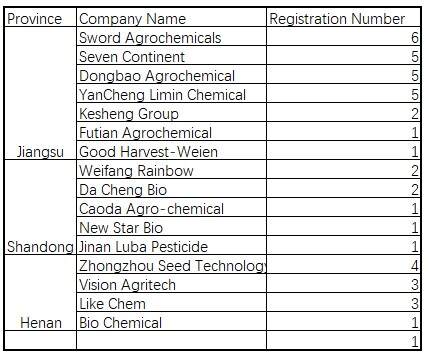
In terms of the registration holders, there were 187 holders in 23 provinces, among which 35 companies in Jiangsu Province ranked first, accounting for 18.71%. Shandong Province has 33 companies, ranking second, accounting for 17.64%; Henan Province ranked the third with 32 companies, accounting for 17.11%. Hebei (13), Anhui (12), Sichuan (10), Shaanxi (10), Shanxi (5), Heilongjiang (5) and other regions. In addition to the Chinese companies, an American company (Mesa Tech) has also registered Triadimefon products in China. The table shows some companies in the provinces with the leading number of Triadimefon products registered in China.
2. Formulations Registered
A total of 11 formulations were involved in the 286 Triadimefon products (as shown in Figure 1). It can be seen that WP, which can pollute human body and ecological environment and threaten non-target biosafety, and EC, which is easy to pollute the environment, produce pesticide damage to crops and have potential safety risks, account for a large proportion (83.56%). The environmentally friendly pesticide formulations, such as SC, FSC, ME, EW and WDG only account for 11%.

3. Registration of technical
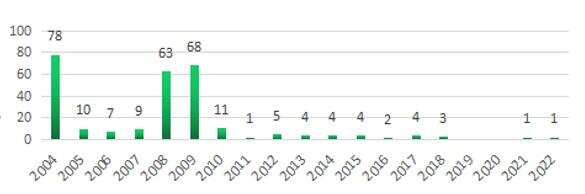
On August 19, 1991, Tongbai Biological got the first temporary registration of Triadimefon technical (the active ingredient content was 95%,90%) in China. From then on, there were many technical products registered, but the number was not big. The peak time of registration was from 2004 to 2007, which reached 8(5 in valid period). There are no technical registration since 2015.
Among the 286 Triadimefon registrations, there were 10 of technical and 276 of formulations. Among the registered technicals, there was 1 with 97% content, 2 with 96% content and 7 with 95% content. All are low toxicity and are fungicides.

4. Registration of formulations
In terms of the number of formulations registered, a total of 276 Triadimefons were approved, including 119 single formulation (including 1 EX pesticide) and 157 mixed formulatons of 29 kinds. There were 235 low toxicity, 19 medium toxicity, 15 high toxicity, 6 medium toxicity (high toxicity of technical) and 1 low toxicity (high toxicity of technical). There were 231 fungicides, 35 insecticides/fungicides, 7 insecticides and 3 fungicides/insecticides.
Compared with the single formulation, the number of compound products registered was slightly more, including 18 kinds of binary compound products 130 and 11 kinds of ternary compound products 27.
Compared with the single formulation, the number of compound products registered was slightly more, including 18 kinds of binary compound products 130 and 11 kinds of ternary compound products 27.
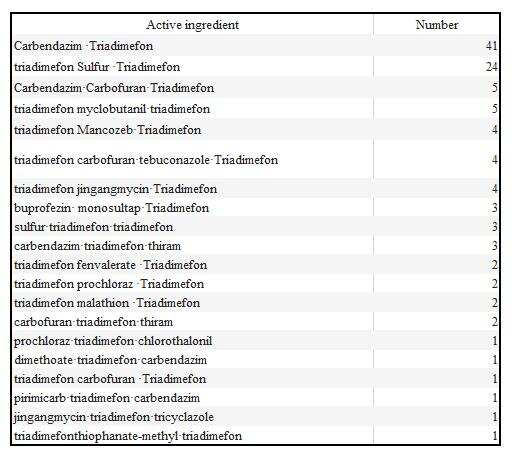
Registered active ingredients and numbers of Triadimefon mixture products in China shown in the following table.
In the terms of registered crops, Triadimefon formulations were registered in 13 types, and the number of registered products in wheat was 349, accounting for 74.41% with absolute leading position, followed by 48 paddies (including hybrid paddy) and 30 corns, accounting for 10.23% and 6.39%, respectively. Cotton (9), rape (8), rubber (7), cucumber (6), apple (4), tobacco (3), pear (3), ornamental rose (1) and ornamental chrysanthemum (1) followed.
In the term of the objects of product registration and control, a total of 47 objects were registered with Triadimefon formulation, 214 were registered with powdery mildew, which had an absolute leading position. Followed by 42 wheat scab, 37 wheat aphids, 35 wheat rust, 16 paddy leaf tip blight, 15 corn head smut and 10 paddy blast. Followed by paddy sheath blight (9), paddy sclerotinia scleroticosis (8) and wheat field underground pests (8), wheat sheath blight (6) and cucumber powdery mildew (5). Then there were four pests in the corn fields and four powdery mildew in rubber trees, and more than two in tobacco powdery mildew, rubber tree anthracnose, wheat starspider, pear black star, paddy evil seedling, paddy smut and paddy planthopper.
In the term of application methods, Triadimefon products were registered in 7 application methods, with 405 sprays, 35 seed coating followed by 18 seed treatments, 4 hot fog machine spray, 3 seed soaking, spray or seed treatment, and 1 smoke spray from smoke machine.
From export only registration, Chinese companies have begun to pay attention to the export business of Triadimefon formulation products. On Oct 8, 2022, Rainbow registered 50% Triadimefon WDG. It achieved an exchange for Triadimefon, which are only allowed export to Panama.
Summary and prospect
From the perspective of the registration trend of formulations, compared with the registration of single product, the registration of Triadimefon mixed products showed a steady upward trend. From 2008 to 2010, the number of registered Triadimefon single and mixed products increased from 50 to 96 and 54 to 150, with 0.92 and 0.54 times increases, respectively, with compound growth rates of 24.28% and 40.57%.
In conclusion, as a control product affecting fungal plasma membrane biosynthesis, Triadimefon will continue to be favored by scientific research institutions, pesticide production companies and many farmers in the future market, especially some plant protection and control service organizations. With the increase of registrations of Triadimefons, the expansion of the range of applied crops, the development of new formulation, the in-depth application of mixed products, and the expansion of control objects, Triadimefon and its mixed formulation have a large development space in the future plant protection market, with broad prospects for future development. Some analysts believe that with the arrival of all kinds of agricultural crops seeding period, and economic forest rubber tree to extract new leaves will have a great demand for fungicides, at that time Triadimefon and its mixed products will have a certain market share.

You May Interested In


Glow70/KLOW80 99% China Peptides Warehouse Direct Delivery Lyophilized Powder in Stock
$169/UNIT FOB


2026-10-16
Trade Alert
Delivering the latest product trends and industry news straight to your inbox.
(We'll never share your email address with a third-party.)

Related News
-
ACE will be held during 14-16,Oct.,2026. There are detailed information about ACE.
-
Renaissance BioScience Receives Genome BC Funding to Extend RNAi Biopesticide Platform to Target Soil-Dwelling Crop Pests
-
Renaissance BioScience Receives Genome BC Funding to Extend RNAi Biopesticide Platform to Target Soil-Dwelling Crop Pests
-
DBN and MOLBREEDING signed a strategic cooperation agreement to carry out in-depth cooperation in six areas such as the integration of transgenic corn traits
-
Brazil's Agriconnection uses a new model to import and direct sell pesticides, with revenue exceeding $340 million
-
Brazil's Agriconnection uses a new model to import and direct sell pesticides, with revenue exceeding $340 million
-
The Indian biopesticide market will grow at a CAGR of 9.38%
-
China's insecticide import and export data for June
-
China's insecticide import and export data for June
-
Jiangsu TrustChem’s degradable pesticide packaging bottle won the domestic and international invention patent authorization
Recommend Reading
-
![BASF Partners with Sinopec to Accelerate Application of Biomethane at Nanjing]()
BASF Partners with Sinopec to Accelerate Application of Biomethane at Nanjing
-
![After Two Price Hikes in One Week, Dow Has Fully Exposed the Most Sensitive Nerve in Europe’s Polyurethane Market]()
After Two Price Hikes in One Week, Dow Has Fully Exposed the Most Sensitive Nerve in Europe’s Polyurethane Market
-
![Advent Drops Its 2026 Purchase, and LANXESS’s €1.2 Billion Exit Plan Falls Through]()
Advent Drops Its 2026 Purchase, and LANXESS’s €1.2 Billion Exit Plan Falls Through
-
![Unilever Reports Stronger Margins and Accelerated Portfolio Transformation in FY2025]()
Unilever Reports Stronger Margins and Accelerated Portfolio Transformation in FY2025
-
![Isopropanol vs. Isopropyl Alcohol: Are They Different? (Uses & Safety)]()
Isopropanol vs. Isopropyl Alcohol: Are They Different? (Uses & Safety)
-
![This week, the caustic soda price was weak in China (4.20-4.24)]()
This week, the caustic soda price was weak in China (4.20-4.24)
-
![This Week's Styrene Market Weakens and Declines (4.20-4.24)]()
This Week's Styrene Market Weakens and Declines (4.20-4.24)
-
![This Week's PVC Market in China: Bottoming Out with Low-level Fluctuations, Intensifying Supply and Demand Competition]()
This Week's PVC Market in China: Bottoming Out with Low-level Fluctuations, Intensifying Supply and Demand Competition
-
![Polyester Bottle Flakes Remain Highly Volatile This Week; Weekly Average Price Rises Compared to Previous Week]()
Polyester Bottle Flakes Remain Highly Volatile This Week; Weekly Average Price Rises Compared to Previous Week
-
![Business Society’s PVC Market Outlook on September 7, 2026: Relatively Strong Fluctuations]()
Business Society’s PVC Market Outlook on September 7, 2026: Relatively Strong Fluctuations