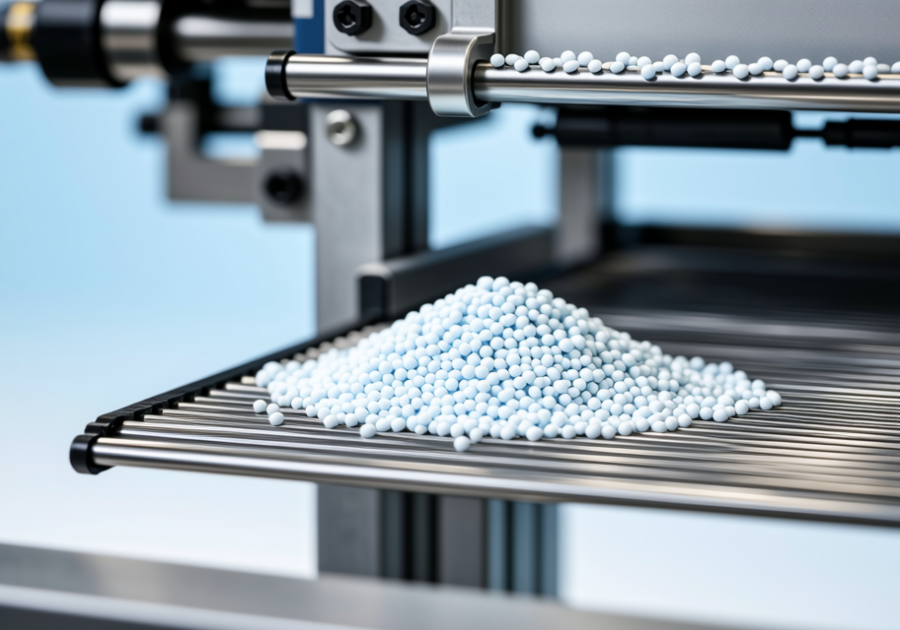
Polysys Additive Technologies opens OPS plant in Abu Dhabi, UAE
Air Products & Chemicals is ending a costly foray into the waste-to-energy business. Because of technical issues, it will not commission a pair of plasma gasification plants in Tees Valley, England, and will instead write down as much as $1 billion in costs.
Each of the units was to have produced about 50 MW of power from 1,000 metric tons per day of refuse. The company completed the first of the units last year but halted construction on the second unit when it encountered difficulties starting up the first one.
Air Products CEO Seifi Ghasemi disclosed the issues to stock analysts in January. “For the past year, we start the plant up, learn something, and the plant goes down because something goes wrong,” he said. “We have given ourselves a few months to keep trying it, but there will come a time that we might stop trying.”
The decision to abandon its largest-ever capital investment comes as the company has been sharpening its focus on its core industrial gases business. The firm’s chemical business is slated to be spun off, with Evonik Industries reportedly in negotiations to buy it.
Air Products licensed the waste gasification process, which was developed by Westinghouse Electric in the 1980s, from the Canadian firm Alter NRG. In the process, plasma torches heat oxygen and waste to more than 3,000 °C to make synthesis gas, a mixture of carbon monoxide and hydrogen.
The technology has been running at a pilot plant in Madison, Pa., since 1984. Larger-scale plants operate in Japan, China, and India. The largest of these, in Wuhan, China, can process 150 metric tons of wood waste per day. The Tees installation would have been, by far, the largest of its kind in the world.
Plasma gasification has a couple of advantages in energy-from-waste plants over conventional combustion technologies, explains Steve Simmons, a vice president at the solid waste management consulting firm Gershman, Brickner & Bratton. Syngas, he says, is easier to clean up than combustion flue gases, leading to lower emissions. Moreover, syngas can fire combined-cycle power plants, which are more efficient than the steam-cycle generators in combustion plants.
Combustion plants, however, are cheaper. One that turns 1,000 tons of waste per day into 35 MW of power costs about $250 million to build.
Alexander H. Tullo
Looking for chemical products? Let suppliers reach out to you!
You May Interested In


Glow70/KLOW80 99% China Peptides Warehouse Direct Delivery Lyophilized Powder in Stock
$1.8E+2/UNIT FOB


2026-08-28
Trade Alert
Delivering the latest product trends and industry news straight to your inbox.
(We'll never share your email address with a third-party.)

Recommend Reading
-
![July Palm Oil Market Oscillates and Rises in China]()
July Palm Oil Market Oscillates and Rises in China
-
![High Supply Remains Firm, Weakness in ABS Market Persists at End of October in China]()
High Supply Remains Firm, Weakness in ABS Market Persists at End of October in China
-
![Cost Side Rebounds, Polyester Staple Fiber Prices Rise Slightly]()
Cost Side Rebounds, Polyester Staple Fiber Prices Rise Slightly
-
![Tert Butylate: Properties and Applications]()
Tert Butylate: Properties and Applications
-
![PVC Market Prices Fluctuate and Decline Under Dual Supply and Demand Pressures]()
PVC Market Prices Fluctuate and Decline Under Dual Supply and Demand Pressures