




Egyptian Cotton Gains Mass Recognition and Awareness
When asked which brand they would pay a premium for, 61% said Egyptian Cotton, which respondents also named as their preferred option for towels and bedding at the survey, commissioned by the Cotton Egypt Association, which was conducted by the independent custom research arm of Progressive Business Media, HTT’s parent company. When consumers were asked to arrange a list of cotton brands in order of perceived quality 89% placed Egyptian Cotton as one of their top two choices. Pima made the top two in 45% of selections, followed by Turkish Cotton (35%), Supima (19%) and Sea Island Cotton (12%).
Tracy Saunders, home category technical manager at U.K. retailer John Lewis, has endorsed the program. He said that,” We support the measures being taken by the CEA to root out dishonest manufacturers and counterfeit goods from the supply chain and have welcomed the opportunity to work in collaboration with the CEA in setting out requirements to assure the provenance of Egyptian Cotton products.”
Khaled Schuman, executive director of the Cotton Egypt Association, said: “We are extremely proud of the thorough accreditation program we have created in association with Bureau Veritas. “The success of this is mirrored in the increase in retailer confidence we have experienced in the U.K.”
Wael Olama, chairman of the Cotton Egypt Association said ”This survey underlines the strength of the Egyptian Cotton brand in the mind of the consumer.”
The Cotton Egypt Association recently unveiled a new brand identity and digital platform to re-enforce Egyptian Cotton's stature. According to new consumer research,Egyptian Cotton is the most recognized cotton brand in the United States. Egyptian Cotton was also the name most people associated with quality and the cotton fiber they said they were prepared to pay a premium for.
It found that while 86% of those questioned couldn’t name a brand of cotton, among those who could, 95% cited Egyptian Cotton, with the remaining 5% naming Pima.
52% of consumers said texture was the most important consideration when buying a cotton product and only 2% considered products being manufactured in the USA as an important factor, when asked to rate the importance of listed qualities.

You May Interested In


2026-09-21
Trade Alert
Delivering the latest product trends and industry news straight to your inbox.
(We'll never share your email address with a third-party.)

Related News
-
25 Companies Raise Prices Three Times Within a Month: China’s Titanium Dioxide Industry Shifts from “Price Wars” to a “Pricing Alliance”
-
Titanium Dioxide Prices Are Up Again! This Round of Increases Has One Real Driver: Sulfuric Acid
-
U.S. 10% Temporary Tariff Expires, New Section 301 Tariffs Not Yet Implemented
-
Chung Lien Oil’s 8,000-Ton Soybean Oil BaP Scandal: NT$165 Million Fine, 401 Product Recalls, Source Still Unknown
-
EU Plans Broader Quotas and Tariffs on China, With Chemicals Clearly Named
-
Ukraine Strikes Russia’s Perm Refinery Again, Forcing Crude Unit Offline at 260,000-BPD Facility
-
Trump’s Steel, Aluminum and Copper Tariff Changes Pull Chemical Manufacturing Into the Impact Zone
-
European Diesel Crack Spread Hits Record $74.66 per Barrel as Global Refinery Outages Mount
-
Global Chemical Giants Accelerate Plant Closures and Layoffs as Industry Enters Structural Capacity Rationalization
-
Ukraine Strikes Russia’s Ryazan Refinery Again, Setting 17-Million-Tonne Facility Ablaze
Recommend Reading
-
![Wanhua Chemical Raises Southeast Asia MDI and TDI Offers by $200 per Tonne]()
Wanhua Chemical Raises Southeast Asia MDI and TDI Offers by $200 per Tonne
-
![API Supplier Audits Move to the Center of Pharma Supply Resilience]()
API Supplier Audits Move to the Center of Pharma Supply Resilience
-
![Supplement Recall Puts Nutrition Ingredient Safety Back Under Pressure]()
Supplement Recall Puts Nutrition Ingredient Safety Back Under Pressure
-
![EU Finalizes Anti-Dumping Duties on Chinese Adipic Acid as Chemical Trade Enters a Rule-Intensive Phase]()
EU Finalizes Anti-Dumping Duties on Chinese Adipic Acid as Chemical Trade Enters a Rule-Intensive Phase
-
![EU Biocidal Data Protection Extension Raises the Stakes for Chemical Market Entry]()
EU Biocidal Data Protection Extension Raises the Stakes for Chemical Market Entry
-
![This Week, Anhydrous Hydrogen Fluoride Prices Remain Steady at High Levels in China (4.20-4.24)]()
This Week, Anhydrous Hydrogen Fluoride Prices Remain Steady at High Levels in China (4.20-4.24)
-
![BDO Market Continues to Fluctuate and Rise in China]()
BDO Market Continues to Fluctuate and Rise in China
-
![This Week, the Chinese Polymeric MDI Market Showed a Weak Decline (4.20-4.24)]()
This Week, the Chinese Polymeric MDI Market Showed a Weak Decline (4.20-4.24)
-
![March Ethylene Oxide Prices Surge 52.73% in China]()
March Ethylene Oxide Prices Surge 52.73% in China
-
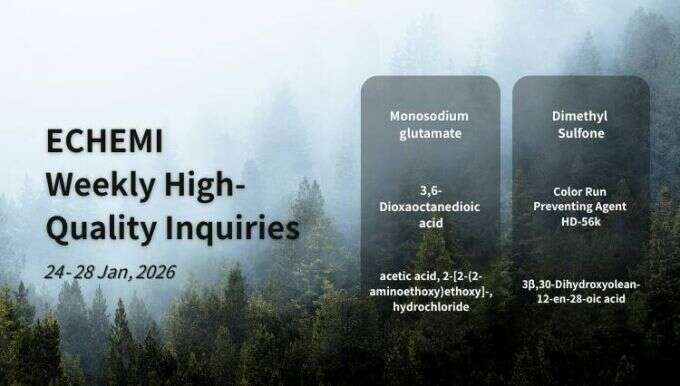
![Premium Global Chemical Sourcing Requests (24 - 28 Jan, 2026)]()
Premium Global Chemical Sourcing Requests (24 - 28 Jan, 2026)




- Hot Searches
- sodium lignosulfonate suppliers
- fuel kerosene price
- deca for sale
- sigmoid.volvulus
- n-isopropylbenzylamine for sale
- n-isopropylbenzylamine for sale
- petroleum coke prices
- ethylene vinyl acetate price
- ammonium nitrate prices
- propylene glycol price
- zirconium silicate
- retatrutide peptide supplier