March Ethylene Oxide Prices Surge 52.73% in China
March 27th News
In March 2026, the price of ethylene oxide in China rose significantly.
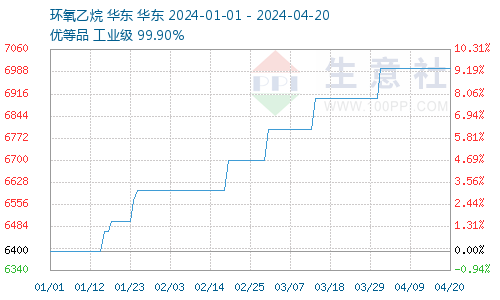
In 2026, the price of ethylene oxide increased significantly in March. According to the data, as of March 27, the average market price of ethylene oxide in China was 8,400 CNY/ton, a 52.73% increase from the beginning of the month when the average market price was 5,500 CNY/ton.
Reasons for the Surge
The main drivers of the epoxy ethane (EO) price surge in March 2026 were soaring costs, supply contraction, synchronized demand, and market control by leading players.
1. Cost Side: Geopolitical Conflicts Trigger a Surge in Upstream Prices—Ethylene/Ethane Prices Soar (the Core Driver)
Crude oil and ethylene prices have surged: Influenced by the escalating situation in the Middle East and disruptions to shipping through the Strait of Hormuz, international crude oil prices have broken through the $100 per barrel mark, directly driving a sharp increase in ethylene prices. Specifically, the ex-factory price of ethylene in Northeast Asia rose from about $800 per ton in early March to $1,050 per ton by the end of the month, while China’s spot price for ethylene also climbed above 7,700 CNY per ton simultaneously. According to calculations, for every $10 increase in crude oil prices, the cost per ton of ethylene oxide (EO) will rise by approximately 600 to 800 yuan.
The cost of imported ethane has skyrocketed: Most of China's ethylene oxide (EO) production facilities rely on imported ethane as a raw material. Due to a significant increase in international shipping costs and import tariffs, the cost per ton of imported ethane has increased by about 2,000 yuan. This has led small and medium-sized producers to face a cost inversion dilemma, forcing them to reduce production to avoid losses.
Cost transmission rigidity is becoming increasingly prominent: Ethylene oxide (EO) accounts for more than 70% of the costs of core downstream products such as polyether monomers and battery solvents (EC). The cost pressure resulting from rising upstream raw material prices can be directly and swiftly passed on to the final pricing of ethylene oxide (EO), further supporting upward price trends.
2. Supply side: Plant maintenance + cost inversion, leading to a significant reduction in market commodity volume in China
The overlap of scheduled maintenance and unplanned shutdowns: In March, China entered the regular maintenance season for ethylene oxide (EO) plants. Several plants operated by companies such as Satellites Chemical and Gulei Petrochemical were successively shut down for maintenance. At the same time, some plants experienced sudden, unplanned shutdowns, leading to a significant drop in the industry’s overall operating rate and a decline in effective supply capacity.
Cost inversion leads to reduced production or shutdowns for small and medium-sized factories: For producers without the ability to self-supply ethylene oxide (EO) and who need to purchase raw materials externally, the sharp rise in upstream raw material prices has completely eroded their profits, leading to widespread reductions in production load or even shutdowns, further reducing the supply of products in the market.
Industry leaders are holding back sales and collectively raising prices: Sinopec, CNPC, Oxiranchem, and Dow, among other industry leaders in China, have simultaneously increased the listed prices of ethylene oxide (EO) by more than 2,600 CNY per ton in March. At the same time, they have taken measures such as suspending external quotations, limiting orders, and prioritizing supply to long-term customers, artificially intensifying the market supply shortage, creating a "can't buy" panic atmosphere, and driving up prices.
Market commodity supply elasticity is insufficient: Although China's total ethylene oxide (EO) production capacity has exceeded ten million tons, most of the new capacity is allocated to meet the downstream production needs of the companies themselves. The increase in the amount of goods released to the market is limited. When faced with a sudden increase in demand, the supply side struggles to respond quickly, further exacerbating the supply shortage.
3. Demand Side: Spring Peak Season + New Energy Boom, Rigid Demand Concentrated Release
Traditional infrastructure "golden March and silver April" peak season boost: In March and April, China's infrastructure and real estate industries accelerated their resumption of work and production. Coupled with the implementation of trillion-yuan national debt and special bond policies, this has driven a concentrated release of demand for polycarboxylic acid water reducers (a core downstream application of polyether monomers). Downstream companies have significantly increased their procurement volumes, providing strong demand support for ethylene oxide (EO).
New energy demand is experiencing explosive growth: the demand for lithium battery electrolyte solvents (EC/DMC) is rapidly expanding, becoming a new driver for the growth in demand for ethylene oxide (EO). Additionally, downstream companies in China are anticipating that prices will continue to rise, leading them to initiate panic buying to replenish inventories. This further amplifies the demand, driving up the price of ethylene oxide (EO).
The low inventory levels in the industrial chain have created a positive feedback loop: Previously, the epoxy ethane (EO) market in China had been operating at low prices for a long time, with overall inventory levels across all segments of the industrial chain remaining low. After the price started to rise, downstream companies showed a strong desire to replenish their inventories, forming a virtuous cycle of "price increase → rush buying → inventory replenishment → further price increase," which accelerated the upward trend in prices.
4. Market Sentiment and Pricing Power: Dominated by Leaders + Capital Boost, Amplifying Price Increase Effects
Leading companies dominate pricing power: The ethylene oxide (EO) industry is highly concentrated, with leading companies such as Sinopec, CNPC, and Ouke Shares holding the dominant pricing power. Against the backdrop of rising costs and tight supply and demand, these companies collectively raise prices significantly, guiding the overall market price upward and further consolidating the trend of price increases.
Market panic and speculative capital: Under the expectation of a tight supply and high costs, traders are hoarding and holding back from selling, while downstream companies are panic buying. The market sentiment remains optimistic; at the same time, some speculative capital is intervening, further amplifying price fluctuations and driving the rapid increase in the price of ethylene oxide (EO). This ultimately leads to a significant price surge within a single month.
Future Market Outlook
In April, the mainstream quotation for ethylene oxide (EO) in China is expected to remain at 7,500-8,200 CNY/ton. At the beginning of the month, due to the high prices from March and the incomplete recovery of supply, the price may stay at 7,900-8,200 CNY/ton. By mid-month, as facilities gradually resume operations and supply increases, the price may slightly decrease to 7,500-7,800 CNY/ton. Towards the end of the month, with the completion of maintenance at Gulei Petrochemical and further recovery of supply, the price is expected to stabilize, likely remaining at 7,700-7,900 CNY/ton. The monthly fluctuation is expected to be around 5%-8%, significantly lower than the nearly 50% price increase in March.
The main basis is: the core driving logic has shifted from "supply-demand gap + cost surge" in March to "cost support + supply and demand trending towards balance." Short-term fluctuations are significantly influenced by plant resumptions, raw material prices, and the pace of downstream demand, with no foundation for sustained surges or crashes. In the future, as extreme events subside and supply gradually recovers, the supply-demand gap will continue to narrow; however, costs remain rigid, with no significant room for a short-term decline.

You May Interested In


Glow70/KLOW80 99% China Peptides Warehouse Direct Delivery Lyophilized Powder in Stock
$169/UNIT FOB


2026-10-21
Trade Alert
Delivering the latest product trends and industry news straight to your inbox.
(We'll never share your email address with a third-party.)

Related News
-
Business Society October 21, 2026 Phthalic Anhydride Trend Analysis: Moderately Bearish
-
Weak Demand Drags Down the Chinese TDI Market (10.12-10.16)
-
This Week, China's Titanium Dioxide Market Slightly Increased (10.12-10.17)
-
Business Society October 15, 2026 Phthalic Anhydride Trend Analysis: Clear Uptrend
-
Cost Pushes Combined with Moving Average Golden Cross: Acrylic Acid Market Strongly Holds Prices and Rises
-
Business Society October 14, 2026 Acrylonitrile Trend Analysis: Clear Uptrend
-
Business Society October 14, 2026 Phthalic Anhydride Trend Analysis: Strongly Bullish
-
Business Society October 14, 2026 Isooctanol Trend Analysis: Clear Uptrend
-
Business Society October 13, 2026 Acrylonitrile Trend Analysis: Uptrend Confirmed
-
Business Society, October 13, 2026: Rubber Market Outlook—Short-Term Prices Likely to Remain Strong at High Levels
Recommend Reading
-
![This week, the price of anhydrous hydrogen fluoride remained high and stable in China (5.11-5.13)]()
This week, the price of anhydrous hydrogen fluoride remained high and stable in China (5.11-5.13)
-
![Business Society October 9, 2026 Maleic Anhydride Trend Analysis: Volatility]()
Business Society October 9, 2026 Maleic Anhydride Trend Analysis: Volatility
-
![Polyester Bottle Flakes Slightly Lowered on May 13, Showing Weak and Volatile Trends]()
Polyester Bottle Flakes Slightly Lowered on May 13, Showing Weak and Volatile Trends
-
![Business Society October 10, 2026 DOP Trend Analysis: Clear Uptrend]()
Business Society October 10, 2026 DOP Trend Analysis: Clear Uptrend
-
![Weather Themes Remain; Palm Oil Futures Expected to Rise]()
Weather Themes Remain; Palm Oil Futures Expected to Rise
-
![Premium Global Chemical Sourcing Requests (11-13May, 2026)]()
Premium Global Chemical Sourcing Requests (11-13May, 2026)
-
![Pesticide Market in Limbo: Prices Plunge Amid Weak Demand and Overcapacity—Only a Few Hold Firm]()
Pesticide Market in Limbo: Prices Plunge Amid Weak Demand and Overcapacity—Only a Few Hold Firm
-
![India’s Tariff Cuts Could Lower Agrochemical Costs]()
India’s Tariff Cuts Could Lower Agrochemical Costs
-
![Applications of Aluminium Orthophosphate]()
Applications of Aluminium Orthophosphate
-
![Premium Global Chemical Sourcing Requests (26 - 29 Mar, 2026)]()
Premium Global Chemical Sourcing Requests (26 - 29 Mar, 2026)