Angry FDA & CDC: $5 billion bivalent Moderna coronavirus vaccine is not as effective as one-price
Recently, the U.S. Food and Drug Administration (FDA) and the Centers for Disease Control and Prevention (CDC) accused Moderna of withholding data during the approval process of its bivalent coronavirus vaccine. Several FDA and CDC advisors said: "Anger and disappointment at Moderna's behavior! To secure a $5 billion order from taxpayers, Moderna withheld data on the fact that 3.2 percent of study participants who received the bivalent vaccine were infected, compared to only 1.9 percent of those who received the bivalent vaccine. Both Moderna and the FDA have unshirkable responsibility in this matter. For now, spokespeople for Moderna and the FDA are divided over who exactly is responsible for the data omission.
Is the key data missed, intentional or unintentional?
For new vaccines to be approved, both the FDA and CDC must convene their advisory boards and brief the advisory panel. This objective review panel will then vote on whether to get the new vaccine approved. The independent consultants, who include infectious disease experts and vaccinologists from Stanford, Pennsylvania and Harvard universities, have now expressed concern about some of the information that Moderna has shown them in its discussions on the approval of the bivalent vaccine.
At the June FDA meeting and the September CDC Advisory Group meeting, data from the Moderna bivalent vaccine showed that the new bivalent vaccine was more effective than monovalent. These results are based on laboratory tests: blood taken from bivalent vaccine recipients is exposed to Omicron and then compared to samples from people who received the monovalent vaccine to measure how effective each vaccine is against coronavirus antibodies. However, other data from the same study were not presented to the team, and these data reflect actual infections. The withheld data indicated that 3.2% of study participants who received the bivalent vaccine were infected. In contrast, only 1.9% of participants who received the monovalent vaccine were infected. But the FDA's 22-page briefing to advisers made no mention of the infection data. Dr. Jerry Weir, director of the Division of Viral Products in the FDA's Office of Vaccine Research and Review, also did not mention infection data in his presentation to advisors.
Spokespersons for Moderna and the FDA were divided over who exactly was responsible for the data omission. Christopher Ridley, a spokeswoman for Moderna, said, "After the FDA asked Moderna to provide an update on ongoing research, Moderna shared infection data with the FDA prior to the June meeting of the FDA panel. The study was publicly available online as a preprint on June 25, three days before the expert group met. However, FDA spokesman Michael Felberbaum said, "FDA received the preprint less than a day before the advisory committee meeting, at which point it was too late for the preprint to be reviewed and incorporated into the agency's meeting materials." ”
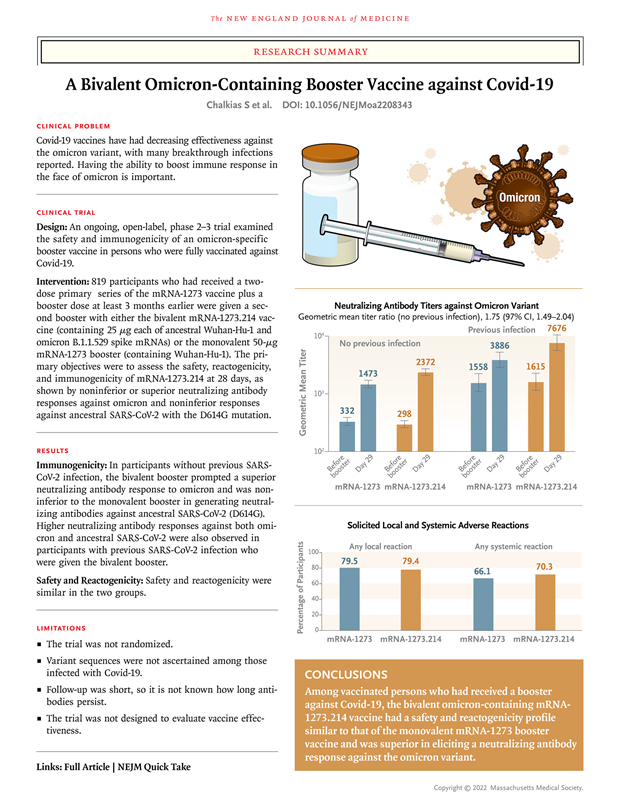
Moderna bivalent vaccine clinical phase 2/3 data (Source: [2])
Dr. Jacqueline Miller, Moderna's senior vice president, was accused of using "carefully selected" materials for his presentation to CDC counsel in September. When a member of the panel explicitly asked people who received the monovalent vaccine about the coronavirus infection with people who received the bivalent vaccine, Dr. Miller gave an incomplete answer. Dr. Miller cited disease incidence in those with or without evidence of prior infection, which highlights the efficacy of the bivalent vaccine in a more positive light, but did not mention the incidence of hundreds of study participants who had not previously been infected with the new coronavirus, as the data showed that monovalent vaccination was significantly more effective at preventing infection.
FDA needs credibility and transparency in its data
Dr. Eric Rubin, a member of the FDA's Vaccine Advisory Committee, said, "Our consultants are not a bunch of kids, not so easy to fool, they know how to interpret these results. Six FDA and CDC advisers said the infection data withheld by Moderna does not change the way they vote because it has certain limitations, but Moderna should still present the full data to advisors.
The consultants believe that Moderna's failure to provide them with infection data is important for three main reasons: first, the decisions they make are potentially impactful, and if Americans are to get these vaccines, all available data should be on the table for evaluation; Second, advisory committee meetings are webcast, and regulators around the world use this information to make decisions about vaccines in their countries; Third, transparency is important for the public, which is related to the credibility of the FDA. The public cannot see conversations between FDA officials or between agency officials and pharmaceutical company executives, but they do have access to the minutes of advisory panel meetings. If all the data, not just some of it, is discussed in an advisory meeting, it will reassure the public.
Dr. Arnold Monto, professor of epidemiology at the University of Michigan School of Public Health and acting chair of the FDA's advisory panel, said: "Moderna should always be fully transparent about its data and should not ignore it. Although it's only early data, the results suggest that we need to study them and measure their value. CDC panel member Dr. Pablo Sanchez said: "The Advisory Committee on Immunization Practices says that if data are reviewed as part of a study, they should be presented to advisors before they make a decision. ”
FDA spokesman Michael Felberbaum said, "The FDA received the preprint less than a day before the advisory committee meeting. As a result, this information is not provided in sufficient time to include it in FDA meeting materials, and typically FDA only discusses data at advisory committee meetings on which the agency has the opportunity to conduct substantive review. The vaccine remains the best way to protect against severe disease, and an upgraded vaccine may help better protect against the currently circulating variants. Throughout the pandemic, the FDA has been as transparent as possible about the COVID vaccine process and decision-making, and Moderna would have had the option to submit data prior to the FDA Advisory Committee meeting. ”
Bivalent mRNA vaccines: BA.4 and BA.5 neutralizing antibody titers cannot be enhanced
Given the ability of mRNA technology to respond quickly to variant strains, bivalent vaccines have emerged. In January 2022 and February 2022, Pfizer-BioNTech produced a bivalent vaccine containing 15 μg of mRNA against the ancestral strain of the new crown and 15 μg of mRNA against BA.1. Moderna used 25 μg of mRNA to target the same two strains.
On June 28, 2022, researchers from Pfizer-BioNTech and Moderna presented data on their bivalent vaccines to the FDA's Advisory Committee on Vaccines and Related Biologics. The results were disappointing: bivalent boosters resulted in neutralizing antibody levels against BA.1 that were only 1.5 to 1.75 times higher than those of monovalent vaccines. Experience suggests that this difference is unlikely to be clinically significant. Meanwhile, BA.1 is no longer circulating in the United States, replaced by the more immune-evasive and contagious Omicron subvariant. However, winter has arrived, the spread of Omicron has accelerated, and in response to these immune evasion strains, the FDA advisory committee decided to pass the review.
A series of policies followed. On June 29, 2022, the day after the Advisory Committee meeting, the Biden administration agreed to purchase 105 million doses of the Pfizer-BioNTech bivalent vaccine for $3.2 billion. On July 29, 2022, the government agreed to purchase 66 million doses of Moderna's bivalent vaccine for US$1.74 billion, with the intention to provide both vaccines in the fall and winter. On September 1, 2022, FDA revoked emergency use authorization for monovalent vaccine boosters, and CDC recommended bivalent vaccine boosters for everyone 12 years of age or older. On October 12, 2022, CDC expanded this recommendation to include all people 5 years of age or older. However, there is no data from humans at this time, including immunogenicity data.
On October 24, 2022, David Ho and colleagues published a study of neutralizing antibody levels against BA.4 and BA.5 after receiving monovalent or bivalent booster doses. They found "no significant difference in neutralization for any Covid variant" between the two groups. A day later, Dan Barouch and colleagues published the results of a similar study, finding that "BA.5 neutralizing antibody titers differed little in the inoculated monovalent and bivalent mRNA booster groups." Barouch and colleagues also noted no significant differences in CD4+ or CD8+ T cell responses between participants in the monovalent vaccine and bivalent plus vaccination. Neither research group found that the bivalent vaccine elicited a better immune response [4].
Six months after the FDA advisory meeting, Moderna has yet to release data from another randomized Phase 3 trial with 3,000 participants that compares infections in bivalent vaccinators with monovalent donors. Moderna's bivalent vaccine was available to all Americans over the age of 12 at the end of August, but vaccination rates are very low. According to the FDA, only 15.4 percent of the U.S. population received the bivalent vaccine, compared with about 70 percent who received the bivalent vaccine. Even in the highest-risk age group (65 years and older), only 38% chose to receive the bivalent vaccine. This low vaccination rate is attributed to concerns about a lack of transparency in the vaccine development and approval process, which may be further exacerbated by recent allegations made by FDA advisers.

You May Interested In


2026-10-14
Trade Alert
Delivering the latest product trends and industry news straight to your inbox.
(We'll never share your email address with a third-party.)

Related News
-
Pharma Asia 2026: Bringing the Global Pharmaceutical Industry to Pakistan
-
Egyptian Pharmaceutical Market Research
-
CPHI China 2023 | At the Heart of Pharma
-
A Guide Into What the Pharmaceutical Use of Hexamine Is
-
In line with the 8201, Hengrui Pharmaceutical plans the HER2 ADC in this way
-
$50 billion in products were 'returned' to rationalize those blockbuster BD deals
-
Tronsound long-acting IL-36R antibody obtained FDA clinical IND
-
Dapagliflozin is approved in the EU for the treatment of symptomatic chronic heart failure
-
The FDA accepted Zuranolone's NDA application and granted it priority review rights for the treatment of MDD and PDD
-
Asia Hong Pharma announced that it has co-developed an innovative tumor therapy based on AI+RNA technology route with ReviR
Recommend Reading
-
![Fertilizer Prices Put U.S. Farmers Under Pressure]()
Fertilizer Prices Put U.S. Farmers Under Pressure
-
![ANVISA Updates Additive Rules]()
ANVISA Updates Additive Rules
-
![Deméter Enters China with a Stress-Focused Pitch]()
Deméter Enters China with a Stress-Focused Pitch
-
![India Prepares New Seed and Pesticide Laws]()
India Prepares New Seed and Pesticide Laws
-
![India’s API Trade Balance Turns Positive]()
India’s API Trade Balance Turns Positive
-
![This Week's Activated Carbon Prices Rise (11.17-11.21)]()
This Week's Activated Carbon Prices Rise (11.17-11.21)
-
![Premium Global Chemical Sourcing Requests (15-19 Nov 2025)]()
Premium Global Chemical Sourcing Requests (15-19 Nov 2025)
-
![ADAMA Targets Sucking Pests with Ateka]()
ADAMA Targets Sucking Pests with Ateka
-
![India Prepares New Seed and Pesticide Laws]()
India Prepares New Seed and Pesticide Laws
-
![Game Theory Does Not Change Stability, China's Acrylic Acid Market Operates with Balanced Supply and Demand]()
Game Theory Does Not Change Stability, China's Acrylic Acid Market Operates with Balanced Supply and Demand