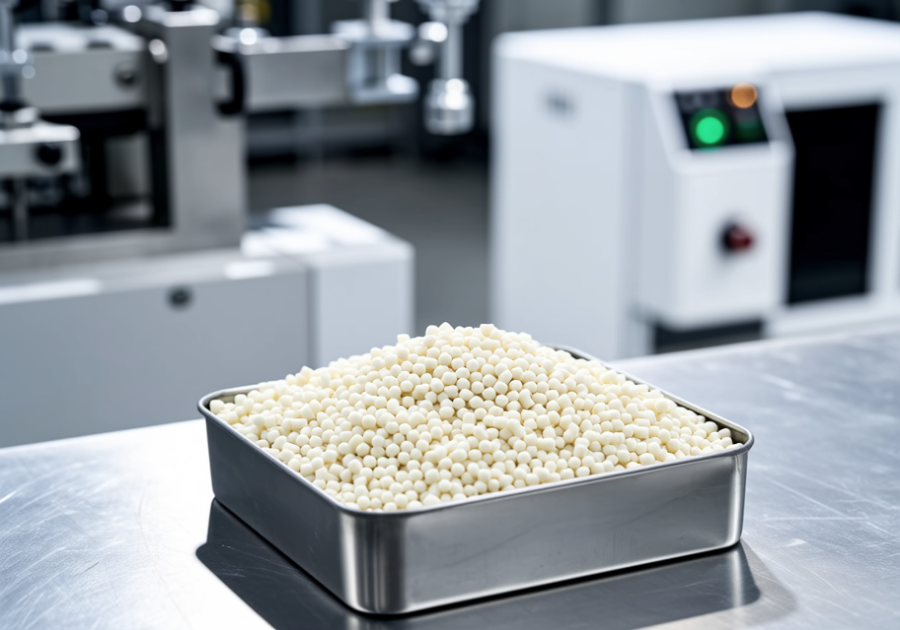
D-ribose: physiological function/application/safety
Ribose has the characteristics of chiral carbon atoms and has two configurations in L-type and D-type. L-type ribose is extremely unstable in nature, and ribose mainly exists in D-type form, namely D-ribose. D-ribose is a five-carbon sugar with strong water solubility and sweet taste, also known as D-ribofuranose. It is a natural aldose that exists in all living cells and is widely present in the form of furan.
D-Ribose is widely used in common foods, health foods, clinical nutritional foods, special functional foods, medicines and many other aspects. Especially in the pharmaceutical industry, ribose is not only an intermediate of a variety of drugs, but also has medical effects. In recent years, with the gradual maturity of the process of producing D-ribose by fermentation, the reduction of production costs and the improvement of new processes, its application scope has been further expanded.
01 The physiological functions of D-ribose
ATP is the "energy currency" of cells. Under high-intensity exercise or disease conditions, the decomposition rate of ATP will be greater than the synthesis rate, and the ATP concentration will decrease accordingly. Most of the ATP degradation product IMP can re-synthesize ATP through a remedial pathway, and a small part of IMP will be further degraded and lost in the form of purines, which will cause the nucleotide pool to continue to decline. Cells can make up for lost ATP through regeneration and salvage synthesis pathways, and the content of D-ribose is the limiting factor for its recovery speed.
1.1 The effect on the heart
The content of ATP and nucleotide pool in the failing heart will gradually decrease, and their content is closely related to the degree of failure. Insufficient energy supply is considered to be an important cause of heart failure. Ribose can replenish ATP by accelerating the heavy and salvage synthesis pathways of ATP. A large number of clinical trials have shown that ribose can improve the cardiac function of patients with ischemic failure. However, Kiterie et al. found no improvement in non-ischemic chronic heart failure mice with ribose in animal experiments for unknown reasons.
1.2 Impact on athletic ability
Wang Yakun et al. studied the recovery effect of D-ribose on the heart and skeletal muscle function of rats during exercise and recovery period with load-bearing swimming rats. They found that D-ribose significantly increased the rate of ATP synthesis in the gastrocnemius muscle, making the body within 72h The ATP consumed during exercise is completely restored within. Another study found that ribose did not show the effect of restoring ATP during intermittent high-intensity exercise.
1.3 The effect on blood sugar
D-ribose is a monosaccharide, all monosaccharides have the effect of increasing insulin secretion, so the intake of ribose will cause a temporary decrease in blood sugar. Generally, ribose is recommended as a meal, but its short-term hypoglycemic effect cannot be ignored. Therefore, people with low blood sugar should follow the doctor's advice when taking it.
1.4 The role of beauty and skin care
As people grow older, the Collagen and elastic fibers in the skin decrease, and clinically, the skin lacks elasticity and wrinkles increase. With aging, the ATP in the dermal cells gradually decreases, resulting in insufficient energy supply, which will change the function of the cells. An experiment selected 20 women with dull skin tone and more wrinkles. They were given 0.5% ribose facial lotion. After one month, the wrinkles were significantly reduced, proving that ribose has the effect of delaying skin aging.
In addition, there are reports showing that D-ribose can significantly improve the energy level and sleep quality of patients with fibrous pain and chronic fatigue syndrome, make the mind clearer, and reduce the pain and clinical symptoms of patients. Ribose also has the effect of reducing the oxidative damage to the testis of mice after fatigue, and has a certain antioxidant effect. Other related physiological functions of ribose need to be further explored.
02 Application of D-ribose
2.1 Application in food
D-ribose can be used as a synthetic raw material for flavoring substances such as condiments and flavors. Utilizing the sweetness and energy supplementation of D-ribose, it has been widely used in beverages, energy bars and other foods, especially in the United States.
2.2 Application in medicine
In the pharmaceutical industry, D-ribose can be used as a synthetic raw material for many drugs. D-ribose can be covalently linked to anti-tumor drugs to prepare sugar-binding tumor-targeted drugs, so that the drugs have the effect of targeting tumor sites. D-ribose was also used as a synergist for cardiac imaging in the early stage to detect reversible thallium deficiency in the cardiovascular system. There are also ongoing clinical trials of D-ribose on muscle fiber pain syndrome. However, at present, drugs that use D-ribose as raw materials have not been approved by any relevant national authority.
2.3 Application in clinical nutrition
D-ribose has been widely used in clinical nutrition (adjuvant treatment for patients with heart disease, muscle fiber pain syndrome), anti-altitude hypoxia and other products.
2.4 The application of D-ribose in sports nutrition
D-ribose has anti-fatigue and anti-anoxia effects. Several patents filed by Bioenergy of the United States opened the application of D-ribose in sports nutrition. A dozen of liquid and solid sports drinks from many foreign companies all use the addition of D-ribose as a new energy factor. There are also a series of products produced using D-ribose additives in China.
03 Safety of D-ribose
D-ribose is a dietary supplement in the US market, and it is recognized by the US FDA as a new food material. When the intake of ribose exceeds 200mg/(kg·h), it may cause diarrhea. D-ribose is a five-carbon sugar, and five-carbon sugars have strong water absorption. Excessive intake can cause intestinal dehydration.
Taking ribose may also cause a few people to have nausea, dizziness and other minor symptoms. When the amount of ribose is less than 15g/d, there are no side effects for most people.
In addition, the half-life of ribose is relatively short. After taking it for about 30 minutes, it reaches the maximum value of about 120 minutes. It is almost completely absorbed. Although ribose can effectively replenish ATP in muscles, exercise experts do not recommend that healthy young people use ribose as a function enhancer. energy.

You May Interested In


High Quality β-Nicotinamide adenine dinucleotide CAS 53-84-9 NADwith ready stock and best price
$3/UNIT FOB


2026-10-15
Trade Alert
Delivering the latest product trends and industry news straight to your inbox.
(We'll never share your email address with a third-party.)

Related News
-
Wacker Under Global Cost Pressure: Dual-Track Restructuring Through Layoffs, Consolidation, and Strategic Repositioning
-
Global Chemical Giants Light the Fuse: A TDI/MDI Price Storm Sweeps Asia and Europe—Who’s Fueling This “Cost Carnival”?
-
China’s TiO₂ Industry Launches Sixth Price Hike Wave as More Than 20 Producers Follow
-
From Ancient Volcanoes to Modern Feed Mills: EFSA Validates Volcanic Zeolite as Safe and Effective Feed Additive
-
Probiotic Promise, Safety Snag: EFSA Gives Mixed Verdict on Multi-Strain Dog Feed Additive
-
Spice Up the Coop: EFSA Reaffirms Safety of Botanical Blend for Broiler Feed—With a Warning for Handlers
-
Sika Undertakes Structural Adjustments Amid Weak Markets
-
Arkema and ENNEX Forge Global Alliance to Power the Next Generation of Safer, Smarter Battery Separators
-
Trinseo Faces Pressure in Resin Markets but Sees Growth in Recycled Products
-
Toxic Ammonia Leak Prompts Emergency Response in Mississippi
Recommend Reading
-
![EU Blocks Entry of Chinese Food Supplement Due to Unauthorized Ingredient]()
EU Blocks Entry of Chinese Food Supplement Due to Unauthorized Ingredient
-
![Lanxess Reports Challenging Third Quarter Amid Weak Global Demand and Geopolitical Uncertainty]()
Lanxess Reports Challenging Third Quarter Amid Weak Global Demand and Geopolitical Uncertainty
-
![Lilly’s Mounjaro Enters China’s State Insurance System]()
Lilly’s Mounjaro Enters China’s State Insurance System
-
![Behind Arkema’s ¥430 Million Claim: A Patent War Over Acrylic Acid Is Tearing Off the “Technical Fig Leaf” of China’s Chemical Giants]()
Behind Arkema’s ¥430 Million Claim: A Patent War Over Acrylic Acid Is Tearing Off the “Technical Fig Leaf” of China’s Chemical Giants
-
![Vertex Pushes Gene Therapy Into Younger Children With Blood Disorders]()
Vertex Pushes Gene Therapy Into Younger Children With Blood Disorders
-
![Business Society September 30, 2026 Lithium Carbonate Trend Analysis: Pullback]()
Business Society September 30, 2026 Lithium Carbonate Trend Analysis: Pullback
-
![Business Society, September 24, 2026: ABS Market Outlook – Volatile and Bearish]()
Business Society, September 24, 2026: ABS Market Outlook – Volatile and Bearish
-
![Business Society’s Petroleum Coke Trend Analysis for September 16, 2026: Volatile]()
Business Society’s Petroleum Coke Trend Analysis for September 16, 2026: Volatile
-
![Cost Reversal & Weak Supply and Demand: Polypropylene Prices Consolidate at High Levels]()
Cost Reversal & Weak Supply and Demand: Polypropylene Prices Consolidate at High Levels
-
![Business Society’s Diesel Trend Analysis for September 17, 2026: Volatile Performance]()
Business Society’s Diesel Trend Analysis for September 17, 2026: Volatile Performance