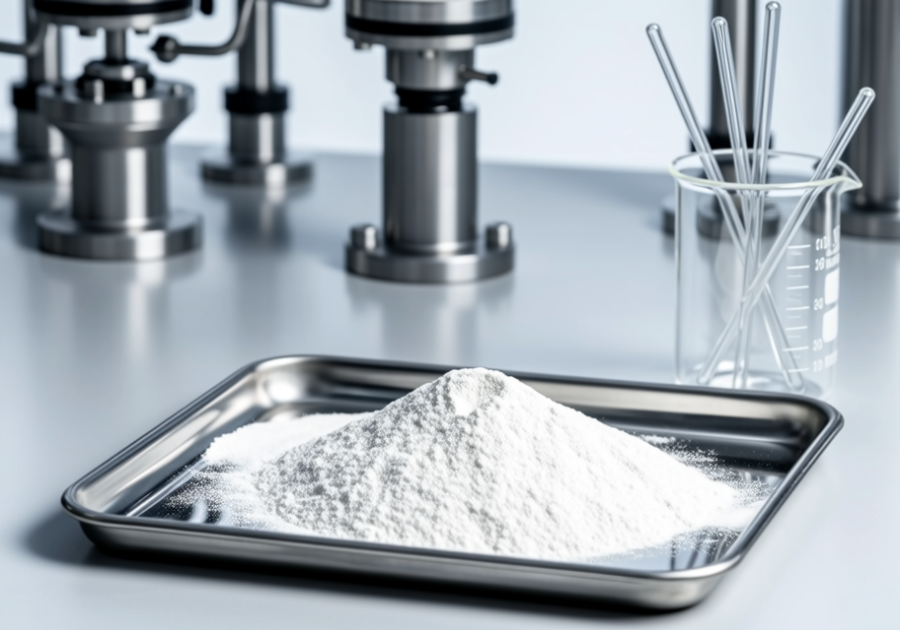
The difference between Alum and Al₂(SO₄)₃ Structure and Application
Aluminum sulfate is a widely used industrial reagent, often confused with alum. Today we will introduce these two products separately, and find out the difference of Alum and Al₂(SO₄)₃ structure and application.
Al₂(SO₄)₃ Structure
Aluminum sulfate is an inorganic compound with the Al₂(SO₄)₃ structure, a molecular weight of 342.15, and a molar mass of 342g/mol. It is a white orthorhombic crystalline powder. It is soluble in water and insoluble in ethanol, and the solution is acidic. It loses some of its crystal water at 86.5℃ and all of it at 250℃. When heated, it expands violently and becomes a sponge-like substance. When burned to red heat, it decomposes into sulfur trioxide and aluminum oxide. Its melting point is 770℃ and its density is 2.71g/cm³.
Al₂(SO₄)₃ Application
In the papermaking industry, it is used as a precipitant for rosin glue, wax emulsion and other sizing materials, as a flocculant in water treatment, and as an internal retention agent for foam fire extinguishers. It is also a raw material for making alum and aluminum white, a petroleum decolorizer, a deodorant, and a raw material for certain drugs. It can also be used to make artificial gems and high-grade ammonium alum.
The first major use of aluminum sulfate, which accounts for about 50% of the total output, is for papermaking. The second largest use is as a flocculant in drinking water, industrial water and industrial wastewater treatment, accounting for about 40% of the total output of aluminum sulfate. When aluminum sulfate is added to this type of water, colloidal aluminum hydroxide flakes can be generated that can adsorb and precipitate bacteria, colloids and other suspended matter. It can be used in drinking water treatment to control the color and taste of water. Aluminum sulfate is usually used as a flocculant for purifying drinking water and sewage treatment equipment, and is also used in the papermaking industry.
Alum Structure
The scientific name of alum is potassium aluminum sulfate dodecahydrate, also known as white alum, potassium alum, potassium aluminum alum, potassium alum, and potassium alum. It is a complex salt of potassium sulfate and aluminum sulfate containing crystal water. It is a colorless cubic crystal, which often appears as an octahedron, or forms a polyhedron with a cube or rhombic dodecahedron. Sometimes it is shaped like a hexagonal plate. It belongs to the α-type alum complex salt and has a glassy luster. The molar mass of alum is 474g/mol, the density is 1.757g/cm³, and the melting point is 92.5℃. It loses 9 molecules of crystal water at 92.5℃ and 12 molecules of crystal water at 200℃. It is soluble in water and insoluble in ethanol.
Alum Application
Alum is sour, astringent, cold, and toxic. Therefore, it has antibacterial and astringent effects, and can be used as a traditional Chinese medicine. Alum can also be used to prepare aluminum salts, baking powder, paint, tanning materials, clarifiers, mordants, papermaking, waterproofing agents, etc. It can also be used as a food additive. In our lives, it is often used for water purification and as an edible expansion agent.
In summary, we can roughly understand the difference of Alum and Al₂(SO₄)₃ structure and application.

You May Interested In


Glow70/KLOW80 99% China Peptides Warehouse Direct Delivery Lyophilized Powder in Stock
$169/UNIT FOB


2026-10-25
Trade Alert
Delivering the latest product trends and industry news straight to your inbox.
(We'll never share your email address with a third-party.)

Related News
-
South Korea’s June Petrochemical Export Value Rises 18.8%, While Export Volume Falls 14.6%
-
Syngenta Gets a New Boss
-
350 Million Yuan! Shandong Huayang Dr Chemical Industry Co., Ltd.'s Nitric Acid Expansion in Ningyang, Tai'an
-
Bayer Wins Big on Roundup
-
Growing Pains, But the Roots Are Strong: Corteva Narrows Losses Amid Sales Surge in Q3 2025
-
From the Brink to the Bend: Bayer’s Q3 2025 Shows Dramatic Loss Reduction—but Crop Science Still Bleeds
-
Profit Soars While Sales Dip: Syngenta Group Defies Headwinds with 28% EBITDA Surge in Q3 2025
-
Yara’s Green Surge: Record Profits Fuelled by Precision, Not Just Prices
-
From Modest Gains to Massive Profits: Nutrien’s Q3 2025 Marks a Stunning Agricultural Comeback
-
BASF India to Shut Two Dahej Care Chemicals Plants as Overcapacity Squeezes Margins
Recommend Reading
-
![LANXESS Specialty Additives Earnings Jump 32.8%, but Chemical Demand Recovery Remains Elusive]()
LANXESS Specialty Additives Earnings Jump 32.8%, but Chemical Demand Recovery Remains Elusive
-
![Huntsman’s Rotterdam MDI Line Stumbles—$10M EBITDA Hit Sends Q4 Guidance to the Low End]()
Huntsman’s Rotterdam MDI Line Stumbles—$10M EBITDA Hit Sends Q4 Guidance to the Low End
-
![April Chemical Industry Shutdown Wave Arrives: Maintenance Plans Reflect Deep Cost Anxiety Across Enterprises]()
April Chemical Industry Shutdown Wave Arrives: Maintenance Plans Reflect Deep Cost Anxiety Across Enterprises
-
![Saudi Arabia Flips the Switch on Jafurah: World’s Largest Non-U.S. Shale Gas Field Begins Production]()
Saudi Arabia Flips the Switch on Jafurah: World’s Largest Non-U.S. Shale Gas Field Begins Production
-
![PTT Global Chemical Targets 30% Specialty Mix by 2030 as Petrochemical Strategy Shifts]()
PTT Global Chemical Targets 30% Specialty Mix by 2030 as Petrochemical Strategy Shifts
-
![Business Society’s Market Outlook for Phenol on August 11, 2026: Factories Lower Prices]()
Business Society’s Market Outlook for Phenol on August 11, 2026: Factories Lower Prices
-
![Business Society August 11, 2026 Soda Ash Market View: Fluctuating and Consolidating]()
Business Society August 11, 2026 Soda Ash Market View: Fluctuating and Consolidating
-
![Business Society’s August 12, 2026 Acrylic Acid Market Outlook: Clearly Upward Trend]()
Business Society’s August 12, 2026 Acrylic Acid Market Outlook: Clearly Upward Trend
-
![Cost Floor + Downstream Support—How Far Can the High-Price Trend for Acrylic Acid Last?]()
Cost Floor + Downstream Support—How Far Can the High-Price Trend for Acrylic Acid Last?
-
![Multiple Positive Factors Drive Significant Increase in MTBE Market in China]()
Multiple Positive Factors Drive Significant Increase in MTBE Market in China