Take Japan as a mirror, where will China chemical industrial go?
Deja vu:
The development of the chemical industry in Japan has practical guiding significance to our country
Part 1
There are many similarities in the process of industrialization between different countries. As a basic industry closely related to the national economy, the development of chemical industry mostly follows similar logic.We can make use of the structural change of chemical industry in industrialized countries and the universal law of each stage in the process of industrialization to discuss the reference significance for the development of chemical industry in China today.
In macroeconomic outlook uncertain now, from the perspective of historical experience, we select finish time is the most close to the contemporary Japanese of industrialization, the development of the post-war Japan chemical industry, especially in the economic transitional period after on a summary of development and structural changes, the resulting Japan chemical industry transformation and upgrading of the basic logic, and to forecast the long-term trend of the development of China chemical industry.
After the war, Japan's manufacturing structure followed the different stages of economic development and successfully achieved three transformations:
1.From light industry to heavy chemical industry;
2.From the heavy chemical industry in the raw material industry as the center to the processing and assembly industry
3.From general machinery industry to advanced mechanical and electrical integration of the mechanical industry.
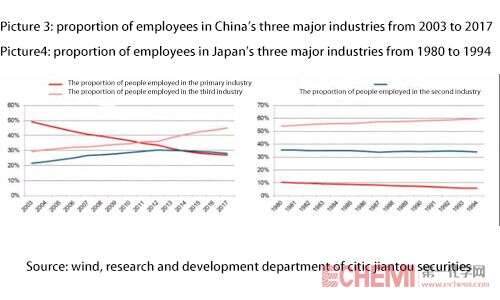
The transformation of Japan's industrial structure fully deduces clark's theory of industrial structure change. The focus of a country's industrial structure shifts from the primary industry to the secondary industry, and then from the secondary industry to the tertiary industry.
The former is the process of industrialization, which is also deeply manifested in the shift of industrial center of gravity from light industry to heavy chemical industry, and the rise of heavy chemical industry to the leading position, that is, the realization of "heavy chemical industrialization", and the shift of heavy chemical industry's center of gravity from the material industry to the processing and assembly industry.
In the whole process, the industrial center is a process of transferring from labor intensive industry to capital intensive industry, and then to technology and knowledge intensive industry.

The development of Japan's heavy chemical industry
can be divided into two stages
①From 1955 to 1964, the heavy chemical industry was strengthened and developed mainly by substituting import and expanding domestic market.
Japan introduced a large number of foreign advanced technology, completed the preliminary improvement of domestic equipment, and then "investment-driven investment" to achieve the heavy chemical industry heavy equipment, equipment investment in various departments grew rapidly.
Traditional basic industries, such as Iron and steel, petrochemical and electric power industries, have all adopted modern production methods. The production of electrical machinery and automobiles has also been gradually modernized, and the shipbuilding and industrial machinery sectors have reached the leading level in the world.
②from 1965 to 1973, the dominant industries developed towards the direction of large-scale and internationalization, during which equipment investment and foreign trade became the two engines of economic growth.
Heavy chemical industrialization is not only an important result of Japan's rapid economic growth, but also an important reason for achieving rapid economic growth.In 1968, Japan surpassed the federal republic of Germany to become the second largest capitalist economy after the United States, and the heavy chemical industry continued to increase its share in industrial production.

Two oil crises in the 70 s Japan relies heavily on overseas resources of heavy chemical industry has been hit, had to industry transformation, and comes at a time when in microelectronics, new materials, new energy and biological technology as a representative of the rise of the fourth technological revolution, Japanese industrial structure by the capital-intensive to high value-added knowledge intensive.
In 1980, the Japanese government clearly put forward the strategy of "building a country by technology".At this stage, Japan's economy grew slowly and steadily, and the GDP structure of the three industries was relatively stable.And the international competitiveness of Japanese products is enhanced, exports are increasing rapidly, Japanese industry is on the offensive in the international market is strong, products swept across the European and American markets, crowned as the veritable "world factory".
Since then, due to the increasing growth of Japanese exports, the trade friction between Japan and the United States finally came into being. The appreciation of the yen after the "plaza accord" seriously affected the export of manufacturing industry. The economic bubble in Japan finally burst in the early 1990s, and Japan began to fall into a long-term economic depression.
Although Japan still has the shining halo of being the second largest country in the world and its manufacturing industry as the core of the economy still occupies an important position in the world, its growth pace is slow and sluggish, and the Japanese economy has entered a stage of continuous structural adjustment.
Under the condition of participating in the international industrial division of labor, China will face similar difficulties in the medium - and long-term transformation period in the future as Japan did in the industrial structure adjustment in the 1970s, such as the emergence of domestic environmental problems and the increase of international trade friction.
The industrial upgrading and replacement, structural changes and organizational changes that have taken place in Japan in the stage of economic restructuring are, to a certain extent, universal in the transformation from a backward economy to a developed economy. They have important reference values for China's industrial upgrading, especially for the chemical industry, which is the cornerstone of the manufacturing industry in the middle reaches.
Part 2
Like a god:
Japanese road Chinese version reproduced
But it's different

At present, China is in the stage of heavy chemical industry in the middle stage of industrialization. It is in the transition period from low-energy consumption and high-value-added assembly and processing industry to knowledge-intensive industry.
Many pressure on resources, environment and trade friction, China in the international division of labor value chain in low value-added, low technology content and low level of unsustainable status, China's manufacturing sector also have the high added value, high technology content, high level of industrial upgrading spontaneously, but the road is shaped as a miraculous, with Japan on the way of industrial upgrading in China to completely give up the lower part of the light industry and the processing of base.
Traditional economic theory holds that in the transition from take-off stage to maturity and promotion stage of economy, industry develops to diversification, new industrial sectors accelerate development, old industrial sectors stagnate, and new leading industrial sectors gradually replace the old leading industrial sectors.
For example, in the early postwar period, Japan's textile industry, as a major industrial sector, developed a lot and reached the advanced level in technology. The export of products accumulated a large amount of funds for the development of heavy chemical industry. However, with the rapid development of heavy chemical industry, the textile industry began to decline rapidly.
But China's heavy industrialization stage is not a completely different from the past stage of heavy industrialization advanced industrial countries, it is the basic content of both the international advanced industrialized countries, is a heavy industrialization with "Chinese characteristics", which contains a strong agricultural colour and great imbalance, is a new type of heavy industrialization rather than mainstream theory described "classic" heavy industrialization.
China's urban and rural dual economic structure led to special agriculture always accounts for a considerable proportion of workers, 2013 years ago has been the largest industry of employment, while the second industry in 2014 for the first time the first industry workers, but still can't fall behind, industrial sector for the absorption of agricultural labor force is still inadequate, the urbanization level space is huge.
Since 1978, China's industrialization has been mainly carried out in the eastern coastal areas, resulting in a serious economic gap between the east and the central and western regions in all aspects. The eastern region has entered the middle and late stages of industrialization, while the central and western regions are still in the primary stage of industry.
In essence, the upgrading and transformation of China's manufacturing industry specifically refers to the adjustment of industrial structure in the industrial developed areas along the east coast. The industrial transfer in the eastern region is not to the overseas division of labor as traditional international division of labor is, but to the inland areas in the central and western regions.
The central and western regions need to undertake industries eliminated in the east, achieve economic take-off, transfer rural employment, and make up for the huge infrastructure and urbanization gap with the east
It can be seen that China's traditional light industry and primary manufacturing industry still have broad market demand and development prospects for a long time to come.
East China will develop emerging industries such as electronic information industry, new materials industry and biotechnology industry, while central and western China will develop labor-intensive industries such as textile and garment industry and even heavy chemical industry, which will be the possible prospects for China's industrial development.
The primary position of China's manufacturing industry in the national economy will probably remain unchanged for a long time and space. The structure will include light industry, capital-intensive industry and technology-intensive industry at the same time. It will be a complete flashback picture of the industrialization process from the east coast of China to the central and western regions.
Part 3
Take Japan as a mirror:
New fields of fine chemicals and new materials
It will be the future direction of chemical industry

Chemical industry is the basic industry of national economy, providing supporting services and products for various economic departments of the three industries.Only by placing chemical industry in the macroscopic picture of the whole national economy can we understand the context of its transformation and development.
In the stage of economic take-off, chemical industry, as the pillar industry of heavy chemical industry, is the direct driving force of economic development, and basically has a synchronous relationship with the growth of national economy and industry.
After a country's economy enters the late stage of industrialization and advances to the mature stage, the heavy chemical industry changes into the equipment processing industrial structure, and then to the knowledge-intensive transition, the industrial sector begins to show diversification, and the tertiary industry gradually develops and expands.
In this development paradigm, the demand growth of bulk basic chemicals tends to slow down, and the technical equipment, enterprise scale and industrial form of traditional chemical industry are becoming more and more mature. The proportion of chemical industry in the industry is gradually declining.
China's traditional chemical industry has slowly entered a stage of relative decline: since 2012, China's industrial added value as a proportion of GDP began to decline sharply, which represents the decline of traditional industry.In traditional industries, the gross profit ratio of chemical industry started to be significantly lower than the revenue ratio in 2012, and the traditional chemical industry has begun to enter a downward channel.


China petroleum and chemical industry after years of rapid development, most product capacity increase rapidly, at present, the supply has the shortage of "holistic" into a "structural shortage" : low technical barriers of general-purpose products, such as soda ash, Caustic Soda, nitrogenous fertilizer, urea, tanning, pigment, general plastic rubber products, such as saturated domestic market, products are exported abroad;
However, high-end chemical products with high technical content, such as drugs, special plastics, rubber and fine chemicals in segmented fields, are still needed to be imported due to insufficient domestic self-sufficiency.Although the chemical trade deficit is still in China, in contrast to the overall trade surplus, but in recent years, China's chemical products trade deficit has narrowed sharply, chemical trade deficit of $9.1 billion in 2016, compared with $2013 in 27.8 billion, has narrowed nearly 70%, in addition to the drug, the rest of the chemical products in general has been in surplus, the domestic most of the bulk chemical raw material market is saturated.
After the oil crisis in Japan, the chemical industry is faced with the dilemma of excess production capacity, saturation of the domestic market, high raw material cost and declining competitiveness of products, resulting in the hindrance of foreign exports. On the eve of the transformation, the supply of basic chemical products in Japan belongs to the "overall surplus".
At present, China's chemical industry is at a stage similar to Japan's transformation period. Most bulk chemical raw material markets are saturated, and there is still room for import substitution for a few varieties.
For a few bulk chemicals still in shortage, such as PC and caprolactam, etc., the huge domestic market demand will promote the continuous expansion of the production capacity of the above products, and the increased output can replace the market of imported products as the target.
However, as a resource-deficient country, China imports more raw materials such as oil and natural gas year by year, and the cost of chemical products is directly affected by international prices.With the rising cost of raw materials and the saturation of domestic market demand, the molecular industry of the ministry of chemical industry has entered the stage of structural adjustment in advance under the market pressure and the promotion of national policies, with backward production capacity gradually eliminated and industrial concentration gradually increased.
Throughout the development of the Japanese chemical industry, can be found that after the oil crisis, Japan's basic chemical industry faces a long-term disadvantage, non renewable resources to the rise in prices of crude oil long term trend is irreversible, emerging in the developing world petrochemical industry that makes the market more and more crowded, the raw material cost increase and profit decline decision update production facilities lack of economic power, outdated equipment and small scale becomes inevitable.
When the production and development of basic stone chemical products are hindered, it becomes an inevitable choice for Japanese petrochemical enterprises to turn to the field of fine chemical and specialty chemicals with high added value.The added value of fine chemicals is higher, and the profit is less affected by the price of crude oil than that of basic chemicals.
Fine chemicals are applied in a wide range of fields, close to the terminal consumption market. With the economic development and the improvement of social consumption level, the demand for various new products will continue to emerge, and the market scale will gradually grow.
From the transformation of chemical industry in Japan, it can be seen that compared with basic chemical industry, fine chemical industry and special chemical industry belong to sunrise industry.However, the production process of fine chemicals is complex and its development is difficult. It belongs to the knowledge-intensive industry and has great technical barriers for emerging and developing countries. In the long run, the number of market participants is limited and the market profit prospects are good.
Fine chemicals are classified into pesticides, dyes, paints, pigments, reagents and high purity substances, information chemicals, food and feed additives, adhesives, catalysts and various auxiliaries, chemicals and daily chemicals, functional polymers in polymers and other categories.The refining rate (the proportion of the output value of fine chemical industry in the total output value of chemical industry) is not only a symbol of the product structure of chemical industry, but also a symbol of the technical level of chemical industry. Developed countries are as high as 60-70%, while China is still around 50%.
At present, China's chemical industry is in the transition period from the initial and intermediate stages to the stage of fine chemical industry. The proportion of traditional bulk general-purpose products will gradually decline, and high-end products will gradually achieve breakthroughs. On the whole, China's chemical industry will gradually break the structural shortage situation.
The fine chemical industry in China is divided into traditional fine chemical industry and new fine chemical industry.Traditional fine chemical industry, including dyestuffs, organic pigments, inorganic pigments, auxiliaries, pesticides and their preparations, coatings and their supporting raw materials, dyes and pesticides supporting intermediates and other industries, has formed a relatively complete industrial system, part of the products exported in large quantities;
New field fine chemical industry including feed additives, Food Additives, surfactants, water treatment chemicals, paper chemicals, leather chemicals, oil field chemicals, adhesives, biological, chemical, electronic chemicals, cellulose derivatives, polyacrylamide, aerosol products, such as the overall market rate has reached more than 80%.
Although China's fine chemical industry has a relatively large scale of production capacity, but the product structure is dominated by low-end products, it is difficult to meet the needs of market segments, high-end fine chemicals represented by electronic chemicals are heavily dependent on imports.
New chemical materials generally refer to: general engineering plastics, including formaldehyde (POM), polycarbonate (PC), polyamide (PA), polybutylene terephthalate (PBT), acrylonitrile butadiene styrene copolymer (ABS);Special engineering plastics, such as polysulfone (PF), polyimide (PI), polyphenyl ether (PPO), polyether ether ketone (PEEK), etc.Special fiber, such as carbon fiber, spinning fiber;And organic silicon materials, organic fluorine materials and so on.
New chemical materials are necessary supporting materials for modern industry and advanced science and technology, such as automobiles, electronics, machinery, communications, aerospace and national defense industries.
After the development of the 12th five-year plan, the situation of heavy dependence on import of new chemical materials in China has been improved to some extent. By 2015, the overall self-sufficiency rate of new chemical materials in China was 63%, and most of the dependence on import has gone forever.
However, the import dependence of some varieties is still serious. In 2015, the self-sufficiency rate of engineering plastics in China was 49%, that of high-performance film materials was 43%, and that of carbon fiber was only 28.6%.During the 13th five-year plan period, the self-sufficiency rate of new chemical materials will be further improved.
It is estimated that by 2020, its self-sufficiency rate of China chemical new materials will reach more than 80%, high performance resin, engineering plastics, high-end polyolefin plastics, special rubber, high performance fiber, functional membrane materials and electronic chemical products such as target consumption reached 29.86 million tons, 5.74 million tons, 11.15 million tons, 5.57 million tons, 150000 tons, 610000 tons and 1.09 million tons, the target rate were 83%, 76%, 69%, 80%, 92%, 75% and 66%.New chemical materials will shine brilliantly in the 13th five-year plan, leading the hot spot of investment in chemical industry.
Part 4
Find growth in certainty
New materials lead the upgrade of chemical industry
The theory of industry development indicates that when the industry develops to the late prosperity stage (i.e. the early maturity stage), a large number of enterprises, low-level duplication and excess capacity will be a common phenomenon. As the maturity deepens, an industry will be crowded and profits will decline.
After the development of this stage to a certain extent, enterprises with initial capital, resources, technology and operating advantages will gradually acquire larger and larger scale and scope advantages, and continue to push forward this positive feedback.
In the end, if we do not consider the government regulation and the factors of regional segmentation, most of the cyclical industry will enter a state of oligopoly is relatively stable and efficient, in this process, leading enterprises to seize the opportunity of growth for the industry leader with the giant, and the process in addition to endogenous capacity expansion, also including the merger integration, internationalization, product upgrading and four means of diversification.
According to the industry cycle operation, combined with the current trend of the chemical industry, the chemical industry has gone to the back end of the third inventory cycle, that is, has entered the era of breaking the bureau, which is characterized by the change of industrial pattern, the rise of emerging demand, environmental protection fine leadership.
Therefore, China is in the era of breaking the bureau. New materials are leading the industrial upgrading, panel, semiconductor and other acceleration of localization. Relevant domestic chemical new material technical barriers are constantly breaking through, ushering in an excellent opportunity to replace;Driven by policies (in 2012, the state council issued the development plan for energy conservation and new energy vehicles industry) and green environmental protection, the sales volume of new energy vehicles in China in 2016 and 2017 exceeded half of the global sales volume of new energy vehicles for two consecutive years. The new energy vehicles sector accelerated catalysis, and the demand for relevant upstream materials surged.It is recommended to focus on electronic chemicals, OLED and lithium electric materials and other related materials.

Core screen rise, domestic acceleration
LCD panel from the tide of domestic production
With the strong support of national policies, China's panel industry is gradually developing. From 2010 to 2017, China's panel industry has gone through a period of rapid expansion. At present, China's mainland panel production capacity accounts for about one third of the global total.
Although the base continues to expand, but in the future with the continuous development of the high generation line, China's panel production capacity will still grow rapidly, it is expected that in 2017-2020, China's panel industry production capacity growth will remain at about 25%, it is expected that by 2020, China's panel production capacity will more than double than in 2017.
In terms of the proportion of panel production capacity in 2017, boe is the absolute leader in China, accounting for 46% of the total production capacity.By 2020, as the sun 8.6 generation of line and line 11 generations, cec panda 8.6 line, hon hai 6 generation line and 10.5 generation of line put into production, the capacity of the three system manufacturers will be up to 2308, 2287, 1270 square meters, with domestic capacity share will reach 13%, 13%, 7% respectively, there was some uncertainty due to production, combined with the cec panda and hon hai is expected in 2020 is very close to capacity, cec and hon hai will compete for domestic third seat, and the first and second industry is still respectively by Beijing Oriental, huaxing photoelectric comfortably.
Under the tide of LCD panel localization, it is recommended to focus on the domestic leading liquid crystal material feikai material (continue to benefit from the substitution of domestic mixed crystal, and gradually expand the production capacity of single crystal).


The global PCB industry is recovering
The center of gravity is shifting to China
Global PCB industry output value returns to growth channel in 2017.From the perspective of global PCB industry development, 2012-2016 is the stagnation stage of industry development, during which global GDP fluctuates between 3% and 3.5%. Affected by this, the growth of electronic industry is also relatively slow.
In 2017, benefiting from the recovery of the downstream electronic consumer goods market, the total output value of PCB industry in the whole year reached 55.277 billion us dollars, with a year-on-year increase of 1.97%, re-entering the rising channel.Prismark estimated that the global PCB output value will reach $76 billion in 2022, and the industry CAGR will be maintained at about 3.2% from 2017 to 2022.

PCB industry center of gravity shifts to mainland China.Due to the prominent cost advantages in mainland China and the gradual improvement of upstream and downstream industrial chain supporting facilities, the global PCB industry focus has gradually shifted to mainland China in recent years.In 2017, the total output value of the global industry reached $55.277 billion, and the global compound growth rate of the industry from 2008 to 2017 was 1.50%.
From the perspective of specific countries and regions, the output value of Europe, America and Japan has decreased to varying degrees in the past decade, with compound growth rates of -5.70%, -5.17% and -7.42%, respectively.Asia (excluding mainland China and Japan) also grew at a compound rate of 1.32 per cent below the global average.In sharp contrast, PCB industry in mainland China has maintained rapid growth in the past decade, with the composite growth rate of industrial output reaching 7.19%.
In 2017, the output value of China's PCB industry reached 28.093 billion us dollars, accounting for 50.82% of the global total, up from 31.11% in 2008.In addition, the number of listed companies in China's PCB industry has increased from 6 ten years ago to 26 now, which also proves that China's PCB industry has achieved rapid development in recent years.
With the recovery of global PCB industry and the shift of focus to mainland China, we mainly recommend guanghua science and technology co., LTD., the leader of PCB chemicals with profound history, and powerful new materials, the leader of PCB photoresists related products with rich history.


The integrated circuit industry is
Accelerating the transfer to mainland China
From 2011 to 2017, the composite growth rate of the sales volume of the domestic IC manufacturing industry reached 20%, and the sales volume in 2017 reached 144.8 billion yuan.As China becomes the world's largest electronics manufacturing base, the centre of semiconductor manufacturing is moving inland.
According to a report released by SEMI, the international semiconductor equipment and materials industry association (SEMI), the world is currently in the planning or construction stage of capacity construction. It is estimated that about 62 semiconductor wafer factories will be put into production between 2017 and 2020, of which 26 are located in China, accounting for 42% of the global total.
Under the circumstance of accelerating the transfer of integrated circuit industry to China, it is recommended that Jacques technology (the first electronic chemical material company invested by large funds) and Shanghai xinyang (the leader of semiconductor materials, electronic electroplating and electronic cleaning are the two core technologies;By the end of 2018, the production capacity of 300mm large silicon wafers of the company will reach 100,000 pieces), jianghua micro and jingrui shares (leading wet electronic chemicals).

Domestic OLED panels meet the intensive production period
The upstream material market space expands rapidly
The Organic Light Emitting Diode, or OLED, is a new display technology that has been developed since the mid-20th century.Driven by the external voltage, electrons and holes injected by the electrode compound in the organic material, and the released energy is transferred to the organic luminous material, which is excited to jump from the ground state to the excited state.When excited molecules jump from the excited state to the ground state, photons will be released to generate luminescence.

OLED has the characteristics of easy flexibility, outstanding display effect, strong environmental adaptability, low power consumption, low theoretical production cost and so on, making it become the next generation of display technology to replace LCD.

OLED material industry is located at the upstream of the whole OLED industrial chain.Because OLED panel has a fundamental change in display principle compared with LCD panel, OLED material will usher in a great development opportunity in the process of replacing LCD panel with OLED panel, especially for OLED luminous material.

In terms of small and medium-sized screens, with the introduction of OLED screens by apple in 2017, many mobile phone manufacturers such as huawei, oppo, vivo and xiaomi followed suit one after another, and the penetration rate of OLED small and medium-sized screens rose linearly. IHS predicts that the penetration rate of OLED will be 45.7% in 2018, more than 50% in 2019 and 73% in 2025.
In terms of large screen, OLED TV shipments are growing rapidly, from less than 100,000 units in 2014 to 1.5 million units in 2017, with an average annual growth rate of 400%. It is expected to maintain a growth rate of about 65% in 2018 and reach 12.5 million units in 2024.

Due to the obvious advantages of OLED, mainstream panel manufacturers all have their own layout. In recent years, they have gradually entered the intensive production period of the new capacity of OLED panel globally.According to our statistics, the global OLED panel production capacity will increase from 8.62 million square meters in 2017 to 31.42 million square meters in 2021, with an annual compound growth rate of about 38%.The global OLED panel shipment area will increase from 4.97 million square meters in 2017 to 20.42 million square meters in 2021, with an annual compound growth rate of 42%.
OLED panel enterprises in China are in the second echelon of the international market. With the support of capital and national policies, OLED industry in China is developing rapidly.According to our statistics, the domestic OLED panel production capacity will increase from 910,000 square meters in 2017 to 17.35 million square meters in 2021, with an average annual growth rate of 109%.The shipping area will increase from 80,000 square meters in 2017 to 4.34 million square meters in 2021, with an average annual growth rate of 173%.
No matter from the perspective of production capacity or shipments, the OLED inventory market in China in 2017 will be only a drop in the bucket. After a large amount of newly added production capacity is released in China, the whole OLED industrial chain will usher in a promising future.
The rapid release of OLED panel production capacity will lead to the rapid increase of OLED terminal material demand. Combined with the shipment area of OLED panel, the proportion of flexible screen, the cost and cost composition of flexible screen and rigid screen, we estimated the market space of OLED terminal material in the world and China.
By 2021, the market space of OLED terminal materials in the world will reach 21.9 billion yuan, with a compound annual growth rate of 27% from 2017 to 2021.The market space of OLED terminal materials in China will reach 4.4 billion yuan, with a compound growth rate of 153% from 2017 to 2021.
China's OLED terminal material market space is significantly higher than the global average, local manufacturers are expected to play the geographical advantages to achieve the import substitution of terminal materials, the focus is recommended to focus on OLED terminal materials wangrun shares, strong new materials and domestic blue light intermediate leader puyang huicheng.
Six landing, catalyst demand ahead of schedule
The heavy vehicle is landed according to the national six standards.
Blue sky defense key areas ahead of schedule
On June 28, 2018, the ministry of ecology and environment issued a notice on the national pollutant emission standard "pollutant emission limits and measurement methods for heavy diesel vehicles (China's sixth stage)", which is referred to as the national six standards for heavy vehicles.
A timetable for emissions from the six countries was issued and implemented in two phases, 6a and 6b, with some regions taking the lead in implementing the new standards.The standards will be implemented on July 1, 2019, July 1, 2020 and July 1, 2021 for China's 6a gas heavy duty vehicles, urban heavy duty vehicles and all heavy-duty diesel vehicles.China's 6b gas heavy-duty vehicles and all heavy-duty vehicles will be implemented successively on January 1, 2021 and July 1, 2023.
At the same time, the state council issued the three-year action plan for winning the battle to protect the blue sky, which requires key areas of the country to take the lead in implementing the six national standards.In these countries, compensation and supervision measures were adopted to regulate the elimination of motor vehicles and promote the smooth implementation of the six national standards.
Previously, on December 23, 2016, the environmental protection department and the state administration of quality supervision, inspection and quarantine jointly issued the light vehicle emissions limits and measurement methods phase 6 (China), hereinafter referred to as light vehicle six standards, some cities began to implement the standard ahead of time, in other parts of the six countries 6 a light vehicle and light vehicle b respectively in July 1, 2020 and 2020 in the country on July 1, 6 emissions standards.It is estimated that the sales volume of motor vehicles in key regions accounts for about 69% of the national sales volume, and the technical upgrading demand brought by the six national standards will be increased in advance.
Emission standards have been sharply tightened
Zeolite molecular sieve and honeycomb ceramics increased demand
On September 17, 2013, the ministry of environmental protection issued the emission limits and measurement methods for pollutants from light vehicles (China's fifth stage), commonly known as the "national five standards". On January 1, 2018, the national five standards were fully implemented for motor vehicles.Compared with the national five standards, the national six standards are generally more than double the limit on pollutants.

As the emission standard is significantly stricter than the national five standards, the national six standards, gasoline engine and diesel engine exhaust catalytic purification system will usher in change, catalyst related industries will appear a lot of demand.
Zeolite molecular sieve: after the implementation of the sixth national standard, diesel vehicles previously using vanadium based SCR must be replaced with zeolite SCR, and heavy diesel vehicles must be estimated at the consumption of 4.875kg per vehicle (the average displacement of heavy wood is calculated as 13 liters, the total volume of SCR catalyst is calculated as 2.5 times the displacement, and the consumption of zeolite is calculated as 150g per liter of catalyst).
Light diesel vehicles were estimated at 1.125kg per vehicle (average diesel emission was measured as 3 litres, SCR catalyst volume was 2.5 times the emission, zeolite consumption was 150g/L).According to the comprehensive calculation, the global demand for zeolite in 2017 is about 12,000 tons, and the global market capacity of zeolite products in euro vi and above diesel vehicle exhaust treatment market in 2021 is at least 26,900 tons.However, due to the successive implementation of the six national standards, China will directly produce a net increment of about 7,144 tons.
Honeycomb ceramics: mainly used as catalyst carrier, honeycomb ceramics surface coated with zeolite molecular sieve, the latter reload noble metal catalyst.The amount of catalyst increased greatly under the national six standards, resulting in increased demand for honeycomb ceramics. The amount of honeycomb ceramics for non-national six standards vehicles was calculated at 1.4 times the average displacement of 15L, that is, 21L.Since DOC, DPF and ASC are added under the six national standards, honeycomb ceramics are required for all three mentioned above, and the amount of catalyst is increased by PEMS detection. It is conservatively estimated that the amount of single cycle is doubled, namely 42L per cycle.
According to the above assumptions, the amount of honeycomb ceramics for light vehicles and heavy vehicles is calculated respectively.Global demand for honeycomb ceramics will increase from 340 million liters in 2017 to 630 million liters in 2023, with an average annual growth rate of 11%.Domestic demand for honeycomb ceramics will increase from about 58 million liters in 2017 to 172 million liters in 2023, with an average annual growth rate of 20%.
Six catalyst demand capacity under the condition of ahead of time, the key recommendation bibcock of zeolite molecular sieve honest shares (Johnson matthey (jm) core suppliers, the current capacity of 3350 tons, 2019 annual increase of 2500 tons, 7000 tons) and long-term planning, honeycomb ceramic tap the porcelain material (make from aluminum oxide and cerium zirconium solid solution, ceramic honeycomb carrier and molecular sieve material of complete vehicle exhaust catalyst map).
New printing technology, environmental protection ink development is at the right time
Strict environmental protection, ink market is facing change
As the most common and overlooked thing in daily life, packaging products are facing a profound revolution.At present, soft packaging occupies 15% of the whole packaging industry with a market scale of 600 billion yuan.
In China, the market size of soft packaging in 2017 is 100 billion yuan, accounting for 24% of the whole packaging industry.For packaging printing ink category products (can be counted as the annual sales of more than 20 million enterprises) output of 742 million tons, ink consumption of 732 million tons, industrial output value of about 17.1 billion, sales revenue of 17.88 billion yuan.
In the ink technology used in the market, the largest proportion is gravure printing ink, mainly used in soft packaging printing, followed by offset printing ink, mainly used in books and magazines printing.A large amount of VOC (volatile organic compounds) will be generated in ink printing. The total VOC emission of packaging and printing industry in 2017 is about 1-2 million tons, of which the plastic color printing soft packaging is estimated to be 80-1.2 million tons.

In the action plan for the prevention and control of air pollution released on September 12, 2013, the packaging and printing industry has been listed as a key industry of VOC emission reduction by the state. The 13th five-year plan for the prevention and control of volatile organic compounds requires that the total emission of packaging and printing industry should be reduced by more than 30% and that of key regions by more than 50%.
In the environmental protection tax law of the People's Republic of China, which came into effect on January 1, 2018, VOC is not included in the scope of environmental protection tax collection, but the policy adopted by the central government is to gradually include pollutants in the taxable items, so the ink market needs a change in the foreseeable future.
UV ink: new high efficiency environmental protection ink
UV ink is an important application of radiation curing materials.Its characteristics are in a certain wavelength, energy of ultraviolet radiation, UV ink photoinitiator and photosensitive oligomer, photosensitive dilute monomer polymerization, instantly crosslinked reaction, from liquid to solid, forming a network of dry skin film.
UV ink with its high efficiency, wide adaptability, economy, energy saving and environmentally friendly features, is accelerating the replacement of traditional solvent ink.In recent years, the growth rate of UV ink market in China has been more than 10%, but the annual output of only 48,300 tons, in the total ink accounted for only about 7%, the space for development is still huge.

Uv-led: a new stage in the development of UV ink
Uv-led curing refers to the use of LED light to make ink, paint, paint, slurry, adhesives and other fluids into solid, it mainly relies on light irradiation to stimulate light initiator, and then promote the monomer and prepolymer contained in the fluid through polymerization reaction combination, forming a hardened film layer.
Compared with UV ink, uv-led ink has the following advantages:
(1) less power consumption, only UV ink 1/4 of the power consumption;
(2) wide applicability, can be used for plastic film and other poor heat resistance or heat sensitive substrate;(3) long life, the life of the light source element is about 12 times of the life of the UV light source element;
(4) high efficiency, can be turned on or off instantly, without UV ink necessary preheating and cooling time;
(5) environmental protection, no ozone, no need to install capture and incineration equipment to eliminate ozone hazards.
Due to traditional UV printing ink light initiator for UV mercury lamp design, belong to the broad spectrum of light initiator, while sensitive wavelength range is larger, but within the scope of the UV - LED emission wavelength absorbance is not high enough, coupled with a UV - LED low power relative to the traditional UV mercury lamp, and a longer wavelength energy is low, so the system of relative mercury lamp UV curing rate is slow, improve the cure rate is the key technology of UV ink - LED the difficulty.In order to solve this problem, it is necessary to develop new high-sensitive photoinitiator and its colloid, monomer, prepolymer and other materials specially for uv-led curing technology.
Ink new technology market is broad,
blue sea layout can be expected in the future
TechNavio, a market research company, predicts that the global average annual compound growth rate of uv-led technology will reach 39% from 2015 to 2020, among which the asia-pacific region will see the fastest growth rate of 39.31%.The growth rates in Europe and North America were 39.29% and 39.14% respectively.Yole, another market research firm, predicts that uv-led market share in UV curable light sources will grow from 21% in 2015 to 52% in 2021.

In 2015, the market size of UV ink market about 3.4 billion yuan.In terms of all ink markets, the total output of all inks in 2015 was about 710,000 tons. As about 60% of the weight of traditional solvent inks evaporated after drying, the dry weight of all inks was about 300,000 tons. Assuming that 30-50% of them were replaced by uv-led inks, the corresponding weight of uv-led inks was about 90,000 to 150,000 tons.
Under the promotion of environmental protection policies and the promotion of foreign replacement, it is expected that the replacement speed of ink technology will be accelerated in the future. The domestic market of ink technology is still in the blue sea. It is recommended to accumulate strong new materials for uv-led ink and integrate the whole industrial chain of UV photoinitiator in a comprehensive layout, and continuously expand high-growth new materials for sail.
Lithium battery recovery:
The new energy automobile industry is developing rapidly.
Lithium power recovery is imperative
In recent years, China's new energy automobile industry has developed rapidly.China's new energy automobile industry started gradually around 2011. With the introduction of the preferential subsidy policy from 2013 to 2015, the industry experienced explosive growth. In 2014 and 2015, the sales volume of new energy vehicles increased by 323.78% and 342.86%.In 2017, China's new energy vehicle production is 794,000 units, sales reached 777,000 units.

It is estimated that China's annual output of new energy vehicles will reach 2 million in 2020.In April 2017, the ministry of industry and information technology, the national development and reform commission and the ministry of science and technology jointly issued the medium - and long-term development plan for the automobile industry.
It clearly puts forward the market forecast that "it is expected that China's auto market will maintain moderate and stable growth in the next 10 years, with the output of new energy vehicles reaching 2 million by 2020 and 7 million by 2025".It is expected that the production and sales of new energy vehicles will maintain a growth rate of 40-50% in 2018-2020.
2023 power lithium battery recycling market is expected to break through 40 billion yuan.In general, the theoretical service life of lithium battery varies from 8 to 10 years, but due to the influence of factors such as immature technology in the early stage of development of power battery, the actal service life of battery is difficult to reach the standard.
According to the comprehensive calculation of enterprise quality assurance period, battery cycle life, vehicle service conditions and other aspects in the "power battery recycling industry report (2018)", the new energy vehicle power battery will enter the stage of large-scale retirement after 2018.


You May Interested In


High Quality β-Nicotinamide adenine dinucleotide CAS 53-84-9 NADwith ready stock and best price
$3E+1/UNIT FOB


2026-10-24
Trade Alert
Delivering the latest product trends and industry news straight to your inbox.
(We'll never share your email address with a third-party.)

Related News
-
The operating conditions of the German chemical industry have further deteriorated
-
How can we use nitrogen as fuel in various industry?
-
Nepal consumes 800 metric tons of pesticides every year
-
China's pesticide and fertilizer market seeks biological alternatives
-
China丨“Top 50 Exporting Companies of China Agrochemical in Year 2021” List Released
-
CBI faces up to triple risks at home and abroad, will focus on five areas
-
Three Capabilities Activates New Kinetic Energy of Future Industry.
-
Rising Global Demand for Shrimp Products will Boost Indian Seafood Export Earnings
-
Wanhua Chemical Established A Branch of Functional Chemicals To Promote The Layout of Fine Chemicals
-
The world's largest chemical company is born! Sinochem Group and ChemChina are reorganized and landed!
Recommend Reading
-
![Celanese to Close Acetate Tow Plant in Lanaken, Belgium by 2026]()
Celanese to Close Acetate Tow Plant in Lanaken, Belgium by 2026
-
![Global Chemical Giants Accelerate Plant Closures and Layoffs as Industry Enters Structural Capacity Rationalization]()
Global Chemical Giants Accelerate Plant Closures and Layoffs as Industry Enters Structural Capacity Rationalization
-
![European Diesel Crack Spread Hits Record $74.66 per Barrel as Global Refinery Outages Mount]()
European Diesel Crack Spread Hits Record $74.66 per Barrel as Global Refinery Outages Mount
-
![Wuxi Yinda Nylon Acquires German Century-Old Chemical Giant Perlon]()
Wuxi Yinda Nylon Acquires German Century-Old Chemical Giant Perlon
-
![Ukraine Strikes Russia’s Perm Refinery Again, Forcing Crude Unit Offline at 260,000-BPD Facility]()
Ukraine Strikes Russia’s Perm Refinery Again, Forcing Crude Unit Offline at 260,000-BPD Facility
-
![Downstream Rigid Demand Procurement: Cautiously Observing—Polyester Staple Fiber Prices Slightly Weaken]()
Downstream Rigid Demand Procurement: Cautiously Observing—Polyester Staple Fiber Prices Slightly Weaken
-
![Trump Urges Ukraine to Halt Russian Refinery Strikes as Diesel Shortage Becomes a Global Policy Issue]()
Trump Urges Ukraine to Halt Russian Refinery Strikes as Diesel Shortage Becomes a Global Policy Issue
-
![Supply and Demand Weigh on Costs, Toluene Market Declines in China]()
Supply and Demand Weigh on Costs, Toluene Market Declines in China
-
![Formic Acid Upward Cycle Ends as Scheduled]()
Formic Acid Upward Cycle Ends as Scheduled
-
![Crude Oil Cost Support Provides Positive Boost, PTA Prices Show Volatile Uptrend]()
Crude Oil Cost Support Provides Positive Boost, PTA Prices Show Volatile Uptrend