




Balancing Investments in the Dynamic Pharmaceutical Industry
In 2019, Amgen acquired Celgene's global rights to the psoriasis drug Otezla for a staggering $13.4 billion, raising doubts about whether such a massive investment could generate commensurate or even superior returns. However, high spending does not guarantee the highest returns, a trend reflected in the investment models of the pharmaceutical industry.
Pfizer has invested a cumulative $169.2 billion between 2014 and 2023, ranking it among the top 15 pharmaceutical companies. Its investments are primarily divided between acquisitions (around 50%), in-house research (around 45%), and product licensing deals. Pfizer's success with its COVID-19 vaccine Comirnaty and antiviral drug Paxlovid has driven its revenue to over $100 billion at one point. In 2023, Pfizer further acquired Seagen, a leading antibody-drug conjugate (ADC) company, for $43 billion, making it one of the largest deals in the pharmaceutical industry in recent years.
Despite the massive investments, Pfizer's return on investment (ROI) remains at the industry average level. In contrast, Merck's cumulative investment of $169.1 billion, slightly less than Pfizer's, has generated a higher net present value (NPV), primarily due to the contribution of its blockbuster drug Keytruda (pembrolizumab, or "K-drug"). Keytruda's sales reached $25 billion in 2023, making it the "king of drugs." Merck's in-house research investments account for over 60% of its total, higher than other companies.
In terms of investment efficiency, Novo Nordisk stands out as the biggest winner. Over the past decade, Novo Nordisk's total investment was $36.6 billion, only one-fifth of Pfizer's, but its projected investment return rate is as high as 7.36 times, far exceeding other pharmaceutical companies. Novo Nordisk has focused on metabolic and chronic disease areas like diabetes and obesity, with over 70% of its R&D spending allocated to internal drug development.
Novo Nordisk's semaglutide has become a market star, and its long-acting combination obesity drug cagrisema under development is also highly anticipated, with analysts estimating its net present value at $45 billion. According to the analysis, for every $1 Novo Nordisk invests, its drugs can generate $7.36 in returns.
Eli Lilly, ranking second in investment return rate, is a fierce competitor to Novo Nordisk. Eli Lilly has achieved success in developing drugs for diabetes and obesity, and it also has numerous potential blockbuster products. Analysts estimate that for every $1 Eli Lilly invests, it will generate $3.58 in returns.
However, the investments of Bristol-Myers Squibb (BMS) and Takeda have not yielded corresponding returns. BMS acquired Celgene for $74 billion in 2019 to gain access to Revlimid, but the drug's core patents have expired, leading to a significant decline in sales. Takeda's $62 billion acquisition of Shire in 2018 also failed to deliver the expected returns. These large-scale acquisitions by BMS and Takeda have not achieved the anticipated returns, dampening the industry's enthusiasm for such massive transactions.
The pharmaceutical industry's investment strategy needs to find a balance in the complex and dynamic market and technological environment. Evaluate's analysis suggests that even for industry giants, high investments may not guarantee commensurate returns, and companies need to continuously adjust their strategies to adapt to changing conditions.

You May Interested In


SS-31 Cosmetic peptides, discounted price improving cognitive impairment factory supply
$8E+1/UNIT FOB


2026-09-08
Trade Alert
Delivering the latest product trends and industry news straight to your inbox.
(We'll never share your email address with a third-party.)

Related News
-
Korea’s Petrochemical Pivot: Industry Embraces Historic Restructuring to Slash Overcapacity
-
BASF Moves to Sell 4,400 Employee Homes—Union Fury Reveals the Survival Math of a Chemical Giant
-
The Most Striking Thing in BASF’s 2025 Results Isn’t Profit — It’s “Cutting Weight” and “Stopping the Bleeding” at the Same Time
-
BASF and Clariant Exit Quietly! Behind Henkel’s High-Priced Acquisition, Why Did Former Allies Choose to “Let Go”?
-
COSMAX Acquires 51% Stake in Keminova, Establishes First European Production Base
-
Merck to Lay Off 150 Workers at US Gardasil Plant Amid Sales Weakness
-
Biochem to Acquire BASF’s Global Glycinates Business
-
Can the Manufacturing Sector Withstand Dow’s April Polyethylene Price Doubling?
-
BASF Commits to Safeguarding Jobs at the Ludwigshafen Site Through 2028 with Multi-Billion-Euro Investments
-
“Strategic Amputation” or “Phoenix Rebirth”? AkzoNobel’s Global Retreat and a $25 Billion Gamble
Recommend Reading
-
![Dow Europe Raises Polyurethane Prices in EMEA and India]()
Dow Europe Raises Polyurethane Prices in EMEA and India
-
![Sinopec and CNAF to Implement Restructuring]()
Sinopec and CNAF to Implement Restructuring
-
![$25 Billion Paint Giant Born: AkzoNobel and Axalta Shareholders Approve Merger by Landslide]()
$25 Billion Paint Giant Born: AkzoNobel and Axalta Shareholders Approve Merger by Landslide
-
![ContextLogic Acquires gChem for $850 Million in Major Specialty Chemicals Deal]()
ContextLogic Acquires gChem for $850 Million in Major Specialty Chemicals Deal
-
![BASF Sells Coatings Business for €7.7 Billion, Forming Independent Company with Carlyle]()
BASF Sells Coatings Business for €7.7 Billion, Forming Independent Company with Carlyle
-
![Supply-Demand Contradiction Persists, Making Weak ABS Market Conditions Hard to Reverse]()
Supply-Demand Contradiction Persists, Making Weak ABS Market Conditions Hard to Reverse
-
![This Round of Refined Oil Retail Prices in China Will See a 'Triple Increase']()
This Round of Refined Oil Retail Prices in China Will See a 'Triple Increase'
-
![Acrylic Acid Market]()
Acrylic Acid Market "Hovers" Between Rise and Fall, When is This Temporary Calm Expected to End in China?
-
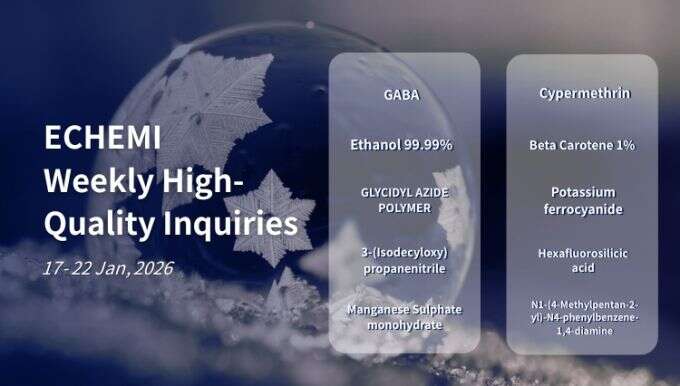
![Premium Global Chemical Sourcing Requests (17 - 22 Jan, 2026)]()
Premium Global Chemical Sourcing Requests (17 - 22 Jan, 2026)
-
![Upstream Production Cuts Lead to Stable but Supported Formic Acid Prices]()
Upstream Production Cuts Lead to Stable but Supported Formic Acid Prices




- Hot Searches
- polyurethane foam price news
- reta price
- best places to buy retatrutide
- scrotal dermititis
- buy retatrutide peptide online
- pyrazine
- methyl ethyl ketone peroxide mekp
- where can i buy steroid
- phosphoric acid price
- drospirenone-ee 3-0.02 mg tab
- best peptide company for retatrutide
- na 931 peptide for sale