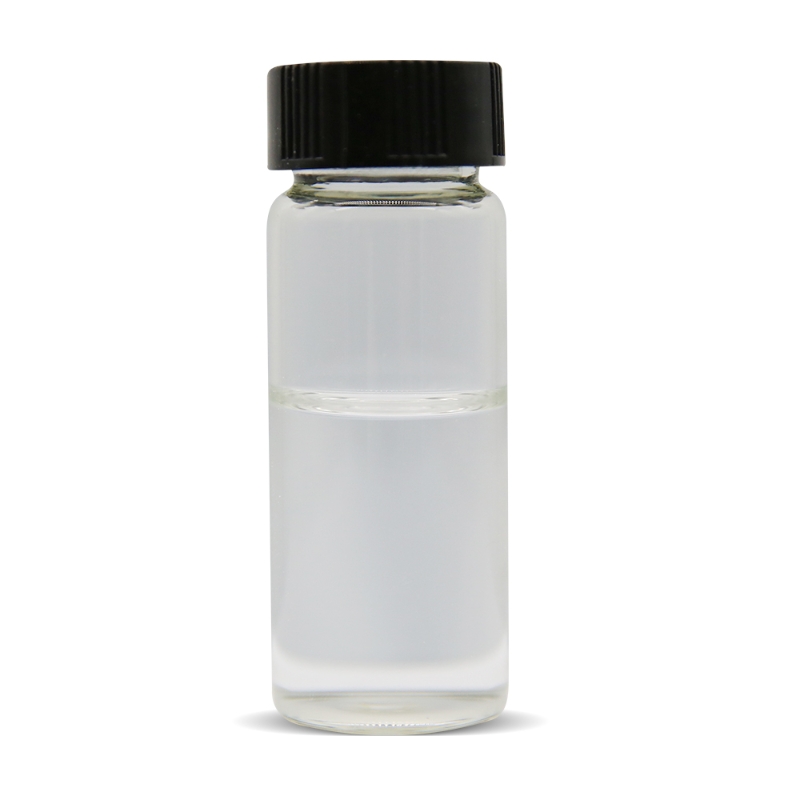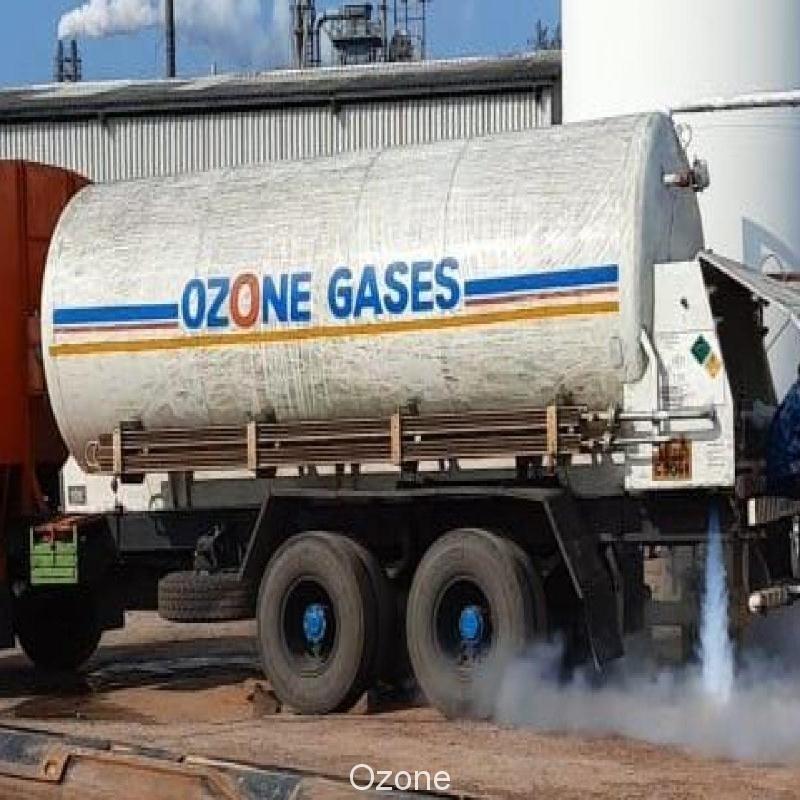
Best Selling Ozone Liquid Gas
TDS
10028-15-6
Food Grade
99%
Texas
TRN TRADER
25
Yes
2024-11-22
Fertilisers,Water Traitement,Ferro Alloys,Chemicals
-
Product Details
-
Seller Information
-
DescriptionECHEMI Editorial ReferenceColorless to blue gas with a very pungent odor.
Ozone appears as a colorless to bluish gas that condenses to a dark blue liquid, or blue-black crystals. Has a characteristic odor in concentrations less than 2 ppm. Used as a disinfectant for air and water; used for bleaching waxes, textiles and oils, ozonolysis of unsaturated fatty acids to pelargonic and other acids; manufacture of ink; catalyst; water treatment for taste and odor control; mold and bacteria inhibitor in cold storage; bleaching agent. (EPA, 1998)|COLOURLESS OR BLUISH GAS WITH CHARACTERISTIC ODOUR.|Colorless to blue gas with a very pungent odor.
Ozone appears as a colorless to bluish gas that condenses to a dark blue liquid, or blue-black crystals. Has a characteristic odor in concentrations less than 2 ppm. Used as a disinfectant for air and water; used for bleaching waxes, textiles and oils, ozonolysis of unsaturated fatty acids to pelargonic and other acids; manufacture of ink; catalyst; water treatment for taste and odor control; mold and bacteria inhibitor in cold storage; bleaching agent. (EPA, 1998)|Ozone is an elemental molecule with formula O3. An explosive, pale blue gas (b.p. -112℃) that has a characteristic, pleasant odour, it is continuously produced in the upper atmosphere by the action of solar ultraviolet radiation on atmospheric oxygen. It is an antimicrobial agent used in the production of bottled water, as well as in the treatment of meat, poultry and other foodstuffs. It has a role as a member of greenhouse gas, a disinfectant, a tracer, an electrophilic reagent, a mutagen, an oxidising agent and an antiseptic drug. It is a member of reactive oxygen species, an elemental molecule, a triatomic oxygen and a gas molecular entity.|Ozone has been used in trials studying the treatment of Mild Asthma and Primary Apical Periodontite.|The unstable triatomic form of oxygen, O3. It is a powerful oxidant that is produced for various chemical and industrial uses. Its production is also catalyzed in the ATMOSPHERE by ULTRAVIOLET RAY irradiation of oxygen or other ozone precursors such as VOLATILE ORGANIC COMPOUNDS and NITROGEN OXIDES. About 90% of the ozone in the atmosphere exists in the stratosphere (STRATOSPHERIC OZONE).CertificatesBasic Info-
Product Name:
Ozone
Other Name:Ozone;Triatomic oxygen;Oxygen,mol. (O3);Ozone(16O16O16O);Ozone (O3);Healozone;74087-86-8;412908-40-8;728855-47-8;855426-80-1
CAS No.:10028-15-6
Molecular Formula:O3
InChIKeys:InChIKey=CBENFWSGALASAD-UHFFFAOYSA-N
Molecular Weight:47.9982
Exact Mass:47.98470
EC Number:233-069-2
UNII:66H7ZZK23N
ICSC Number:0068
UN Number:1955|1956
DSSTox ID:DTXSID0021098
Color/Form:COLORLESS GAS; DARK BLUE LIQ; BLUE-BLACK CRYSTALS|BLUISH GAS|Colorless to blue gas.
Categories:
Characteristics-
PSA:
41.1
XLogP3:0.10050
Appearance:colourless gas or dark blue liquid.
Density:0.537 g/cm3
Melting Point:-192.7 °C
Boiling Point:-111.9 °C
Refractive Index:1.278
Water Solubility:(32°F): 0.001%
Storage Conditions:Store in well-ventilated, cool, dark places. Detached storage is preferred. Avoid storage near combustible materials.
Vapor Pressure:>1 atm
Vapor Density:1.66
Toxicity:Inhalation-rat LC50: 4800 PPM/4 hours; inhalation-mouse LC50: 12.6 ppm/3 hours
Flammability characteristics:Combustion
Explosive limit:Passage of oxygen containing 2% of ozone through stibine at -90 deg C caused an explosion.
Odor:CHARACTERISTIC ODOR IN CONCN LESS THAN 2 PPM|Pungent odor|Very pungent odor.
Experimental Properties:HEAT OF FORMATION 34.4 KCAL/MOLE @ 25 °C; POWERFUL OXIDIZING AGENT|An allotropic form of oxygen
Air and Water Reactions:No rapid reaction with air. No rapid reaction with water.
Reactive Group:Oxidizing Agents, Strong
Reactivity Alerts:Strong Oxidizing Agent
Reactivity Profile:OZONE is a propellant; ignites upon contact with alcohols, amines, ammonia, beryllium alkyls, boranes, dicyanogen, hydrazines, hydrocarbons, hydrogen, nitroalkanes, powdered metals, silanes, or thiols [Bretherick 1979. p.174]. Aniline in a atmosphere of ozone produces a white galatinous explosive ozobenzene [Mellor 1:911. 1946-47]. A mixture of ether and ozone forms aldehyde and acetic acid and a heavy liquid, ethyl peroxide, an explosive [Mellor 1:911. 1946-47]. Severe explosions occur attempting to form tribromic octaoxide from bromine and ozone [Mellor 2, Supp. 1:748. 1956]. Mixtures of ozone and dinitrogen pentaoxide are flammable or explosive [Mellor 8, Supp. 2:276. 1967]. Ozone and ethylene react explosively [Berichte 38:3837]. Nitrogen dioxide and ozone react with the evolution of light, and often explode [J. Chem. Phys. 18:366 1920]. Contact of very cold liquefied gas with water may result in vigorous or violent boiling of the product and extremely rapid vaporization due to the large temperature differences involved. If the water is hot, there is the possibility that a liquid "superheat" explosion may occur. Pressures may build to dangerous levels if liquid gas contacts water in a closed container, [Handling Chemicals Safely 1980].
Ionization Potential:12.52 eV
Flammable Limits:Nonflammable Gas, but a powerful oxidizer.
Physical Dangers:The gas is heavier than air.
Critical Temperature & Pressure:CRITICAL TEMP: -12.1 °C; CRITICAL PRESSURE: 53.8 ATM
Hazard IdentificationClassification of the substance or mixture
Oxidizing gases, Category 1
Skin corrosion, Sub-category 1B
Serious eye damage, Category 1
Acute toxicity - Category 1, Inhalation
Specific target organ toxicity â repeated exposure, Category 1
Hazardous to the aquatic environment, short-term (Acute) - Category Acute 1
Hazardous to the aquatic environment, long-term (Chronic) - Category Chronic 1
GHS label elements, including precautionary statements
Pictogram(s) 

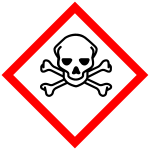

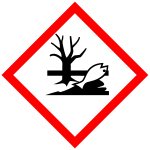
Signal word Danger
Hazard statement(s) H270 May cause or intensify fire; oxidizer
H314 Causes severe skin burns and eye damage
H330 Fatal if inhaled
H372 Causes damage to organs through prolonged or repeated exposure
H400 Very toxic to aquatic life
H410 Very toxic to aquatic life with long lasting effects
Precautionary statement(s) Prevention P220 Keep away from clothing and other combustible materials.
P244 Keep valves and fittings free from oil and grease.
P260 Do not breathe dust/fume/gas/mist/vapours/spray.
P264 Wash ... thoroughly after handling.
P280 Wear protective gloves/protective clothing/eye protection/face protection/hearing protection/...
P271 Use only outdoors or in a well-ventilated area.
P284 [In case of inadequate ventilation] wear respiratory protection.
P270 Do not eat, drink or smoke when using this product.
P273 Avoid release to the environment.
Response P370+P376 In case of fire: Stop leak if safe to do so.
P301+P330+P331 IF SWALLOWED: Rinse mouth. Do NOT induce vomiting.
P363 Wash contaminated clothing before reuse.
P304+P340 IF INHALED: Remove person to fresh air and keep comfortable for breathing.
P316 Get emergency medical help immediately.
P321 Specific treatment (see ... on this label).
P305+P351+P338 IF IN EYES: Rinse cautiously with water for several minutes. Remove contact lenses, if present and easy to do. Continue rinsing.
P305+P354+P338 IF IN EYES: Immediately rinse with water for several minutes. Remove contact lenses, if present and easy to do. Continue rinsing.
P317 Get medical help.
P320 Specific treatment is urgent (see ... on this label).
P319 Get medical help if you feel unwell.
P391 Collect spillage.
Storage P403 Store in a well-ventilated place.
P405 Store locked up.
P403+P233 Store in a well-ventilated place. Keep container tightly closed.
Disposal P501 Dispose of contents/container to an appropriate treatment and disposal facility in accordance with applicable laws and regulations, and product characteristics at time of disposal.
Other hazards which do not result in classification
no data available
Handling and StoragePrecautions for safe handling
NO open flames, NO sparks and NO smoking. NO contact with combustible substances. Closed system, ventilation, explosion-proof electrical equipment and lighting. Handling in a well ventilated place. Wear suitable protective clothing. Avoid contact with skin and eyes. Avoid formation of dust and aerosols. Use non-sparking tools. Prevent fire caused by electrostatic discharge steam.
Conditions for safe storage, including any incompatibilities
Fireproof if in building. Separated from all substances. Cool.CYLINDERS OF DISSOLVED OZONE SHOULD BE STORED IN REFRIGERATED AREAS & AWAY FROM ALL REDUCING AGENTS, FLAMMABLE MATERIALS & SUBSTANCES SUCH AS IRON, COPPER OR CHROMIUM THAT MAY CATALYZE DECOMP.
-
-
Seller Information
-
Business Type:
Manufactory
-
Main Products:
Fertilisers,Water Traitement,Ferro Alloys,Chemicals
-
Location:
5312 State Highway 121
-
Payment Terms:
TT against copy of documents,D/P,L/C,D/A,O/A,TT against B/L draft before shipment,100% TT in advance
-
Average lead Time:
7 days
-
Total Annual Revenue:
$10 million-$25 million
-
Total Employees:
51-100
-
Year of Establishment:
2017
Company Certificates-
 Company Registration
-
 US Tax Clearance 2024
-
 Trade conformity
-
 ACCREDITION
-
-
Country Product Purchase Quantity Date Posted Post an enquiry for this product

More from this Seller
-
-

-
Best Quality Barium Chloride 99%
Food Grade / 99%
-
-
-

-
Best Wholesale Polymaleic acid 99%
Food Grade / 99%
-
-
-

-
Petroleum Jelly White COLOURLESS-TO-WHITE WAXY PASTE
Industrial Grade / 98%
-
-
-

-
Hot Sale Maleic Anhydride 99.98% white briquete
Industrial Grade / 98%
-
-
-

-
100% Vanadium Carbide
Industrial Grade / 98%
-
-
-

-
Wholesale CAS NO.75-21-8 High purity ETHYLENE OXIDE
Industrial Grade / 96%
-



Hot Related Products
-
 99%Benzaldehyde
 -
 123-99-9 Azelaic acid
$10-12/KG FOB
-
 Nonanoic acid
 -
 High quality and low price Saw palmetto extract.
 -
 Azelaic acid
 -
 Perlagonic Acid / Nonanoic Acid SNC | Good Fortune
 -
 High Quality 99% Pelargonic Acid CAS 112-05-0 from YIHANG Supplier
 -
 Wholesale 99% HIgh Purity Azelaic Acid Powder Cosmetic Grade CAS 123-99-9
 -
 Pelargonic Acid raw material CAS 112-05-0 Pelargonic Acid
 -
 Factory Supply Chlorine dioxide CAS NO.10049-04-4