Product
Supplier
Encyclopedia
Inquiry
Home > Agrochemicals > Fungicides > Thiosemicarbazide for Sale > Glyodin Broad-Spectrum Organosulfur Fungicide for Effective Crop Disease Management
Glyodin Broad-Spectrum Organosulfur Fungicide for Effective Crop Disease Management buy - large image1
Glyodin Broad-Spectrum Organosulfur Fungicide for Effective Crop Disease Management buy - image1

Glyodin Broad-Spectrum Organosulfur Fungicide for Effective Crop Disease Management

COA 3 Inquiries

Unit Price: Get Latest Price
CAS No.:

79-19-6

Grade:

Industrial Grade

Port:

Durban Port

Brand:

UMGS

Packaging:

100g, 500g, 1kg, 5kg, 25kg

Price valid (until):

2025-06-20

Company Type:
Distributor
Location:
South Africa
Qualification:
Main Products:

Chemicals bulk

  • Product Description

  • Seller Information

  • Inquiry History

  • Description

    🌾 Glyodin

    Broad-Spectrum Organosulfur Fungicide for Effective Crop Disease Management

    Chemical Name: 2,4,5,6-Tetrachloroisophthalonitrile derivative (commonly classified under organoiodine fungicides)
    Common Name: Glyodin
    CAS Number: 79-19-6 (Note: Confirm based on specific formulation)
    Chemical Class: Organoiodine compound / Sulfamide fungicide
    Mode of Action: Contact protectant fungicide


    🔍 Product Overview:

    Glyodin is a contact, protective fungicide known for its multi-site action against a wide range of fungal pathogens. It belongs to the organosulfur and iodinated compound class and is primarily used in fruit crops, vegetables, ornamentals, and industrial crops to prevent diseases such as leaf spot, blight, mildew, and rust.

    Unlike systemic fungicides, Glyodin remains on the surface of plant tissues, where it acts as a barrier against fungal penetration. Its multi-site mode of action reduces the risk of resistance development, making it a dependable choice in integrated pest management (IPM) programs.


    🌿 Key Applications:

    Crop Types Diseases Controlled
    Grapes, Apples, Citrus Downy mildew, Anthracnose, Scab
    Tomatoes, Cucurbits Early blight, Powdery mildew, Leaf spots
    Rice, Wheat, Barley Sheath blight, Brown spot, Leaf blast
    Ornamentals & Flowers Botrytis blight, Rust, Mildew
    Potatoes, Carrots, Onions Alternaria leaf blight, White mold


    ⚙️ Mode of Action:

    Glyodin works by disrupting enzymatic functions and essential metabolic pathways of fungi on contact. It targets multiple sites in fungal cells, leading to the destruction of cell membranes and inhibition of spore germination. This broad and preventive activity makes it ideal for use before visible symptoms of disease appear.


    🧪 Chemical & Physical Properties:

    Property Value
    Appearance White to off-white powder or crystalline solid
    Solubility Slightly soluble in water; soluble in organic solvents
    Formulation Types Wettable powder (WP), Dustable powder (DP), Suspension concentrate (SC)
    Stability Stable under normal storage; avoid strong oxidizers
    pH (1% solution) 6.0–7.5


    🧴 Application & Usage:

    • Method of Application: Foliar spray

    • Dosage: 0.2% – 0.3% solution (i.e., 2–3 g per liter of water)

    • Timing: Preventive application at early crop stages or during favorable disease conditions

    • Reapplication Interval: Every 7–14 days or as needed based on disease pressure

    • PHI (Pre-Harvest Interval): Typically 7–10 days (depending on crop)

    Always follow local guidelines and label instructions.


    ⚠️ Safety & Handling:

    Category Details
    GHS Classification May cause eye or skin irritation (mild)
    Personal Protection Wear gloves, goggles, and protective clothing
    First Aid Rinse skin or eyes with clean water; seek medical help if ingested
    Environmental Impact Low to moderate toxicity to aquatic life — avoid contamination of water bodies
    Storage Conditions Cool, dry, ventilated area, away from food and feed


    📦 Packaging & Shelf Life:

    • Available Packs: 100g, 500g, 1kg, 5kg, 25kg

    • Container Types: Laminated pouches, HDPE bottles or drums

    • Shelf Life: 2 years in original unopened packaging


    Key Benefits of Glyodin:

    • ✔️ Broad-spectrum protection against multiple fungal diseases

    • ✔️ Contact protectant action – effective with early intervention

    • ✔️ Multi-site mode of action reduces resistance risk

    • ✔️ Compatible with many other agrochemicals

    • ✔️ Effective in both humid and dry climatic conditions


    📌 Conclusion:

    Glyodin is a reliable, preventive fungicide that provides strong surface-level protection against fungal attacks across a wide variety of crops. With its multi-site activity and resistance-management capability, Glyodin is an essential tool in any modern agricultural disease control strategy.


    Disclaimer: This product is intended for agricultural and industrial use only. Always follow local regulatory guidelines and label directions for safe and effective usage.

    Pls input...

    Items Specifications


    Certificates

    Basic Info
    Product Name:

    Thiosemicarbazide

    Other Name:

    Hydrazinecarbothioamide;Semicarbazide,thio-;N-Aminothiourea;TSC;TSZ;Isothiosemicarbazide;Thiosemicarbazide;Thiocarbamoylhydrazine;Thiasemicarbazide;1-Aminothiourea;2-Thiosemicarbazide;1-Amino-2-thiourea;Aminohydrazinomethane-1-thione;NSC 2213;NSC 31792;Aminothiourea;Carbamothioic acid,hydrazide;Hydrazinesulfinamide;Hydrazincarbothioamide;1393653-11-6

    CAS No.:

    79-19-6

    Molecular Formula:

    CH5N3S

    InChIKeys:

    InChIKey=BRWIZMBXBAOCCF-UHFFFAOYSA-N

    Molecular Weight:

    91.13550

    Exact Mass:

    91.14

    EC Number:

    201-184-7

    UNII:

    6056O8W6ET

    NSC Number:

    31792|2213

    UN Number:

    2811|2771

    DSSTox ID:

    DTXSID9021346

    Color/Form:

    White crystalline powder|Long needles from water

    HScode:

    2942000000

    Categories:

    Fungicides

    Characteristics
    PSA:

    96.16000

    XLogP3:

    0.48480

    Appearance:

    THIOSEMICARBAZIDE is a white crystalline powder and is odorless. This material is used as a reagent for ketones and certain metals, for photography and as a rodenticide. It is also effective for control of bacterial leaf blight of rice. Not a registered pesticide in the U.S. It is a chemical intermediate for herbicides and a reagent for detection of metals. (EPA, 1998)

    Density:

    1.376 g/cm3

    Melting Point:

    183 °C

    Boiling Point:

    208.6ºC at 760 mmHg

    Flash Point:

    80ºC

    Refractive Index:

    1.463 (20ºC)

    Water Solubility:

    H2O: soluble ;Very soluble in ethanol

    Storage Conditions:

    Poison room

    Vapor Pressure:

    0.0087 mm Hg at 25 deg C (est)

    Toxicity:

    LD50 orally in adult Norway rats: 13 mg/kg, Dieke, Proc. Soc. Exp. Biol. Med. 70, 688 (1949)

    Odor:

    Odorless

    Henrys Law Constant:

    Henry's Law constant = 6.6X10⁻¹⁰ atm-cu m/mol at 25 °C (est)

    Dissociation Constants:

    pKa1 = 3.86(+); pKa2 = 14.51(-) (est)

    Experimental Properties:

    Hydroxyl radical reaction rate constant = 8.4X10⁻¹¹ cu cm/molec-sec at 25 °C (est)

    Air and Water Reactions:

    No rapid reaction with air. No rapid reaction with water.

    Reactive Group:

    Azo, Diazo, Azido, Hydrazine, and Azide Compounds

    Reactivity Profile:

    Isocyanates and thioisocyanates are incompatible with many classes of compounds, reacting exothermically to release toxic gases. Reactions with amines, aldehydes, alcohols, alkali metals, ketones, mercaptans, strong oxidizers, hydrides, phenols, and peroxides can cause vigorous releases of heat. Acids and bases initiate polymerization reactions in these materials. Some isocyanates react with water to form amines and liberate carbon dioxide. Base-catalysed reactions of isocyanates with alcohols should be carried out in inert solvents. Such reactions in the absence of solvents often occur with explosive violence, [Wischmeyer(1969)].

    Hazard Identification

    Classification of the substance or mixture

    Acute toxicity - Category 2, Oral

    Hazardous to the aquatic environment, long-term (Chronic) - Category Chronic 3

    GHS label elements, including precautionary statements

    Pictogram(s)
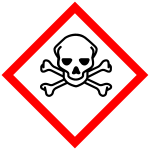
    Signal word

    Danger

    Hazard statement(s)

    H300 Fatal if swallowed

    H412 Harmful to aquatic life with long lasting effects

    Precautionary statement(s)
    Prevention

    P264 Wash ... thoroughly after handling.

    P270 Do not eat, drink or smoke when using this product.

    P273 Avoid release to the environment.

    Response

    P301+P316 IF SWALLOWED: Get emergency medical help immediately.

    P321 Specific treatment (see ... on this label).

    P330 Rinse mouth.

    Storage

    P405 Store locked up.

    Disposal

    P501 Dispose of contents/container to an appropriate treatment and disposal facility in accordance with applicable laws and regulations, and product characteristics at time of disposal.

    Other hazards which do not result in classification

    no data available

    Handling and Storage

    Precautions for safe handling

    Handling in a well ventilated place. Wear suitable protective clothing. Avoid contact with skin and eyes. Avoid formation of dust and aerosols. Use non-sparking tools. Prevent fire caused by electrostatic discharge steam.

    Conditions for safe storage, including any incompatibilities

    Store the container tightly closed in a dry, cool and well-ventilated place. Store apart from foodstuff containers or incompatible materials.

  • Seller Information
    Business Type:

    Distributor

    Main Products:

    Chemicals bulk

    Location:

    1 WOODMEAD DR WOODMEAD SANDTON JOHANNESBURG GAUTENG 2191

    Payment Terms:

    TT against B/L draft before shipment,100% TT in advance

    Year of Establishment:

    2023

  • Inquiry History
    3 Inquiries
    Country Product Purchase Quantity Date Posted
    Russia

    Thiosemicarbazide

    200 KG Feb 26, 2026
    Czech

    Thiosemicarbazid

    1000 KG Jul 7, 2025
    Czech

    thiosemicarbazide

    1000 KG Sep 2, 2024
    Post an enquiry for this product
pic ×

Scan the QR Code to Share

All products displayed on this website are only for non-medical purposes such as industrial applications or scientific research, and cannot be used for clinical diagnosis or treatment of humans or animals. They are not medicinal or edible.

According to relevant laws and regulations and the regulations of this website, units or individuals who purchase hazardous materials should obtain valid qualifications and qualification conditions.

The information shown above is provided by the enterprise itself, and the authenticity, accuracy and legitimacy of the content are the responsibility of the publishing company. ECHEMI does not bear any guarantee responsibility for this. Please be aware that risks in internet transactions objectively exist.

Feedback & Suggestions
Send Message

Thank you for your feedback. If you require further assistance, please contact us by email at info@echemi.com or call us at +86-532-55729510.