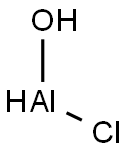
| Uses | Industry Applications Benefit Pharmaceutical Antiperspirants Reduce the amount of sweat on the skin surface Deodorant Reduce the underarm odor Wastewater treatment Precision casting, pharmaceutical, paper making, tanning and dyeing waste water Remove iron, fluoride, cadmium, radioactive contamination and floating oil Dringking water treatment flocculating agent Encourage impurities in the water to clump together into flakes of material Refractory material Refractory binder Increase the bonding of refractory material composition |
| Inorganic high-molecule polymers | Poly aluminium chloride is an inorganic high-molecule polymer with some cementitious property. It can be used as the binder of refractory coating, ultra-pure alumina products and refractory concrete material. Poly aluminium chloride is a multivalent, polyhydroxy electrolyte and can be seen as the intermediate product of the hydrolysis of AlCl3 into Al (OH) 3. The colloidal nucleus contains positive charge with the hydrolysis product being acidic. The composition of these products is the mixed system of various kinds of aqueous complexes in certain ratio under certain conditions. Its expression formula is [Al2 (OH) n • Cl6-n] m, wherein n = 1-5, m≤10. Owing to the difference in the preparation and performance, Poly aluminium chloride can also be called as hydroxy aluminum chloride, basic aluminum chloride, and polymeric alumina. The main index of physical and chemical properties includes alkalinity, pH value, Al2O3 content and the relative density. Poly aluminium chloride is rich in raw materials and has low cost without causing decrease of the refractoriness of refractory concrete. It also has strong activity at high temperatures and can be hardened at room temperature when doped with small quantities of accelerators and thus is promising cement material.
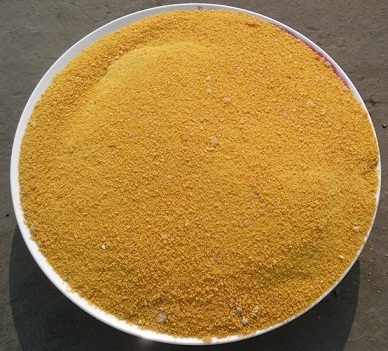
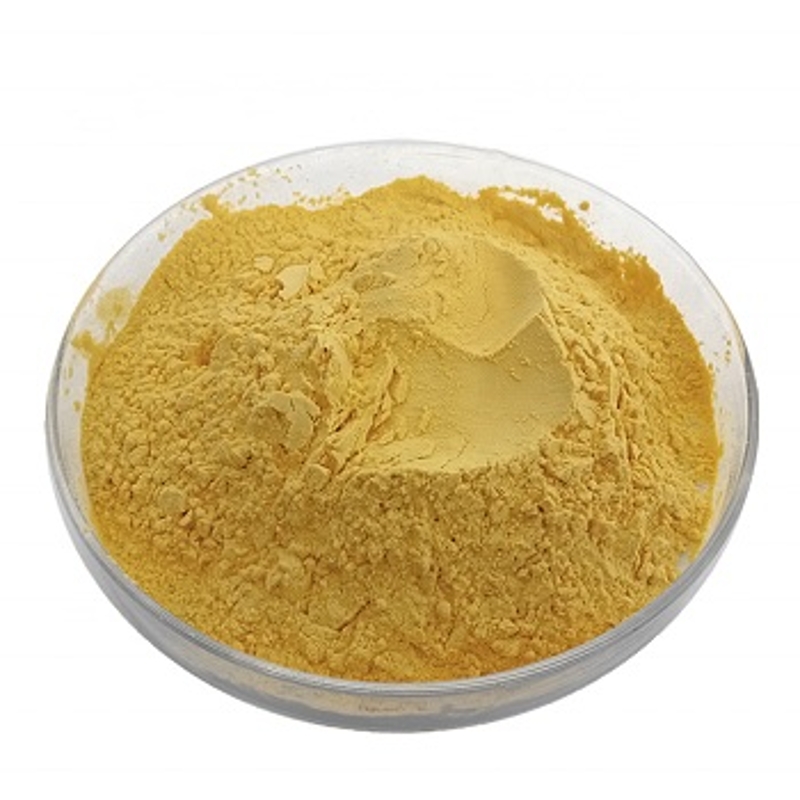
Figure 1 is a solid ploy aluminium chloride. |
| Coagulant | Coagulant is a kind of chemical agent which can promote the coagulation and flocculation effect of the colloidal particles in water and accelerate the formation of coarse particles, thus making it be easier to be subject to fast sedimentation or filtration.
Coagulants include coagulant, flocculants, and coagulant aid agent. These nouns currently have no strict uniform definition and boundaries. Coagulants and flocculants, and coagulant aid agent are often mixed for application.
Commonly used coagulant includes alum, poly aluminium chloride, activated silicic acid, polyacrylamide, magnesium alumina, ferrous sulfate and ferric chloride, etc. The combination between poly aluminium chloride and alum can give the best efficacy.
Poly aluminium chloride is a new type of inorganic polymer coagulant with its fundamental difference with the traditional inorganic coagulant being that the traditional inorganic coagulant is crystalline salt with low molecular weight while the structure of poly aluminium chloride consists of multi-shaped multivariate carboxyl complex. Poly aluminium chloride has a rapid flocculation and sedimentation speed, wide applicable range of PH value, and is non-corrosive to plumbing with a very significant water purification effect. It can effectively remove the water color quality SS, COD, BOD, and arsenic, mercury and other heavy metal ions. This product is widely used in drinking water, industrial water and wastewater treatment, it has the following characteristics:
1. The water purified form poly aluminium chloride has a higher quality than the water purified from inorganic coagulant such as ferric chloride and aluminum sulfate. The cost of poly aluminium chloride in purifying water is also relatively low.
2. Both the formation rate of floc unit and the settlement rate are high. It also has a greater processing capability than traditional flocculant such as ferric chloride and aluminum sulfate.
3. It has a stronger adaption capability on the temperature, turbidity and the alkalinity of the water source than traditional flocculant such as ferric chloride and aluminum sulfate.
4. It has a wide adaptation pH range for the source of water with being able to exert coagulation effect from the range of PH5.0-9.0 with the best results occurring at PH6.5-7.5.
5. It has a small corrosion effect and a good operating condition.
6. It has a better solubility than ferric chloride and aluminum sulfate.
7. After the treatment, the residue of aluminum and salt in water is small which facilitates the handling and preparation of ion exchange.
The above information is edited by the chemicalbook of Dai Xiongfeng. |
| Performance | The main physical and chemical properties of the Poly aluminium chloride are demonstrated from alkalized degree, pH value, Al2O3 content and density.
Alkalized degree (B) and pH: alkalized degree means the degree of Cl-(in poly aluminium chloride) being substituted by OH-; it is generally represented using the ratio of the hydroxyl group percentage over aluminum, namely, B = [OH]/3 [Al] × 100%.
Many features of the Poly aluminium chloride are closely related to its alkalized degree including the degree of polymerization, pH, storage stability and the cementing property of being used as a cementing agent. But we should note that the alkalized degree only represents a statistical average value from the mixture containing various kinds of poly aluminium chloride with different degrees of polymerization.
The pH value of the liquid Poly aluminium was similar with its alkalized degree. However, these two parameters don’t have exactly the same meaning. The alkalized degree indicates the number of hydroxyl groups bound within the poly aluminium structure while the pH value of the solution indicates the number of the free hydroxyl ions OH. But, anyway, the pH value of the poly aluminium solution generally increases with increased alkalized degree.
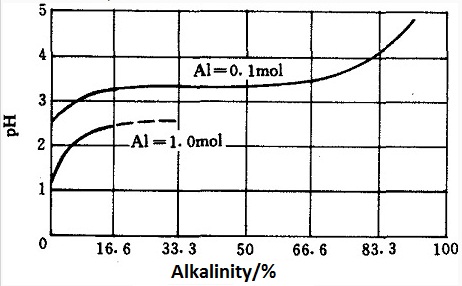
Figure 2 the relation between the alkalized degree and pH values.
For solution with the same alkalized degree, when the concentration varies, the pH value also changes and decreases with the increased concentration of the solution. For example, for the poly aluminium chloride (PAC) and ACl3 solution with the alkalized degree of stock solution being 50%, its pH value changes when diluted to different concentrations.
The Al2O3 content, density and viscosity: there is a certain relationship between the Al2O3 content of the poly aluminium chloride and its density. The density of the solution will increase with the increased Al2O3 content, exhibiting as a linear relationship.

Figure 3 the relation of the density of poly aluminium chloride with its Al2O3 content
The relationship between the density, pH value and viscosity of poly aluminium chloride as follows: the greater the density, the greater pH value as well as the higher the viscosity (dynamic viscosity coefficient).

Figure 4 the relation between the density, pH and viscosity of poly aluminium chloride |
| Uses | It is one kind of refractory binder. It is a kind of aluminum hydroxide sol made from aluminum-containing material or aluminum metal which subject to several chemical/physical treatment steps such as hydrochloric acid dissolution, hydrolysis, and polymerization. Poly aluminium chloride can be taken as the intermediate of the hydrolysis process of AlCl3 into Al(OH)3 and therefore the hydrolysis solution is acidic. Poly aluminium chloride is also known as hydroxy aluminum or basic aluminum chloride with the chemical formula being [Al2 (OH) nCl6-n] m, wherein if the n is close to or equal to 6, it can be called as alumina sol. Applying poly aluminium chloride as a binding agent of loose refractory will not affect its refractoriness. The Al2O3 generated during the dehydration and decomposition of poly aluminium chloride during the heating process is a kind of active alumina oxide with high-degree of dispersion which can facilitate the sintering, and thus being suitable for being used as the refractory binder.
Poly aluminium chloride can be used for non-firing or fired to generate refractory products, fire-resistant plastic, and the binding agent of ramming and casting. When being used as the binding agent of monolithic refractory, it has certain requirement on both the alkalinity and density with poly aluminium chloride with either too low or too high bond strength not good. In general, poly aluminium chloride with alkalized degree being within 46% to 72% and the density being within 1.17~1.23kg/m3 has a good binding strength. When used as the binding agent of refractory casting, it can be used for synthesizing Magnesium aluminium spinel, electronic melting MgO and as the coagulation accelerator of cement. But when applying the poly aluminium chloride as unshaped refractory binder, because of its acidic solution (pH <5), it will have reaction with iron and iron-containing compounds contained in the refractory to release hydrogen and cause swelling of the material. Therefore, the preparation technology should contain aging step in order to avoid the swelling and further cracking of good molded product or lining.
It can be used for the purification process of drinking water as well as various kinds of industrial waste water.
As flocculants, it is mainly used for purifying drinking water and the treatment of special water such as removal of iron, fluorine, cadmium, radioactive contamination as well as floating oil. It can also be used for the treatment of industrial wastewater such as dyeing wastewater. Moreover, it can also be used for precision casting, pharmaceutical, paper, and leathering. |
| Chemical Properties | It is colorless or yellow resinous solid. Its solution is a colorless or yellowish transparent liquid, sometimes exhibits as grayish black mucus due to impurities in it. It is easily soluble in water. |
| Production method | Boiling pyrolysis method: put the crystalline aluminum chloride for boiling and pyrolysis at 170 °C; the generated hydrogen chloride is absorbed by water to prepare 20% hydrochloric acid for recycling. Further add water to have a then added water for aging and polymerization at 60 ℃; Then further go through solidification, dryness, crush to obtain the solid finished product of poly aluminium chloride.
Boiling pyrolysis method: put the aluminum ash (mainly composed of alumina and metal aluminum) into the reactor pre-supplied with washing water at a certain ratio, stir and slowly add hydrochloric acid for condensation reaction with curing and polymerization to a pH of 4.2 to 4.5 and the relative density of the solution being 1.2. Conduct sedimentation to obtain a liquid poly aluminum chloride. The liquid product was subject to dilution and filtering, concentration by evaporation, drying to obtain the solid poly aluminum chloride products. |
| Chemical Properties | often supplied as a suspension or solution in water |
| Uses | In antiperspirants. |
| Definition | An ingredient of commercial antiperspirant and deodorant preparations. Also used for water purification and treatment of sewage and plant effluent. |
| General Description | A clear amber liquid with little or no odor. Denser than water. May severely irritate skin, eyes or mucous membrane. Used in commercial antiperspirants and deodorants. |
| Air & Water Reactions | Will be soluble in water with release of heat. |
| Reactivity Profile | Aluminum chlorohydrate reacts to neutralize chemical bases (for example: amines and inorganic hydroxides) Reacts with or corrodes active metals, including such structural metals as aluminum and iron, to release hydrogen, a flammable gas. Can initiate the polymerization of certain alkenes. Reacts with cyanide compounds to release gaseous hydrogen cyanide. May generate flammable and/or toxic gases in contact with dithiocarbamates, isocyanates, mercaptans, nitrides, nitriles, sulfides, and strong reducing agents. Additional gas-generating reactions may occur with sulfites, nitrites, thiosulfates (to give H2S and SO3), dithionites (to give SO2), and carbonates (to give CO2). |
| Health Hazard | TOXIC; inhalation, ingestion or skin contact with material may cause severe injury or death. Contact with molten substance may cause severe burns to skin and eyes. Avoid any skin contact. Effects of contact or inhalation may be delayed. Fire may produce irritating, corrosive and/or toxic gases. Runoff from fire control or dilution water may be corrosive and/or toxic and cause pollution. |
| Fire Hazard | Non-combustible, substance itself does not burn but may decompose upon heating to produce corrosive and/or toxic fumes. Some are oxidizers and may ignite combustibles (wood, paper, oil, clothing, etc.). Contact with metals may evolve flammable hydrogen gas. Containers may explode when heated. |
| Flammability and Explosibility | Not classified |








 Bangladesh
 South Africa
 United Kingdom
 Qatar
Qatar
 Oman
Oman
 India
India
 Malaysia