Product
Supplier
Encyclopedia
Inquiry
Creatine57-00-1 buy - large image1
Creatine57-00-1 buy - image1
Creatine57-00-1 buy - image2
Creatine57-00-1 buy - image3
Creatine57-00-1 buy - image4
Creatine57-00-1 buy - image5
Creatine57-00-1 buy - image6

Creatine57-00-1

7 Inquiries

Unit Price:

$33-34/MT FOB

Get Latest Price
CAS No.:

57-00-1

Grade:

Pharmaceutical Grade

Content:

95%

Port:

shanghai

Brand:

OORENT

Packaging:

vial

Price valid (until):

2026-07-29

Company Type:
Trader
Location:
China
Qualification:
Main Products:

pharmaceutical intermediates,peptides,electronic chemicals

  • Product Description

  • Seller Information

  • Inquiry History

  • Description

    Product Detail  

    Creatine Basic information
    General description Physical and Chemical Properties Production method Pharmacological effects Uses Side Effects
    Product Name: Creatine
    Synonyms: N-Methyl-N-amidinoglycine;Creatine HMB;2-[amidino(methyl)amino]acetic acid;2-[carbamimidoyl(methyl)amino]ethanoic acid;2-(1-Methylguanidino)acetic acid;Anhydrous Creatine;2-(1-Methylcarbamimidamido)acetic acid;creatine zwitterion
    CAS: 57-00-1
    MF: C4H9N3O2
    MW: 131.13
    EINECS: 200-306-6
    Product Categories: CO - CZEnvironmental Standards;Alphabetic;Amino Acids;C;Metabolites;Pesticides&Metabolites
    Mol File: 57-00-1.mol
    Shop Creatine57-00-1-Detailed Image 1

    Creatine Chemical Properties
    Melting point  ~295 °C (dec.)
    Boiling point  242.43°C (rough estimate)
    density  1,33 g/cm3
    refractive index  1.5700 (estimate)
    storage temp.  Keep in dark place,Inert atmosphere,Room temperature
    solubility  Water (Slightly, Heated)
    pka 2.63(at 25℃)
    form  Solid
    color  White to Off-White
    Water Solubility  Soluble in water.
    Merck  14,2568
    BRN  907175
    Major Application food and beverages
    personal care
    pharmaceutical
    Cosmetics Ingredients Functions SKIN CONDITIONING
    InChI 1S/C4H9N3O2/c1-7(4(5)6)2-3(8)9/h2H2,1H3,(H3,5,6)(H,8,9)
    InChIKey CVSVTCORWBXHQV-UHFFFAOYSA-N
    SMILES CN(CC(O)=O)C(N)=N
    LogP -1.258 (est)
    CAS DataBase Reference 57-00-1(CAS DataBase Reference)
    NIST Chemistry Reference Glycine, N-(aminoiminomethyl)-N-methyl-(57-00-1)
    EPA Substance Registry System Glycine, N-(aminoiminomethyl)-N-methyl- (57-00-1)
    CAS Number Unlabeled 57-00-1

    Safety Information
    Hazard Codes  Xi
    Risk Statements  36/37/38
    Safety Statements  26-36
    WGK Germany  3
    TSCA  TSCA listed
    HS Code  29252900
    Storage Class 11 - Combustible Solids
    Hazardous Substances Data 57-00-1(Hazardous Substances Data)
    Toxicity A compound that is phosphorylated to phosphocreatine, which represents a store of high-energy phosphoryl groups in muscle that can be transferred to ADP, yielding ATP for muscle contraction. The enzyme involved in phosphate transfer between them is creatine phosphokinase that catalyzes the reaction Phosphocreatine+ADP→ATP+creatine An increase in serum creatine phosphokinase may be indicative of damage to non-hepatic tissue but not to the liver.
    MSDS Information
    Provider Language
    Methylglycocyamine English
    SigmaAldrich English
    ALFA English

    Creatine Usage And Synthesis
    General description Creatine(57-00-1) is a kind of natural nutrients in presented in the human body and can also be synthesize through arginine, glycine, and methionine in the liver, kidney and pancreas: in the presence of the catalysis of the arginine/glycine transamidinase in the kidney, the amidino group of the arginine can be transferred to the amino group of the glycine, generating glycocyamine. Then in the liver, with the catalysis of the glycocyamine methyltransferase, the methyl group of the S-adenosylmethionine can be transferred to the glycocyamine, generating creatine; it can increase the water content of the muscle cells, help the muscle cells to store energy, increase the protein synthesis and some other fundamental functions; wherein the artificially synthetic creatine can be used as the nutritional supplements for promoting the adaptation of skeletal muscle on fierce exercise and fighting against the excessive fatigue of individual in weakness; it can also be used for making the drugs for the treatment of heart disease and respiratory insufficiency; it can be used for making the pharmaceutical formulation containing human growth hormones; it can be applied to the compound health food, with anti-aging and physical power-recovering effect.
    Physical and Chemical Properties It is prismatic crystals (containing one crystal water molecule) with the melting point being 303 ℃ and the relative density of 1.33. It is soluble in boiling water and 98% acetic acid, slightly soluble in ethanol but insoluble in diethyl ether and butyrate. It can react with inorganic acid to obtain creatinine and co-heat with total soda lime to generate methylamine. It can be used to generate ammonia when being subject to azeotrope with potassium hydroxide and can react with potassium permanganate to generate methyl guanidine oxalic acid and guanidine; at room temperature, its aqueous solution can react with mercuric acetate role to generate guanidino glyoxylic acid, finally generating oxalic acid and guanidine In the reaction of the self-digestion in the muscle juice or organ extract, it can be converted to creatinine.
    Production method 1. For taking lime nitrogen as raw materials for preparing creatine, there are three different process routes:
    Lime nitrogen has direct reaction with the aqueous solution of sodium sarcosine to generate creatine.
    Lime nitrogen is reacted with the methanol solution pre-saturated with dry hydrogen chloride gas to generate O-methylisourea hydrochloride which is further subject to reaction with sarcosine to generate creatine.
    Upon the condition of passing air, lime nitrogen was reacted with aqueous hydrochloric acid to generate chlorinated formamidine chloride which further reacts with sarcosine sodium to generate creatine.
    2. Cyanamide is reacted with chloroacetic acid, methylamine to generate creatine monohydrate.
    3. Take thiourea and dimethyl sulfate as raw materials to generate S-methylisothiourea sulfate which then have reaction with sarcosine, sodium sarcosine or potassium sarcosine to generate creatine.
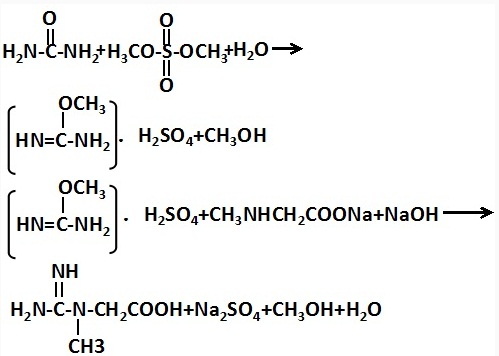
    4. Take urea and dimethyl sulfate as raw materials to generate O-methyl isourea sulfate which then reacts with sodium sarcosine to generate creatine monohydrate.
    Shop Creatine57-00-1-Detailed Image 2
    Figure 1 The reaction formula for production of creatine
    Operation method: add 3.3 mol of urea and 6 mL 50% H2SO4 to a 500 mL four-necked flask equipped with a stirrer, a thermometer, a dropping funnel and a condenser; heat to 40 ℃, add drop wise of 3 mol dimethyl sulfate under stirring for 3 h; during the addition of raw materials, the temperature should be maintained at less than 70 ℃; after the completion of adding the material, stir for 2h about 70 ℃, and cool to obtain 561.8 g of O-methyl isourea sulfate. Add 61.7 of 36% aqueous solution of sodium sarcosinate to a 500 mL four-necked flask equipped with a stirrer, a thermometer, a dropping funnel and a condenser, use 30% HCl to adjust the pH to about 11.0, and then add drop wise at 20 ℃ of 50 g of O-methyl isourea sulfate within 2 h; during the process of adding, drop wise, use 25% NaOH solution to adjust the pH and maintain the pH at about 11.0, after the addition was complete, stirring was continued at 40 ℃ for 2 h, and then cool the mixture at 0 ~5℃ for 2h and filter out the formed colorless crystals. Use 2 × 15 mL of ice water to wash the filter cake to generate crude creatine monohydrate. Put the crude product into beaker, add water of 7 to 8 times the amount of crude product, heat to dissolve all the crude product, have liquid be subject to slow cooling at room temperature, crystallized, filter off the crystals, dry at a temperature below 50 ℃ to obtain the finished product of creatine monohydrate .
    Pharmacological effects 1. Increase the water content of muscle cells:
    During the initial stage of using creatine, you can feel obviously that the muscles can become larger and stronger. This is because creatine leads to that the body's muscle cells store a relatively large amount of water; and when all the muscle cells absorb large amounts of water and get increased volume, the muscle will certainly become more full, visible.
    2. Help the muscle cells to store energy:
    Human muscle fiber contains two different forms of creatine: non-bonded creatine and phosphate-containing creatine phosphate; among them, creatine phosphate accounts for about two-thirds of the total creatine content. When muscle gets contraction for exercise, the body will use a compound called ATP as the energy source. Unfortunately, the body's muscle cells can only support the ATP energy which is enough for only less than ten seconds rapid contraction. Therefore, more ATP must be produced in order to maintain continuous movement. At this time, the creatine phosphate stored in muscle will sacrifice their phosphoric acid group for biosynthesis of ATP again. Therefore, if the muscles contain more creatine, the muscle will have greater potential for exert its strength.
    In addition, the supplement of the creatine can also help the exhausted muscles cells to rejuvenate. This is because when the muscle ATP energy is depleted, the body can use glycolysis pathway to produce lactic acid. When the body undergoes fierce exercise, a large number of lactic acid can be produced to make the muscles get soreness and fatigue; at this time if the muscle can store relative large amount of creatine phosphate for providing more ATP, the body will reduce the lactic acid manufacturing and reduce fatigue of muscle cells so that we can exercise more durable and more explosive.
    3. Increase the biosynthesis of proteins:
    The uptake of creatine makes the body be able to use more protein for muscle growth. Moreover, the two proteins in the muscle structure; actin and myosin, is exactly the main component to lead to muscle fiber contraction and movement. Therefore, if we can supplement sufficient amount of creatine for our bodies, our body can reduce the energy consumed for protein synthesis so that we can have more energy to synthesize large amount of actin and myosin cells, therefore, our muscle will certainly become stronger and more powerful.
    Uses 1. It can be used as the nutritional supplements for promoting the adaptation of skeletal muscle to strenuous exercise and fighting against the excessive fatigue for feeble individuals.
    2. It can be used as the drugs for the treatment of heart disease and respiratory insufficiency.
    3. It can be used for preparation of a pharmaceutical formulation containing human growth hormone.
    4. It can be applied to compound health food with anti-aging and physical-power recovering effect.
    5. It can be used as the reagents for biochemical research.
    Side Effects 1. Byproducts
    Low-purity creatine not only has no apparent effect, but also is harmful to the human body. The major harmful substance is a derivatives called dicyandiamide. It will increase the burden of renal excretion. In the product of creatine of 99.99% purity, the dicyandiamide content is less than 20PPM.
    2. Energy Source
    The movement of the human muscles relies on the energy decomposed by adenosine triphosphate (ATP]. In high-intensity exercise, ATP will be totally depleted within a few seconds exploded, meaning it can only provide a few seconds of energy. In the aerobic exercise, it can be synthesized from the aerobic decomposition of carbohydrates and fats. But in anaerobic exercise, due to the lack of oxygen, creatine began to be involved to energy metabolism. It can combine with phosphoric acid to synthesize creatine phosphate (CP) and quickly replenish ATP. Theoretically, the more the creatine is stored, the more the synthesis of CP will be and the longer time the ATP can be supplied. In that case, the muscle can persist for a longer time at high-intensity exercise. In the recovering period, the synthesis of creatine still relies on carbohydrates for aerobic energy supplying. Therefore, the intake of carbohydrates should not be too small. Otherwise, after the decomposition of creatine, it can’t be synthesized and can’t supply the energy in the next training.
    3. Danger
    Because the creatine can quickly supplement energy, there may be overtraining phenomenon during the exercise.
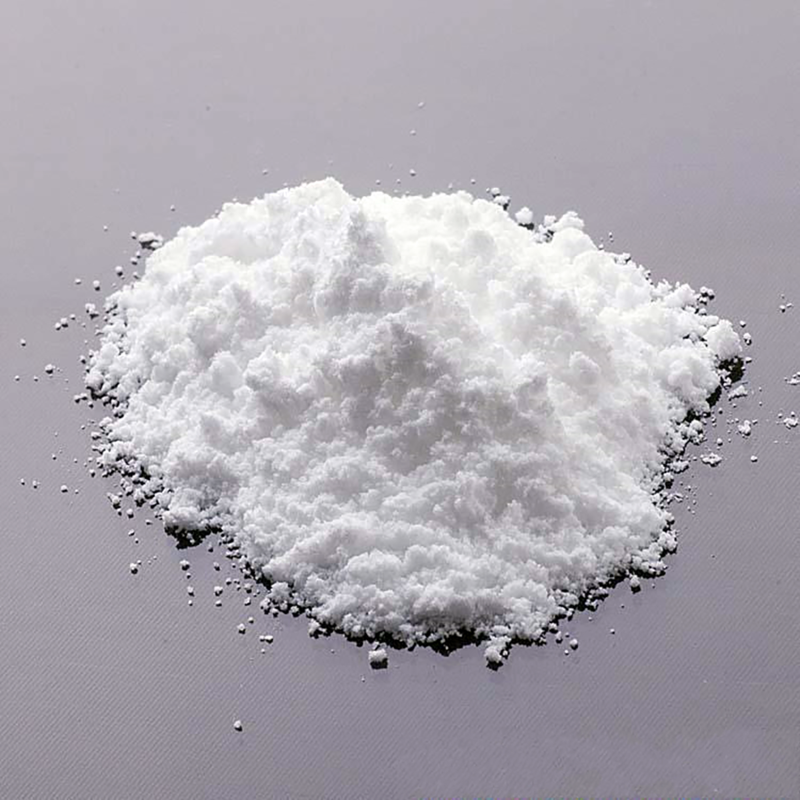
    Chemical Properties White powder
    Occurrence Creatine is an amino acid that occurs naturally in dairy products, seafood, and beef. It is manufactured by the body in the liver, kidney, and pancreas.
    Uses Creatine is used for gyrate atrophy, McArdle's disease, muscular dystrophy, amyotrophic lateral sclerosis, and rheumatoid arthritis. It is used in congestive heart disease to improve exercise tolerance and to enhance athletic performance.
    Uses Creatine is involved in the rapid production of ATP associated with creatine kinases in skeletal muscle tissue. Creatine may be used as a supplement to study its mechanism of action. It acts as a nutraceutical and a neuroprotective agent.
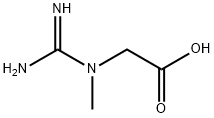
    Definition ChEBI: Creatine is a glycine derivative having methyl and amidino groups attached to the nitrogen. It has a role as a neuroprotective agent, a nutraceutical, a human metabolite, a mouse metabolite and a geroprotector. It is a member of guanidines and a glycine derivative. It is a conjugate acid of a creatinate. It is a tautomer of a creatine zwitterion.
    Biochem/physiol Actions Creatine is a nitrogenous compound that acts as a high-energy reservoir for the rapid regeneration of ATP. Approximately 95% of creatine is found in skeletal muscle, primarily as phosphocreatine. Creatine can be acquired through dietary consumption or formed from L-arginine, glycine, and L-methionine in a multi-step reaction that occurs in the kidneys and liver. Creatine is then transported to muscle tissue. Creatine supplementation is used for the enhancement of sports performance, primarily by increasing muscle mass. Creatine is also being investigated as a treatment of neuromuscular diseases, where it may aid in neuroprotection and by improving the cellular bioenergetic state.
    Purification Methods Likely impurities are creatinine and other guanidino compounds. It crystallises from the minimum volume of boiling H2O as the monohydrate. The hydrate is also obtained by dissolving in H2O and adding Me2CO. Drying under vacuum over P2O5 or drying at 100o gives the anhydrous base. The anhydrous base can be obtained also by dissolving the hydrate in H2O, seeding with the anhydrous base and cooling in ice. A m of 258 -268o(dec) was reported. The picrate crystallises from 17 parts of H2O with m of 218-220o(dec). [King J Chem Soc 2377 1930, Hoffmann et al. J Am Chem Soc 58 1730 1936, Mendel & Hodgkin Acta Cryst 7 443 1954, Greenstein & Winitz The Chemistry of the Amino Acids J. Wiley, Vol 3 p 2750 1961, Beilstein 4 III 1170, 4 IV 2425.]

    Pls input...Shop TRANS-2-DECEN-1-OL18409-18-2-Detailed Image 2 Shop TRANS-2-DECEN-1-OL18409-18-2-Detailed Image 3 Shop TRANS-2-DECEN-1-OL18409-18-2-Detailed Image 4 Shop TRANS-2-DECEN-1-OL18409-18-2-Detailed Image 5 Shop TRANS-2-DECEN-1-OL18409-18-2-Detailed Image 6 Shop TRANS-2-DECEN-1-OL18409-18-2-Detailed Image 7


    Basic Info
    Product Name:

    Creatine

    Other Name:

    Glycine,N-(aminoiminomethyl)-N-methyl-;Creatine;N-(Aminoiminomethyl)-N-methylglycine;N-Methyl-N-guanylglycine;Methylguanidoacetic acid;Phosphagen;NSC 8752;Cosmocair C 100;Tego Cosmo C 100;Neotine;Kre-Alkalyn;[N-(Amidino)-N-methylamino]acetic acid;2-(1-Methylguanidino)acetic acid;(N-Methyl-guanidino)-acetic acid;2-[(C-Azaniumylcarbonimidoyl)-methylamino]acetate;2-(N-Methylcarbamimidamido)acetic acid;2087491-49-2

    CAS No.:

    57-00-1

    Molecular Formula:

    C4H9N3O2

    InChIKeys:

    InChIKey=CVSVTCORWBXHQV-UHFFFAOYSA-N

    Molecular Weight:

    131.13

    Exact Mass:

    131.13

    BRN:

    907175

    EC Number:

    200-306-6

    UNII:

    MU72812GK0

    NSC Number:

    8752

    DSSTox ID:

    DTXSID1040451

    NCI Thesaurus Code:

    C37937

    HScode:

    2925290090

    Characteristics
    PSA:

    90.4

    XLogP3:

    -1.2

    Appearance:

    Solid

    Density:

    1.33 at 25 deg C

    Melting Point:

    303 °C (decomp)

    Flash Point:

    118.1±27.9 °C

    Refractive Index:

    1.552

    Water Solubility:

    soluble in water.

    Storage Conditions:

    Store at RT.

    Vapor Pressure:

    7.9X10⁻⁴ mm Hg at 25 deg C (est)

    PH:

    Neutral reaction to litmus

    Henrys Law Constant:

    Henry's Law constant = 1.7X10⁻¹⁴ atm-cu m/mole at 25 °C (est)

    Dissociation Constants:

    pKa1 = 3.8 (carboxylic acid); pKa2 = 12.7 (amine)|pKb = 11.02 at 20 °C

    Collision Cross Section:

    125.9 Ų [M+H]+ [CCS Type: DT, Method: single field calibrated with Agilent tune mix (Agilent)]|126 Ų [M+H]+ [CCS Type: DT, Method: single field calibrated with ESI Low Concentration Tuning Mix (Agilent)]|126 Ų [M+H]+

    Experimental Properties:

    Crystals heat of fusion = -537.2, Molar heat capacity = 140.9 J/mole-K|Prisms from water at 100 °C /monohydrate/|1 g is soluble in 75 mL of water /monohydrate/|Hydroxyl radical reaction rate constant = 9.5X10⁻¹¹ cu cm/molec-sec at 25 °C (est)

    Hazard Identification

    Classification of the substance or mixture

    Not classified.

    GHS label elements, including precautionary statements

    Pictogram(s) No symbol.
    Signal word

    No signal word

    Hazard statement(s)

    none

    Precautionary statement(s)
    Prevention

    none

    Response

    none

    Storage

    none

    Disposal

    none

    Other hazards which do not result in classification

    no data available

    Handling and Storage

    Precautions for safe handling

    Handling in a well ventilated place. Wear suitable protective clothing. Avoid contact with skin and eyes. Avoid formation of dust and aerosols. Use non-sparking tools. Prevent fire caused by electrostatic discharge steam.

    Conditions for safe storage, including any incompatibilities

    Store the container tightly closed in a dry, cool and well-ventilated place. Store apart from foodstuff containers or incompatible materials.

  • Seller Information
    Business Type:

    Trader

    Main Products:

    pharmaceutical intermediates,peptides,electronic chemicals

    Location:

    Room 102, 1st Floor, East Office Building, No. 45 Pengwan Road, Qianwan Bonded Port Area, Qingdao Zone, China (Shandong) Pilot Free Trade Zone

    Payment Terms:

    100% TT in advance

    Average lead Time:

    10

    Total Annual Revenue:

    $10 million-$25 million

    Total Employees:

    51-100

    Year of Establishment:

    2024

    A reliable supplier is like insurance.

    We are mainly specilized in supply of pharmaceutical intermediates, electronic chemicals,food additives, and other fine chemical products.
    Integrity is the foundation, quality is life. We would like to work together with you to build a greener and brighter future.

    Website: orientchem.cc
    Email: scarlett@orientchem.cc
    WhatsApp: +86 17753254221

  • Inquiry History
    7 Inquiries
    Country Product Purchase Quantity Date Posted
    Singapore

    creatine

    1 MT Jun 29, 2026
    United States

    creatine

    1 G Jul 24, 2025
    Netherlands

    Health Food Additives Creatine Monohydrate powder 99% Monohydrate Creatine

    5 KG Sep 27, 2023
    Poland

    Creatine

    1 MT Jul 15, 2024
    India

    Creatine

    100 KG Sep 18, 2024
    Romania

    CREATINE

    15 MT Mar 12, 2024
    Peru

    Health Food Additives Creatine Monohydrate powder 99% Monohydrate Creatine

    25 KG Nov 7, 2023
    Post an enquiry for this product
pic ×

Scan the QR Code to Share

All products displayed on this website are only for non-medical purposes such as industrial applications or scientific research, and cannot be used for clinical diagnosis or treatment of humans or animals. They are not medicinal or edible.

According to relevant laws and regulations and the regulations of this website, units or individuals who purchase hazardous materials should obtain valid qualifications and qualification conditions.

The information shown above is provided by the enterprise itself, and the authenticity, accuracy and legitimacy of the content are the responsibility of the publishing company. ECHEMI does not bear any guarantee responsibility for this. Please be aware that risks in internet transactions objectively exist.

Feedback & Suggestions
Send Message

Thank you for your feedback. If you require further assistance, please contact us by email at info@echemi.com or call us at +86-532-55729510.