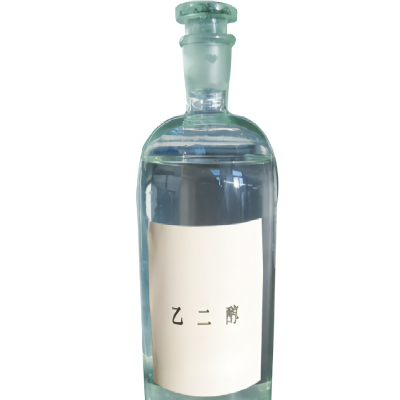
Product
Supplier
Encyclopedia
Inquiry
Chloral75-87-6 buy - large image1
Chloral75-87-6 buy - image1
Chloral75-87-6 buy - image2
Chloral75-87-6 buy - image3
Chloral75-87-6 buy - image4
Chloral75-87-6 buy - image5
Chloral75-87-6 buy - image6

Chloral75-87-6

1 Inquiries

Unit Price:

$33-34/MT FOB

Get Latest Price
CAS No.:

75-87-6

Grade:

Pharmaceutical Grade

Content:

95%

Port:

shanghai

Brand:

OORENT

Packaging:

vial

Price valid (until):

2026-08-01

Company Type:
Trader
Location:
China
Qualification:
Main Products:

pharmaceutical intermediates,peptides,electronic chemicals

  • Product Description

  • Seller Information

  • Inquiry History

  • Description

    Product Detail  

    Chloral Basic information
    Product Name: Chloral
    Synonyms: Acetaldehyde, 2,2,2-trichloro-;2,2,2-trichloroacetaldehyde;TRICHLOROACETALDEHYDE;Trichloroethanal;U.N. 2075;metachloral;2,2,2-Trichloroethanal;Acetaldehyde,trichloro-
    CAS: 75-87-6
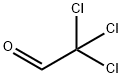
    MF: C2HCl3O
    MW: 147.39
    EINECS: 200-911-5
    Product Categories: API Intermediate
    Mol File: 75-87-6.mol
    Shop Chloral75-87-6-Detailed Image 1

    Chloral Chemical Properties
    Melting point  -57.5°C
    Boiling point  94-98 °C
    density  1.51 g/mL at 20 °C(lit.)
    refractive index  n20/D 1.456
    Fp  75°C
    storage temp.  2-8°C
    solubility  Chloroform (Sparingly), DMSO (Sparingly), Ethyl Acetate (Slightly)
    form  Solid
    pka 10.04(at 25℃)
    color  Off-White
    Water Solubility  Soluble
    Specific Heat Capacity Cp(liquid): 1.02 J/(g·K), at 25℃
    Merck  13,9699
    Henry's Law Constant 3.4×10³ mol/(m3Pa) at 25℃, Burkholder et al. (2019)
    Exposure limits MAC: 3 mg/m3
    Dielectric constant 6.7(Ambient)
    Stability: Stable. Flammable. Incompatible with strong oxidizing agents.
    CAS DataBase Reference 75-87-6(CAS DataBase Reference)
    IARC 2A (Vol. 63, 84, 106) 2014
    NIST Chemistry Reference Acetaldehyde, trichloro-(75-87-6)
    EPA Substance Registry System Chloral (75-87-6)

    Safety Information
    Hazard Codes  T,Xn
    Risk Statements  23-36/37/38-22
    Safety Statements  26-36/37-45-7/9-28
    RIDADR  UN 2075 (CHLORAL, ANHYDROUS, STABILIZED)
    WGK Germany  3
    RTECS  FM7870000
    1-8-9-13
    TSCA  TSCA listed
    HazardClass  6.1
    PackingGroup  II
    HS Code  29130000
    Hazardous Substances Data 75-87-6(Hazardous Substances Data)
    MSDS Information
    Provider Language
    SigmaAldrich English

    Chloral Usage And Synthesis
    Description Chloral is a combustible, oily liquid with a pungent irritating odor. Molecular weight=147.38; Boilingpoint=97-98℃; Flash point=75℃. Hazard Identification(based on NFPA 704 M Rating System): Health 3,Flammability 2, Reactivity 1. Soluble in water. Chloralhydrate is colorless crystals, with characteristic odor.Molecular weight=165.40; Boiling point=97℃ (decomposes); Freezing/Melting point=57-60℃. Hazard Identification (based on NFPA 704 M Rating System): Health 3,Flammability 2, Reactivity 1. Very soluble in water.
    Chemical Properties colourless oily liquid with a pungent odour
    Chemical Properties Chloral is a combustible, oily liquid with a pungent irritating odor.
    Uses manufacture of chloral hydrate, DDT.
    Uses Chloral is used in medicine as a hypnotic.
    Definition A colorless liquid aldehyde made by chlorinating ethanal. It was used to make the insecticide DDT. It can be hydrolyzed to give 2,2,2- trichloroethanediol (chloral hydrate, CCl3CH(OH)2). Most compounds with two –OH groups on the same carbon atom are unstable. However, in this case the effect of the three chlorine atoms stabilizes the compound. It is used as a sedative.
    Production Methods Chloral can be prepared by action of Cl2 on ethanol, chlorination of acetaldehyde, oxidation of 1,1,2-trichloroethylene in the presence of a catalyst (FeCl3, AlCl3, TiCl4 or SbCl3, and by reaction of CCl4 with formaldehyde.
    General Description A colorless oily liquid with a penetrating odor. Reacts with water and denser than water. Contact may irritate skin, eyes and mucous membranes. Toxic by ingestion and inhalation. Used to make pesticides.
    Air & Water Reactions Chloral is sensitive to exposure to moisture and light. Soluble in water. Chloral reacts with water to form chloral hydrate.
    Reactivity Profile Chloral reacts with water to form chloral hydrate. Chloral polymerizes under the influence of light and in the presence of sulfuric acid forming a white solid trimer called metachloral.


    Safety Profile A poison. Mutation E data reported.
    Potential Exposure Chloral is used as an intermediate in the manufacture of such pesticides as DDT, methoxychlor, DDVP, naled, trichlorfon, and TCA. Chloral is also used in the production of chloral hydrate; used as a therapeutic agent with hypnotic, sedative, and narcotic effects; used in a time prior to the introduction of barbiturates
    First aid If this chemical gets into the eyes, remove any contact lenses at once and irrigate immediately for at least15 min, occasionally lifting upper and lower lids. Seek medical attention immediately. If this chemical contacts the skin,remove contaminated clothing and wash immediately withsoap and water. Seek medical attention immediately. If thischemical has been inhaled, remove from exposure, begin rescue breathing (using universal precautions, including resuscitation mask) if breathing has stopped and CPR if heart actionhas stopped. Transfer promptly to a medical facility. Whenthis chemical has been swallowed, get medical attention.Give large quantities of water and induce vomiting. Do notmake an unconscious person vomit.
    storage Color Code—Blue: Health Hazard/Poison: Storein a secure poison location. Prior to working with chloralyou should be trained on its proper handling and storage.Protect from light, moisture, air, and acids. DEA regulationsrequire storage in a locked storage area. Store in tightlyclosed containers in a cool, well-ventilated area. Metal containers involving the transfer of this chemical should begrounded and bonded. Drums must be equipped with selfclosing valves, pressure vacuum bungs, and flame arresters.Use only nonsparking tools and equipment, especially whenopening and closing containers of this chemical. Sources ofignition, such as smoking and open flames, are prohibitedwhere this chemical is used, handled, or stored in a mannerthat could create a potential fire or explosion hazard.
    Shipping UN2811 Toxic solids, organic, n.o.s., Hazard Class: 6.1; Labels: 6.1-Poisonous materials, Technical Name Required.
    Purification Methods Distil chloral, then dry it by distilling through a heated column of CaSO4. [Beilstein 1 H 616, 1 I 328, 1 II 467, 1 III 2663, 1 IV 3142 for anhydr, 1 IV 3143 for hydrate.]
    Incompatibilities Chloral hydrate reacts with strong bases forming chloroform. Contact with acids, or exposure to light may cause polymerization. Reacts with water, forming chloral hydrate. Reacts with oxidizers, with a risk of fire or explosions.
    Waste Disposal Incineration after mixing with another combustible fuel; care must be taken to assure complete combustion to prevent phosgene formation; an acid scrubber is necessary to remove the halo acids produced.


    Pls input...Shop TRANS-2-DECEN-1-OL18409-18-2-Detailed Image 2 Shop TRANS-2-DECEN-1-OL18409-18-2-Detailed Image 3 Shop TRANS-2-DECEN-1-OL18409-18-2-Detailed Image 4 Shop TRANS-2-DECEN-1-OL18409-18-2-Detailed Image 5 Shop TRANS-2-DECEN-1-OL18409-18-2-Detailed Image 6 Shop TRANS-2-DECEN-1-OL18409-18-2-Detailed Image 7


    Basic Info
    Product Name:

    Chloral

    Other Name:

    Acetaldehyde,2,2,2-trichloro-;Chloral;Acetaldehyde,trichloro-;2,2,2-Trichloroacetaldehyde;Anhydrous chloral;Trichloroacetaldehyde;Trichloroethanal;Grasex;Sporotal 100;2,2,2-Trichloroethanal

    CAS No.:

    75-87-6

    Molecular Formula:

    C2HCl3O

    InChIKeys:

    InChIKey=HFFLGKNGCAIQMO-UHFFFAOYSA-N

    Molecular Weight:

    147.39

    Exact Mass:

    147.39

    EC Number:

    200-911-5

    UNII:

    FLI06WS32H

    UN Number:

    2075

    DSSTox ID:

    DTXSID7024744

    Color/Form:

    Colorless, mobile, oily liquid

    HScode:

    2913000010

    Characteristics
    PSA:

    17.1

    XLogP3:

    1.19 (est)

    Appearance:

    Trichloroacetaldehyde appears as a colorless oily liquid with a penetrating odor. Reacts with water and denser than water. Contact may irritate skin, eyes and mucous membranes. Toxic by ingestion and inhalation. Used to make pesticides.

    Density:

    1.5121 g/cm3 @ Temp: 20 °C

    Melting Point:

    -57.5 °C

    Boiling Point:

    97.8 °C @ Press: 760 Torr

    Flash Point:

    75°C

    Refractive Index:

    1.471

    Water Solubility:

    H2O: soluble

    Storage Conditions:

    2-8°C

    Vapor Pressure:

    50 mm Hg at 25 deg C

    Vapor Density:

    5.1 (Air = 1)

    Toxicity:

    Abdominal cavity-mouse LD50: 600 mg/kg

    Flammability characteristics:

    Thermal decomposition of toxic and tear gas

    Odor:

    Pungent, irritating odor

    OH:

    1.60e-12 cm3/molecule*sec

    Henrys Law Constant:

    2.91e-09 atm-m3/mole|Henry's Law constant = 2.91X10⁻⁹ atm-cu m/mol at 25 °C

    Dissociation Constants:

    pKa = 9.66

    Experimental Properties:

    Conversion factor: mg/cu m = 6.03 X ppm|Polymerizes under the influence of light and in the presence of sulfuric acid forming a white solid trimer called metachloral|Hydroxyl radical reaction rate constant = 1.60X10⁻¹² cu cm/molec-sec at 25 °C

    Air and Water Reactions:

    This compound is sensitive to exposure to moisture and light. Soluble in water. This compound reacts with water to form chloral hydrate.

    Reactive Group:

    Aldehydes

    Reactivity Alerts:

    Polymerizable

    Reactivity Profile:

    TRICHLOROACETALDEHYDE reacts with water to form chloral hydrate. It polymerizes under the influence of light and in the presence of sulfuric acid forming a white solid trimer called metachloral. (NTP, 1992)

    Heat of Vaporization:

    97.1 BTU/Lb

    Hazard Identification

    Classification of the substance or mixture

    Acute toxicity - Category 3, Oral

    Skin irritation, Category 2

    Eye irritation, Category 2

    Specific target organ toxicity – single exposure, Category 3

    GHS label elements, including precautionary statements

    Pictogram(s)
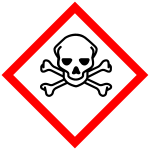
    Signal word

    Danger

    Hazard statement(s)

    H301 Toxic if swallowed

    H315 Causes skin irritation

    H319 Causes serious eye irritation

    H335 May cause respiratory irritation

    Precautionary statement(s)
    Prevention

    P264 Wash ... thoroughly after handling.

    P270 Do not eat, drink or smoke when using this product.

    P280 Wear protective gloves/protective clothing/eye protection/face protection/hearing protection/...

    P261 Avoid breathing dust/fume/gas/mist/vapours/spray.

    P271 Use only outdoors or in a well-ventilated area.

    Response

    P301+P316 IF SWALLOWED: Get emergency medical help immediately.

    P321 Specific treatment (see ... on this label).

    P330 Rinse mouth.

    P302+P352 IF ON SKIN: Wash with plenty of water/...

    P332+P317 If skin irritation occurs: Get medical help.

    P362+P364 Take off contaminated clothing and wash it before reuse.

    P305+P351+P338 IF IN EYES: Rinse cautiously with water for several minutes. Remove contact lenses, if present and easy to do. Continue rinsing.

    P304+P340 IF INHALED: Remove person to fresh air and keep comfortable for breathing.

    P319 Get medical help if you feel unwell.

    Storage

    P405 Store locked up.

    P403+P233 Store in a well-ventilated place. Keep container tightly closed.

    Disposal

    P501 Dispose of contents/container to an appropriate treatment and disposal facility in accordance with applicable laws and regulations, and product characteristics at time of disposal.

    Other hazards which do not result in classification

    no data available

    Handling and Storage

    Precautions for safe handling

    Handling in a well ventilated place. Wear suitable protective clothing. Avoid contact with skin and eyes. Avoid formation of dust and aerosols. Use non-sparking tools. Prevent fire caused by electrostatic discharge steam.

    Conditions for safe storage, including any incompatibilities

    Store the container tightly closed in a dry, cool and well-ventilated place. Store apart from foodstuff containers or incompatible materials.

  • Seller Information
    Business Type:

    Trader

    Main Products:

    pharmaceutical intermediates,peptides,electronic chemicals

    Location:

    Room 102, 1st Floor, East Office Building, No. 45 Pengwan Road, Qianwan Bonded Port Area, Qingdao Zone, China (Shandong) Pilot Free Trade Zone

    Payment Terms:

    100% TT in advance

    Average lead Time:

    10

    Total Annual Revenue:

    $10 million-$25 million

    Total Employees:

    51-100

    Year of Establishment:

    2024

    A reliable supplier is like insurance.

    We are mainly specilized in supply of pharmaceutical intermediates, electronic chemicals,food additives, and other fine chemical products.
    Integrity is the foundation, quality is life. We would like to work together with you to build a greener and brighter future.

    Website: orientchem.cc
    Email: scarlett@orientchem.cc
    WhatsApp: +86 17753254221

  • Inquiry History
    1 Inquiries
    Country Product Purchase Quantity Date Posted
    Croatia

    trichloroacetaldehyde

    25 G Jul 1, 2026
    Post an enquiry for this product
pic ×

Scan the QR Code to Share

All products displayed on this website are only for non-medical purposes such as industrial applications or scientific research, and cannot be used for clinical diagnosis or treatment of humans or animals. They are not medicinal or edible.

According to relevant laws and regulations and the regulations of this website, units or individuals who purchase hazardous materials should obtain valid qualifications and qualification conditions.

The information shown above is provided by the enterprise itself, and the authenticity, accuracy and legitimacy of the content are the responsibility of the publishing company. ECHEMI does not bear any guarantee responsibility for this. Please be aware that risks in internet transactions objectively exist.

Feedback & Suggestions
Send Message

Thank you for your feedback. If you require further assistance, please contact us by email at info@echemi.com or call us at +86-532-55729510.