




AZD 1080
-
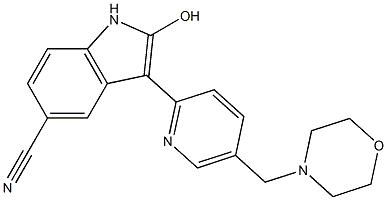
AZD 1080
structure -
-
CAS No:
612487-72-6
-
Formula:
C19H18N4O2
-
Chemical Name:
AZD 1080
-
Synonyms:
AZD 1080;AZD1080;AZD-1080;2-Hydroxy-3-[5-[(morpholin-4-yl)methyl]pyridin-2-yl]-1H-indole-5-carbonitrile;2-Hydroxy-3-[5-[(morpholin-4-yl)methyl]pyridin-2-yl]-1H-indole-5-carbonitrileAZD1080;2-Hydroxy-3-(5-(morpholinomethyl)pyridin-2-yl)-1H-indole-5-carbonitrile
- Categories:
-
CAS No:
Description
AZD1080 is a potent and selective GSK3 inhibitor. AZD1080 inhibits recombinant human GSK3α and GSK3β with pKi (IC50) of 8.2 (6.9 nM) and 7.5 (31 nM), respectively.
AZD 1080 Use and Manufacturing
2-Hydroxy-3-[5-(morpholin-4-ylmethyl)pyridin-2-yll lH-indole-5-carbonitrile using bis- (dibensylideneacetone)palladium(O) and tri-tert-butylphosphine. 5-Bromo-3-[5-(moφholin-4-ylmethyl)pyridin-2-yl]lH-mdol-2-ol (1.00 g, 2.57 mmol), zinc-dust (25.5 mg, 0.386 mmol) and bis(dibensylideneacetone)palladium(0) (37 mg, 0.064 2-Hγdroxy-3-r5-(morpIiolin-4-ylmethyl)pyridin-2-vn lH-indole-5-carbonitrile using di-μ- bromobis(tri-tert-butylphosphine2-Hydroxy-3-[Example 8; 2-Hydroxy-3-r5-(morpholin-4-ylmethyl)pyridin-2-ylllH-indole-S-carbonitrile using bis(dibensylideneacetone)palladrurn(O) and 1, 2, 3, 4, 5-pentaphenyl-r-fdi-ferf- butylρhosphino)ferrocene.5-Bromo-3-[5-(morpholin-4-ylmethyl)ρyridin-2-yl]lH-indol-2-ol (0.100 g, 0.257 mmol), zinc-dust (2.0 mg, 0.031 mmol), bis(dibensylideneacetone)palladium(0) (7.4 mg, 0.0128 mmol) and l, 2, 3, 4, 5-pentaphenyl-r-(di-fert-butylphosphino)ferrocene (9.2 mg, 0.0128 mmol) were added to a 10 mL schlenk tube with a magnetic stirbar. The schlenk tube was sealed with a rubber septum and then evacuated and re-filled with nitrogen gas twice. Degassed dimethylformamide (0.7 mL) was then added with a syringe. The mixture was then heated under stirring to 5O2-Hydroxy-3-r5-(morpholin-4-ylmethyl)pyridm-2-yl11H-indole-5-carbonitrile using bisftri-terf-butylphosphine)palladium(O) 5 5-Bromo-3-[5-(morpholin-4-ylmethyl)pyridin-2-yl]lH-indol-2-ol (0.100 g, 0.257 mmol), zinc-dust (2.0 mg, 0.031 mmol), ) and bis(tri-tert-butylphosphine)palladium(0) (6.7 mg, 0.013 mmol) were added to a 10 mL schlenk tube with a magnetic stirbar. The schlenk tube was sealed with a rubber septum and then evacuated and re-filled with nitrogen gas twice. Degassed dimethylformamide (0.7 mL) was then added with a syringe. The mixture 0 was then heated under stirring to 5O2-Hydroxy-3-|2-Hydroxy-3-r5-(morpholin-4-ylmethylExample 17; 2-Hvdroxy-3-r5-(morpholin-4-ylmethyl)pyridin-2-ylllH-indole-5-carbonitrile; To a solution of l, 2-Dihydroxy-3-(5-morpholin-4-ylmethyl-pyridin-2-yl)-lH-indole-5- carbonitrile (l.Og, 94percent pure, 10.73mmol) in acetic acid (60ml) at 602-Hvdroxy-3-r5-(morpholin-4-ylmethyl)pyridin-2-ylllH-indole-5-carbonitrile usingo triethylamine; To a solution of (2-Amino-5-cyano-phenyl)-(5-morpholin-4-ylmethyl-pyridin-2-yl)-acetic acid ethyl ester solution in n-butyl acetate (10ml, 0.16M, l.mmol) was added triethylamine (0.25ml, l.δmmol) and the mixture heated to 90Example 52; 2-Hydroxy-3-rS-(morpholin-4-ylmethel) pyridin-2-Yll-lH-indole-5-carbonitrile hydrochloride; To a suspension of 5-cyanooxindole (720 mg, 4.55 mmol) in N, N-dimethylformamide (5 mL) was added sodium hydride (248 mg, 6.2 mmol, 60percent dispersion in oil). After 15 min, was added 4-[(6-chloropyridin-3-yl) methyl] morpholine (323 mg, 1.52 mmol; described in: Maienfisch, P. et al. J. Med. Chem. 2000, 43, 5003) to the solution. The reaction mixture was heated at reflux for 1 h. The solvent was removed in vacuo, and the residue was partitioned between ethyl acetate and water. A 2 M aqueous HCI solution was added to the ethyl acetate and water mixture until slightly acidic pH, and then NaHC03 (s) was added until saturation. The mixture was extracted with ethyl acetate. The organic layer was washed with brine, dried (Na2SO4) and the solvent was removed in vacuo. The crude product was dissolved in a mixture of methanol and ethyl acetate and was cooled on ice. A solution of HCI in diethyl ether was added until acidic pH. Approximately half of the solvent volume was removed in vacuo. The precipitated hydrochloride salt was filtered, washed with ethyl acetate, and dried in vacuo. The salt was converted back to the base by partitioning between ethyl acetate and an aqueous saturated NaHC03 solution. The obtained material (142 mg) was purified on a silica gel column using chloroform/ethanol, (9: 1), as the eluent affording 34 mg (7percent yield) of the title compound as the base as a yellow solid : IH NMR (CDCl3, 400 MHz) 8 14.96 (br s, 1 H), 8.83 (br s, 1 H), 7.79 (dd, J = 9, 1 Hz, 1 H), 7.69 (s, 1 H), 7.63 (s, 1 H), 7.50 (d, J = 9 Hz, 1 H), 7.29-7. 26 (m, 1 H), 7.06 (d, J = 8 Hz, 1 H), 3.75-3. 72 (m, 4 H), 3.44 (s, 2 H), 2.50-2. 49 (m, 4 H).2-Hydroxy-3-[5-(morpholin-4-ylmethyl)pyridin-2-yll lH-indole-5-carbonitrile using bis- (dibensylideneacetone)palladium(O) and tri-tert-butylphosphine. 5-Bromo-3-[5-(mophiholin-4-ylmethyl)pyridin-2-yl]lH-mdol-2-ol (1.00 g, 2.57 mmol), zinc-dust (25.5 mg, 0.386 mmol) and bis(dibensylideneacetone)palladium(0) (37 mg, 0.064 2-Hgammadroxy-3-r5-(morpIiolin-4-ylmethyl)pyridin-2-vn lH-indole-5-carbonitrile using di-mu- bromobis(tri-tert-butylphosphine')dirhoalladium.(I) with zinc dust 5-Bromo-3-[5-(morpholin-4-ylmethyl)pyridin-2-yl]lH-indol-2-ol (2.00 g, 5.151 mmol), zinc-dust (40.8 mg, 0.618 mmol) and di-mu-bromobis(tri-tert-butylphosphine)dipalladium(I) (50 mg, 0.064 mmol) were added to a 50 mL schlenk tube with a magnetic stir bar. The schlenk tube was sealed with a rubber septum and then evacuated and re-filled with nitrogen gas twice. Degassed dimethylformamide (14 mL) was then added with a syringe. The mixture was then heated under stirring to 500C and kept there for 4 minutes before zinc cyanide (339 mg, 2.83 mmol) was charged against a positive flow of nitrogen. The mixture was stirred at 5O0C for 3 h at which point of HPLC (high performance liquid chromatography) analysis showed 100% conversion and then cooled to room temperature and filtered through a sintered glass filter. 3-Mercaptopropyl functionalized silica (0.3 g) was then added to the filtrate and the mixture was stirred at 400C over night and then filtered. The filtrate was heated to 600C and tetrasodiumethylenediamine tetra acetate (25 mL of a 0.30 M solution in water) was added over 5 minutes to give a bright yellow precipitate. The mixture was cooled to room temperature and filtered. The precipitate was washed with 25 mL of water and then dried under vacuum at 40C to givel.23 g, 71% yield of 2-hydroxy-3-[5-(morpholin-4-ylmethyl)pyridin-2-yl] lH-indole-5-carbonitrile. 1H NMR (d<5-DMSO, 400 MHz) delta 14.79 (broad s, IH)3 10.86 (broad s, IH), 8.08 (s, IH), 7.95 (s, IH), 7.83 (d, J= 8.8 Hz, IH), 7.27 (dd, J= 8.0, 0.9 Hz, IH), 7.01 (d, J= 8.0 Hz, IH), 3.57 (t, J= 4.4 Hz, 4H), 3.36 (s, 2H), 2.36 (broad s, 4H) ppm; 13CNMR (.lambdaJ-DMSO, 400MHz) delta 168.8, 148.6, 141.8, 137.0, 136.1, 125.4, 123.9, 122.3, 121.1, 118.8, 118.3, 108.7, 101.3, 84.6, 66.1, 58.4, 52.8 ppm; MS (ES) m/z [M++l] 335. Example 132-Hydroxy-3-|5-(morpholin-4-ylmethyl)pyridin-2-yll lH-indole-5-carbonitrile, large scale 5-Bromo-3-[5-(morpholin-4-ylmethyl)rhoyridin-2-yl]lH-indol-2-ol (6.673 kg) and zinc-dust (0.134 kg) was mixed with dimethylformamide (80 L) and the slurry stirred at room temperature. The mixture was purged with nitrogen until the oxygen level was below 0.02 mg/L. Di-mu-bromobis(tri-tert-butylphosphine)dipalladium(I) (0.168 kg was added to the slurry and the vessel was made inert by evacuation and refilling with nitrogen. The mixture was heated to 400C and zinc cyanide (1.109 kg) was added to the suspension in one portion and the system was made inert again. The resulting mixture was heated to an inner temperature of 50C and stirred for 3 h. HPLC indicated full conversion at this point. The reaction mixture was filtered at an inner temperature of 5O0C and the filter cake was washed with dimethylformamide (3 L), mercaptopropyl functionalised silica (1.458 kg, 25%w/w) was added to the filtrate and the mixture was stirred for 82 h at an inner temperature of 5O0C. The scavenger was filtered off and the filtrate was concentrated in vacuo. After 62 L (~ 60%) of the dimethylformamide had been removed, aqueous 2-Hydroxy-3-[5-(morpholin-4-ylmethv'pyridin-2-yl]lH-indole-5-carbonitrile using bisf dibensylideneacetone)palladiurn(O) and tri-ortho-tolylphosphine. 5-Bromo-3-[5-(morpholin-4-ylmethyl)pyridin-2-yl]lH-indol-2-ol (1.00 g, 2.57 mmol), zinc-dust (25.5 mg, 0.386 mmol), bis(dibensylideneacetone)palladium(0) (74 mg, 0.128 mmol) and tri-or£/z°-tolylphosrhohine (79.6 mg, 0.258 mmol) were added to a 10 mL schlenk tube with a magnetic stirbar. The schlenk tube was sealed with a rubber septum and then evacuated and re-filled with nitrogen gas twice. Degassed dimethylformamide (7 mL) was then added with a syringe. The mixture was then heated under stirring to 50C and kept there for 12 minutes before zinc cyanide (169 mg, 1.42 mmol) was charged against a positive flow of nitrogen. The mixture was stirred at 5O0C for 3 h at which point of HPLC analysis showed 100% conversion and then cooled to room temperature and filtered through a sintered glass filter. 3-Mercaptopropyl functionalized silica (0.3 g) was then added to the filtrate and the mixture was stirred at 4O0C over night and then filtered. The Example 8; 2-Hydroxy-3-r5-(morpholin-4-ylmethyl)pyridin-2-ylllH-indole-S-carbonitrile using bis(dibensylideneacetone)palladrurn(O) and 1, 2, 3, 4, 5-pentaphenyl-r-fdi-ferf- butylrhohosphino)ferrocene.5-Bromo-3-[5-(morpholin-4-ylmethyl)rhoyridin-2-yl]lH-indol-2-ol (0.100 g, 0.257 mmol), zinc-dust (2.0 mg, 0.031 mmol), bis(dibensylideneacetone)palladium(0) (7.4 mg, 0.0128 mmol) and l, 2, 3, 4, 5-pentaphenyl-r-(di-fert-butylphosphino)ferrocene (9.2 mg, 0.0128 mmol) were added to a 10 mL schlenk tube with a magnetic stirbar. The schlenk tube was sealed with a rubber septum and then evacuated and re-filled with nitrogen gas twice. Degassed dimethylformamide (0.7 mL) was then added with a syringe. The mixture was then heated under stirring to 5O0C and kept there for 5 minutes before zinc cyanide (17 mg, 0.14 mmol) was charged against a positive flow of nitrogen. The mixture was stirred at 5O0C for 2 h at which point of HPLC analysis showed 100% conversion and then cooled to room temperature and filtered through a sintered glass filter. 3-Mercaptopropyl functionalized silica (0.03 g) was then added to the filtrate and the mixture was stirred at 400C over night and then filtered. The filtrate was heated to 600C and tetrasodiumethylenediamine tetra acetate (1.5 mL of a 0.30 M solution in water) was added over 5 minutes to give a bright yellow precipitate. The mixture was cooled to room temperature and filtered. The precipitate was washed with 1 mL of water and then dried under vacuum at 4O0C to give 0.042g, 49% yield of 2-hydroxy-3-[5-(morpholin-4-ylmethyl)pyridin-2- yl]lH-indole-5-carbonitrile. Characterisation data were in accordance with 2-Hydroxy-3-r5-(morpholin-4-ylmethyl)pyridm-2-yl11H-indole-5-carbonitrile using bisftri-terf-butylphosphine)palladium(O) 5 5-Bromo-3-[5-(morpholin-4-ylmethyl)pyridin-2-yl]lH-indol-2-ol (0.100 g, 0.257 mmol), zinc-dust (2.0 mg, 0.031 mmol), ) and bis(tri-tert-butylphosphine)palladium(0) (6.7 mg, 0.013 mmol) were added to a 10 mL schlenk tube with a magnetic stirbar. The schlenk tube was sealed with a rubber septum and then evacuated and re-filled with nitrogen gas twice. Degassed dimethylformamide (0.7 mL) was then added with a syringe. The mixture 0 was then heated under stirring to 5O0C and kept there for 5 minutes before zinc cyanide (17 2-Hydroxy-3-|'5-('morpholm-4-ylmethyl)pyridiD-2-yl11H-indole-5-carbonitrile usinR bis(dibensylideneacetone)palladium(Q) and 2-fdicyclohexyphosphino')biphenyl. 5-Bromo-3-[5-(moipholm-4-ylmethyl)pyridin-2-yl]lH-indol-2-ol (0.100 g, 0.257 mmol), zinc-dust (2.0 mg, 0.031 mmol), bis(dibensylideneacetone)palladium(0) (7.4 mg, 0.0128 mmol) and 2-dicyclohexylphosphinobiphenyl (4.6 mg, 0.0128 mmol) were added to a 10 mL schlenk tube with a magnetic stirbar. The schlenk tube was sealed with a rubber septum and then evacuated and re-filled with nitrogen gas twice. Degassed dimethylformamide (0.7 mL) was then added with a syringe. The mixture was then heated o under stirring to 50C and kept there for 5 minutes before zinc cyanide (17 mg, 0.14 mmol) was charged against a positive flow of nitrogen. The mixture was stirred at 5O0C for 2 h at which point of HPLC analysis showed 100% conversion and then cooled to room temperature and filtered through a sintered glass filter. 3-Mercaptopropyl functionalized silica (0.03 g) was then added to the filtrate and the mixture was stirred at 400C over night s and then filtered. The filtrate was heated to 6O0C and tetrasodiumethylenediamine terra acetate (25 mL of a 0.30 M solution in water) was added over 5 minutes to give a bright yellow precipitate. The mixture was cooled to room temperature and filtered. The precipitate was washed with 10 mL of water and then dried under vacuum at 4O0C to give 0.03Og, 35% yield of 2-hydroxy-3-[5-(morpholin-4-yhnethyl)pyridin-2-yl]lH-indole-5- o carbonitrile. Characterisation data were in accordance with 2-Hydroxy-3-r5-(morpholin-4-ylmethyl')rhoyridin-2-yll lH-indole-5-carbonitrile using a combination of bis(dibensylideneacetone)palladium(0) and bisftri-fert- butylphosphine)palladium(0)5-Bromo-3-[5-(morpholin-4-yhnethyl)pyridialpha-2-yl]lH-indol-2-ol (0.100 g, 0.257 mmol), zinc-dust (2.0 mg, 0.031 mmol), ) bis(dibensylideneacetone)palladium(0) (7.4 mg, 0.013 mmol) andbis(tri-tert-butylphosphine)palladium(0) (6.7 mg, 0.013 mmol) were added to a 10 mL schlenk tube with a magnetic stirbar. The schlenk tube was sealed with a rubber septum and then evacuated and re-filled with nitrogen gas twice. Degassed dimethyl- formamide (0.7 mL) was then added with a syringe. The mixture was then heated under stirring to 500C and kept there for 5 minutes before zinc cyanide (17 mg, 0.14 mmol) was charged against a positive flow of nitrogen. The mixture was stirred at 5O0C for 2 h at which point of HPLC analysis showed 100% conversion and then cooled to room temperature and filtered through a sintered glass filter. 3-Mercaptopropyl functionalized silica (0.03 g) was then added to the filtrate and the mixture was stirred at 400C over night and then filtered. The filtrate was heated to 600C and tetrasodiumethylenediamine tetra acetate (1.5 mL of a 0.30 M solution in water) was added over 5 minutes to give a bright yellow precipitate. The mixture was cooled to room temperature and filtered. The precipitate was washed with 10 mL of water and then dried under vacuum at 4O0C to give Example 17; 2-Hvdroxy-3-r5-(morpholin-4-ylmethyl)pyridin-2-ylllH-indole-5-carbonitrile; To a solution of l, 2-Dihydroxy-3-(5-morpholin-4-ylmethyl-pyridin-2-yl)-lH-indole-5- carbonitrile (l.Og, 94% pure, 10.73mmol) in acetic acid (60ml) at 600C was added iron powder (1.8g, 32.19mmol) and the resulting dark green solution stirred at 600C for 3hrs. The suspension was removed from the oil bath and cooled to room temperature. Celite (1Og) was added and the mixture concentrated to dryness. The mixture was then purified by silica column chromatography eluting with dichloromethane/methanol (1% ammonium hydroxide) 5:1 to give an orange solid; which was reslurried with isopropanol, filtered and then washed with isopropanol. After drying at 500C under vacumm gave, 2.89g, 81% yield of 2-Hydroxy-3-[5-(morpholin-4-ylmethyl)pyridin-2-yl]lH-indole-5-carbonitrile as a yellow powder. 1H NMR (400MHz;CDCl3, ): delta 14.76 (br s, IH), 10.9 (s, IH), 8.07 (s, IH), 7.88 (s, IH), 7.77 (m, 2H), 7.26 (dd, J = 1.08, 7.97Hz, IH), 7.00 (d, J= 8.0Hz, IH), 3.55 (m, 4H), 3.35 (s, 2H), 2.35 (br s, 4H); 13C NMR: (100MHz, CDCl3): delta 169.2, 148.9, 142.5, 1367.5, 136.4, 125.7, 124.5, 122.8, 121.8, 121.5, 119.3, 118.8, 101.8, 84.9 66.6, 58.8, 53.3ppm; MS (ESI) m/z [M+l]+ 335.2-Hvdroxy-3-r5-(morpholin-4-ylmethyl)pyridin-2-ylllH-indole-5-carbonitrile usingo triethylamine; To a solution of (2-Amino-5-cyano-phenyl)-(5-morpholin-4-ylmethyl-pyridin-2-yl)-acetic acid ethyl ester solution in n-butyl acetate (10ml, 0.16M, l.mmol) was added triethylamine (0.25ml, l.deltammol) and the mixture heated to 900C and stirred overnight. The resulting slurry was cooled to 00C and then filtered and washed with tertbutyl methyl ethers (20ml). After drying at 500C under vacumm gave 0.26g; 49% yield of 2-hydroxy-3-[5-(morpholin-4-ylmethyl)pyridin-2-yl]lH-indole-5-carbonitrile as an orange solid. . 1H NMR (400MHz;CDCl3, ): delta 14.76 (br s, IH), 10.9 (s, IH), 8.07 (s, IH), 7.88 (s, IH), 7.77 (m, 2H), 7.26 (dd, J = 1.08, 7.97Hz, IH), 7.00 (d, J= 8.0Hz, IH), 3.55 (m, 4H), 3.35 (s, 2H), 2.35 (br s, 4H); 13C NMR: (100MHz, CDCl3): delta 169.2, 148.9, 142.5, 1367.5, 136.4, 125.7, 0 124.5, 122.8, 121.8, 121.5, 119.3, 118.8, 101.8, 84.9 66.6, 58.8, 53.3ppm; MS (ESI) m/z [M+l]+ 335.Example 58; 2-Hydroxy-3-r5- (morpholin-4-ylmethyl) pyridin-2-yll-lH-indole-5-carbonitrile; To a suspension of sodium hydride (105 mg, 2.62 mmol, 60% in oil) in N, N- dimethylformamide (2 mL) was added 5-cyanooxindole (310 mg, 1.96 mmol). The mixture was stirred at room temperature for 10 min. To the obtained yellowish solution was added 2-chloro-5- (morpholin-4-ylmethyl) pyridine 1-oxide (299 mg, 1.31 mmol) and the mixture was heated under nitrogen at 130 C for 30 min. The dark reaction mixture was allowed to cool and the solvent was removed in vacuo. The residue was partitioned between a 2 M aqueous solution of HCI and ethyl acetate. The aqueous layer was carefully saturated with NaHC03 (s) and extracted twice with ethyl acetate. The two last organic layers were combined, dried (Na2SO4) and the solvent was removed in vacuo. The residue was dissolved in ethyl acetate (50 mL) and a concentrated solution of phosphorus trichloride (0.5 mL, 5.7 mmol) in ethyl acetate (3 mL) was added. A yellowish precipitate was formed. The mixture was stirred at room temperature overnight and then heated at 60 C for 30 min and finally at reflux for 10 min. The mixture was allowed to cool and was then diluted with ethyl actetate and washed with a saturated aqueous NaHCO3 solution. The aqueous layer was extracted repeatedly with ethyl acetate. The combined organic layers were dried (Na2SO4) and the solvent was removed in vacuo. The residue was purified on a silica gel column using chloroform/ethyl acetate, (9: 1), as the eluent affording 195 mg (45% yield) of the title compound as a yellow solid: mp 228-230 C ;'H NMR (DMSO-d6, 400 MHz) 8 14.79 (br s, 1 H), 10.87 (s, 1 H), 8.10 (s, 1 H), 7.91 (s, 1 H), 7.84 (d, J = 9 Hz, 1 H), 7.79 (dd, J = 9, 1 Hz, 1 H), 7.28 (d, J= 8Hz, 1 H), 7.00 (d, J= 8Hz, 1 H), 3.58 (t, J = 4 Hz, 4 H), 3.39 (s, 2 H), 2.38 (br s, 4 H) ; 13C NMR (DMSO-d6, 100 MHz) 8 168.6, 148.4, 142.0, 136.9, 135.9, 125.2, 124.0, 122.3, 121.0, 118.7, 118.3, 108.7, 101.2, 84.4, 66.1, 58. 3, 52. 8; MS (ESP) m/z 335 (M++1).Example 52; 2-Hydroxy-3-rS-(morpholin-4-ylmethel) pyridin-2-Yll-lH-indole-5-carbonitrile hydrochloride; To a suspension of 5-cyanooxindole (720 mg, 4.55 mmol) in N, N-dimethylformamide (5 mL) was added sodium hydride (248 mg, 6.2 mmol, 60% dispersion in oil). After 15 min, was added 4-[(6-chloropyridin-3-yl) methyl] morpholine (323 mg, 1.52 mmol; described in: Maienfisch, P. et al. J. Med. Chem. 2000, 43, 5003) to the solution. The reaction mixture was heated at reflux for 1 h. The solvent was removed in vacuo, and the residue was partitioned between ethyl acetate and water. A 2 M aqueous HCI solution was added to the ethyl acetate and water mixture until slightly acidic pH, and then NaHC03 (s) was added until saturation. The mixture was extracted with ethyl acetate. The organic layer was washed with brine, dried (Na2SO4) and the solvent was removed in vacuo. The crude product was dissolved in a mixture of methanol and ethyl acetate and was cooled on ice. A solution of HCI in diethyl ether was added until acidic pH. Approximately half of the solvent volume was removed in vacuo. The precipitated hydrochloride salt was filtered, washed with ethyl acetate, and dried in vacuo. The salt was converted back to the base by partitioning between ethyl acetate and an aqueous saturated NaHC03 solution. The obtained material (142 mg) was purified on a silica gel column using chloroform/ethanol, (9: 1), as the eluent affording 34 mg (7% yield) of the title compound as the base as a yellow solid : IH NMR (CDCl3, 400 MHz) 8 14.96 (br s, 1 H), 8.83 (br s, 1 H), 7.79 (dd, J = 9, 1 Hz, 1 H), 7.69 (s, 1 H), 7.63 (s, 1 H), 7.50 (d, J = 9 Hz, 1 H), 7.29-7. 26 (m, 1 H), 7.06 (d, J = 8 Hz, 1 H), 3.75-3. 72 (m, 4 H), 3.44 (s, 2 H), 2.50-2. 49 (m, 4 H).The base was dissolved in a mixture of methanol, dichloromethane, and ethyl acetate (15 mL total volume) and cooled on ice. A solution of HCI in diethyl ether (1 M) was added until acidic pH. Approximately half of the solvent volume was removed in vacuo, and ethyl acetate was added. The precipitated hydrochloride salt was filtered, washed with ethyl acetate, and dried in vacuo at 40 C affording 33 mg (87% yield from the base) as a yellow solid :'H NMR (DMSO-d6, 400 MHz) 5 14.75 (br s, 1 H), 11.36 (br s, 1 H), 10.98 (s, 1 H), 8.30 (s, 1 H), 8.07-8. 02 (m, 2 H), 7.90 (d, J = 9 Hz, 1 H), 7.32 (d, J =8 Hz, 1 H), 7.02 (d, J = 8 Hz, 1 H), 4.29 (s, 2 H), 3.98-3. 94 (m, 2 H), 3.82-3. 75 (m, 2 H), 3.37-3. 32 (m, 2 H), 3.11-3. 08 (m, 2 H) ; l3C NE (DMSO-d6, 100 MHz) 8 168.9, 148.4, 142.6, 139.7, 137.4, 124.8, 124.8, 120.8, 119.4, 118.4, 113.1, 108.9, 101.5, 85.6, 63.0, 55.5, 50.2 ; MS (TSP) m/z 335 (M++1).2-Hvdroxy-3-[5-(morpholin-4-ylmethyl')pyridin-2-yll lH-indole-5-carbonitrile citrate salt 2-Hydroxy-3-[5-(morpholin-4-ylmethyl)pyridin-2-yl] lH-indole-5-carbonitrile (5.14 kg, 15.4 mol) was suspended in ethanol (54 L) at room temperature. The suspension was heated to an inner temperature of 7O0C and a solution of citric acid (3.424 kg, 17.82 mol) in water (103 L) was added keeping the inner temperature above 650C. The mixture was heated to reflux. After this the resulting solution was mixed with activated charcoal (0.412 kg) and reflux continued for 3.5 h after which the reaction mixture was clear filtered at 830C followed by cooling to room temperature over 20 h. After filtration the precipitate 2-Hydroxy-3-r5-(mophiholin-4-ylmethyl)pyridin-2-yl1 lH-indole-5-carbonitrile citrate salt 2-Hydroxy-3-[5-(mophiholin-4-ylmethyl)pyridin-2-yl] lH-indole-5-carbonitrile (5.14 kg, 15.4 mol) was suspended in ethanol (54 L) at room temperature. The suspension was heated to an inner temperature of 700C and a solution of citric acid (3.424 kg, 17.82 mol, 1.300 eq)) in water (103 L) was added keeping the inner temperature above 650C. The mixture was heated to reflux. After this the resulting solution was mixed with activated charcoal (0.412 kg) and reflux continued for 3.5 h after which the reaction mixture was clear filtered at 830C followed by cooling to room temperature over 20 h. After filtration the precipitate was washed twice with a cold mixture of ethanol/water (6.9 L/13.7 L). Drying under vacuum at 5O0C gave 6.648 kg, 82.2% yield of 2-hydroxy-3-[5-(morpholin- 4-ylmethyl)pyridin-2-yl]lH-indole-5-carbonitrile citrate having a purity of at least 98%. The palladium content was less than 1 ppm and the zinc content was lower than 10 ppm. 1H NMR (Jd-DMSO3 400 MHz) delta 14.7 (br s, 1 H), 11.55 (s, 1 H), 10.98 (s, IH), 8.31 (s, 1 H), 8.08 (br d, J= 1.84Hz, IH), 8.02 (s, IH), 7.90 (br d, J = 8.92Hz, 1 H), 7.31 (d, J = 8.0 Hz, 1 H), 7.02 (d, J= 8.0Hz), 4.28 (s, 2 H), 3.97 (m, 2 H), 3.94 (m, 2H), 3.35 (m, 9H), 3.32 (m, 2H) ppm; 13C NMR (d6-DMSO, 400MHz) delta 168.9, 148.5, 142.7, 139.8, 137.5, 126.4, 124.9, 124.8, 120.9, 119.4, 118.4, 113.3, 109.0, 101.6, 85.7, 63.1, 55.5, 50.3, 40.1, 39.9, 39.7, 39.2, 39.0, 38.8ppm; MS (ES) m/z [M++l] 335.2-Hydroxy-3-{5-r('4-oxidomorpholm-4-yl)methyllpyridin-2-yl}-lH-indole-5-carbonitrile; 2-Hydroxy-3-[5-(morpholin-4-ylmethyl)pyridin-2-yl]-lH-indole-5-carbonitrile (prepared as described in Example 58 of WO 03/082853; 1.26 g, 3.75 mmol) was dispersed in 40 niL chloroform. A solution of meta-chloroperbenzoic acid (80%) (716 mg, 4.16 mmol) in chloroform (10 mL) was added dropwise and the mixture was stirred for 10 minutes. The solvent was evaporated in vacuo and the crude product was purified by preparative etaPLC (column: XTerra prep MSC8, gradient 05-45%B, 20mL/min, 40C, (A-O. IM ammonium acetate in 0.1% acetonitrile aqueous solution, B-acetonitrile)) to give the title compound (750 mg, yield: 57%).
Recommended Suppliers of AZD 1080
-
![China]() CN
1 YR
Business licensed Certified factoryManufactory Supplier of SR17018

Latest News on AZD 1080
- BMS Over $900 Million to Help Develop Potential 'Best-in-class' SHP2 Inhibitors
- AbbVie's blockbuster product for atopic dermatitis, Upadacitinib, has been approved for marketing in the EU and Japan
- Designing peptide inhibitors for possible COVID-19 treatments
- Chinese scientists discover the inhibitors of SARS-CoV-2
Learn More Other Chemicals
-
AZD 9668
848141-11-7
-
AZD 3514
1240299-33-5
-
AZD 2932
883986-34-3
-
Dabrafenib Formula
1195765-45-7
-
BOC-VAL-VAL-OH Formula
69209-73-0
-
BMS 303141 Formula
943962-47-8
-
(2S)-2-[[(2S)-2-[[2-[[2-[[(2S)-2-amino-3-(4-hydroxyphenyl)propanoyl]amino]acetyl]amino]acetyl]amino]-3-phenylpropanoyl]amino]-4-methylsulfanylbutanamide Structure
60117-17-1
-
(2S)-2-acetamido-6-amino-N-[(2S)-2-amino-3-methylbutanoyl]-N-propylhexanamide Structure
57899-96-4
-
What is 1-(6-methoxy-1,3-benzothiazol-2-yl)-3-phenylurea
26130-02-9
-
What is L-Tyrosyl-L-phenylalanine
17355-11-2