




H-HIS-SER-ASP-GLY-ILE-PHE-THR-ASP-SER-TYR-SER-ARG-TYR-ARG-LYS-GLN-MET-ALA-VAL-LYS-LYS-TYR-LEU-ALA-ALA-VAL-LEU-NH2

-
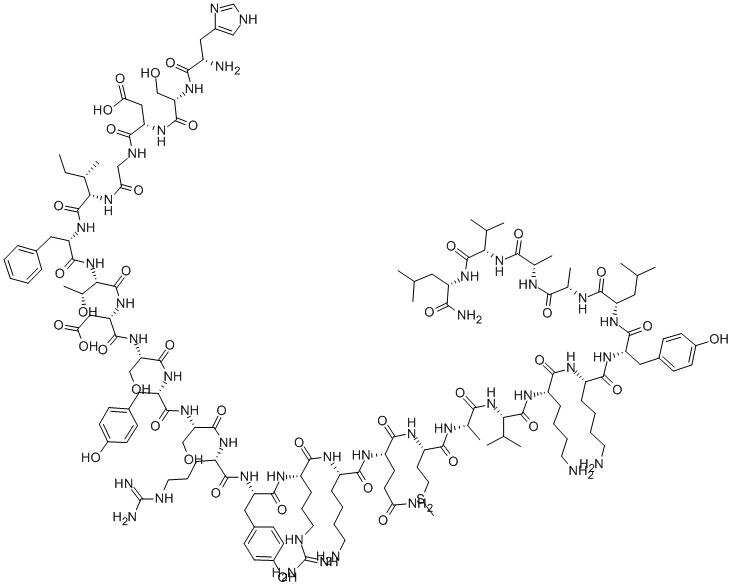
H-HIS-SER-ASP-GLY-ILE-PHE-THR-ASP-SER-TYR-SER-ARG-TYR-ARG-LYS-GLN-MET-ALA-VAL-LYS-LYS-TYR-LEU-ALA-ALA-VAL-LEU-NH2
structure -
-
CAS No:
127317-03-7
-
Formula:
C142H224N40O39S
-
Chemical Name:
H-HIS-SER-ASP-GLY-ILE-PHE-THR-ASP-SER-TYR-SER-ARG-TYR-ARG-LYS-GLN-MET-ALA-VAL-LYS-LYS-TYR-LEU-ALA-ALA-VAL-LEU-NH2
-
Synonyms:
HSDGIFTDSYSRYRKQMAVKKYLAAVL-NH2;HIS-SER-ASP-GLY-ILE-PHE-THR-ASP-SER-TYR-SER-ARG-TYR-ARG-LYS-GLN-MET-ALA-VAL-LYS-LYS-TYR-LEU-ALA-ALA-VAL-LEU-NH2;H-HIS-SER-ASP-GLY-ILE-PHE-THR-ASP-SER-TYR-SER-ARG-TYR-ARG-LYS-GLN-MET-ALA-VAL-LYS-LYS-TYR-LEU-ALA-ALA-VAL-LEU-NH2;[ARG14,20,21, LEU16] PACAP (1-27), HUMAN, OVINE, RAT;[ARG14,20,21, LEU16] PITUITARY ADENYLATE CYCLASE ACTIVATING PEPTIDE (1-27), HUMAN, OVINE, RAT;ADENYLATE CYCLASE ACTIVATING POLYPEPTIDE-27 OVINE;ADENYLATE CYCLASE ACTIVATING PEPTIDE-27;pituitary adenylate cyclase activating*polypeptid
- Categories:
-
CAS No:
Description
PACAP (1-27), human, ovine, rat, the N-terminal fragment of PACAP-38, is a potent PACAP receptor antagonist with IC50s of 3, 2, and 5 nM, respectively, for rat PAC1, rat VPAC1, and human VPAC2.
H-HIS-SER-ASP-GLY-ILE-PHE-THR-ASP-SER-TYR-SER-ARG-TYR-ARG-LYS-GLN-MET-ALA-VAL-LYS-LYS-TYR-LEU-ALA-ALA-VAL-LEU-NH2 Basic Attributes
3147.61
3145.649414
H-HIS-SER-ASP-GLY-ILE-PHE-THR-ASP-SER-TYR-SER-ARG-TYR-ARG-LYS-GLN-MET-ALA-VAL-LYS-LYS-TYR-LEU-ALA-ALA-VAL-LEU-NH2 Use and Manufacturing
Extraction of posterior pituitary powder The posterior leaves are dried in a phosphorus pentoxide vacuum dryer (moisture content below 3%), and then pulverized with a ball mill to obtain coarse posterior leaves powder. Then add 90% acetone (3-6 times), stir at 25°C for 4h, and let it stand overnight. Repeat the treatment for 2-3 times, take a small amount of acetone solution and add a small amount of distilled water until it is no longer turbid. Then treated with ether (3 times the amount) once, filtered, and the ether was naturally volatilized to dryness to obtain the leaf powder. The treatment with acetone and ether is to remove low molecular substances and lipids to ensure clarity. Porcine neurohypophysis [P2O5] → coarse posterior leaf powder [acetone, ether] → [25℃, 4h] posterior pituitary powder. Refining of posterior pituitary powder. Adding 0.25% acetic acid to extract the posterior pituitary powder twice, first Add 5 times the amount at one time, and 2 times the amount at the second time. Stir and extract at 50°C for 15 minutes, and filter. After the two extractions, combine the filtrate, quickly heat the filtrate to 100°C, keep it for 15min, add 0.5% chlorobutanol (volume ratio 1:1, if necessary, add activated carbon treatment) while hot, and cool to below 30°C After refrigerating overnight, filter repeatedly until clear. The acetic acid extract contains invalid proteins and autolyzed enzymes, which can be coagulated and destroyed by heating (Note: The oxytocin potency of oxytocin is easily invalid under alkaline or strong acid. It is stable under weak acid such as pH 3-4, and steam is passed at 100°C. Sterilization for 30 minutes or autoclaving is also stable). Posterior pituitary leaf powder [0.25% acetic acid]→[50℃, 15min] filtrate [0.5% chlorobutanol]→[refrigerated, filtered] Refined leaf powder liquid Preparation of leaf powder injection preparation Determination of leaf powder liquid After the potency, add water for injection to make it reach 10.5 U/ml, and add an appropriate amount of chlorobutanol to reach 0.5%, adjust the pH to 3.5 with glacial acetic acid, filter with a vertical melting funnel, potting, and steam at 100°C. After half an hour of inoculation, the finished product of posterior pituitary injection is obtained. Posterior leaf powder solution [testing potency]→[pH3.5] Posterior leaf injection [filtration, sterilization]→ Posterior leaf injection finished product.
Vasoconstrictors and antidiuretics. It is used for postpartum hemostasis, to promote contractions and incomplete abortion; also for the treatment of esophageal and gastric varices bleeding, diabetes insipidus, etc. Adverse reactions and contraindications: Injections should be used with caution when inducing labor, and should be instilled slowly in small doses. Abnormal fetal position and history of caesarean section are prohibited. High blood pressure, coronary heart disease, heart failure, pulmonary heart disease patients and those allergic to this product are contraindicated. After taking the medicine, nausea, paleness, palpitations, chest tightness, abdominal pain, urgency, etc. immediately discontinued. Nasal inhalants are contraindicated in patients with respiratory tract inflammation, paranasal sinusitis, and bronchial asthma. Inhalation too deep can cause throat tightness, shortness of breath, chest tightness, and too much inhalation can cause abdominal pain. Long-term medication can cause atrophic rhinitis.
Computed Properties
Molecular Weight:3147.6
XLogP3:-10.3
Hydrogen Bond Donor Count:48
Hydrogen Bond Acceptor Count:47
Rotatable Bond Count:107
Exact Mass:3146.6528635
Monoisotopic Mass:3145.6495086
Topological Polar Surface Area:1340
Heavy Atom Count:222
Complexity:7000
Undefined Atom Stereocenter Count:28
Covalently-Bonded Unit Count:1
Compound Is Canonicalized:Yes
Drug Function and Efficacy
Extract from the above information
Registered Holders
-
Ningbo Renjian Pharmaceutical Group Co., Ltd.
Active China
China
-
Wuhan Biochemical Pharmaceutical Co., Ltd.
Active
China
-
SPH NO.1 Biochemical & Pharmaceutical Co., Ltd.
Active
China
Recommended Suppliers of H-HIS-SER-ASP-GLY-ILE-PHE-THR-ASP-SER-TYR-SER-ARG-TYR-ARG-LYS-GLN-MET-ALA-VAL-LYS-LYS-TYR-LEU-ALA-ALA-VAL-LEU-NH2
-
InquiryCAS No.: 127317-03-7Grade: Industrial GradeContent: 99%
-
![China]() CN
CN
5 YRS
Business licensedTrader Supplier of Peptides,Chemicals,API,AdditivesInquiryCAS No.: 127317-03-7Grade: Pharmaceutical GradeContent: 99% -
![China]() CN
CN
5 YRS
Business licensedTrader Supplier of PVC resin,pvc paste resin,melamineInquiryCAS No.: 127317-03-7Grade: Industrial GradeContent: 99%
Learn More Other Chemicals
-
ARG-PRO-PRO-GLY-PHE-SER-PRO-PHE
15958-92-6
-
CLIP
53917-42-3
-
Trilysine
13184-14-0
-
Alanylasparagine Formula
31796-57-3
-
2-[[(2S)-3-phenyl-2-[[(2R)-3-phenyl-2-(phenylmethoxycarbonylamino)propanoyl]amino]propanoyl]amino]acetic acid Formula
75539-79-6
-
L-Arginyl-L-phenylalanyl-L-alanine Formula
67368-27-8
-
BNP-45 (RAT) Structure
123337-89-3
-
2-[[2-[(2-aminoacetyl)amino]-3-phenylpropanoyl]amino]propanoic acid Structure
17123-30-7
-
What is 4-(3-BROMOBENZYL)MORPHOLINE
364793-82-8
-
What is Z-GLY-GLU-OH
3916-39-0
H-HIS-SER-ASP-GLY-ILE-PHE-THR-ASP-SER-TYR-SER-ARG-TYR-ARG-LYS-GLN-MET-ALA-VAL-LYS-LYS-TYR-LEU-ALA-ALA-VAL-LEU-NH2
SDSRequest for Quotation